


As podcast content grows increasingly popular, many creators have also begun sharing program highlights on social platforms. However, podcasts are inherently an audio-centric medium, and when users browsing social networking sites are accustomed to keeping their phones on mute, they often find it difficult to immediately understand audio content, which reduces their willingness to watch. To address this issue, Meta’s social platform Threads is currently testing a new feature, hoping to make audio content more acceptable and shareable in a text-oriented social environment.
Threads hopes to make it easier for users to listen to podcasts through transcripts.
Head of Threads Connor Hayes Recently demonstrated this experimental feature.Based on publicly available footage, the system can automatically generate verbatim transcripts for podcast audio segments and overlay the text directly onto the video. When podcast hosts or guests speak, the subtitles update in real time, allowing users to quickly grasp the key discussion points even without turning on the sound.
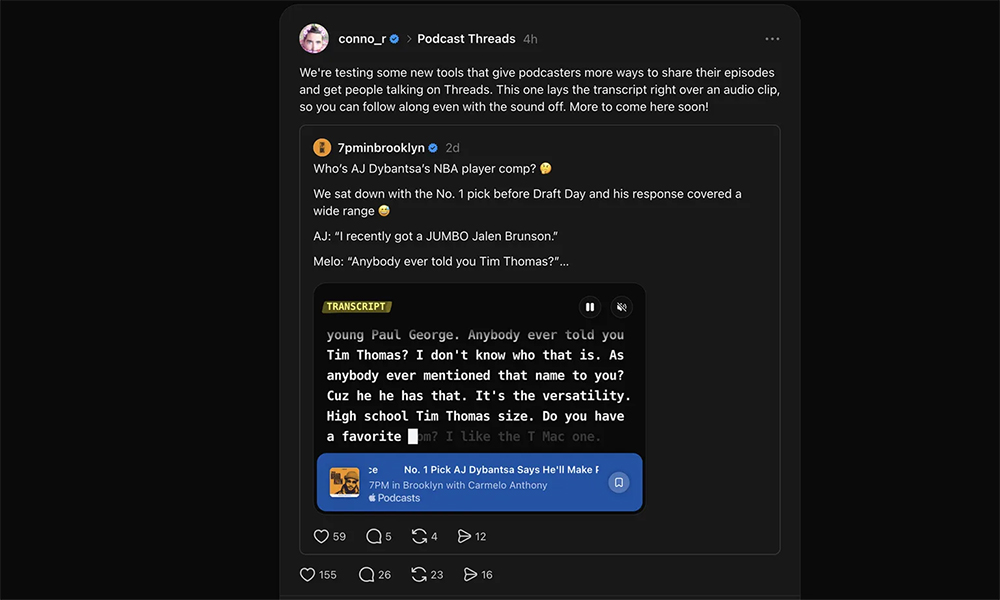
The greatest advantage of this design is that it improves the readability of Podcast content on social platforms. Many people use social media while commuting, in offices, libraries, or other places where it’s inconvenient to turn on the volume. In the past, when encountering audio content, they often had no choice but to skip it or put on headphones to listen. Now, by being able to read the content directly through synchronized subtitles, even in quiet environments, they can easily understand the information conveyed in Podcast clips.
From the examples shown on Threads, the system uses larger subtitle fonts and a clear layout, making the text easier to read. This not only lowers the barrier to browsing but also helps attract users who wouldn’t normally click on audio content. For creators, this could mean higher view rates and more engagement opportunities, since users scrolling through their feed are more likely to be drawn in by clearly displayed text rather than quickly skipping past audio-only posts.
In fact, this feature aligns quite well with Threads’ platform positioning. Compared with other social platforms that lean toward audio-visual content, Threads has featured text-based communication as its core characteristic since its launch, with many users accustomed to obtaining information and participating in discussions by reading posts. Therefore, converting Podcast content into a form that can be read synchronously, to some extent, also allows the audio medium to integrate more naturally into Threads’ usage context.
In addition, Meta has been actively strengthening support for content creators in recent years, and podcast creators are one of the key groups it focuses on. Besides the automatic transcript feature being tested this time, the company also revealed that more new tools related to podcast sharing are in development, hoping to help creators promote their show content more effectively and reach more potential listeners.
For podcast operators, Threads offers substantial growth potential. As the platform’s user base continues to expand, creators can reach a broader audience. If the relevant features are officially launched in the future, podcast content will no longer be limited to being understood only through listening; instead, with text and audio working in parallel, it can significantly boost content visibility and distribution.
However, this automatic transcription feature is still in the testing phase. Threads has not announced an official launch date, nor confirmed whether it will eventually be made available to all users. But overall, this feature shows a fairly clear direction: making audio-focused podcast content better suited to the reading habits of social platforms. If Meta successfully combines audio and text experiences seamlessly, users in the future will be able to easily discover and understand podcast content they’re interested in—even in crowded subways, trains, or other environments where playing sound is inconvenient—further bringing podcasts and social media closer together.
Source: KOCPC Chinese