


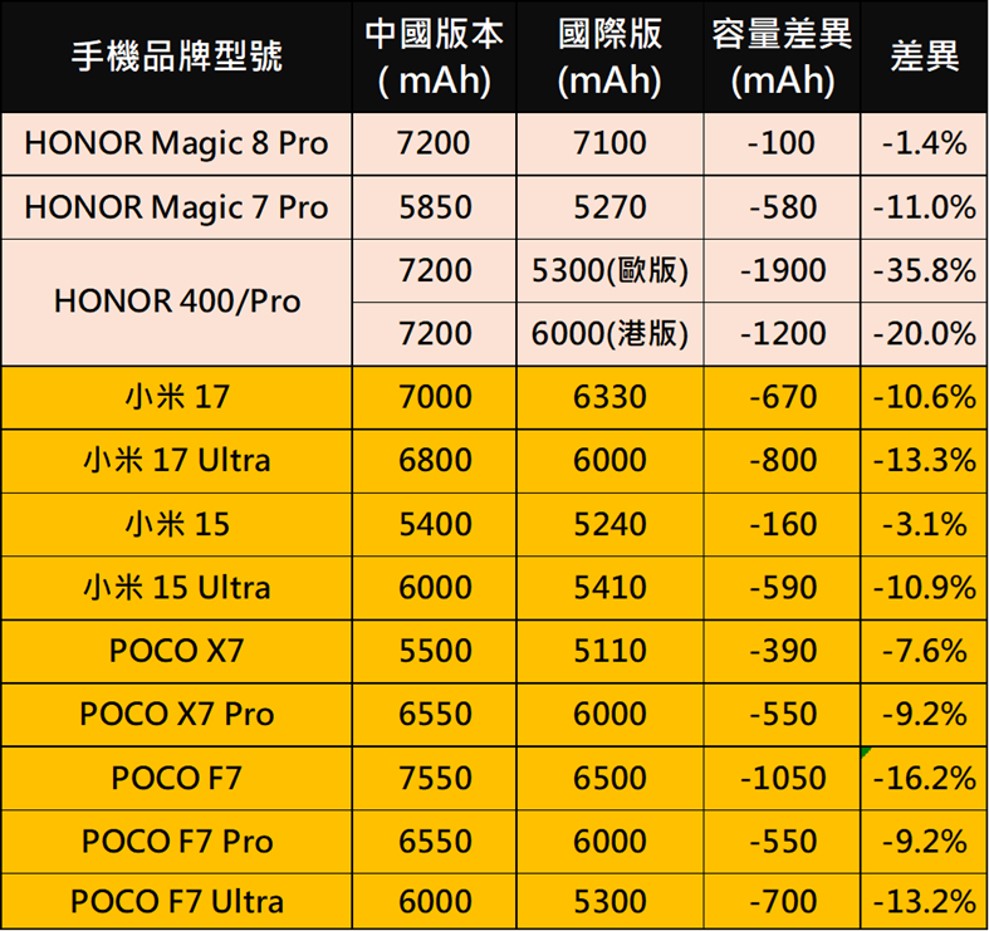
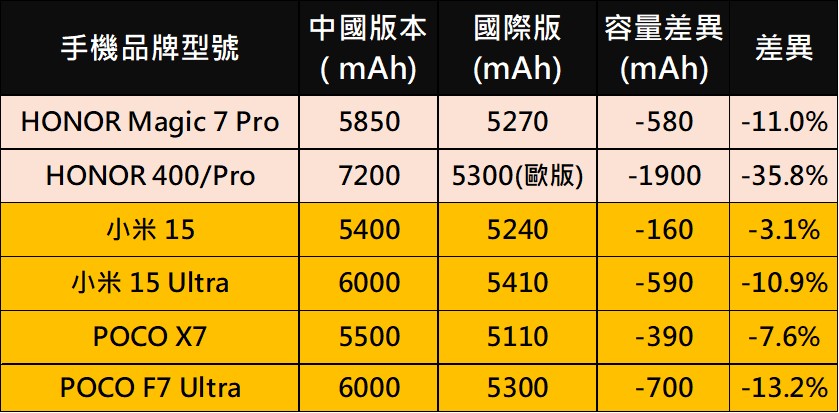
In order to maintain the thin and light body of mobile phones and effectively solve users’ concerns about battery life, Chinese mobile phone brands have been committed to adopting and promoting silicon-carbon batteries with higher battery capacity and faster charging speeds in recent years. However, what puzzles many overseas fans who love Chinese brand mobile phones is that the battery capacity of the international versions launched by some Chinese brands (Xiaomi and Honor) is lower than that of the national version (China version), with a capacity gap ranging from -1.4% to -35%.
Why do the international versions of Chinese brand mobile phones have to castrate their own battery capacity? Here is an analysis:
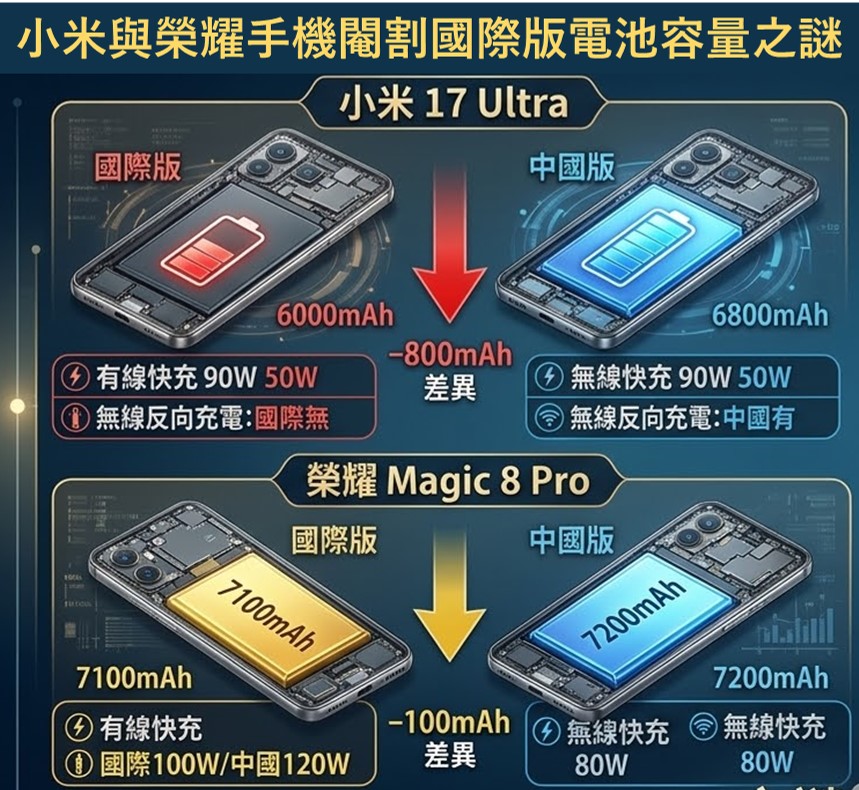
The use of ultra-high-capacity and fast-charging silicon-carbon batteries has been one of the main marketing appeals of Chinese brand mobile phones in recent years. However, the international versions of Xiaomi and Honor mobile phones generally have lower battery capacities than the national version (Chinese version). The following is a summary video and detailed explanation of the reasons for the shrinkage of battery capacity in the international versions of Xiaomi and Honor mobile phones:
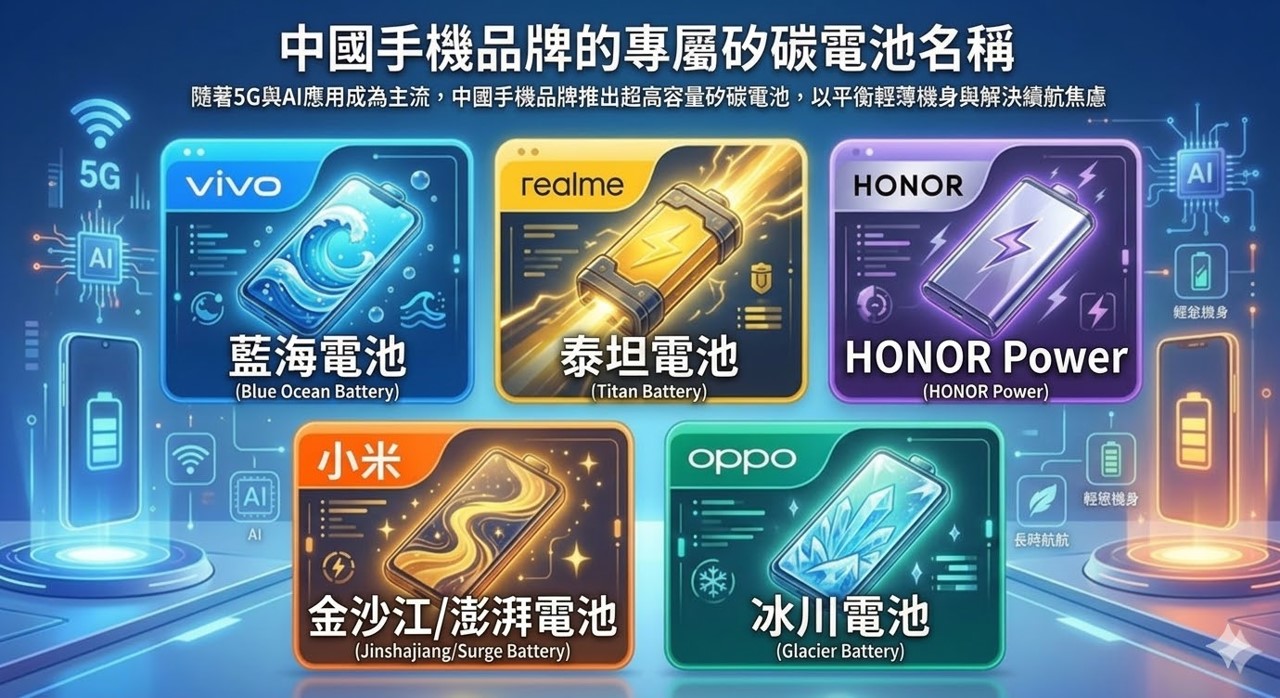
Since the daily life of mainland Chinese users, including mobile payments, short videos, and online offices, are closely related to the use of mobile phones, and the introduction of 5G and AI applications into mobile phones has become mainstream, Chinese users use their mobile phones for more than 6 hours on average every day, and there is an urgent need for smart phone battery life and fast charging. In order to maintain the thin and light body of mobile phones and effectively solve the anxiety of battery life, Chinese mobile phone brands vigorously promote their own ultra-high-capacity silicon-carbon batteries, such as vivo’s “Blue Ocean Battery”, realme’s “Titan Battery”, Honor (HONOR) “HONOR Power”, Xiaomi’s “Xiaomi Pengpai/Jinshajiang Battery”, and Oppo’s “Glacier Battery”.
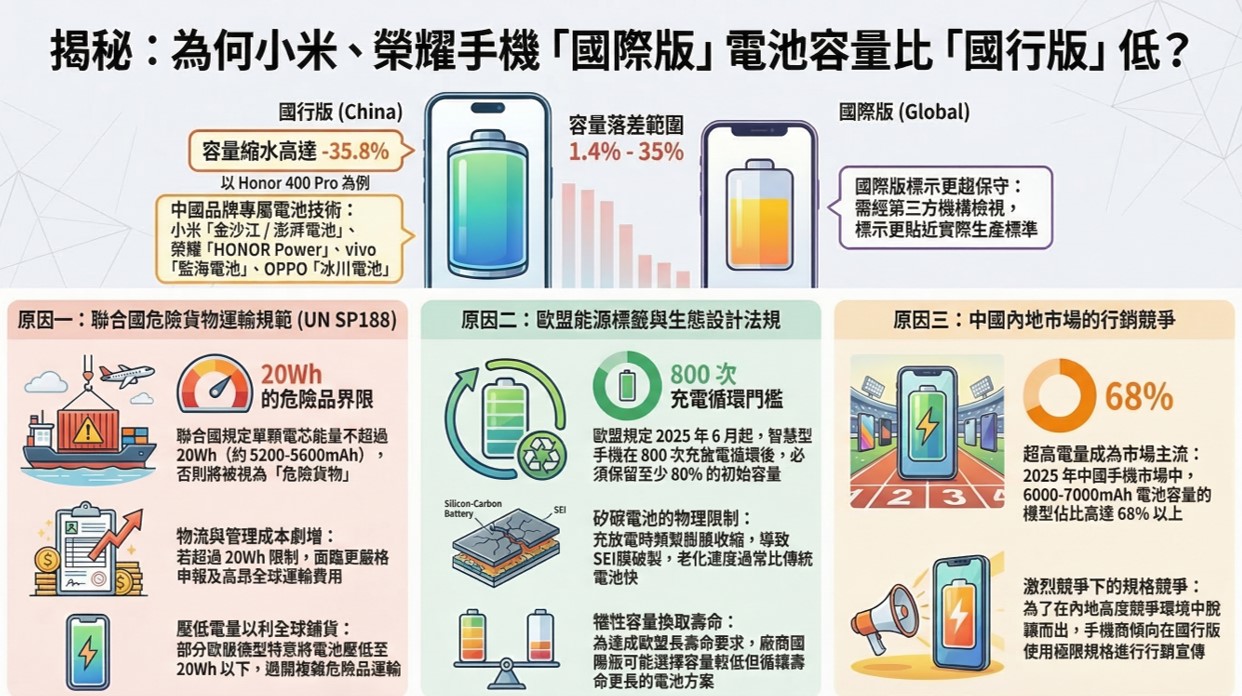
Although the use of ultra-high-capacity batteries and higher charging speeds are features of Chinese brand mobile phones, many overseas fans are puzzled by the fact that the battery capacity of the international versions launched by Xiaomi and Honor is often lower than that of the national version (China version), and the EU version is up to 35.8% less (Honor 400 Pro).
Why do the international versions of Chinese brand mobile phones have lower battery capacity than the Chinese versions? It may be related to the United Nations’ dangerous goods battery core capacity specifications, the EU’s “Energy Labeling and Ecological Design Regulations” restrictions, and China’s own marketing demands. The explanation is as follows:
1. Single battery exceeding 20WhcoreWill be regarded as dangerous goods, hindering global logistics and transportation:
According to the United Nations special regulations on the transportation of dangerous goods (Special Provision 188), lithium-ion battery, the rated energy of a single cell does not exceed 20Wh, and the rated energy of a single battery does not exceed 100Wh, otherwise it is regarded as dangerous goods.
The corresponding battery capacity of 20Wh is 5200mAh to 5600mAh for a single battery cell. If the capacity of a single battery cell exceeds 20Wh, it will be included in the complete dangerous goods transportation management system, followed by more complex declarations, stricter operating requirements, and higher logistics and management costs. For manufacturers that need to distribute goods in multiple countries for a long time, this will add a lot of trouble.
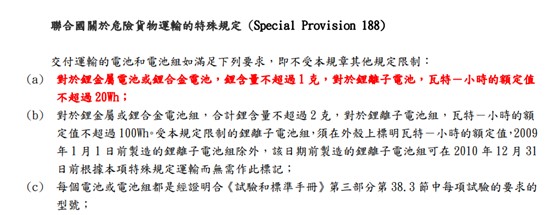
The international versions (especially the European versions) of some models of Xiaomi and Honor have reduced the battery capacity to less than 20Wh. It is speculated that this may be related to the United Nations battery cell transportation regulations.
2. EU “Energy Labeling and Eco-Design Regulations” restrictions:
Although the battery capacity of the international versions of Xiaomi and Honor flagship mobile phones has been reduced, it still exceeds 6000mAh and exceeds the upper limit of 20Wh. It is a bit too strong to point the reason for castration entirely at the United Nations transportation regulations!
Since the European Union has stipulated that smartphones and tablets sold in the EU must comply with the “Energy Labeling and Eco-Design Regulations” from June 20, 2025, among which,Battery durability must withstand at least 800 charge and discharge cycles and retain at least 80% of the original capacity。
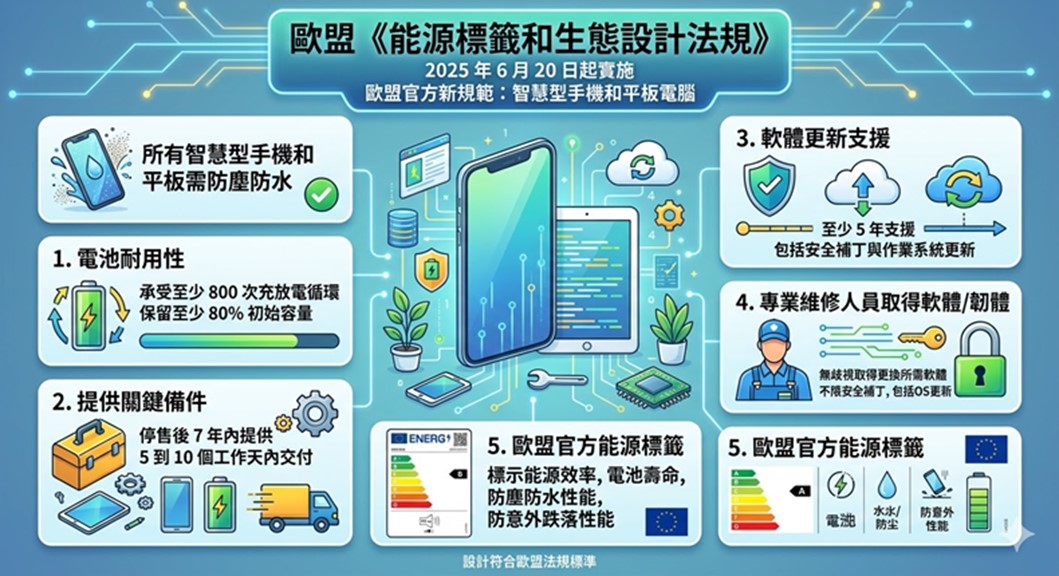
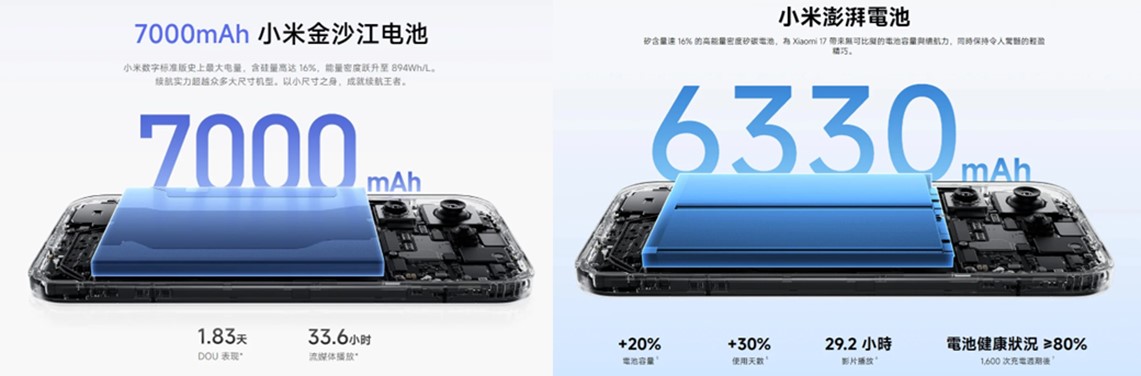
Due to the frequent expansion and contraction of silicon during charging and discharging, silicon-carbon batteries will constantly rupture and re-grow the solid electrolyte interface (SEI) film on the surface of the negative electrode, which will continue to consume lithium ions and cause them to age faster than traditional lithium-ion batteries. The number of charging cycles has been questioned. In order to meet the EU’s requirement of more than 800 charging and discharging cycles, Chinese mobile phone manufacturers may switch to products with lower capacity but longer charging cycles for the international version. Take Xiaomi as an example. The national version (Chinese version) uses Xiaomi Jinshajiang Batteries (the main cooperative supplier is Sunwoda), while the international version uses Xiaomi Pengpai batteries (the main cooperative supplier is Zhuhai Guanyu). In addition to cost considerations, different manufacturers may also be customized due to different market specifications (number of charging cycles).
C. Marketing competition demands to increase battery capacity:
According to data compiled by the Charging Head Network in mid-November 2025, the 6000-7000mAh battery capacity range will account for the highest proportion of mobile phone models in mainland China in 2025, accounting for over 68%, far exceeding the average level of international brands.
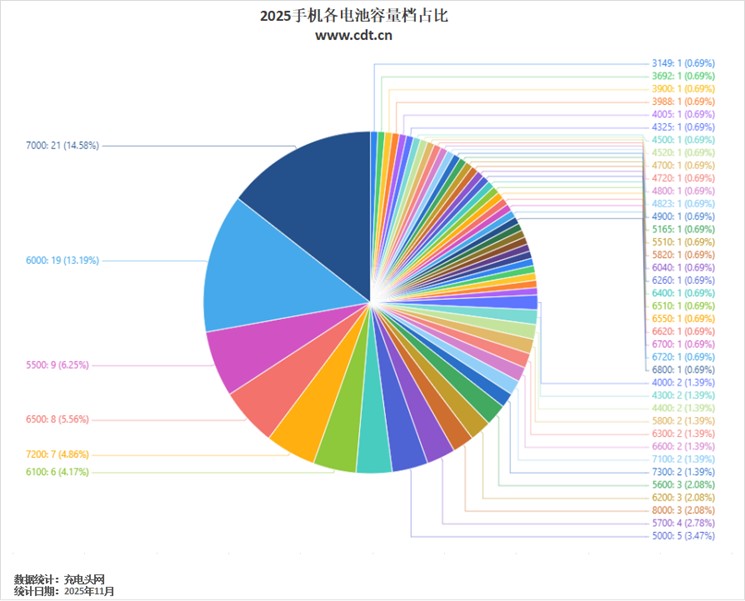
Image source: charging head network
Since the competition among Chinese mobile phone brands in mainland China is very fierce, it is not unusual for mobile phone manufacturers to consider the performance of the products (specially selected machines) sent to the mainland for testing due to marketing competition. considerThe international version submitted for testing must be inspected by a third-party agency and must comply with the laws and regulations of each country. The battery capacity of the international version is relatively conservative. The use of standard products for testing allows the performance to be closer to the actual production and sales products. This is one of the reasons why the battery capacity specifications of the international version are slightly lower than the national version.
At present, the battery differences between the international version and the Chinese version are mainly concentrated in Xiaomi (including POCO) and Honor. Other Chinese brands usually do not have the problem of battery capacity differences. The real answer to why Xiaomi and Honor have castrated the battery capacity on their own has to be solved by themselves!
Source: KOCPC Chinese