


Google’s Made by Google event is set to take place tomorrow, with all four Pixel 11 series models—the Pixel 11, Pixel 11 Pro, Pixel 11 Pro XL, and Pixel 11 Pro Fold—expected to be showcased. The design and specs have already leaked beforehand, and unsurprisingly, benchmark results have also surfaced ahead of the launch. Earlier, foreign media spotted Pixel 11 Pro XL scores in the Geekbench 7 database.

Pixel 11 Pro XL benchmark leaks! Tensor G6 switched to 7 cores, single-core up 7%, multi-core down 12% instead
According to Notebookcheck’s report, in the Geekbench 7 database, records for the Pixel 11 Pro XL are already visible.
From the spec sheet, you can see that this machine’s motherboard is codenamed “Kodiak,” running Android 17 with 16GB of RAM and a 7-core Google Tensor G6 chip. The Kodiak codename has previously appeared alongside the Pixel 11 Pro XL in earlier leaks, and combined with the 16GB RAM spec, it’s almost certain that this is the Pixel 11 Pro XL.
Scored 2,112 points in single-core and 5,196 points in multi-core on Geekbench 7:
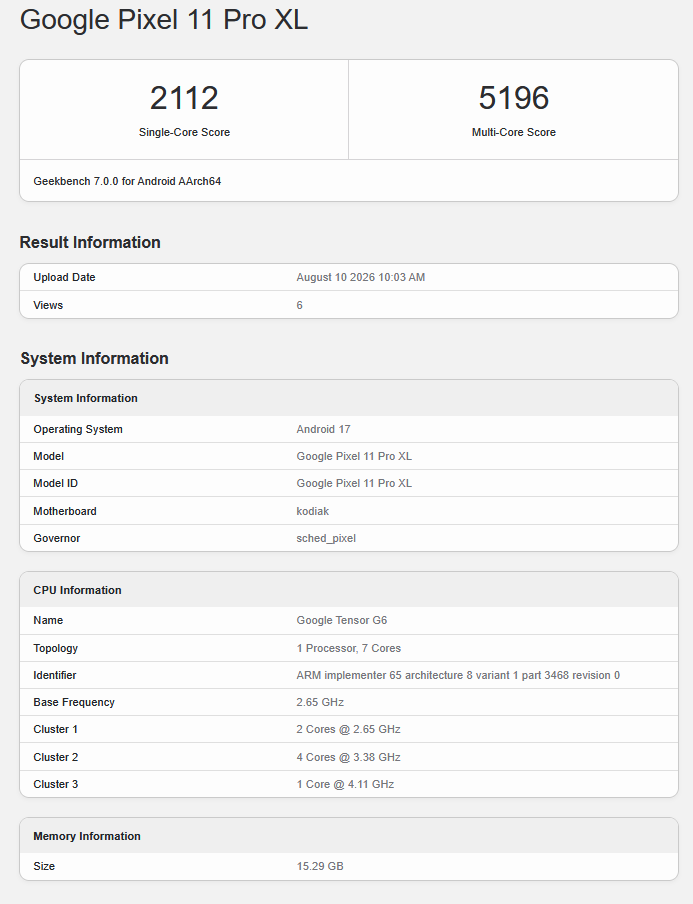
Compared with the Geekbench 7 scores of the Tensor G5 currently in the Pixel 10, the single-core has improved, but the multi-core has regressed. Below are the Tensor G5’s scores:
- Single-core: 2,112 vs 1,973, an improvement of about 7%
- Multi-core: 5,196 vs 5,872, a regression of about 12%
Supplement:Since Geekbench 7 has only been out for a short time, there aren’t many test results in the database yet. Notebookcheck is comparing using the Tensor G5 reference data provided by Primate Labs. This data is derived from the average of two Pixel 10 test results.
The next-gen chip’s multi-core performance is actually slower than the previous model, which is indeed a bit odd, and one possible reason, of course, is that the Tensor G6 has one fewer CPU core than the Tensor G5.

The Tensor G5 uses an 8-core configuration, while the Tensor G6 has only 7 cores, divided into three clusters:
- 1 ultra-large core, clocked at 4.11GHz
- 4 performance cores, clock speed 3.38GHz
- 2 energy-efficient cores, clocked at 2.65GHz
That is, the “seven-core” architecture of 1+4+2. Compared to the common 8-core flagship smartphone chipsets, a 7-core configuration is indeed relatively rare, but it is not without precedent—Qualcomm and MediaTek have also released 7-core products in the past. Previous leaks suggested that the 4.11GHz prime core may adopt the Arm C1-Ultra, while the other six cores are C1-Pro.
Compared to the rival Galaxy S26 Ultra, it loses by a significant margin in both single-core and multi-core performance. However, Tensor-series chips have never been known for raw performance anyway. Additionally, this Tensor G6 result could still come from a pre-launch test unit, as clock speeds, cooling, and system tuning may not be finalized. Therefore, this benchmark score does not yet directly represent the final performance of the Pixel 11 Pro XL at launch.
| Device / Chip | Single-core | multi-core | Number of cores |
|---|---|---|---|
| Pixel 11 Pro XL(Tensor G6) | 2,112 | 5,196 | 7 |
| Pixel 10 (Tensor G5, average of 2 entries) | 1,973 | 5,872 | 8 |
| Galaxy S26 Ultra | 3,030 | 10,495 | 8 |
Aside from the CPU, the Tensor G6’s graphics chip has also changed. Geekbench data shows that the Tensor G6’s GPU has been switched to the Imagination PowerVR C-Series CXTP-48-1536 MC1, replacing the PowerVR D-Series DXT-48-1536 used in the Tensor G5.
Additionally, earlier supply chain reports indicated that the Tensor G6 will use TSMC’s 2nm process, and the Pixel 11 series may launch before this year’s iPhone 18 series, becoming the first smartphone to adopt a TSMC 2nm chip.
In recent generations, Apple has typically been the first to adopt TSMC’s advanced process nodes for mobile devices. If this report is accurate, Google beating Apple to it this time would be quite unusual. However, Google has not yet officially announced the process for the Tensor G6, so final confirmation will have to wait until the launch event.
Source: KOCPC Chinese