


Tesla CEO Elon Musk said on the X platform that Tesla’s sixth-generation AI-specific chip “AI6” has the opportunity to complete tape-out in December this year. This chip uses Samsung’s second-generation 2nm process. Musk claimed that the performance of a single AI6 is expected to be comparable to that of dual AI5s. This is also Tesla’s first statement on the performance of AI 6 manufactured by Samsung Electronics after they announced a multi-year foundry agreement of up to US$16.5 billion (approximately NT$526.4 billion). It will also affect the future layout of FSD self-driving systems to the humanoid robot Optimus.
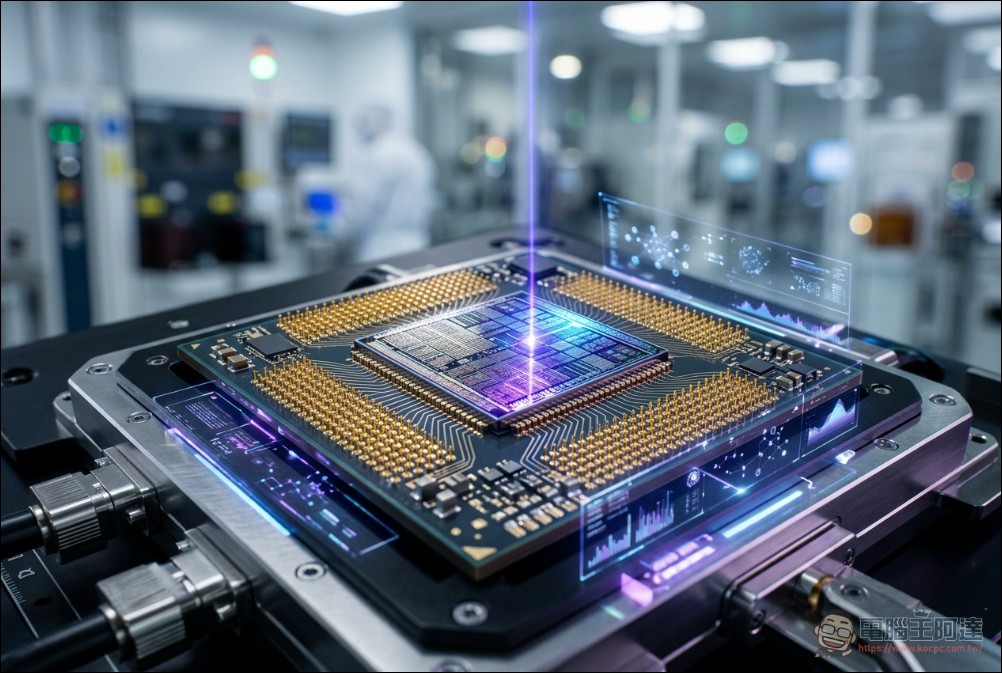
Tesla AI6 chip taped out in December as soon as possible: Musk claims that the performance of a single chip is comparable to dual AI5
Tesla’s AI chip development history is, to some extent, an evolutionary history from reliance on external suppliers to full vertical integration. From the earliest use of NVIDIA GPUs, to the launch of self-developed FSD chips in 2019, to the AI6, which is about to enter its sixth generation, Musk has always adhered to the concept of “software and hardware collaborative design.”
According to Musk, AI6 is currently in its early stages, but progress is in line with expectations. He said on the X platform: “If we are lucky and use artificial intelligence to accelerate, we may be able to complete the tape-out of AI6 in December.” This sentence reveals two important messages: First, the tape-out time is still experimental and depends on the verification results; second, Tesla is using AI tools to accelerate the chip design process, which itself is an interesting cycle of “using AI to design AI chips.”
With some luck and acceleration using AI, we might be able to tape out AI6 in December
— Elon Musk (@elonmusk) March 19, 2026
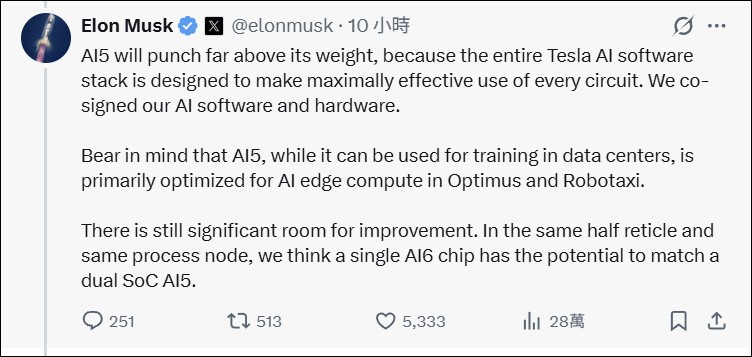
What’s more noteworthy is that Musk has extremely high expectations for the performance of AI6. He declared: “With the same half-mask and the same process node, we believe that a single AI6 chip is expected to be comparable to the AI5 of a dual-chip system.” This means that AI6 may bring nearly double the performance-power consumption ratio improvement. For FSD systems and Optimus robots that need to run in a vehicle environment, such a breakthrough is crucial.
$16.5 billion Samsung alliance: Secrets of Gigafactory in Tyler, Texas
In July 2025, Tesla and Samsung Electronics signed a multi-year chip foundry agreement with an initial value of US$16.5 billion (approximately NT$526.4 billion), and the cooperation will last until the end of 2033. This is not only one of the largest chip foundry orders in Samsung’s history, it can also be said to be a life-saving straw for American wafer factories.
According to the agreement, Samsung’s new super factory in Taylor, Texas, will be dedicated to the production of AI6 chips. The factory is one of Samsung’s largest semiconductor investments in the United States, totaling more than $25 billion. There are several strategic considerations in choosing the Taylor factory: First, Texas is Tesla’s home base, which is conducive to supply chain coordination; second, the Taylor factory will use Samsung’s most advanced second-generation 2-nanometer (SF2P) process, which is currently one of the most advanced chip manufacturing technologies in the world. Moreover, Samsung also agreed to Musk’s request to enter the wafer factory to guide design and production, which TSMC would not have been able to agree to. This also gave Musk the opportunity to deeply understand the operation mode of the wafer factory, which would also be helpful for Tesla’s own “Terafab” in the future.
The SF2P (Samsung Foundry 2nd Generation Process) process uses an advanced GAA (Gate-All-Around) transistor structure. Compared with traditional FinFET technology, it can improve performance by 15% at the same power consumption, or reduce power consumption by 30% at the same performance. This improvement in energy efficiency is crucial for AI chips that need to run on electric vehicles and robots.
AI6 application ecosystem: full scene coverage from FSD to Optimus
The application scenarios of AI6 chips outline Tesla’s ambition of “AI everywhere”. According to the official plan, AI6 will serve four core businesses at the same time:
FSD fully self-driving system: This is the most mature application scenario for Tesla AI chips. As FSD V13 is promoted globally, the demand for edge computing power is increasing day by day. AI6 will provide next-generation FSD algorithms with more powerful real-time inference capabilities.
Cybercab robot taxi: Tesla expects to launch a driverless taxi service in 2027. Cybercab requires an AI system that operates 24/7, placing extremely high requirements on the reliability and energy efficiency of the chip.
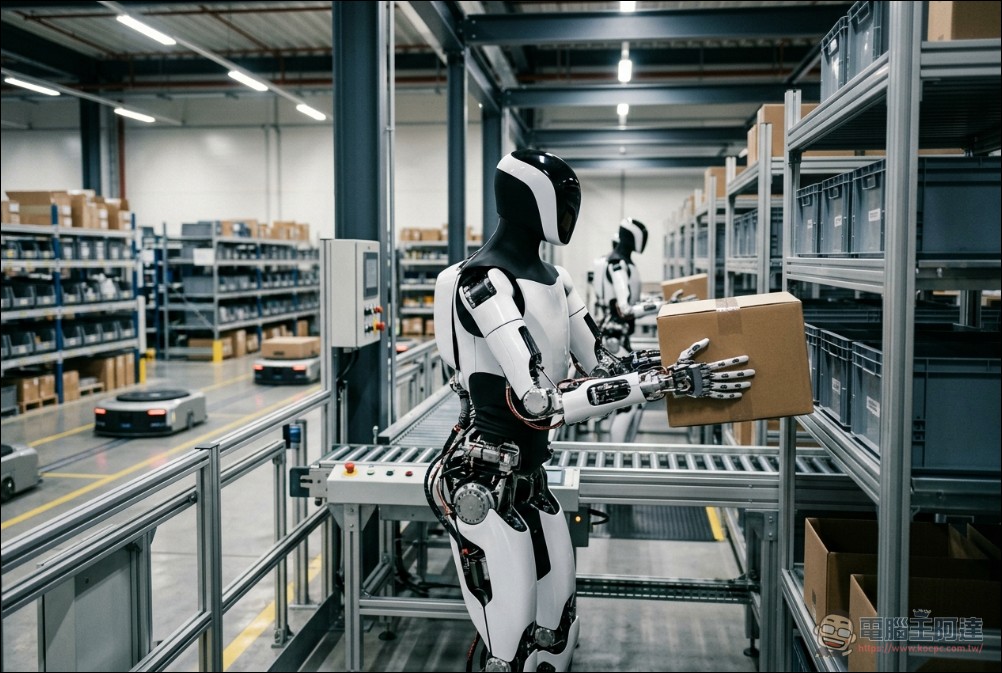
Optimus humanoid robot: This may be the most imaginative application of AI6. Optimus needs to run a variety of AI models such as visual perception, action planning, and natural language understanding locally, and its computing power requirements are no less than that of a self-driving car.
Tesla data center: Although Musk emphasized that AI5 is mainly optimized for edge computing, AI6 will also be used in Tesla’s cloud training infrastructure (and may even be sent to space) to support larger-scale model training.
point of view
The Tesla AI6 chip marks a new stage for the automaker’s self-developed AI chips. Rather than saying this is a chip, it is a concrete manifestation of Tesla’s “software and hardware collaboration” strategy: from autonomous driving to robots, from the car to the cloud, Tesla is building a fully autonomous and controllable AI computing ecosystem.
What deserves more attention is the US$16.5 billion agreement between Tesla and Samsung. In the field of advanced manufacturing, TSMC has long dominated. For Tesla, choosing Samsung instead of TSMC is not only based on considerations of supply chain diversification (mainly because TSMC’s production capacity is fully loaded, Musk’s order is not a big one for TSMC), but it may also be to obtain more stable production capacity in the United States. However, the yield control of Samsung’s 2nm process, the design verification of complex AI chips, and the deep collaboration with the software stack are all difficulties that Tesla must overcome next.
Source: KOCPC Chinese