


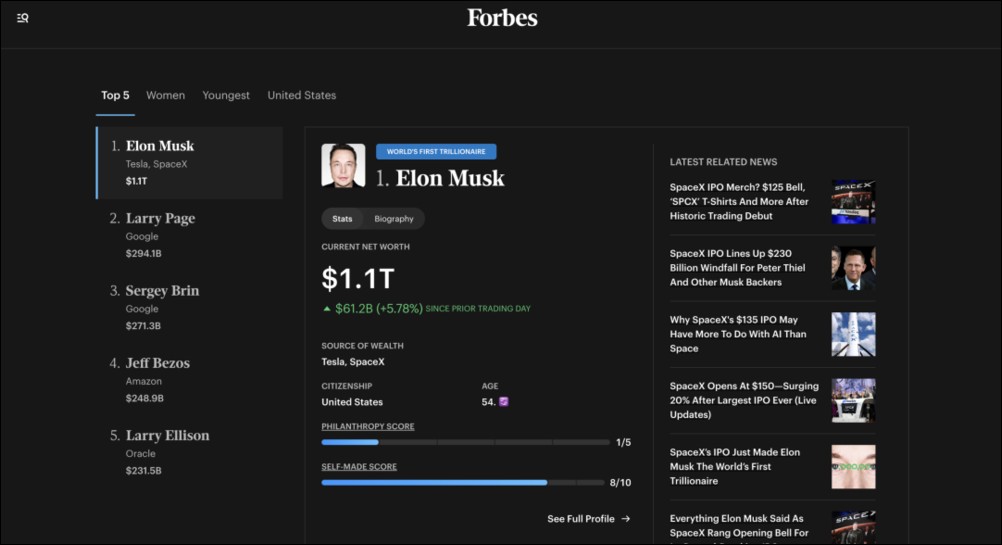
Last night, on June 12, Eastern Time, SpaceX officially listed on Nasdaq under the symbol SPCX, raising US$75 billion (approximately NT$2.4 trillion), setting a new human IPO record in one fell swoop. After the opening, the stock price soared, and the market value exceeded the US$2 trillion mark. The 54-year-old Musk’s paper net worth officially exceeded US$1 trillion, becoming the first trillionaire in human history.
SpaceX lands on Nasdaq: The largest IPO in human history, Musk becomes the first trillionaire
SpaceX is offering 555.6 million shares at a price of $135 each, raising $75 billion. Adjusted for inflation, the figure is about double Saudi Aramco’s IPO record in 2019 and more than three times Alibaba’s $22 billion IPO in 2014. Even more amazing is the speed. According to the New York Times, SpaceX only began interviewing investment banks in December last year, and it only took half a year to complete the entire process from preparation, roadshow to listing. It was the first time in history that an IPO was so large and so fast.
On the day of the listing, SpaceX President and COO Gwynne Shotwell and CFO Bret Johnsen rang the bell at the Nasdaq, and Musk himself appeared via video link. NPR reported that this is the first of three giant AI IPOs expected to debut this year.
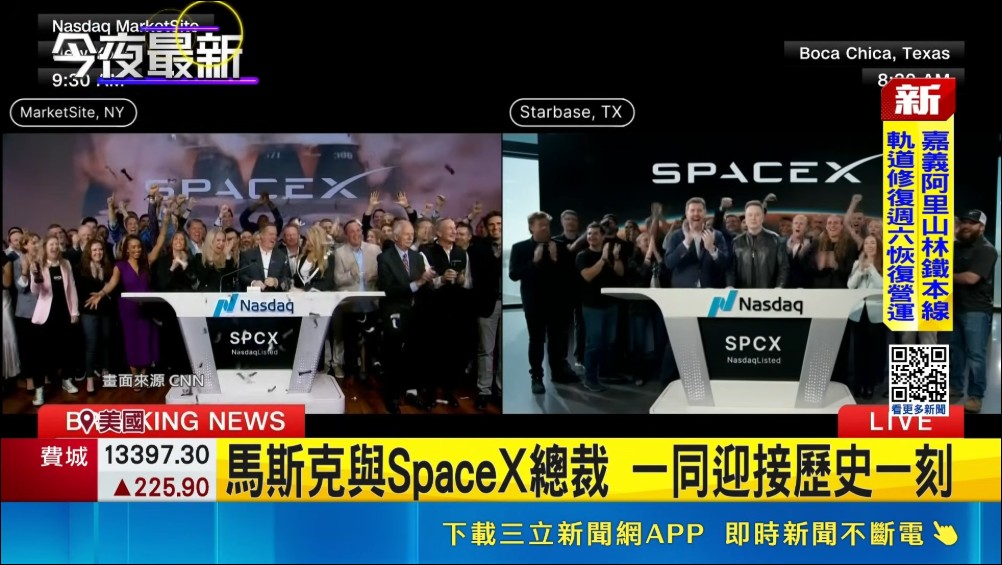
The stock price soared 25%, and the market value once exceeded US$2.2 trillion.
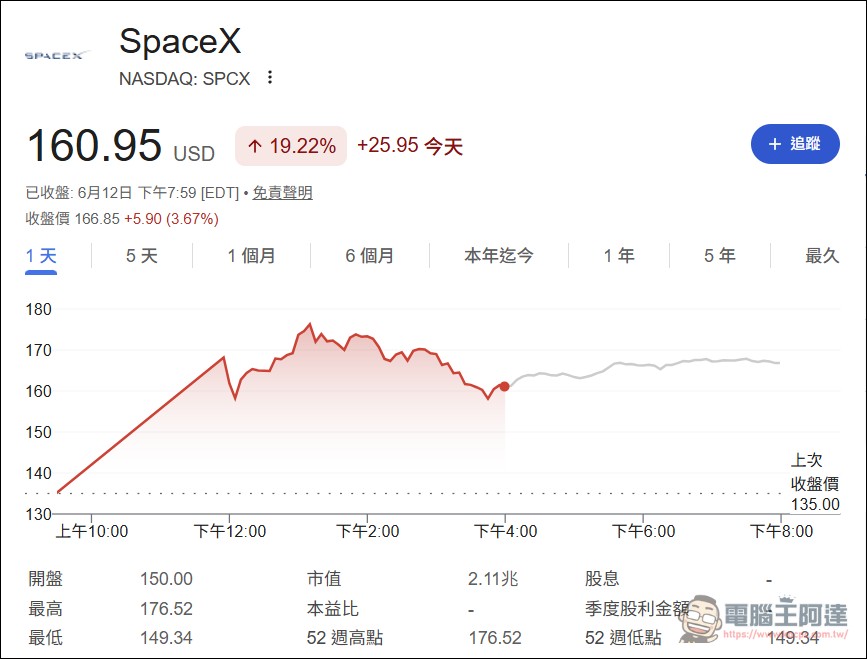
SpaceX jumped to $150 at the opening, hit $165 in the first 30 minutes, and hit an intraday high of $176. As of late trading in the U.S. stock market, the stock price rose by $34.86, or 25.82%, to $169.86. The market value exceeded $2.2 trillion, ranking among the top seven in the United States. The closing price on the first day was US$160.95, an increase of 19.22%, and the company’s total market value rose to US$2,104.56 billion (2.1 trillion).
According to reports, the subscription demand exceeded 4 times of the shares available for sale. A large number of institutions did not get the shares at all and could only wait for the opening of the market to buy them in the secondary market. The shares in this public offering only accounted for about 4% of the total share capital, and the rest was in the hands of early investors and employees. The circulation market is extremely small, there are many people and few people, and it is difficult for the stock price not to rise.
Wealth creation effect: 4,400 employees became millionaires overnight
The wealth creation effect of this IPO covers the entire chain. According to an analysis by Hill.com, an investment platform in San Francisco, about 4,400 current and former SpaceX employees became millionaires as a result of the IPO, and about 400 of them are worth more than $100 million. Even grassroots welders have achieved financial freedom. Some netizens lamented: “The person the whole Internet envies most is not Musk, but the welders of SpaceX.”
A man working as a welder at SpaceX for $28 an hour has just become a millionaire.
Juan Hernandez, who came from Mexico, welded rockets for SpaceX at $28 an hour.
SpaceX gave him $10,000 in stock when he went full time in 2015, and he bought more with every paycheck for 10… pic.twitter.com/kfgnwVwJGN
— Bull Theory (@BullTheoryio) June 12, 2026
In terms of venture capital, Founders Fund invested US$600 million that year and held a 3% stake. The return based on the issue price has exceeded US$50 billion, which is one of the largest returns in the history of venture capital. Sequoia’s $2 billion investment back then is now worth more than $20 billion, and a16z’s position is worth more than $10 billion. The lead underwriters, Goldman Sachs and Morgan Stanley, each received about $100 million in underwriting fees.
Musk’s $1 trillion: How much is it really?
According to data from Forbes, after Musk’s net worth exceeded US$1 trillion, the combined net worth of the next four tycoons on the Forbes list, Larry Page, Sergey Brin, Bezos, and Larry Ellison, could barely equal Musk alone.
What exactly is $1 trillion? If you count one number per second, it would take 11 and a half days to count to 1 million, 31.7 years to count to 1 billion, and 31,700 years to count to 1 trillion. In other words, if you want to count 1 trillion, you have to start counting from the Paleolithic era.
SpaceX’s business portfolio: rockets + satellite networks + AI + social media
SpaceX has delivered more than four-fifths of the world’s mass put into orbit over the past three years. Satellite network business Starlink had revenue of US$18.7 billion (approximately NT$607.7 billion) last year, an annual increase of 33%. It is a cash cow with high gross profit margins. In February this year, SpaceX acquired Musk’s AI company xAI, which had already swallowed the social platform X. SpaceX is now a four-in-one behemoth of rockets + satellite networks + AI + social media. It focuses on the concept of “orbital AI computing power” and claims that the market size it faces reaches US$28.5 trillion.
But SpaceX’s net profit shows a completely different side. It also earned US$791 million in 2024, and turned from profit to loss the following year. The main reason was that it spent crazy money to build an AI data center. At the current rate of money burning, the US$75 billion raised in this IPO will be exhausted soon. Therefore, many investment institutions believe that SpaceX cannot support such a market value. It is purely due to the “Musk premium” and “fan effect.”
What do investors want? Bet on Musk
Since it is still burning money, why are investors rushing to buy it? Shaun Maguire, a partner at Sequoia, said: “Musk deserves an extreme premium because he has a track record and vision of judging technology trends in advance.” ERShares CEO Joel Shulman even said that to find comparable entrepreneurs, you have to go back 100 years.
Musk himself also emphasized the same statement in the live broadcast video of the listing: “What SpaceX has to do is to remove the word ‘fantasy’ from science fiction novels. No matter who you are, SpaceX wants to take you to the moon, to Mars, and even beyond.”
But the New York Times did some calculations before the IPO: They sorted out 602 goals that Musk had publicly set on social media and investor calls over the past 15 years, and concluded that only about 19% were fulfilled on time, about 35% were either late (some years late) or had no follow-up at all, and about 33% were too vague to be verified. What’s even more ironic is that his annual fulfillment rate has been declining over time: nearly three-quarters of the 13 goals set in 2015 were completed, and less than half of the 27 goals set in 2020 were completed on time.
Governance structure dispute: one person controls 85% of voting rights
SpaceX’s corporate governance structure has raised many questions. In January this year, the board of directors granted Musk a compensation package of up to 1.3 billion restricted shares. The unlocking conditions include building a million-population colony on Mars and sending high-power data centers into space. Each of these goals seems difficult to achieve in Musk’s lifetime, but according to the prospectus, the voting rights of these 1.3 billion shares can be used by Musk now, which means that he has absolute say in SpaceX. Moreover, the board of directors does not intend to allow independent directors to form a majority, and executive compensation will not be determined by an independent board committee. If shareholders want to safeguard their rights in accordance with federal securities laws, they must go through arbitration procedures according to the company’s articles of association. After the IPO, Musk controlled about 85% of the voting rights. The beneficiaries of the company all pointed to the same person (Musk) inside and outside the company.
The prospectus also honestly lists Musk himself as a “risk factor” on the grounds that other companies under his name may compete with SpaceX for precious supply resources. Tesla holds nearly 19 million shares of SpaceX’s Class A common stock. SpaceX purchases Cybertruck and Megapack energy storage batteries from Tesla and also leases office space to Musk’s tunneling company, the Boring Company.
Next step: Merger with Tesla?
On the day of the listing, SpaceX President Shotwell was asked in an interview with CNBC about the possibility of merging with Tesla. Her answer was: This “may make Musk’s life a little easier.” SpaceX revised its S-1 document before going public and added a new sentence to the risk factors: “We may issue a large amount of equity in future transactions.” Many people have analyzed that this sentence most likely refers to Tesla, which has a current market value of approximately US$1.26 trillion.
Musk is already very skilled at putting together building blocks: xAI swallows X, SpaceX swallows xAI, and it seems to be only a matter of time before the next piece is Tesla.
Market Impact: Risk of Indigestion
SpaceX’s huge IPO also has some investors worried about whether the market can digest it. Douglas Beath, global equity strategist at Wells Fargo Investment Institute, said: “History shows that large IPOs occur during times of strong market sentiment, but the new supply of shares can cause indigestion.” He pointed out that U.S. household equity allocations are close to historical highs, which means they may sell existing positions to fund new positions (crowding-out effect).
However, no one is more excited about SpaceX’s surge than OpenAI and Anthropic. Both companies are currently valued at close to $1 trillion, and both have secretly submitted IPO applications this month. Advisors to the two companies have been worried that if SpaceX’s listing collapses and retail investors lose money, the AI stocks lined up behind them will be difficult to sell. Now that SpaceX has performed well on its first day, the two executives can finally breathe a sigh of relief and prepare for an epic wave of AI wealth creation that is likely to come this year and next.