


In the past two years, Chinese smartphone brands have seen a massive surge in battery capacity, with silicon-carbon batteries actively adopted by Chinese brands boosting capacities to 8000mAh or even 10000mAh. Coincidentally, Samsung’s new flagship foldables (8-series) have also adopted silicon-carbon batteries for the first time, and rumors are swirling that the Samsung S27 series and Apple’s new foldable will adopt them too—silicon-carbon batteries have essentially become the undisputed champion of the phone lithium battery world! However, in the latest comprehensive battery life comparison, Geekerwan revealed a secret manufacturers didn’t disclose: the actual usable capacity measured at the device’s charge/discharge boundaries showed a considerable gap from the rated capacity, sparking widespread debate over silicon-carbon battery “capacity capping.”
What is “capacity locking” in silicon-carbon batteries? Why do phone manufacturers lock capacity? Here’s an analysis:
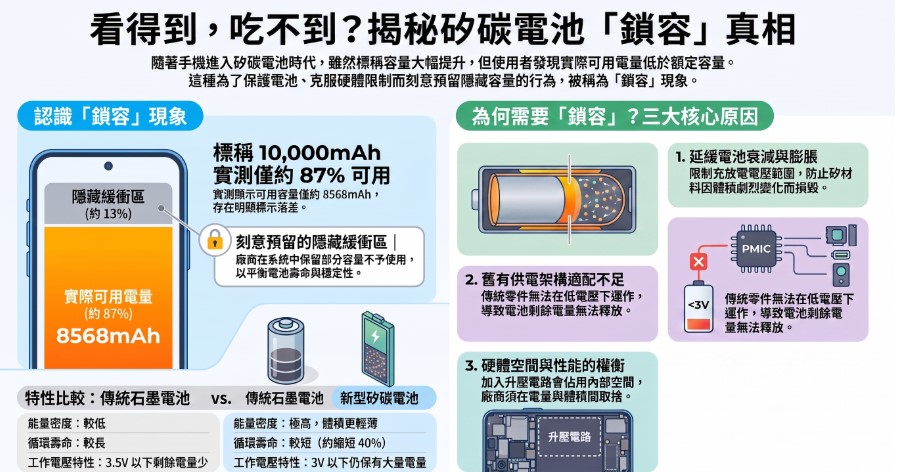
Silicon-carbon batteries, which offer the advantages of extremely high capacity in a thin and light form factor, have been highly sought after by Chinese-brand phone makers over the past two years. However, renowned phone review influencer “Geekerwan” recently revealed that most Chinese manufacturers using silicon-carbon batteries have a “capacity locking” phenomenon, making the labeled battery capacity visible but not fully accessible. The summary video and detailed explanation of the “capacity locking” patterns in silicon-carbon batteries and the mystery of the disappearing battery capacity are as follows:
1. What is “capacity locking” in silicon-carbon batteries?
Geekerwan in the latestComprehensive Smartphone Battery Life ComparisonIn the test, 28 smartphones were disassembled and examined. Among them, one phone with a typical capacity of 10,000mAh measured a usable capacity of about 8,568mAh based on the actual charging/discharging boundaries of the whole device, equivalent to only 87.84% of the rated capacity, raising doubts about phone manufacturers using silicon-carbon batteries that are “capacity-locked,” making the nominal capacity visible but unusable.
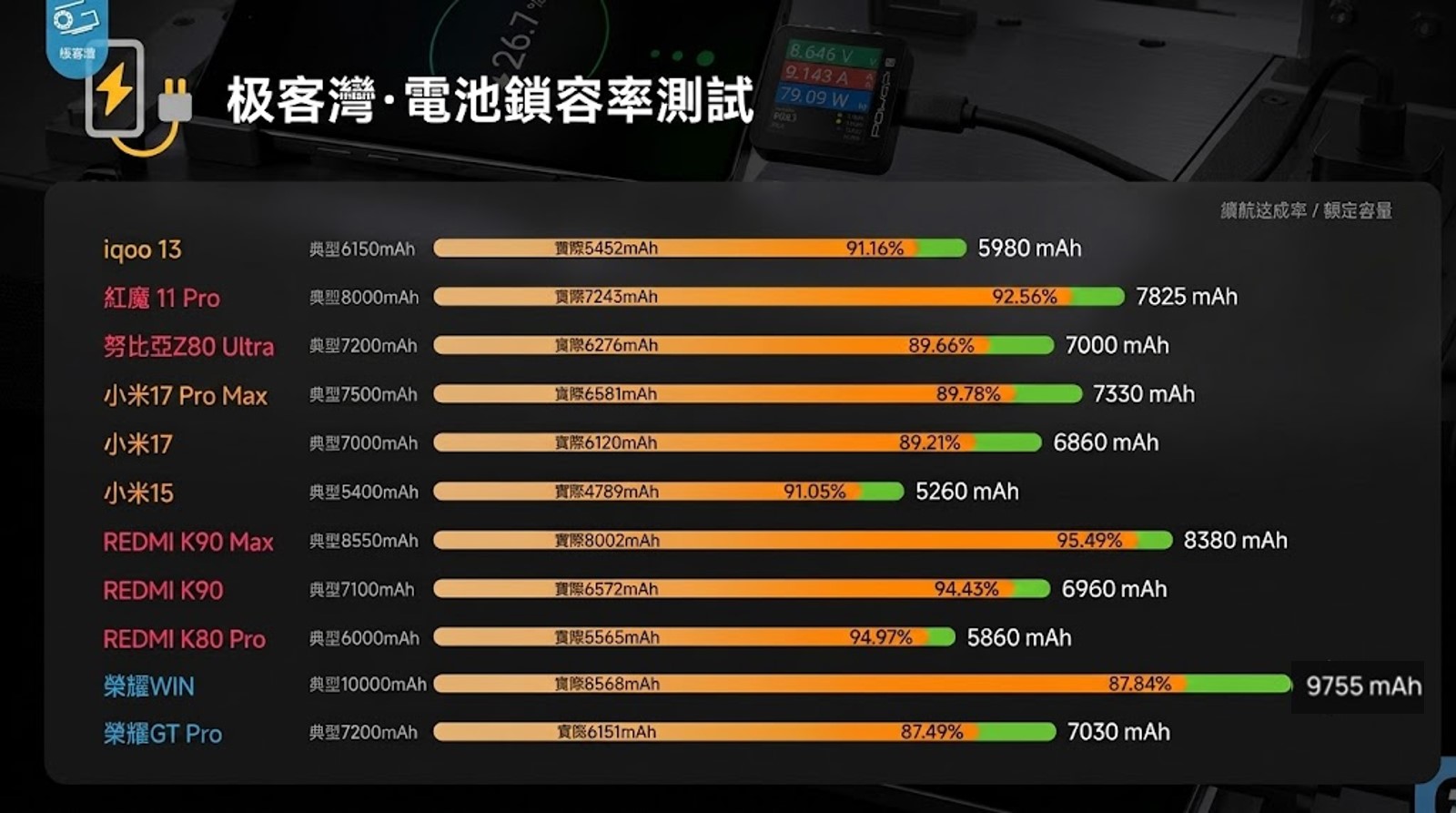
Image source: Geek Bay
What is “capacity locking”? In the context of silicon-carbon batteries, “capacity locking” refers to the practice where phone manufacturers deliberately reserve a portion of hidden capacity in the battery system that users cannot access, either to protect the silicon-carbon anode battery or for other reasons. This has sparked controversy over the discrepancy between the advertised battery capacity and the actual usable capacity.
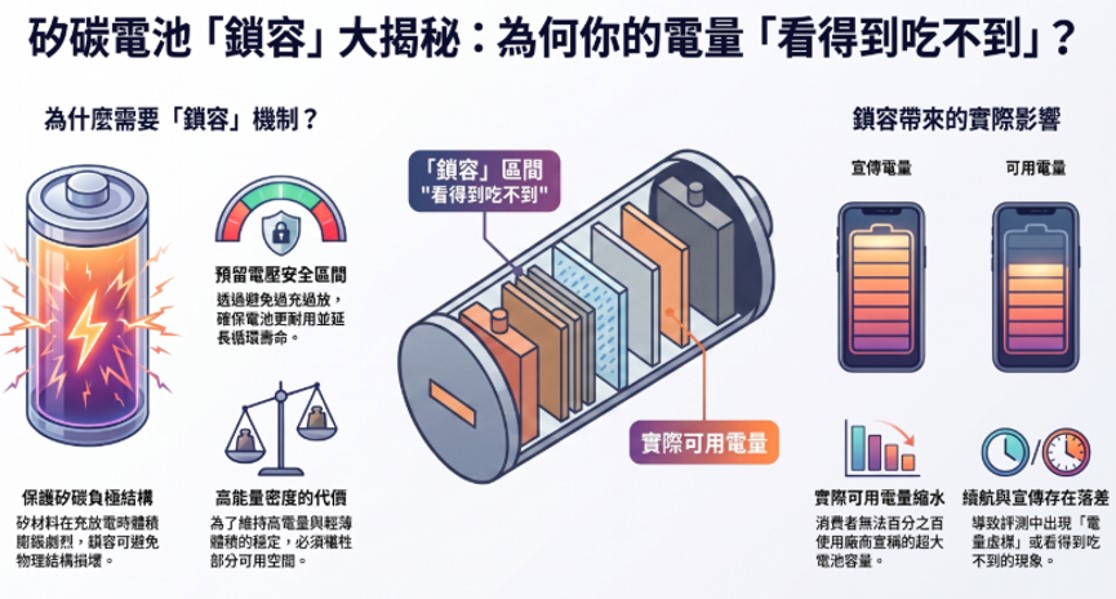
2. Why do phone manufacturers lock the capacity of silicon-carbon batteries?
Chinese brand smartphone manufacturers have various explanations for locking the capacity of silicon-carbon batteries. Currently, there are generally three main reasons: protecting the silicon-carbon battery,Insufficient low-voltage power supply adaptation in smartphones, and the zero-sum game between hardware space and performance:
A. Protect the silicon-carbon battery from overcharging and overdischarging, and extend its lifespan:
Silicon materials are prone to volume expansion and structural damage during power cycling, which often shortens their lifespan compared to traditional graphite anode lithium batteries. Taking Samsung’s newly announced foldable phone as an example, the lifespan of its first silicon-carbon battery is 40% shorter than that of traditional lithium batteries (see “This article“)。

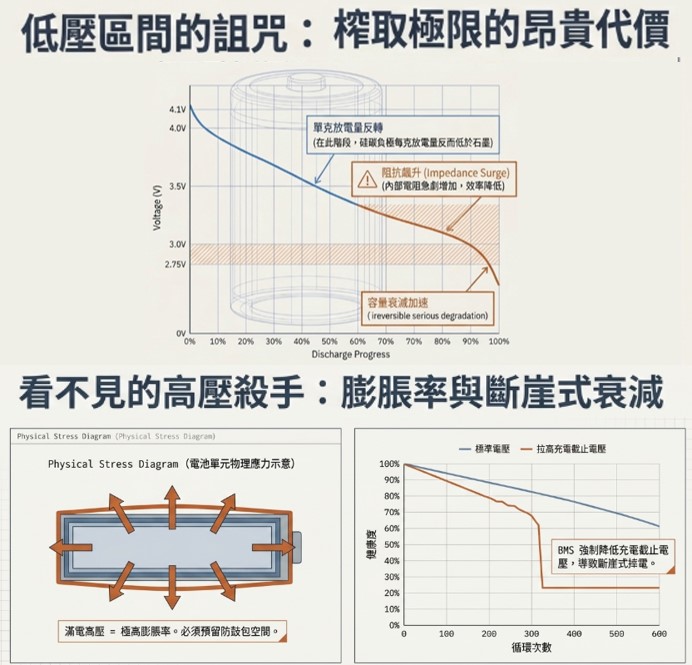
According to Geek Bay’s analysis: “During charging, silicon undergoes an alloying reaction with lithium ions, causing significant volume expansion, and then contracts after discharge, which damages the protective film (SEI film) and accelerates electrolyte and lithium consumption. In extreme states of being fully charged or fully discharged, the material suffers considerable degradation.”To address the severe degradation issue of large batteries, manufacturers set more conservative upper limits for full-charge voltage and lower limits for shutdown voltage in system scheduling,By leaving a buffer at both ends of the charging and discharging process, limiting the voltage at both ends (capacity locking) delays degradation. As battery capacity increases (with more silicon content), lifespan becomes harder to control, so manufacturers need to “lock” more capacity. In other words, Geekerwan believes that one of the main reasons manufacturers lock capacity is likely to prevent overcharging and over-discharging and to protect battery cycle life.
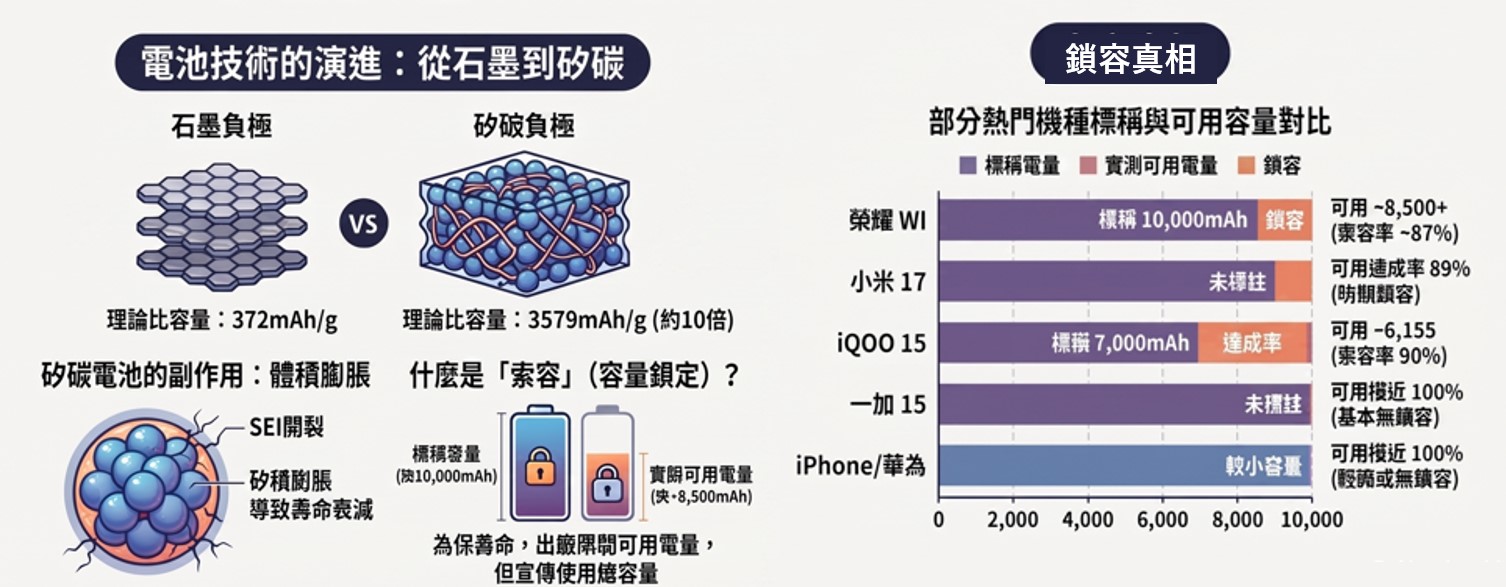
Additionally, some experts have pointed out that the closer a battery is to being fully charged or fully depleted, the greater the stress on its internal materials. Even if manufacturers unlock the low-voltage zone and frequent power draw causes the battery’s impedance to spike and undergo irreversible severe degradation, the impressive high capacity of silicon-carbon batteries is partly squeezed out by raising the cutoff voltage. When facing extreme high voltage, not only is预留 space needed to prevent swelling, but after a certain number of charge cycles, the BMI will forcibly lower the charging cutoff voltage to suppress the accelerated degradation caused by high voltage, preventing a “cliff-like drop” in battery health. In other words,Limiting the upper and lower charge/discharge voltages (capacity locking) is meant to accept the cost of “running out of power sooner” in exchange for “not losing battery health (battery health) as quickly.”
B. Mobile phoneInsufficient adaptation of low-voltage devices and power supply architecture to the battery.Unable to continue operating at a lower voltage:
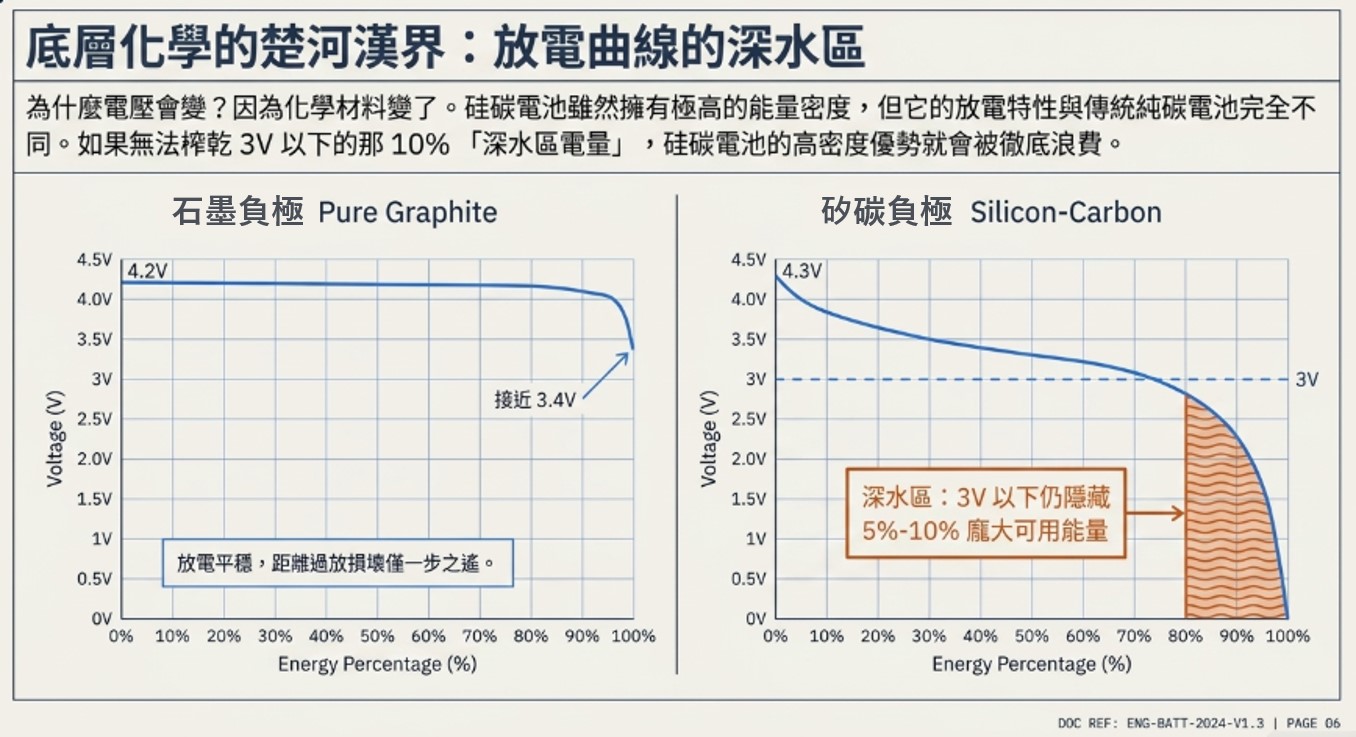
Li Xiaolong, CTO of Huawei’s Consumer Business Group, cited the “battery capacity release rate” explainer published this February, saying that some phones are not cases of manufacturers deliberately limiting capacity, but may also be due to the device not being fully adapted to the low-voltage operating characteristics of silicon-anode batteries.
Huawei’s Li Xiaolong analyzed: “Traditional graphite anode batteries have less remaining capacity after voltage drops below 3.5V; silicon anode batteries may still retain more capacity below 3V. If a phone switches to a silicon-carbon battery but still uses the higher shutdown voltage previously designed for graphite batteries, the low-voltage capacity cannot be released. Some capacity in silicon-carbon batteries is not actively locked away for longevity, but rather because the phone cannot continue operating at lower voltages.”
Huawei’s Li Xiaolong: “The Huawei nova 15 series supports low-voltage device adaptation, split power supply, and local boost, reducing the overall device voltage to 2.8V, allowing the capacity in the low-voltage range of the silicon-carbon battery to continue being released. This also shows that whether the capacity can be fully utilized depends not only on the battery cell, but also on the device’s power architecture and low-voltage working capability.”
C. Zero-sum game in hardware space:
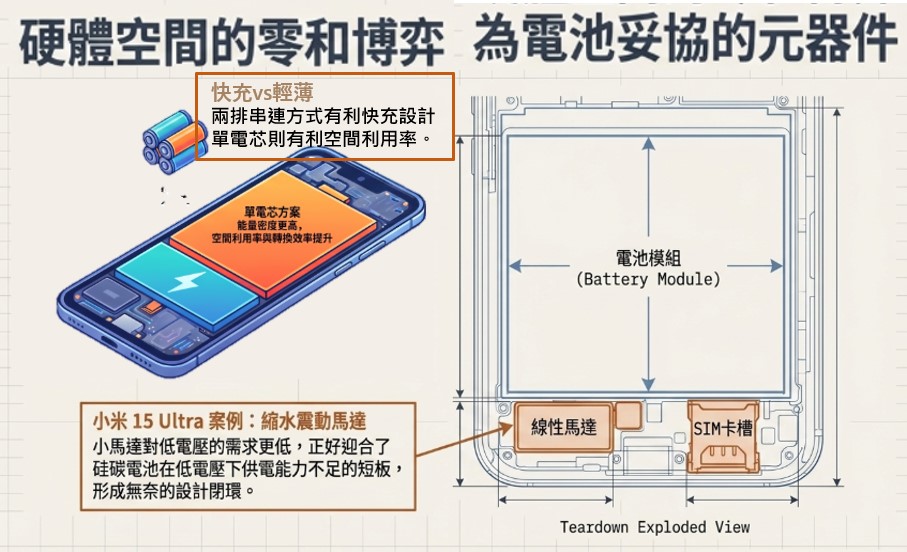
Silicon-carbon batteries have only become popular in the past two years, and their working voltage characteristics differ from those of traditional graphite anode batteries. To fully meet the requirements of siliconCarbon battery low voltagePower supply architecture compatibility requires a full overhaul of the entire circuit architecture design and component supply. In particular,The internal devices of a phone, such as the display, audio amplifier, SoC, and PMU, have different minimum operating voltage requirements. If some devices cannot operate stably at low voltage, the phone may shut down prematurely.
To address low-voltage power supply issues, manufacturers can only choose the space-consuming “boost circuit” (as in the Huawei nova 15 series model), meaning they have to replace the original high-power components to allow the device to barely survive under low voltage (as in the Xiaomi 15 Ultra), creating a zero-sum game between hardware space and performance. With limited hardware space and considerations of component and design costs, manufacturers’ choices will affect the differences in battery capacity lock rate across various phone brands and models.
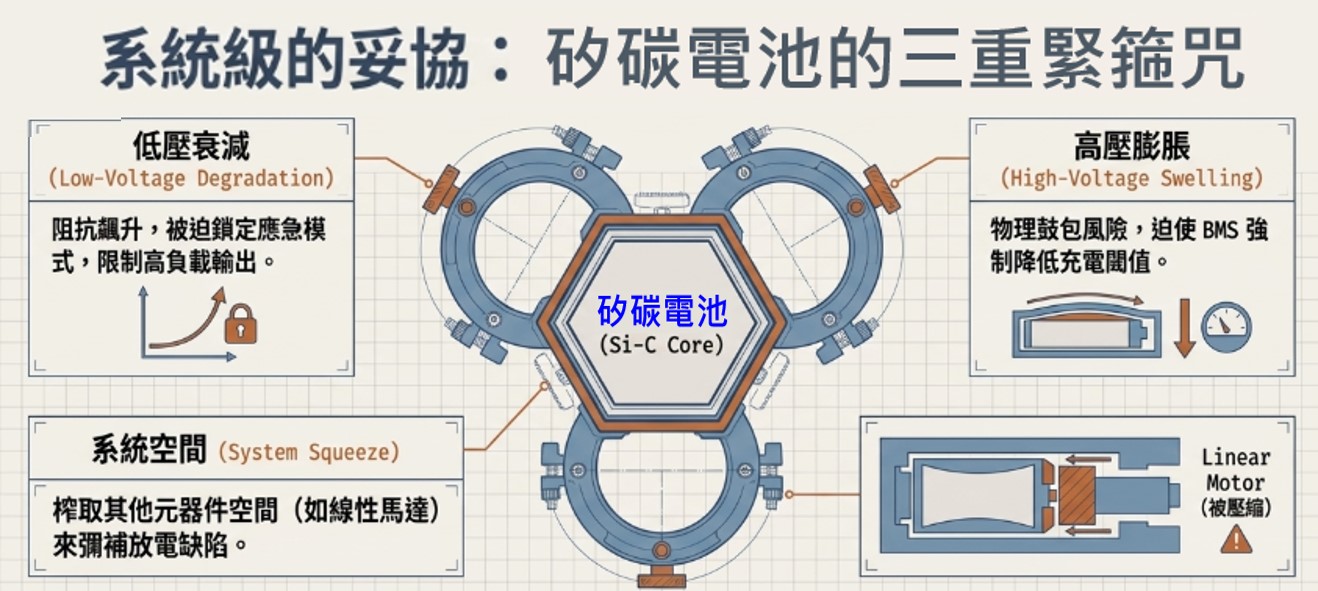
Although silicon-carbon anodes can deliver extremely high capacity in a thin and light form factor, the triple constraints of their physical characteristics—low-voltage decay, high-voltage expansion, and hardware space—force manufacturers to reserve more battery capacity to maintain stability.
As it seems to be an irreversible trend that mobile phones are entering the era of large batteries, the public’s future focus on battery capacity labeling must also shift from “How much capacity does it hold?, turning toHow much capacity is actually available?In order to avoid public disputes over the rated capacity and usable capacity marked on silicon-carbon batteries,In the future, in addition to typical capacity and rated capacity, manufacturers will also need to provide more informative product information, including system usable capacity, capacity release rate, and corresponding test conditions.
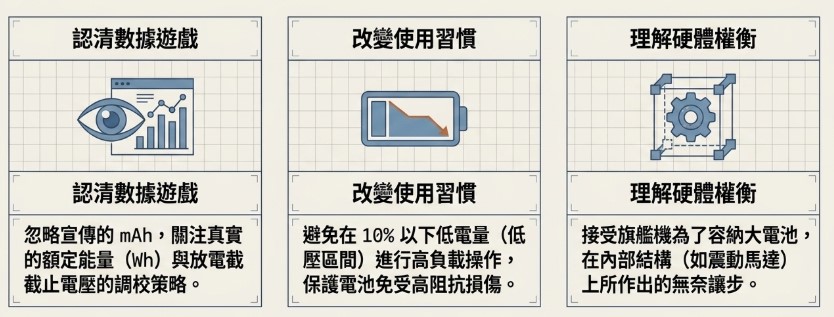
For mobile phone users, they must learn to ignore the typical mAh battery capacity label and instead focus on the Wh rated energy, develop the habit of avoiding high-power operations when the battery is below 10% low voltage, and understand that some new-generation flagship phones sacrifice battery lifespan and some high-energy-consumption performance as a compromise to increase battery capacity.
Source: KOCPC Chinese