


As we all know, after Samsung chip manufacturing entered the 7nm process, Apple, Qualcomm, and NVIDIA have all reaped the “dividends” of Samsung’s process because of the process. These manufacturers have never used Samsung’s process to manufacture high-end products in the field of advanced processes. But Samsung is not planning to sit still and wait for death. It recently launched the first mobile phone processor “Exynos 2600” using its latest 2nm process. It shoulders the important task of restoring the reputation of Samsung’s self-developed chips for many years. How is its performance this time? According to the latest foreign media tests, it doesn’t look good.
The tragic fate of the Exynos series that even its own flagship phones dare not use
In fact, the fate of Exynos processors has not been smooth. Samsung’s own flagships used to adopt a dual-version processor strategy of Qualcomm and Exynos. However, due to the poor performance of Exynos, Exynos processors can only be used in the Korean market and European markets that do not have high performance requirements. However, due to overheating problems, from the Galaxy S23 to completely abandoning Exynos, and to the Galaxy S25 being detoured again, Samsung’s self-developed chip Exynos has repeatedly suffered setbacks in terms of performance and heat dissipation issues. Now that the Galaxy S26 series returns with Exynos 2600, Samsung claims that it has completely solved the past overheating and frequency reduction problem through its new HPB (Heat Path Block) cooling technology. However, the actual game test data once again slapped Samsung’s process in the face.
The idle temperature is already lost: an inherent difference of 7°C
Android Authority reporter Robert Triggs conducted a series of real-world gaming tests on the Exynos 2600-powered Galaxy S26 Plus, compared with the Xiaomi Mi 17 Ultra equipped with Snapdragon 8 Elite Gen 5.
The first red flag in test results comes in the most basic usage scenarios. The internal temperature of the Galaxy S26 Plus exceeded 30°C just by sliding between the menu and the home screen, while models in the Snapdragon camp can usually stay below 30°C. The temperature difference between the two in the idle state is about 7°C. This figure is difficult to explain solely by the difference in the heat dissipation design inside the fuselage. It is more likely to be caused by the power consumption and heating characteristics of the chip itself.
Actual measurement of three games: the temperature rises twice as fast
Triggs selected three popular Android games for testing: Asphalt Legends, Call of Duty Mobile, and Genshin Impact, with each game taking 3 minutes to test.
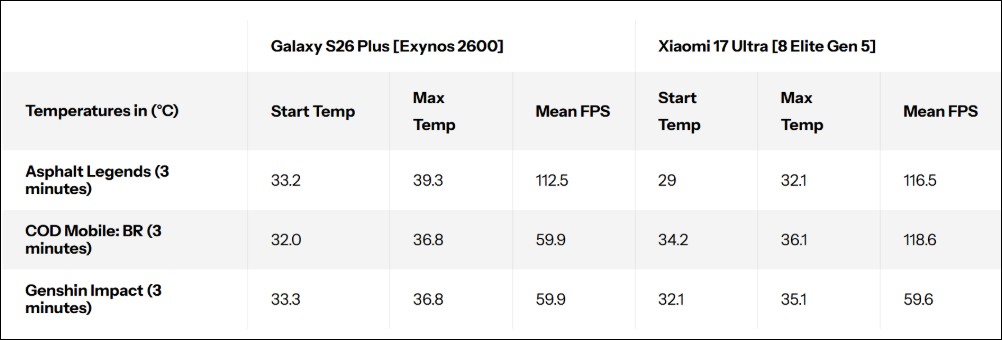
In the Asphalt Legends test, the Galaxy S26 Plus started at 33.2°C and soared to 39.3°C after 3 minutes, an increase of 6.1°C; in comparison, the Xiaomi Mi 17 Ultra rose from 29°C to 32.1°C, an increase of only 3.1°C. The Exynos heats up almost twice as fast as the Snapdragon. In terms of average frame rate, the S26 Plus is 112.5fps and the Mi 17 Ultra is 116.5fps.
The testing of Final Moment Mobile revealed another problem. The Galaxy S26 Plus’s frame rate is locked at 60fps, while competitors have unlocked 90fps and even 120fps modes. It is speculated that this is because the game actively sets the frame rate to a safe upper limit after detecting the thermal characteristics of the Exynos 2600. Even at this lower load, the S26 Plus still saw temperatures rise from 32.0°C to 36.8°C, while the Mi 17 Ultra only went from 34.2°C to 36.1°C when subjected to the higher rendering load of 120fps.
The test results of Genshin Impact are relatively mild. The temperature rise of the two models in 3 minutes is 3.5°C (S26 Plus) and 3.0°C (Xiaomi 17 Ultra) respectively. The final temperature difference is not big. However, Genshin Impact itself has a special load pattern on the CPU, and this result is not representative of the performance of other high-load games.
Play continuously for 10 minutes: Performance plummets by 30%
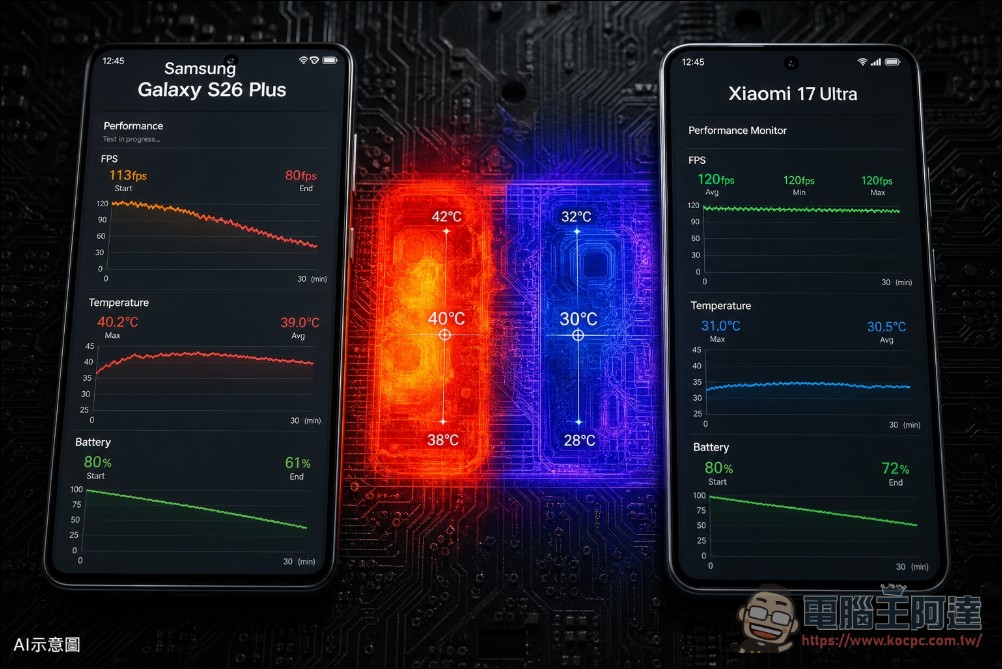
The temperature difference in short-term tests may be within an acceptable range, but the real problem arises in sustained gaming scenarios. According to Android Authority’s extended testing, after running Asphalt Legends for about 10 minutes, the average frame rate of the Galaxy S26 Plus dropped from 113fps to about 80fps, a performance drop of up to 30%.
The critical point that triggers frequency reduction is approximately when the die temperature reaches 40°C. Once this threshold is crossed, the system will forcibly reduce the clock speed to protect the hardware, resulting in obvious lags and frame drops in the game screen. An analysis by Hong Kong technology media GameApps.hk also confirmed this finding, pointing out that the Exynos 2600’s temperature control and sustained performance in high-load environments still lag significantly behind Snapdragon and Dimensity flagship platforms.
In the 3DMark stress test, the Exynos 2600’s stability was only 57.5%, which is far lower than the Snapdragon 8 Elite Gen 5’s level of more than 70%. This means that under long-term high performance requirements, the peak performance that Exynos 2600 can maintain is less than 60% of the original.
In fact, the conclusion of this Android Authority test is similar to that of the previous Android Addicts test. Compared with Qualcomm processors using TSMC technology, the Exynos 2600 is worse in terms of performance, heat generation and battery life (and it is not a little worse, but a lot worse).
三星 Galaxy S26 雙版本續航實測:驍龍 8 Elite Gen 5 大幅領先 Exynos 2600 達 2 小時 38 分鐘
HPB cooling technology: progress, but not enough
To be fair, Samsung did introduce a number of cooling innovations into the Exynos 2600. HPB (Heat Path Block) is the core one. It places a copper heat sink directly above the processor chip and moves the DRAM memory to the side so that heat can be dissipated from the core of the chip more quickly. According to Samsung, this technology can improve thermal resistance performance by up to 30%.
In addition, Exynos 2600 adopts Samsung’s first 2nm GAA (Gate-All-Around) gate all-around architecture. The 3D transistor structure allows the gate to completely cover the channel, bringing better electrostatic control and lower threshold voltage, which fundamentally improves the energy efficiency ratio. At the same time, it is equipped with FOWLP (Fan-Out Wafer-Level Packaging) wafer-level packaging technology to replace traditional PCB substrate packaging with thinner and more direct silicon chip connections.
These technologies are indeed showing results in early testing. In February 2026, when the Galaxy S26 was initially released, the Exynos 2600’s running scores and game tests showed that the “heat island” effect in the CPU area that was common with Exynos chips in the past has been significantly improved, and the surface temperature distribution is more even.
However, these results did not translate into any advantages in real-world gaming scenarios. In Android Authority’s real-life gaming tests, HPB technology only made the Exynos 2600 perform better than its predecessor, but there is still a significant gap between the heat dissipation level of Snapdragon. Technology has improved, but opponents have not stopped either.
Game frame rate lock: A vote of no confidence from the developers
In addition to temperature data, an easily overlooked detail is also worthy of attention. In Call of Duty Mobile, the frame rate of the Galaxy S26 Plus is locked at 60fps, while other Snapdragon-powered flagship models already support 90fps or even 120fps.
This frame rate limit is most likely a safety upper limit actively set by the game engine after detecting the thermal characteristics of the Exynos 2600. Game developers choose a conservative strategy, preferring to sacrifice frame rates rather than overheat the chip and crash the experience. This reflects from the side that even though Samsung vigorously promotes breakthroughs in 2nm process and HPB technology, the gaming ecosystem’s confidence in Exynos has not yet been fully restored.
Hidden worries of Samsung OEM: 2nm maturity is still questioned
The poor heat dissipation performance of the Exynos 2600 involves a larger problem with Samsung’s foundry business. Samsung has always hoped to attract more chip foundry orders through its mature 2nm process to compete with TSMC. However, actual measurement results of the Galaxy S26 show that Samsung’s 2nm process still has room for improvement in power consumption control.
In addition, Samsung has decided to postpone the development of the 1.4nm process and will continue to focus on optimizing the 2nm process in the next few years. This decision reflects from another perspective that Samsung’s progress in advanced processes is not as fast as expected. The first task at this stage is to stabilize and mature 2nm, rather than rushing to a more advanced node.
Interestingly, Samsung’s HPB technology has already caught the attention of its competitors. Recent reports indicate that Qualcomm may introduce a similar Heat Path Block cooling design in the next generation Snapdragon 8 Elite Gen 6 Pro. This means that Samsung’s judgment in the direction of heat dissipation technology is correct, but there is still a big gap between technological leadership and actual product performance.
Samsung has shown its sincerity in technological progress on Exynos 2600. The three major innovations of 2nm process, FOWLP packaging and HPB heat dissipation do exist. But there is still a distance between “technical existence” and “problem solving”. For users who are looking forward to Samsung’s revenge, the actual measurement results of the Galaxy S26 can only be regarded as “better than before, but not yet caught up”. I would like to ask all Samsung fans a question. If the Taiwan version of Samsung’s flagship phone uses Exynos series processors for the first time, will you be willing to give it a chance? Or would you rather wait for the TSMC version of the Qualcomm processor version?
Source
Source: KOCPC Chinese