


OpenAI, the company once renowned for its lofty mission to “ensure that artificial general intelligence benefits all of humanity,” has recently been found to have quietly revised its core mission statement. In tax filings updated at the end of 2024, two key phrases have disappeared: “safely” and “unconstrained by a need to generate financial return.” This change is more than a word game; it reflects a fundamental shift by this AI giant toward commercialization.
OpenAI Quietly Removes “Safety” and “Unconstrained by Profit” from Its Mission Statement
Reviewing OpenAI’s 2023 official mission statement, the company explicitly promised: “to build artificial general intelligence (AGI) that can safely benefit humanity, unconstrained by the need to generate financial returns.” This passage reflects the nonprofit nature of the company at its founding: the primary goal of technological development is human welfare, not shareholder interests. However, in the tax documents filed at the end of 2024, this sentence was revised to: “ensure that artificial general intelligence benefits all of humanity.” It appears to retain the core spirit of “benefiting humanity,” but the two key qualifiers—“safely” and “unconstrained by profit”—have been removed.

The deletion of these two terms is anything but trivial. In the context of AI development, “safety” signifies alignment, risk assessment, and a responsible pace of deployment, while “not constrained by profit” is a fundamental safeguard against commercial interests overriding the public interest. Their disappearance indicates that OpenAI has completely abandoned the pure idealism of its founding.
Organizational Restructuring: Disbandment of the Security Team
Changing the wording is only cosmetic; adjusting the organizational structure is far more critical. OpenAI had already disbanded the Superalignment Team, which Chief Scientist Ilya Sutskever led and which was dedicated to AI safety; the team had originally been responsible for ensuring that AI systems behave in line with human values. Meanwhile, several senior executives responsible for AI safety resigned or were dismissed one after another. Ilya Sutskever later co-founded Safe Superintelligence (SSI), an AI safety-focused company, with Daniel Gross and Daniel Levy; the company focuses on superalignment and aims to develop safe artificial intelligence systems that far exceed human capabilities.
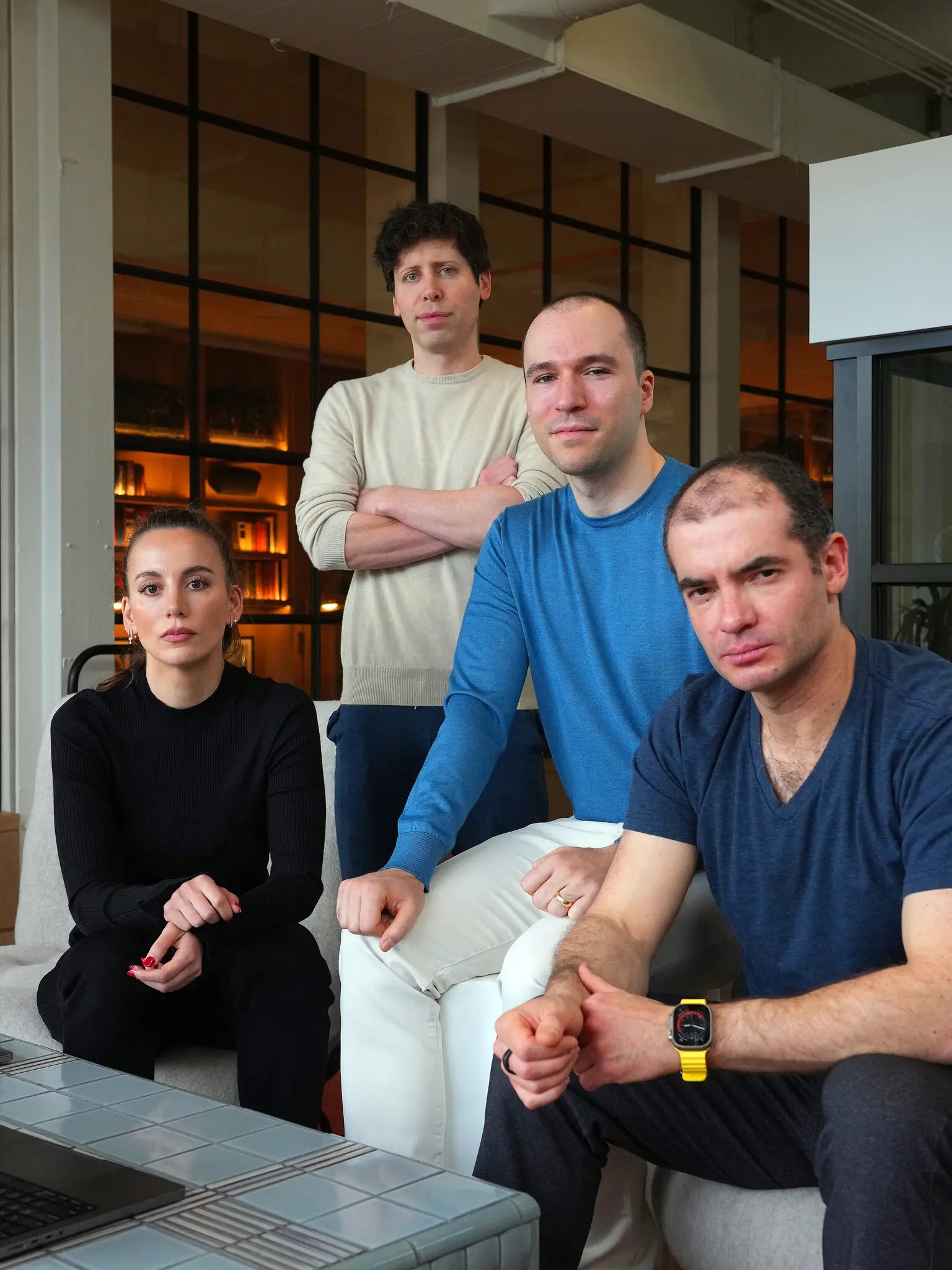 In the image above, on the left is CTO Mira Murati, currently serving as interim CEO, followed by Sam Altman and Greg Brockman; on the far right is OpenAI Chief Scientist Ilya Sutskever.
These personnel changes echo the revisions to OpenAI’s mission statement, forming a clear trend: OpenAI is shifting resources from long-term safety research toward short-term product development and commercialization. For a company claiming to be developing AGI that could alter the course of human civilization, such a shift in priorities is deeply troubling.
Legal Battlefield: Elon Musk’s Allegations
OpenAI’s transformation has also become a focal point of legal disputes. Elon Musk, an early co-founder of OpenAI, is suing the company, accusing it of violating its founding nonprofit commitment and prioritizing commercial interests over the public interest. Musk’s complaint particularly emphasizes that OpenAI’s close partnership with Microsoft has turned the company into a “closed-source subsidiary of Microsoft.”
馬斯克:我贊助了一個非盈利組織去保護森林,結果它去砍伐森林成為一家木材公司……
我頓時明白了 OpenAI 的鬧劇~ pic.twitter.com/njWbwf1iab
— LEI (@TheMarketMemo) September 27, 2024
Although Musk’s own motives were also widely questioned—and he later founded xAI himself—the core issue raised in his lawsuit is hard to ignore:When an organization raises funds and recruits talent in the name of “benefiting all humanity,” yet ultimately transforms into a profit-maximizing commercial entity, does that constitute deception toward its early participants?
From Nonprofit to “Profit Cap”
OpenAI’s organizational transformation has been a gradual process. Originally, it was a purely nonprofit research institution; in 2019, to raise enough funding to support large-scale AI training, the company created a “capped-profit” model: investor returns are capped at a certain multiple, and any excess flows to a nonprofit foundation for AI safety research. However, with the success of ChatGPT and the surge in its valuation, this “cap” has become increasingly unclear. In the latest funding round, OpenAI’s valuation has exceeded $500 billion, while the outside world knows very little about the specific implementation details of the profit cap. Moreover, OpenAI is considering further adjustments to its corporate structure, possibly eliminating the profit cap entirely and transforming into a traditional for-profit company. This would completely sever its last remaining ties to its nonprofit roots.
OpenAI’s shift is highly symbolic for the entire AI industry. As a leader in generative AI, its values and priorities often influence the strategic direction of other companies. When OpenAI removed “safety” from its mission statement and downsized its safety research team, it sent a dangerous message to the whole industry: in fierce commercial competition, safety can give way to speed and profit. Smaller competitors such as Anthropic continue to emphasize the importance of AI safety, but their voices are relatively faint amid the torrent of capital and market forces.
broader social implications
AI safety is not only a technical issue, but also a governance issue that bears on the future of human society. Once artificial general intelligence is realized, its influence will exceed the control of any single country or enterprise. Against this backdrop, whether developers treat “safety” as a non-negotiable core principle is tied to the interests of all humanity.
The revision of OpenAI’s mission statement reflects a deeper tension: in a capitalist system, how can we ensure that transformative technologies are not held hostage by the short-term interests of a few corporations? When development costs routinely run into the billions of dollars, is a purely nonprofit model really viable?
These questions have no easy answers, but OpenAI’s decision to drop its “safety” and “nonprofit” commitments is clearly not a step in the right direction.
viewpoint; perspective; point of view; opinion; view
OpenAI’s deletion of the two key phrases “safely” and “unconstrained by profit” is no casual editorial polish, but a clear signal of the company’s strategic pivot. From an organizational perspective, the dissolution of its safety team and executive shake-ups had already foreshadowed this day; from a commercial perspective, a valuation in the hundreds of billions and its deep partnership with Microsoft had long made the “nonprofit” posture untenable. Yet the crux of the issue lies in the unique nature of AGI. This is not an ordinary consumer technology product, but a transformative technology that could fundamentally alter the trajectory of human civilization. When developers no longer treat safety as a core goal on par with capability, and when commercial returns take precedence over human well-being, are we heading toward a future of uncontrollable risk?
OpenAI’s renaming: from “Open” to effectively “Closed,” from “nonprofit” to “profit maximization”—may be the inevitable result of the logic of capital. But this very outcome is precisely why AI governance cannot rely solely on corporate self-regulation. When technology’s influence transcends borders, and when developers are no longer constrained by the public interest, society needs stronger regulatory frameworks to fill this void.
Back when OpenAI was founded, Musk and others wanted to prevent AGI from being monopolized by a handful of tech giants like Google and Meta and exploited for profit. Ironically, it eventually became the very kind of entity it had originally set out to oppose—and it’s no wonder Musk is now suing Sam Altman for astronomical damages.
Source: KOCPC Chinese