


Google DeepMind was officially released on April 2, 2026. Gemma 4 The open-source model family has launched four models with different specifications in one go, comprehensively covering application scenarios from flagship workstations to smartphones. This release not only significantly surpasses the previous-generation Gemma 3 in technical specifications, but also marks a major strategic shift in Google’s open-source licensing: Gemma 4 now fully adopts the Apache 2.0 license, officially parting ways with its past custom usage terms.
Gemma 4 Unveils Four Models: A Comprehensive Lineup from Flagship to Edge
The Gemma 4 series launched four models: flagship-level. 31B Dense Designed for high-performance workstations, it supports context windows of up to 256K and fits entirely on a single 80GB NVIDIA H100 GPU in unquantized bfloat16 format;26B MoE(Mixture-of-Experts) uses a sparse activation architecture, activating only 380 million parameters during inference while delivering disproportionately high-speed inference efficiency.E4B(Effective 4B) Operates with a footprint equivalent to 4 billion parameters, emphasizing “near-zero latency” performance;E2B(Effective 2B) is purpose-built for smartphones and edge devices, supports a 128K context window, and can power smart home controllers or voice assistants fully offline on a Raspberry Pi 5.
| Model | Type | Total number of parameters | Parameters actually enabled | Context Window | target hardware |
|---|---|---|---|---|---|
| E2B | Effective 2B | 2B | 2B | 128K | Mobile phones, IoT, Raspberry Pi |
| E4B | Effective 4B | 4B | 4B | 128K | Mobile phones, Qualcomm/MediaTek chips |
| 26B | MoE | 26B | 3.8B | 256K | Consumer-grade GPUs, professional workstations |
| 31B | Dense | 31B | 31B | 256K | Single H100 (80GB) |
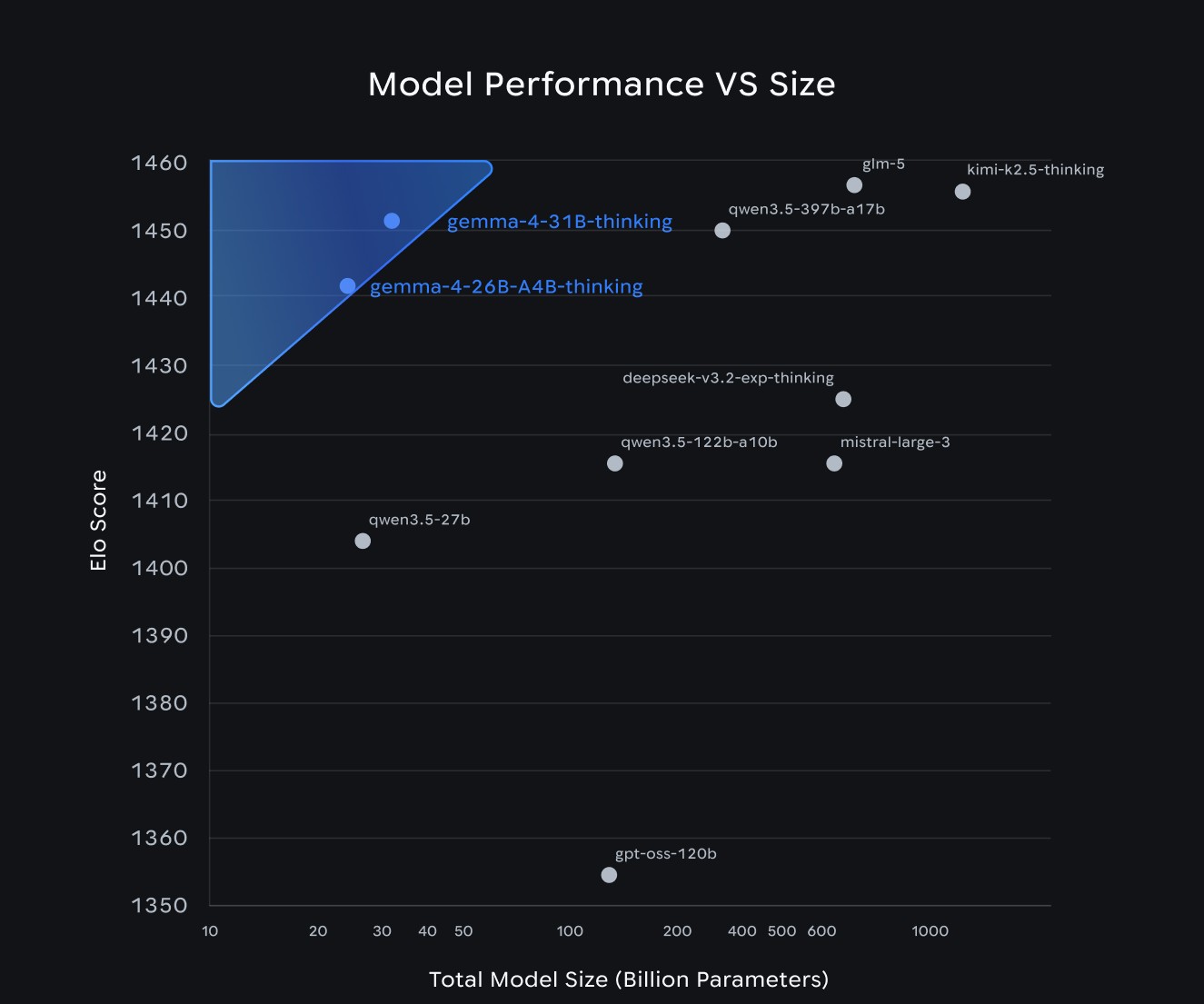
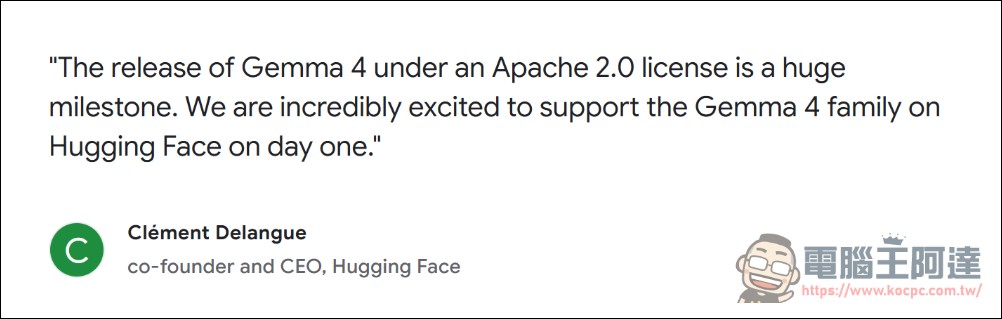
According to data released by Google, the 31B model currently ranks third in the open-licensed model category on the Arena AI text leaderboard, behind only GLM-5 and Kimi 2.5; the 26B MoE model took sixth place and beat competitors more than 20 times larger within their respective parameter tiers. After pre-release testing, the Hugging Face team stated bluntly: “They perform so well out of the box that we can hardly find good examples that need fine-tuning.”
Licensing Strategy Pivot: Dropping Custom Clauses, Fully Embracing Apache 2.0
Earlier generations of the Gemma models used Google’s custom “Gemma Terms of Use” rather than a standard open-source license. The terms allowed Google to unilaterally update prohibited uses, and were even interpreted as permitting Google to claim rights over other AI models trained on synthetic data generated by Gemma, leaving many developers cautious about commercial use.
Gemma 4’s Apache 2.0 license completely turned the tables. Users are free to use the model for any purpose—personal, commercial, or enterprise—without paying royalties; they can freely modify, redistribute, and even create derivative works, and Google cannot change the license terms unilaterally. Additionally, Apache 2.0 provides patent protection, automatically granting users patent licenses related to their contributions, eliminating concerns about patent infringement claims. This shift is widely seen in the industry as a crucial step for Google to broaden the appeal of the “Gemmaverse” ecosystem.
Native Agent Capabilities: From Chat to Autonomous Task Execution
Since 2025, the prevailing narrative in the AI industry has shifted from “single-turn Q&A” to “Agentic Workflow”: enabling AI to plan multi-step tasks, autonomously call tools, search databases, trigger external APIs, and continue reasoning in complex scenarios. Gemma 4 supports native function calling, structured JSON output, and native system instructions, so developers can build Agent applications that autonomously execute multi-step tasks without complex fine-tuning.
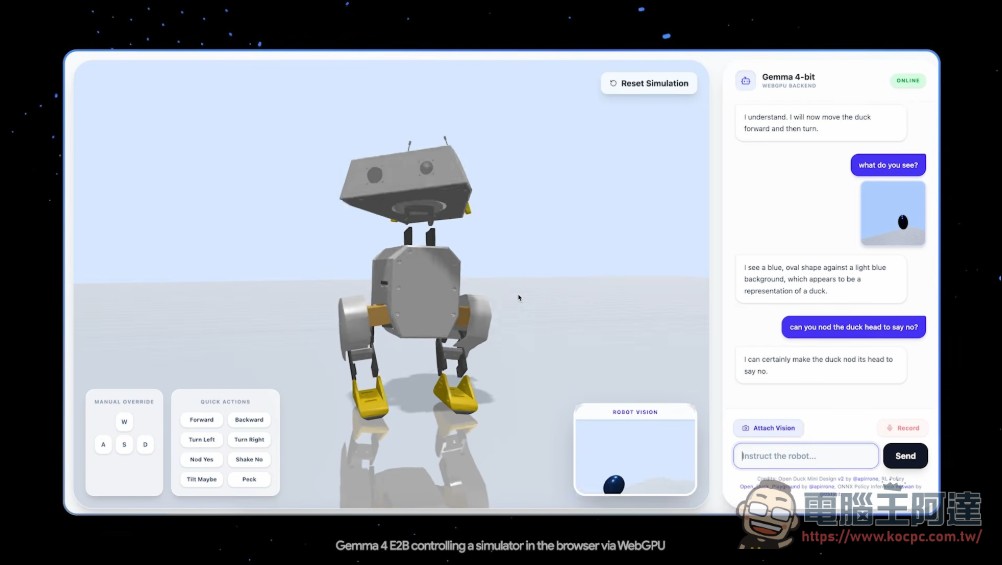
In Google AI Edge Gallery, the Gemma 4–based “Agent Skills” feature has already demonstrated several concrete scenarios: querying knowledge bases such as Wikipedia to extend the model’s real-time information capabilities, converting voice input into sleep and mood trend charts, and even combining text-to-speech, image generation, or music synthesis to create a complete offline end-to-end experience.
Multimodal, Edge Deployment, and Mobile Blueprint
In terms of multimodal capabilities, the entire Gemma 4 series natively supports image and video input, and can perform visual tasks such as OCR document recognition and chart understanding. The two edge models, E2B and E4B, are further equipped with native audio input, enabling direct speech recognition and understanding. Regarding context windows, the edge models offer 128K tokens, while the flagship models (31B and 26B MoE) are increased to 256K tokens, allowing entire codebases or long documents to be processed in one go without chunking. Gemma 4 natively supports over 140 languages, covering application needs in major global markets without additional training.

On the mobile front, the Gemini Nano 4 on Google’s next-generation Pixel phones will be built on Gemma 4 E2B and E4B, with 2B and 4B variants. Developers can now prototype Agent workflows early in the Android AI Core developer preview using Gemma E2B/E4B, enabling a seamless transition when Gemini Nano 4 officially launches.
Those who are interested can also watch the official introduction video:
Ecosystem Fully Launched: Hugging Face, Ollama, and Kaggle Now Supported Simultaneously
On the model deployment front, Google has fully embraced the open-source ecosystem. The flagship Gemma 4 models are available in Google AI Studio, while the edge models are available for download through the Google AI Edge Gallery. Model weights are simultaneously released on Hugging Face、Kaggle and/with Ollamaand provides native integration with mainstream inference frameworks such as Transformers, llama.cpp, MLX (Apple Silicon), WebGPU, and Rust.
Since the first-generation Gemma debuted in February 2024, the developer community has downloaded Gemma models more than 400 million times, spawning over 100,000 derivative variants and creating a thriving “Gemmaverse” ecosystem. Google says Gemma 4 was designed specifically to address developers’ most pressing needs: on their own hardware, at a reasonable cost, to have reasoning capabilities approaching those of closed flagship models and the flexibility to build Agents.
Source: KOCPC Chinese