


every time iOS After the update is launched, in addition to new features and system corrections, most iPhone One thing that users care about most is often not new features, but “will the update consume more power?” Apple Although the recently released iOS 26.3.1 is not a large-scale revision, it still makes adjustments to system stability, device support and some details. In particular, it further enhances the iPhone’s ability to connect to external displays and works with the newly launched Studio Display and Studio Display XDR displays.
However, for most people, whether there is a change in battery life after the update is a more important issue than the function of the external monitor. Earlier, YouTube channel iAppleBytes also soon launched a battery update for iOS 26.3.1Battery lifeTest, and test multiple iPhones of different generations at once, and compare the power consumption after the update through a unified test method.
Exactly how the battery life performs after the iOS 26.3.1 update, and what the differences will be between different generations of iPhones under the same test environment, have also become the focus of many users.
▲Picture source:iAppleBytes
Will navigation become better or worse after the iOS 26.3.1 update? Actual battery test results of 6 iPhone models exposed
The iOS 26.3.1 version update released by Apple a few days ago is not a major update focusing on new features, but Apple is still adding a number of optimizations and corrections to this version. The official update description mentioned that this time it is mainly adjusted for system stability, and some bugs with undisclosed details have also been fixed.
One of the more noteworthy changes is to further improve the iPhone’s ability to connect to external monitors. As Apple launches a new generation of Studio Display and Studio Display XDR, the compatibility and display stability of iPhone and external display devices have also continued to be optimized. For those who need to use iPhone as a mobile work device or a simple desktop environment, this update is somewhat helpful.
However, for most ordinary users, this kind of underlying optimization is not easy to directly feel. What really impresses everyone is the smoothness of the updated system and battery life.
▲Picture source:iAppleBytes
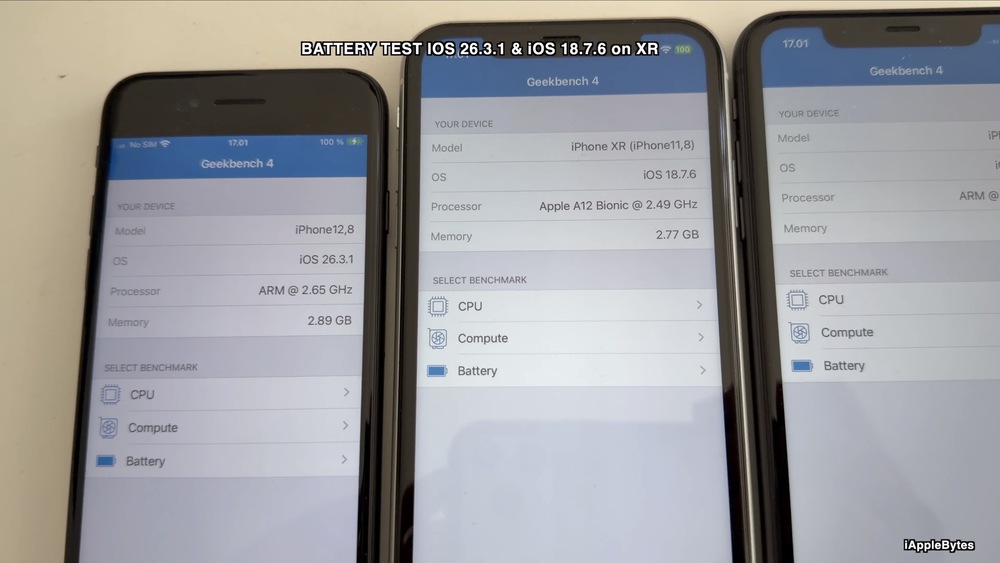
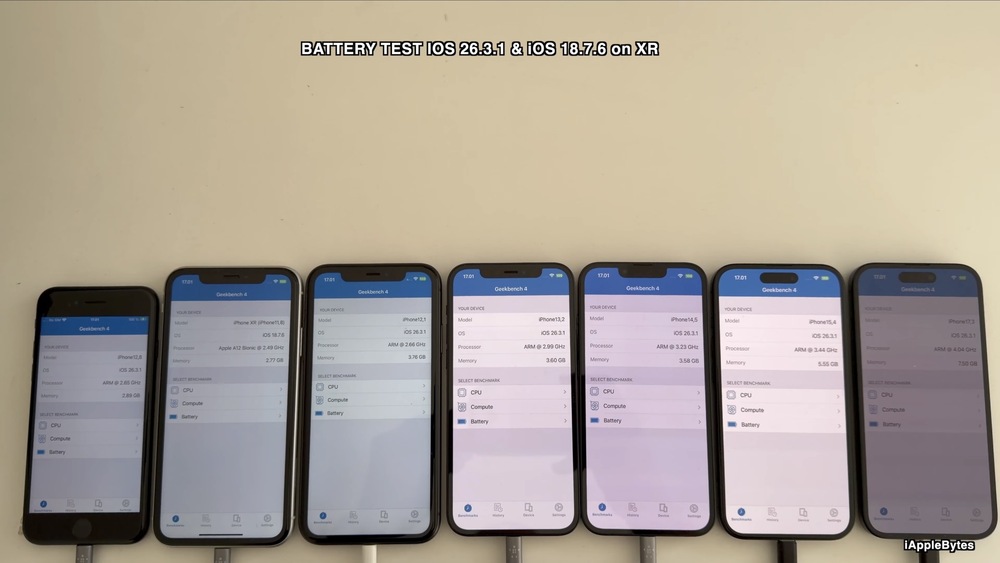
In order to more objectively compare the battery life of different iPhones on iOS 26.3.1, YouTube channel iAppleBytes still uses Geekbench 4’s battery stress test tool this time.
This test method will cause the phone to continue to perform high-load operations, such as executing algorithms for a long time, maintaining screen brightness, and continuously performing computing tasks until the battery is exhausted. After the test is completed, two data will be obtained, one is the full battery life, and the other is the Geekbench battery score.
Although this test situation is still different from ordinary daily use, such as swiping Instagram, watching YouTube or playing games, its advantage is that it allows all devices to be compared under the exact same environment and conditions, so it is very suitable for observing the difference in battery life between different models.
▲Picture source:iAppleBytes
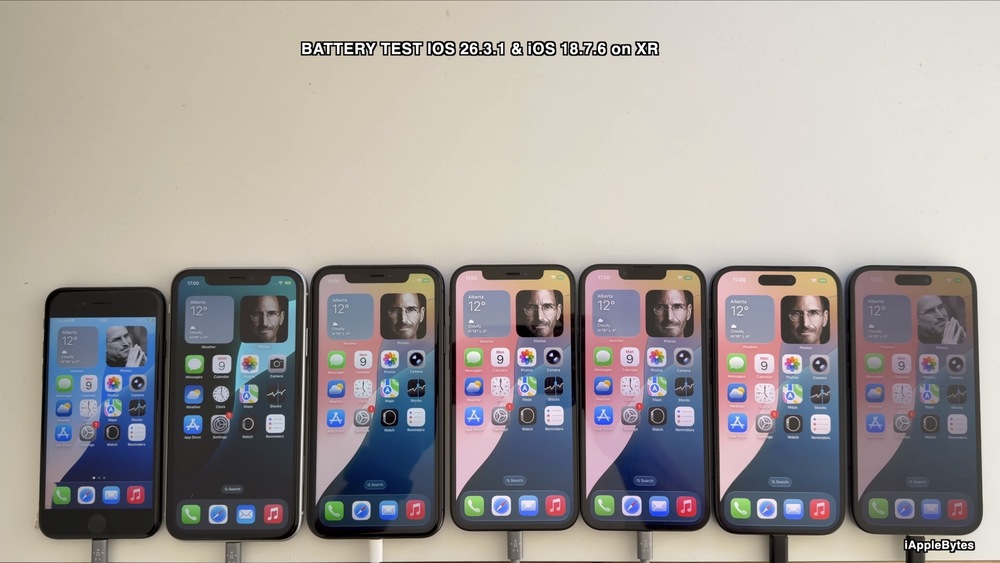
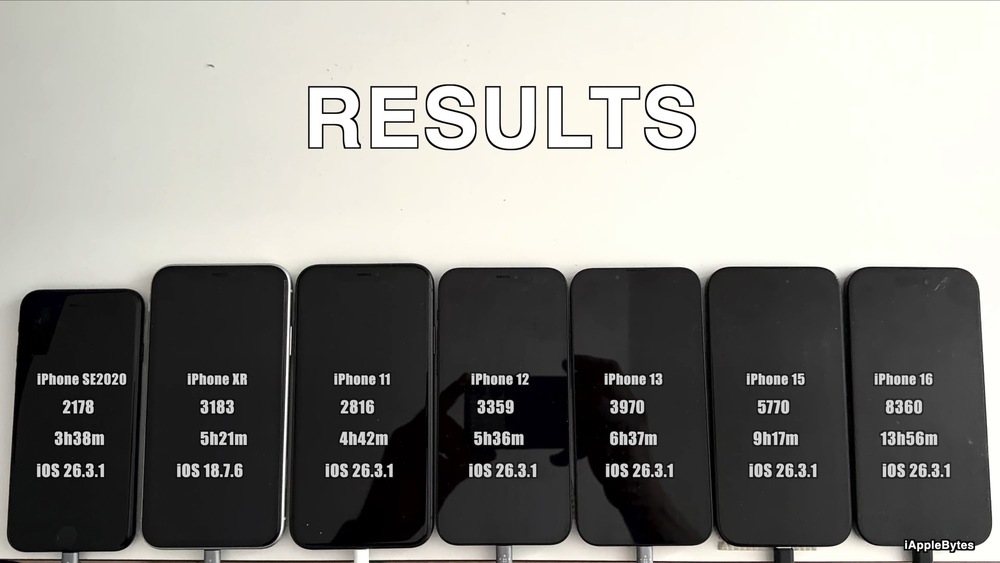
In this test, iAppleBytes tested a total of 6 iPhones of different generations, from the earlier iPhone SE to the latest iPhone 16. All devices were updated to iOS 26.3.1 before testing. Geekbench battery life results are as follows:
- iPhone SE (2nd generation): 3 hours, 38 minutes
- iPhone 11: 4 hours 42 minutes
- iPhone 12: 5 hours 36 minutes
- iPhone 13: 6 hours 37 minutes
- iPhone 15: 9 hours 17 minutes
- iPhone 16: 13 hours 56 minutes
In addition, because the older iPhone XR cannot be upgraded to the iOS 26 series, it was tested with the iOS 18.7.6 version and the battery life was 5 hours and 21 minutes.
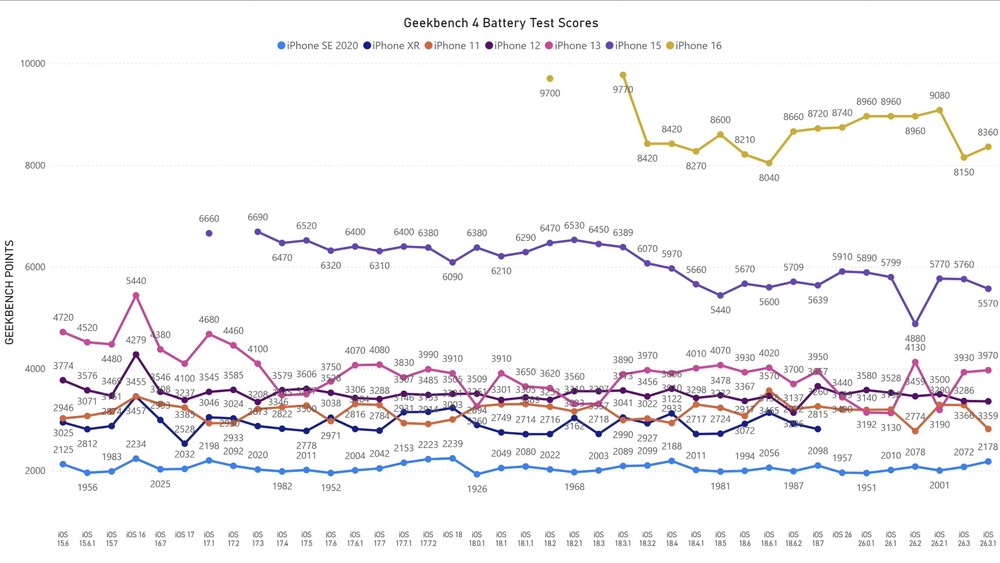
It can be seen from the test results that as the model generations advance, the battery life of the new iPhone has actually improved significantly. Especially the iPhone 15 and iPhone 16 in recent years have shown longer battery life in the Geekbench high load test.
▲Picture source:iAppleBytes
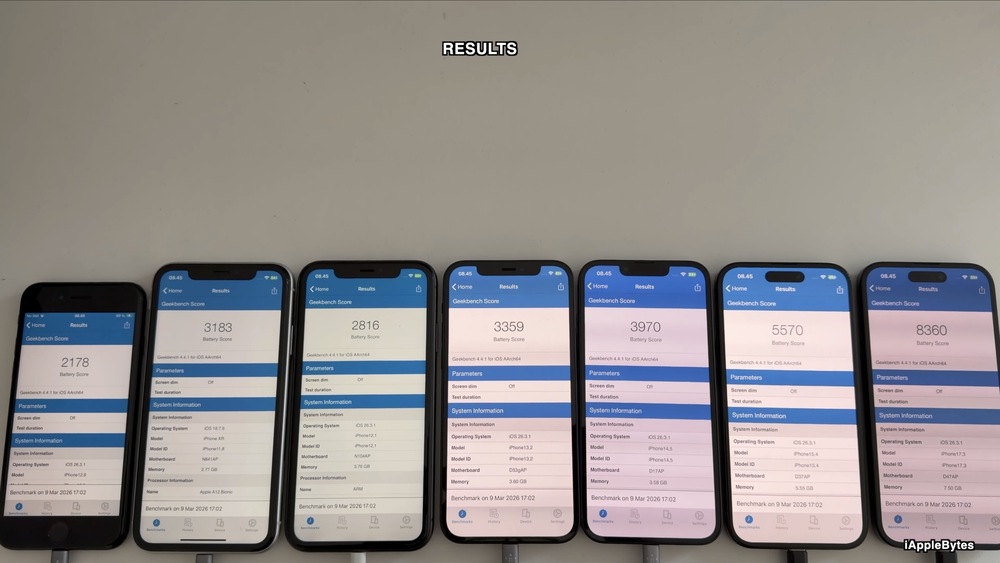
In addition to battery life, Geekbench will also provide battery performance scores, making it easier to compare different devices. The battery scores of each model are as follows:
- iPhone SE (2nd generation): 2078 points
- iPhone 11: 2816 points
- iPhone 12: 3359 points
- iPhone 13: 3970 points
- iPhone 15: 5770 points
- iPhone 16: 8360 points
Similarly, the iPhone XR’s battery score measured under iOS 18.7.6 was 3183 points. From these data, it can be seen that the new generation iPhone has made considerable progress in processor efficiency and battery management technology. In addition to the improvement of battery capacity itself, chip energy efficiency and system tuning also play an important role in battery life performance.
▲Picture source:iAppleBytes
Conclusion
Overall, although iOS 26.3.1 is not a version that features major feature updates, through this test we can still observe the differences in battery life between different generations of iPhones. As chip efficiency continues to improve and system power management technology continues to be optimized, the new iPhone’s battery life performance under high load conditions is indeed getting better and better.
Of course, the Geekbench stress test isn’t exactly equivalent to everyday use scenarios. In real life, most people scroll through social media, watch videos, chat or take photos, so battery life is usually longer than in stress tests. However, through unified environmental testing, a comparison benchmark with reference value can still be provided.
▲Picture source:iAppleBytes
If you are considering whether to update to iOS 26.3.1, this kind of test data can provide some reference. As for the actual experience, it will still be affected by various factors such as battery health, usage habits, and App background activities. For most users, as long as the system stability and battery life do not drop significantly, it usually means that this update is a relatively safe upgrade.
Further reading:
Source: KOCPC Chinese