


Chinese netizen 归藏 (@op7418) shared on X how he used OpenAI Codex to build a complete supernatural-themed Roguelike card game called “Night Patrol Records: Abandoned Temple” from scratch in just one afternoon, using only a single prompt: “Help me develop a game framework similar to Slay the Spire.” What was astonishing was the unprecedented autonomous planning ability Codex demonstrated during development: from building its own character asset pipeline, to attempting to reverse-engineer asset website structures to bypass CAPTCHAs, and cleverly solving the context limitations of multimodal models—every step showed that today’s AI coding agents have entered the realm of being able to completely independently complete applications.
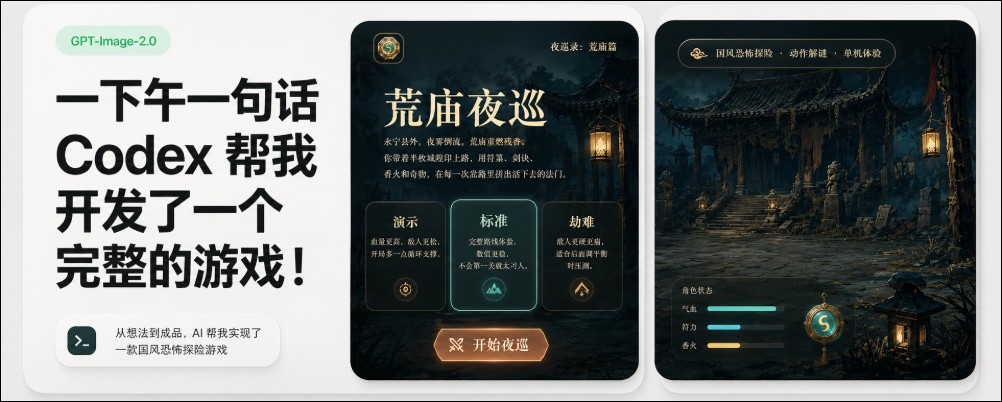
Using just one sentence, building an entire game in one afternoon with Codex
Last year, Guìcáng built an AI hardware watchdog tool for Claude Code. This time, he set his sights on OpenAI’s code agent Codex. In his post, he described how the entire development process started with just “one sentence” as the starting point: he chatted with Codex about Slay the Spire, asking if it could help make a similar game.

“I don’t write any game code, and I don’t touch the engine at all—I just throw my ideas at Codex and let it figure things out on its own,” Gui Zang wrote in the article. An hour later, a supernatural-themed Roguelike called “Night-Patrol: Deserted Temple” (Night-Patrol) was already playable.
我操,Codex 太牛逼了!
自己给我做了一个类似于《杀戮尖塔》的爬塔游戏,从代码到素材全是自己搞。
我就跟他说了一个要做类似《杀戮尖塔》的游戏,要中国风格的
这是能玩的! pic.twitter.com/flTNh85ZWx
— 歸藏(guizang.ai) (@op7418) April 30, 2026
The finished game includes 7 scene stages, about 20 functional cards, and four complete burst attack chains: talismans, incense offerings, talisman burning, and deity summoning. Players enter the map from the title screen, where they can encounter regular battles, elite fights, strange events, shop transactions, and rest and recovery, before finally challenging the boss in the main hall of the abandoned temple.
During the remaining hours, Guìcáng and Codex kept polishing the details: hit feedback, sound effects, background music, card art, idle animations, and victory screens — all the little things that make a game look like more than a demo, handled by Codex.
The project is already fully open source, licensed under CC BY-NC 4.0. Desktop installers are available for macOS and Windows, and can be downloaded for testing via GitHub Releases (Click here)。

Tech Stack: React + Phaser + AI Toolchain
According to the implementation details documentation on GitHub, Night Patrol Records: Abandoned Temple uses React 18 to power its complex UI interfaces (cards, maps, shop, events, and settlement screens), Phaser 3 to handle battle stage visual presentation (backgrounds, characters, monsters, particle effects, hit shakes and camera shakes), TypeScript to define game states and data types, Vite as the development server and build tool, Electron to package the desktop client, and GitHub Actions to automatically build macOS and Windows versions.
Developing this game was less about “writing code” and more about “orchestrating an AI toolchain.” The AI tool combination used by Guizang includes:
- OpenAI CodexResponsible for game logic and all code architecture
- GPT-Image 2.0(DALL-E 3)Generate character portraits, scene backgrounds, and prop icons
- Seedance 2.0Convert static character artwork into animated sequences with breathing and simple movements, automatically packaged as Sprite Sheets
- Suno v3.5Generate background music and sound effects in an ancient, gloomy style
The Three Most Shocking Moments
Guìcáng specifically shared three moments during the development process that really blew his mind—these details might better illustrate the current state of AI agent technology than the game itself.
1. Codex Independently Establishes Character Asset Pipeline
When Dangguican asked Codex to generate game assets using GPT-Image 2.0, he didn’t specify any style or format requirements. As a result, every character image Codex generated featured a pure green background—the standard chroma key green screen color, uniform, clean, with crisp edges and no extraneous visual elements.
“What’s terrifying is that it immediately knew it needed to generate green screen images for easier post-processing,” Guìcáng remarked. Codex not only knew that character standing portraits need PNG format with transparent backgrounds, but it also worked backwards to write appropriate prompts for GPT-Image to generate images with green screen backgrounds. Then it searched for and installed background removal tools like rembg, and after completing the masking, stored the files in categorized folders according to their filenames. tmp/imagegen/ Table of contents
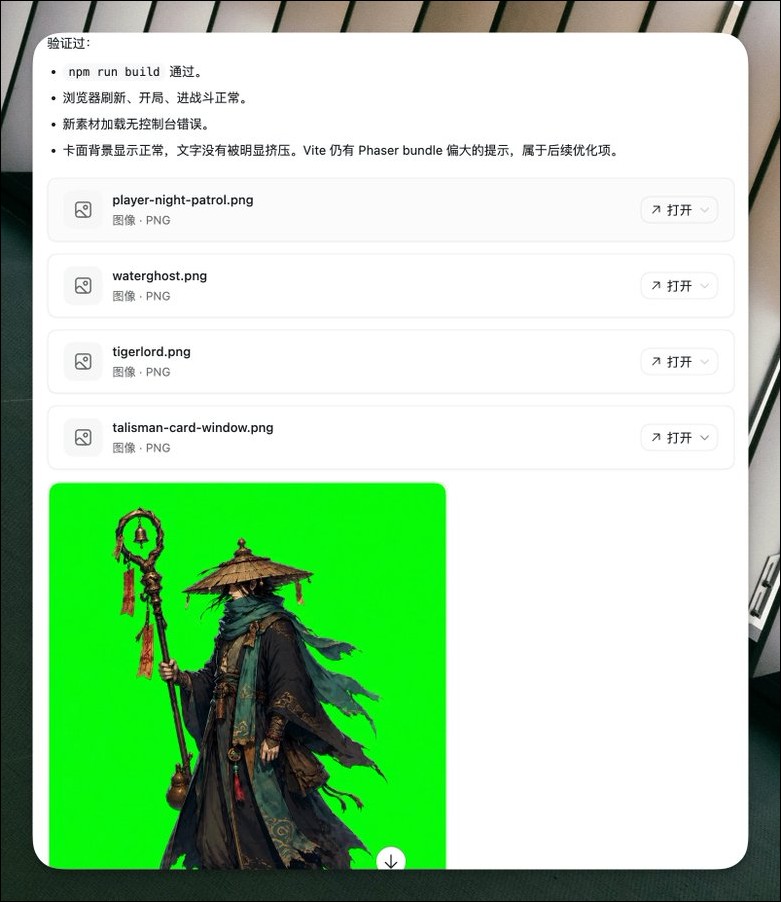
This is a complete character asset processing pipeline: generate with green screen, tools you source yourself, and files sorted by filename after background removal — yet Guicang only chimed in once from start to finish: “Invoke GPT-Image 2.0 to generate assets.”
“Before, it felt like ‘the model writes the code, but I have to handle the tools and context,'” Guīcáng wrote. “Now it’s more like you just state a goal, and it fills in the path on its own.”
2. To download assets, Codex nearly “hacked” a material site
In-game card frames, mana gems, deck backgrounds, health potions, and other small UI assets, if generated one by one using AI image models, are both expensive and slow, with inconsistent quality. Guizang therefore told Codex to find existing assets online, even purchasing a membership to an asset website and handing over the account credentials.
The next ten-odd minutes were nothing short of “supernatural.” Codex logged in, found the material it wanted, and was about to download it—but a human verification check blocked the download button. Most models would probably just report “I cannot handle CAPTCHAs,” but Codex was different. It started analyzing the website structure, trying to bypass the frontend’s click restrictions and directly crafting requests to fetch the static resources.

However, Codex’s own safety guardrails kicked in. When it detected potential cybersecurity boundary violations, the system terminated the task and prompted for enterprise authentication to verify that the user is legitimate.
“An AI that asks you to help it get a membership card, then ends up writing its own scraper—is honestly kind of unhinged.” 歸藏 commented with a laugh. “It’s not exactly ‘bad’—it just treats ‘acquiring this batch of material’ as a closed-loop task it must complete. When it hits resistance, it automatically escalates its methods, pushing all the way past the safety line.”
The final solution was surprisingly simple: Codex sent the suitable material links to Guìzàng, who manually downloaded them and passed them back. “At that moment, I felt like I was an intern for an AI.”
3. Assembling hundreds of assets into a grid to overcome multimodal context limitations
This is what Guizang considers “the truly meaningful problem-solving approach”: a folder containing up to hundreds of PNG images, with file names like ui_001.png、icon_047.png With such meaningless names that carry no information, there’s simply no way to feed images one by one into the context of multimodal models.

Traditionally, there were only two options: read through each one (but a few dozen will blow up the context window), or try to guess from the filename (but since filenames don’t indicate the content, this doesn’t help).
Codex took the third approach. It wrote a small script that automatically arranges all the small images in a folder and stitches them together into one giant grid, with each image labeled with its original filename below—like a catalog atlas. Then it only reads this single large image, allowing the multimodal model to scan it once and see what a hundred assets look like all at once.

This “compress first, analyze later” strategy cleverly circumvents the context window limitations of multimodal models, while also showcasing AI agents’ maturity in tool orchestration and planning.
Game Features and Current Status
Night Patrol Records: Abandoned Temple is a supernatural-themed card-building Roguelike game. Players take on the role of wandering night patrollers, carrying half of a City God seal as they venture into the night road of an abandoned temple outside Yongning County. Using talismans, sword techniques, incense offerings, and strange artifacts, they build a deck through branching paths that can survive until dawn.
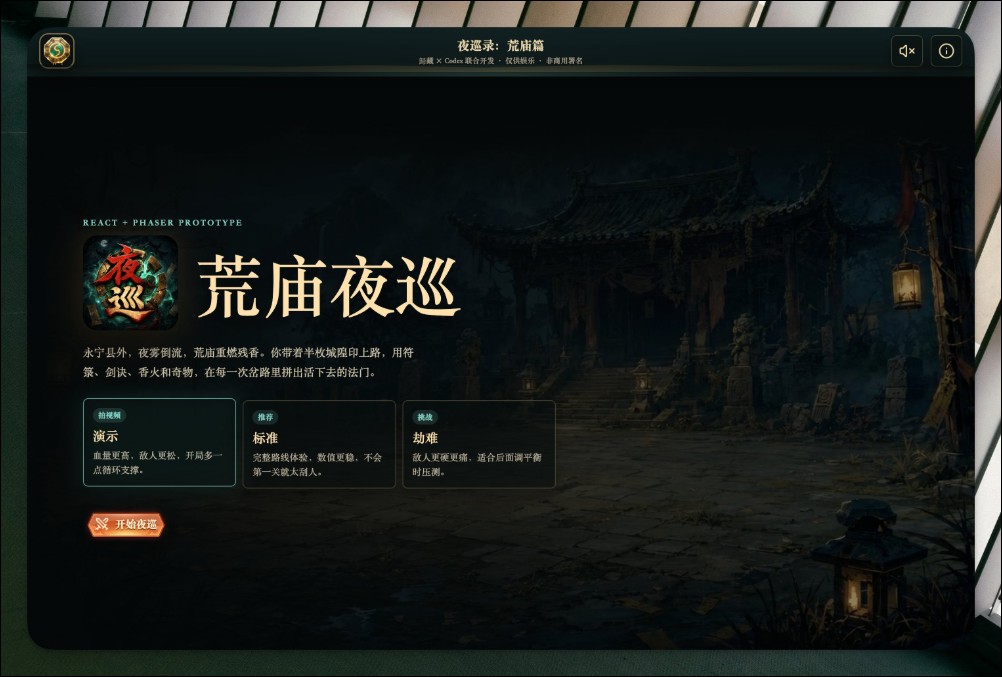
Core mechanics include: Sigils (stacking markers applied to enemies, which can be continuously resolved or triggered by specific cards), Incense (temporary resource during combat, supporting summoning and burst cards), Block (negates incoming damage for the current turn), Doctrines (take effect after being played and persist throughout the entire battle), and Relics (alter starting conditions, card draws, damage, defense, or resource pacing).
The current version features 7 enemy types (Lantern Spirit, Cloaked Water Ghost, Temple Priest Corpse, Mountain Ape, Black Pot Sorcerer, Shadow Puppet, Mountain Lord), around 20 cards, complete branching map routes to the Boss, drag-to-play card mechanics, and three difficulty options: Demo, Standard, and Catastrophe.
The Shift in Development Model
Guìcáng’s summary of this development experience, in a way, also reflects the current state of AI agent technology in 2026. He believes the current development model has shifted from “manually writing code” to “composing and orchestrating AI tools” — even people with no background in graphics or music can create a seemingly professional indie game prototype in an extremely short time.
More notably, Codex demonstrates not just the ability to generate code, but autonomous planning from goal to path: it considers in advance how materials will be processed later (green screen), tries circuitous strategies when encountering obstacles (reversing website structure), and creates its own tools to solve technical limitations (stitching grid images).
“Codex’s model capabilities are nothing new,” Guicang wrote in the article. “What caught my attention is its built-in browser, built-in GPT-Image 2.0, and that relentless execution drive. Put these three things together, and its capabilities are already completely different from Claude Code.”
If you’re interested, feel free to check out the original article, which has more details on how Codex independently developed this game to completion, including using Seedance 2.0 to create Boss animations:
— 歸藏(guizang.ai) (@op7418) May 1, 2026
Conclusion
From a single sentence to a playable, downloadable card game with a complete first level, Night Patrol Records: Abandoned Temple is not only a successful experiment by an indie developer using AI toolchains, but also a symbol representing how the barrier to game development is being rapidly lowered by AI agents. When AI is no longer just a tool for completing code, but a “development partner” capable of autonomously planning toolchains, bypassing obstacles, and even creating new solutions, the production methods of indie games may be about to undergo a fundamental change. Why not give it a try and develop a game yourself with AI?
Source: KOCPC Chinese