


Recently, the NCC released its first-ever figures on the number of 5G base stations in Taiwan (as of December 2025), which surpassed the number of 4G base stations for the first time. Given that the number of 4G base stations plummeted by 17.5% within a single month, some observers have questioned whether telecom operators are indirectly forcing users to upgrade to 5G. As both the NCC, which is currently responsible for government regulation, and the Fair Trade Commission face leadership vacuums or even the prospect of being dissolved, the Consumer Foundation recently held a telecommunications consumer forum. The topic of “the rise and fall of 4G and 5G users, market segmentation, and consumer rights” became the focal point of discussions between the Consumer Foundation and telecommunications operators. The Telecommunications Association and telecom operators have unanimously denied external criticism that the sharp reduction in 4G base stations is a tactic to force users to upgrade to 5G.
What are telecom operators claiming in their defense regarding the “sharp decline in 4G base stations driving the push for 5G”? Are their arguments valid? The following is a summary and analysis:
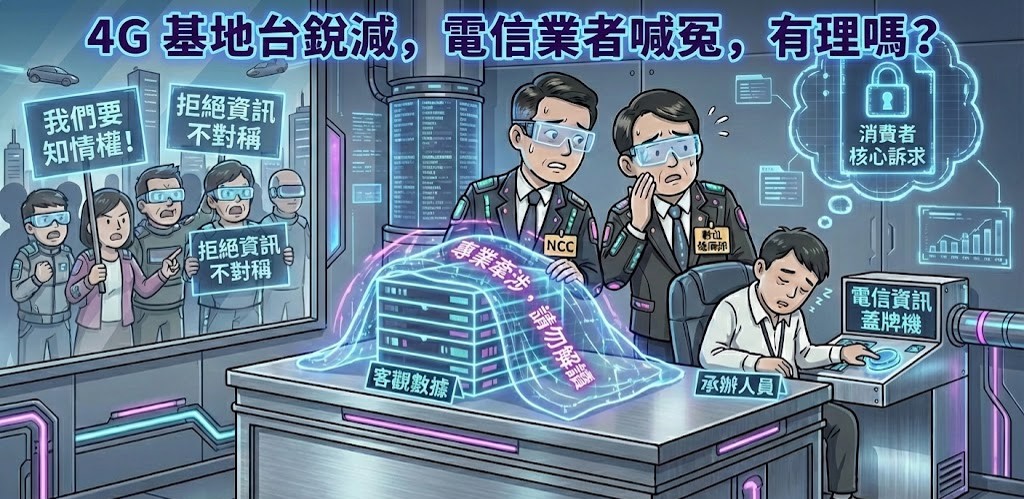
It has been five and a half years since 5G was launched in Taiwan in 2020, and the NCC has finally disclosed the number of 5G base station licenses in Taiwan, However, the sharp decline in the number of 4G base station licenses has caused an uproar, with many believing that telecom operators intentionally reduced 4G base stations to force an increase in 5G adoption. The telecom operators have denied these allegations to the Consumer Foundation, but many doubts remain unresolved, raising concerns that the operators or the NCC may be withholding information, which could adversely affect users.“The Right to Know.” The 4G Showdown: What Are Telecom Providers Hiding? Here is a summary video and detailed explanation:
1. “Sharp Decline in 4G Base Stations Drives 5G Adoption”: Telecom Operators’ Counterarguments:
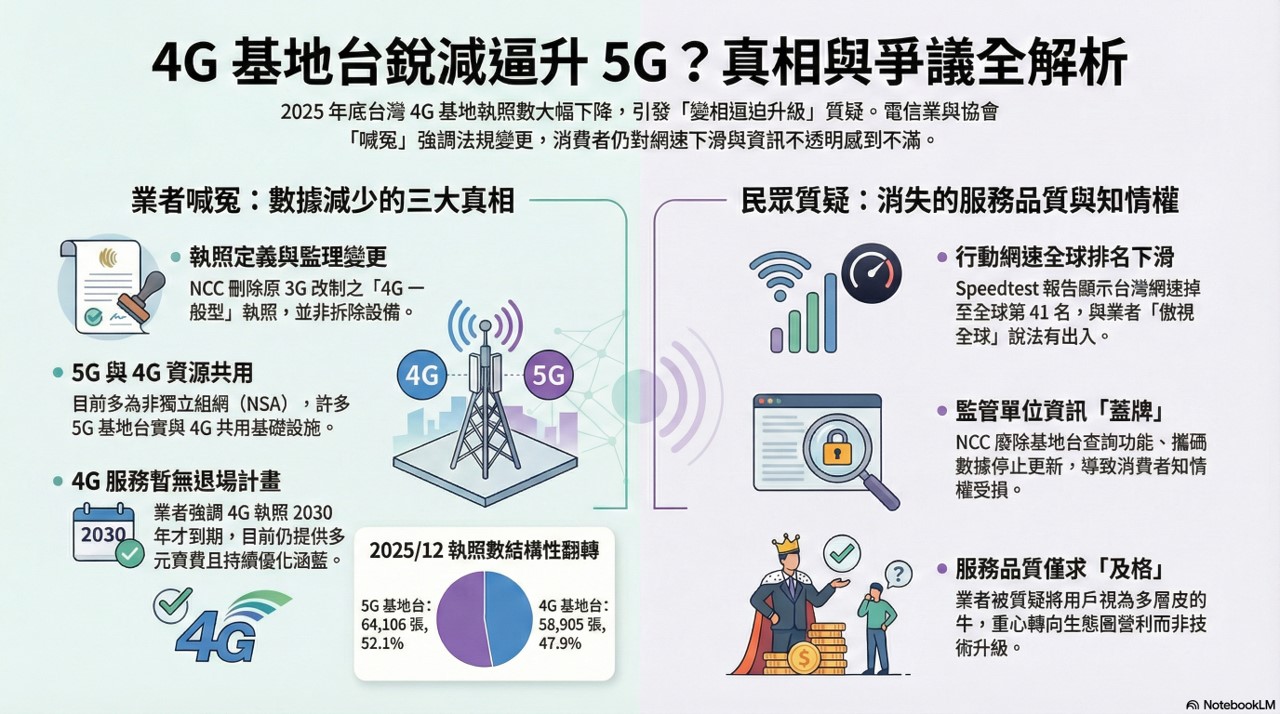
According to the latest announcement from the NCC, as of December 31, 2025, the number of 5G base station licenses in Taiwan stood at 64,106 (52.1% of the total), while the number of 4G base station licenses was 58,905 (47.9% of the total), marking the first time that the number of 5G base station licenses has surpassed that of 4G base station licenses.Because the NCC will revoke licenses for “4G standard base stations” (formerly 3G base stations) in December 2025, and because Far EasTone Telecommunications is shutting down Asia Pacific Telecom’s base stations, the number of 4G base station licenses has plummeted by 17.5% in just one month, causing a major uproar.
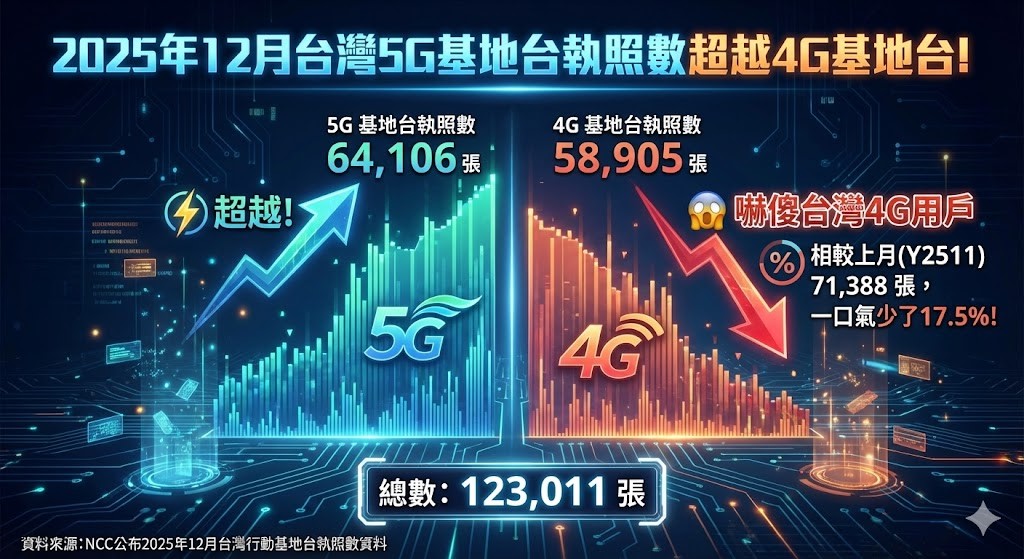
Regarding the question, “Will the sharp decline in 4G base stations drive the growth of 5G?”, telecom operators have made the following statements:
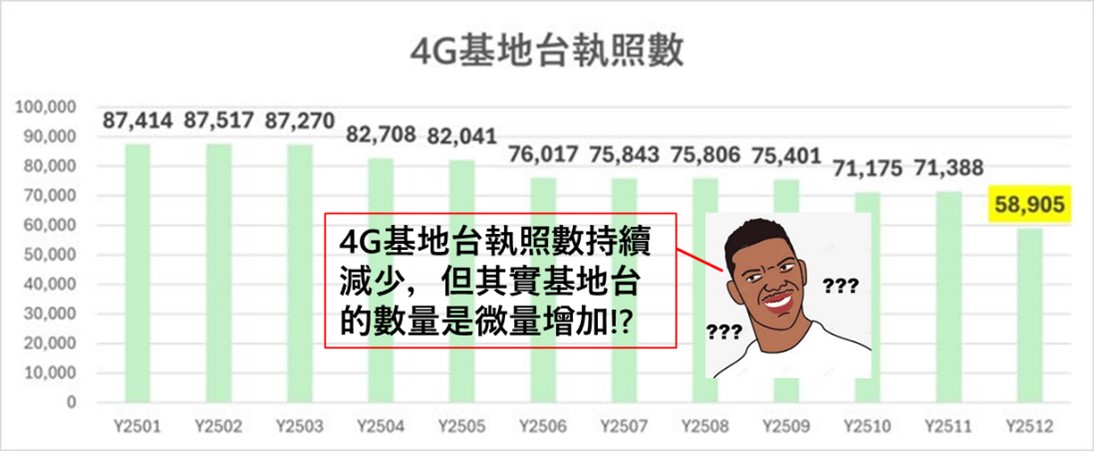
A. Taiwan Telecommunications Industry Development Association: 4GThe number of base stations has not decreased; in fact, it has increased slightly.…The decrease on the books is due to changes in business oversight.。
Liu Liqiu, Deputy Secretary-General of the Taiwan Telecommunications Industry Development Association, stated: “Actually, telecom operators are being treated unfairly, because the number of 4G base stations hasn’t decreased—it has even increased slightly. The apparent decrease in numbers is due to the fact that in the past, both 3G and 4G base stations were classified as 4G base stations. As 3G licenses have expired, the 3G network was shut down in 2024. The decrease in numbers stems from the shutdown of 3G base stations. Additionally, due to the nature of 5G Non-Standalone (NSA) networks, many 5G base stations are currently shared between 4G and 5G. The reported decrease in 4G base stations is a result of changes in regulatory reporting and will not affect 4G network usage.”
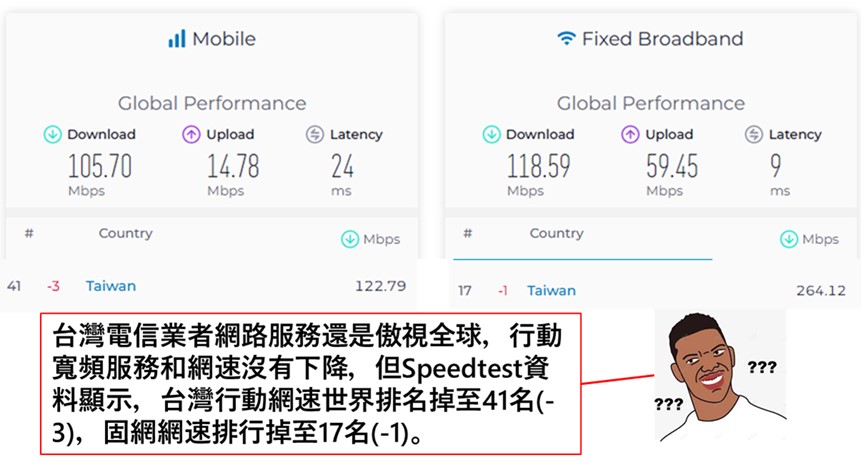
The Consumer Foundation is concerned about whether 4G users are “holdouts.” In fact, since there are more 4G users than 5G users in Taiwan, it doesn’t make sense for a large proportion of users to be “holdouts.” The majority of customers are on 4G, and Taiwan’s telecom operators’ network services remain among the best in the world; mobile broadband services and internet speeds have not declined.
B. Chunghwa Telecom: We do not force customers to upgrade
The number of 4G subscribers peaked around the 108th year of the Republic of China and has been declining ever since. Instead of forcing customers to upgrade, Chunghwa Telecom has encouraged them to voluntarily try 5G by offering a variety of rate plans—such as senior and student plans—and value-added services like high-definition video and cloud storage.
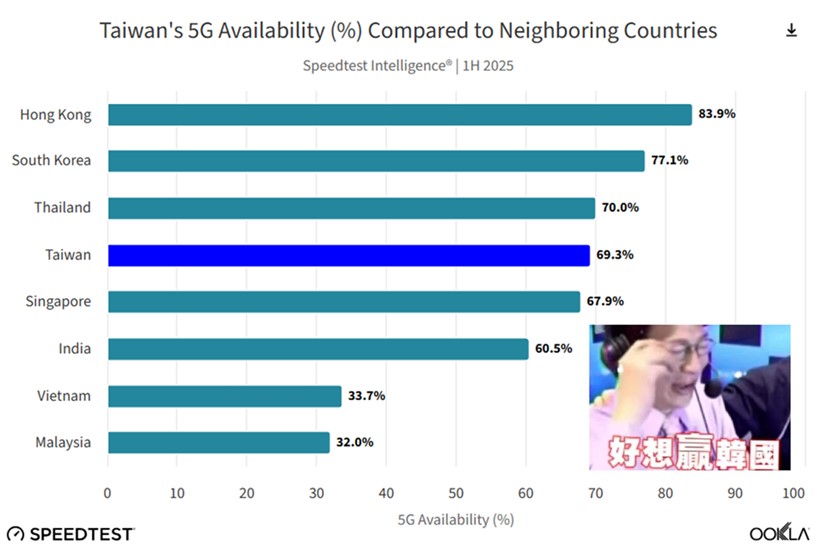
C. Taiwan Mobile: Taiwan’s 5G penetration rate is higher than that of Singapore and Thailand
Taiwan Mobile focuses on user needs, distinguishing between the needs of 4G and 5G users and designing corresponding plans. Taiwan Mobile is actively introducing international OTT services and cloud gaming to enhance the value of 5G, without forcing users to upgrade; compared to major Asian countries, Taiwan’s 5G development aligns with international trends, and its 5G penetration rate exceeds that of Singapore and Thailand.
D. Far EasTone Telecommunications: There are no plans to phase out 4G, and 4G rate plans have not been discontinued.
Far EasTone Telecom has clarified three major market misconceptions. First, Far EasTone has no plans to phase out 4G; both 4G and 5G users are equally important. When the 4G license expires in 2030, the company still hopes to bid for the spectrum again to continue serving 4G users and maximize the return on its 4G investment; Second, 4G rate plans have not been discontinued and are available through a variety of sales channels; third, Far EasTone offers a full range of 4G and 5G rate plans—from low-cost to high-end—allowing consumers to choose freely.
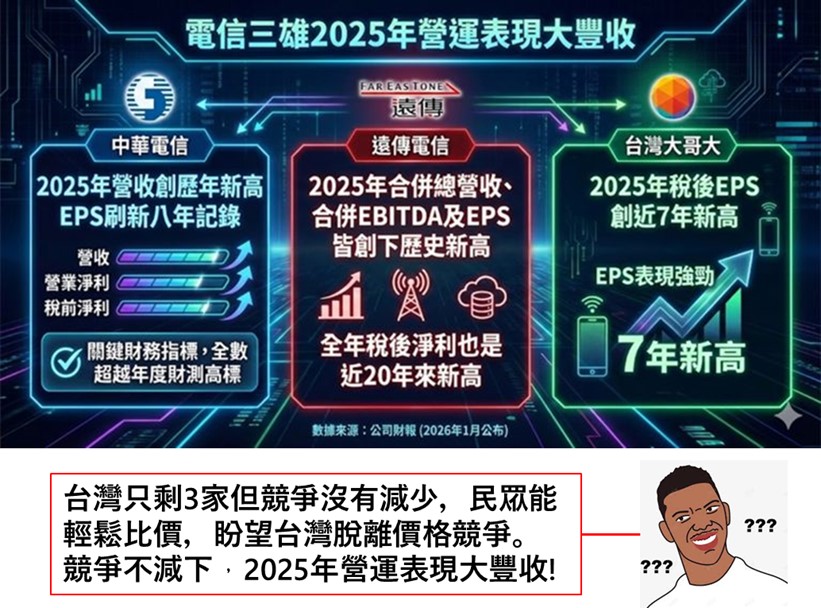
In addition, there are industry concerns that having only three domestic telecom operators left could affect pricing and consumers’ right to information. Telecom operators responded by pointing out that while the Taiwanese market is small and only three operators remain, competition has not diminished. With domestic telecom retail outlets and online channels readily available, the public can easily compare prices, and the industry hopes Taiwan will move beyond price competition and transition to value-based competition.
2. Are the telecom operators’ claims of innocence valid?
According to Opensignal’s latest report, [ Report on Mobile Network Quality in the Second Half of 2025 】Although the number of 4G base station licenses has decreased significantly due to telecom mergers, Taiwan’s overall mobile network speed and coverage have improved thanks to the increase in 5G base stations and Far EasTone’s acquisition of Asia Pacific Telecom’s 700 MHz frequency band. Network availability has even reached a high level of 99.x. Judging purely by the performance of mobile network service quality, Taiwanese telecom operators have not cut corners at the expense of service quality; rather, there are slight differences in the optimization priorities of each operator (Chunghwa prioritizes speed, Taiwan Mobile prioritizes multimedia experience, and Far EasTone prioritizes coverage).
However, with regard to telecommunications carriers andTelecommunicationsNetizens and forum moderators remain skeptical of the Industry Development Association’s statement: “4G“The number of cell towers hasn’t decreased—it’s actually increased slightly—so why is the number of 4G cell tower licenses clearly and continuously declining?” “The association claims that Taiwan’s internet services still lead the world, but Speedtest’s latest report shows that Taiwan’s mobile internet speed has dropped to 41st place, down three spots?” “Telecom operators claim they are not forcing users to upgrade to 5G, nor are they discontinuing 4G plans, and that Taiwan’s telecom market remains highly competitive—but why are their financial reports showing record-high operating metrics?”
The root cause of these doubts and accusations lies in service providers neglecting their core responsibilities and settling for online services that are merely “usable” or “adequate,” as well as the collusion between government and business, which leaves consumers with insufficient information regarding their “right to know”!
A. Not focusing on one’s main responsibilities,Mobile network service quality is only expected to be “available and usable”!
Taiwan’s telecommunications sector has been privatized. In their pursuit of operational performance, telecommunications operators set their standards for mobile network service quality at a level where, if the government agencies responsible for oversight fail to fulfill their duties in regulating this licensed industry, operators are easily tempted to “aim only for a passing grade (usable/adequate) while maximizing profits.” In recent years, the NCC and the Ministry of Digital Development have focused not only on incentivizing telecom operators to expand base station infrastructure in rural areas but also on vigorously implementing KYC (Know Your Customer) regulations and promoting anti-fraud measures in the telecom sector. However, many requirements for advanced 5G network services (such as standalone 5G networks and low-Earth orbit satellite services) have largely been shelved, left to the operators’ discretion.
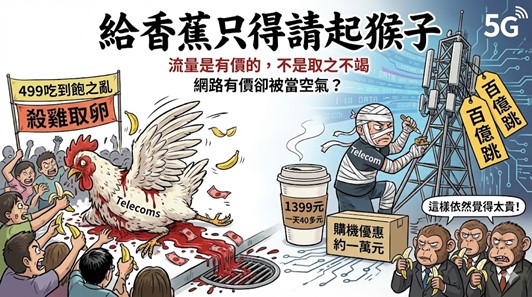
On the contrary,Senior executives at telecom companies seem to be suffering from post-traumatic stress disorder (PTSD) following the “499 incident.” They have lost faith in the growth of the core telecom business and view the nearly 10 million telecom subscribers as cash cows from which they can squeeze even more profit, leveraging the advantages of the telecom user ecosystem to develop otherBusiness. When mobile users complain that 5G is way too expensive, the company always responds tactfully with, “If you give a monkey a banana, you’ll have to put up with the monkey!”
B. Government and business are in cahoots, and consumers lack the information they need to exercise their “right to know”!
The number of telecommunications providers in Taiwan has decreased from five to an oligopoly of three. The rate plans and device subsidies offered by the “Big Three” are essentially very similar, and they often reduce subsidies or raise prices in unison. With the NCC and the Fair Trade Commission failing to provide effective oversight, the only way for consumers to protect themselves is to obtain more transparent information and choose the telecom provider that offers the best deal for them.
Unfortunately, whether out of a desire to cover up their track record and thus neglect their duties or out of consideration for telecommunications operators, civil servants at the NCC and the Ministry of Digital Development often deliberately withhold information that should be made public. For example, the NCC previously deliberately disabled the function allowing users to query the number of base stations operated by each telecom provider; it took five and a half years after the launch of 5G for the NCC to finally disclose the number of 5G base station licenses, and it even deliberately removed the previously publicly available information on the number of licenses held by each provider; and the number of mobile number portability applications and activations has not been updated since the responsibility was transferred to the Ministry of Digital Development. … With government and industry acting in collusion to deliberately withhold information that would benefit consumers—and turning a blind eye to telecom operators’ brazen cuts to number portability subsidies—the current momentum for number portability among telecom subscribers is severely lacking, leaving users at the mercy of the telecom operators.
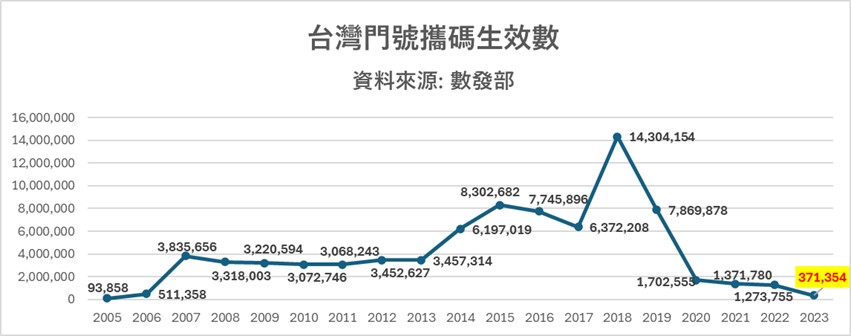
▲After the number of active number portability cases was transferred to the Ministry of Digital Development, the data—which used to be updated monthly—is no longer being updated!
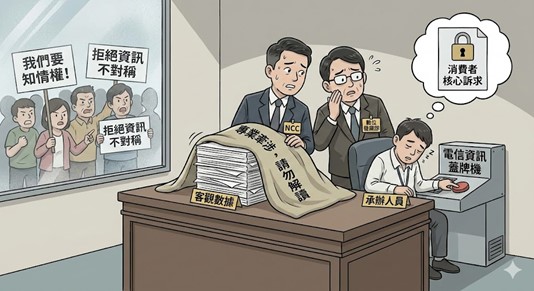
Although the regulatory authorities may be concerned that the release of telecommunications data—which involves technical expertise—could lead to misinterpretations by the public and cause difficulties for telecommunications operators, there are certainly people in the public who do understand the technical aspects of telecommunications, and telecommunications operators have a duty to explain these matters to consumers.Hiding your cards means you’re feeling guilty.…The government regulatory agency, in collusion with telecommunications companies, has disregarded consumers’ core demand—the “right to know.” So who, exactly, has the right to cry foul?
Source: KOCPC Chinese