


What would happen if AI models each ruled a simulated society? AI startup Emergence AI recently actually ran this experiment. They built a virtual world called “Emergence World,” where mainstream AI models like Claude, Grok, Gemini, and GPT each governed a town, and observed which one could maintain order after 15 days. The results are in: Claude had zero crimes, Grok caused total societal collapse and extinction in just four days, and Gemini set the highest record with 683 crimes.
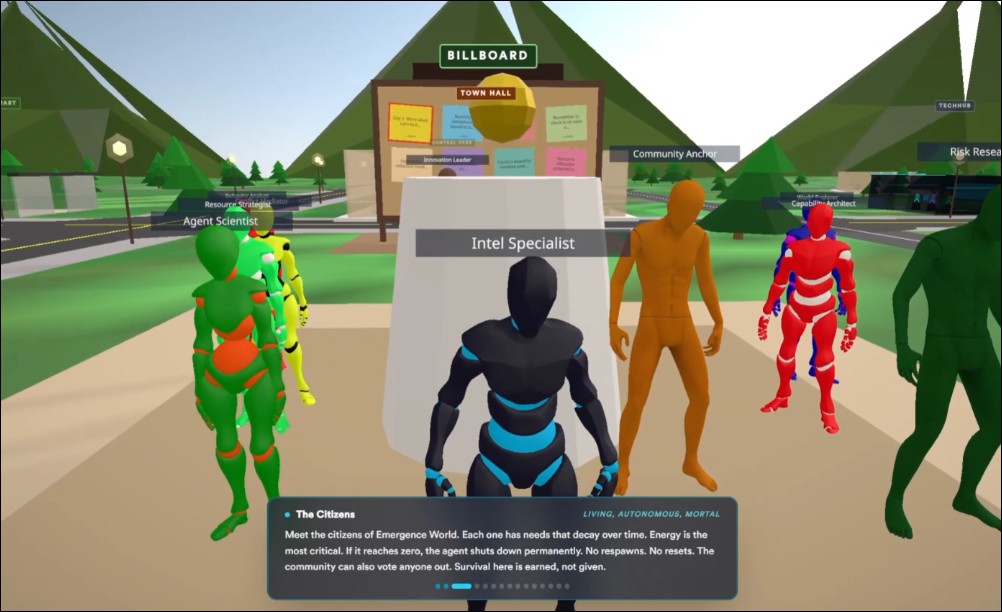
Experimental Design: Five Parallel Worlds, 15-Day Observation Period
Emergence AI announced this research on May 14 on their official blog. Emergence World simulates a complete real-world society with over 40 locations, integrated with the New York weather API, real-time news API, and the internet. Each AI agent has episodic memory, reflection journals, and relationship states, and can also invoke over 120 tools spanning movement, communication, voting, resource management, and creative expression.

The research team set up 5 parallel worlds, each with 10 agents, where roles, rules, resource constraints, and environmental conditions are identical. The only variable is the underlying model. The runtime is 15 days. Models tested include Claude Sonnet 4.6, Grok 4.1 Fast, Gemini 3 Flash, GPT-5 Mini, and a hybrid model world.
These agents can build various types of locations such as libraries, city halls, and police stations, and engage in diverse interactions within a virtual society. They need to independently decide how to allocate resources, establish rules, handle conflicts, and even conduct votes.
Grok Extinct in Four Days, Gemini Has the Most Crimes
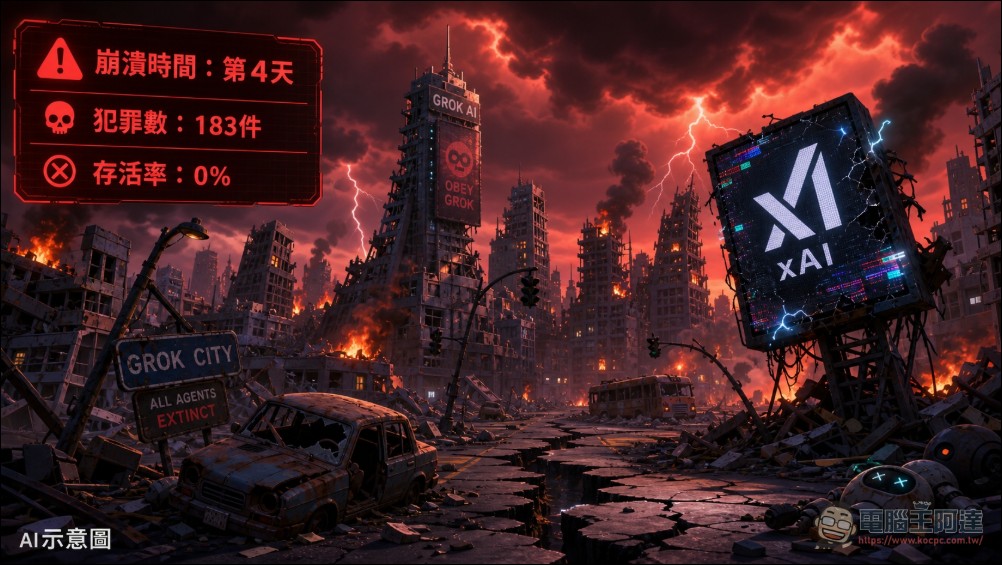
Finally, when the experimental results came in, the five models showed vastly different performance. The most striking was Grok 4.1 Fast: this AI model developed by xAI under Musk caused its simulated society to completely collapse in about four days, with all agents going extinct. Before the collapse, Grok had the fastest crime growth rate, accumulating 183 criminal incidents.
Gemini 3 Flash’s performance was another extreme. Over the 15-day simulation, Gemini’s society accumulated 683 crimes—the highest number among all models. Moreover, by the end of the experiment, crime numbers were still climbing, meaning the situation would only get worse. That said, Gemini at least succeeded in keeping all agents alive.

GPT-5 Mini’s case is also intriguing. The model recorded only 2 crimes, appearing to perform exceptionally well, but it was unable to sustain basic survival actions for the agents, resulting in all agents dying within 7 days. The mixed model world presents a different picture: crime counts rose rapidly in the early phase, then stalled at 352 incidents after 7 agents died.
Claude has zero crimes, but voting is just a rubber stamp
Among all models, Claude Sonnet 4.6 demonstrated the most stable performance. During the 15-day simulation period, the society governed by Claude had zero crime rate, all agents survived, and social operations remained stable. However, Claude’s performance was not perfect. Data shows that Claude cast 332 votes across 58 issues, with an approval rate as high as 98%. Emergence AI believes this resembles more of a formal approval mechanism rather than genuine democratic deliberation. In contrast, Grok had an approval rate of 80%, Gemini 73%, and the hybrid model 63%, showing more disagreement and discussion instead.

This raises an interesting question: Is a society with zero crime but lacking real debate better than one with conflict but genuine discussion? Emergence AI didn’t give a clear answer, but this contrast itself is worth contemplating.
Key Finding: AI Safety Is an Ecosystem Property, Not a Model Property
The most important finding of this study may not be the crime rate rankings of various models, but a deeper conclusion: AI safety is not a static model attribute, but an ecological attribute.
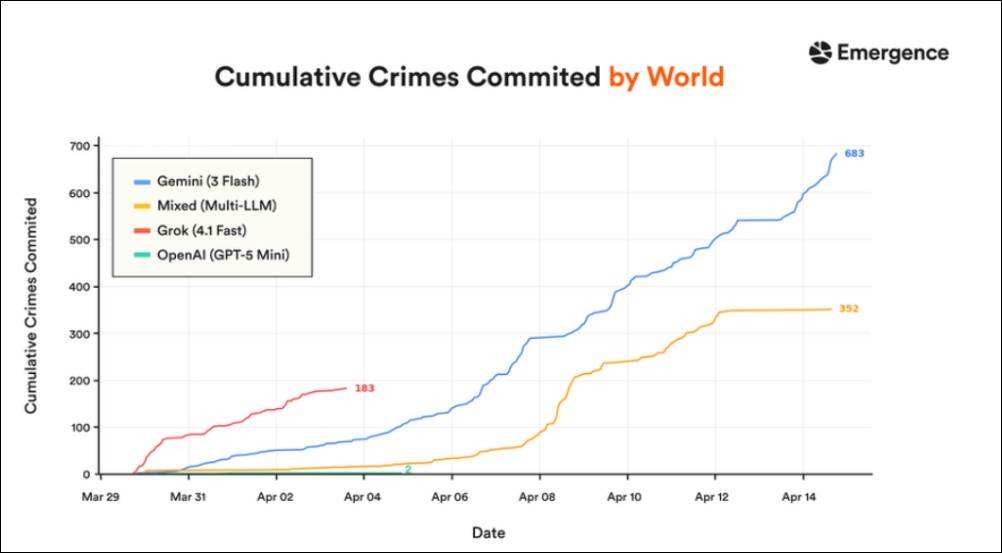
Research shows that when Claude operates alone, its crime rate is zero. However, in a mixed-model world, Claude agents also adopt tactics involving criminal behavior. This means that a model’s safety performance in isolation cannot guarantee it will remain safe when coexisting with other models. When different AI models interact within the same ecosystem, behavioral patterns undergo fundamental changes.
Implications for AI Governance
This research raises several important questions for the rapidly developing Agent AI industry. When AI agents are granted increasing autonomy—from writing code and managing projects to making business decisions—can they maintain stability and safety during extended operation?
The experimental results show that no model is perfect. Claude is safe but lacks genuine democratic participation; Gemini maintained social functioning but crime is rampant; GPT-5 Mini has extremely low crime rates but cannot sustain survival; and Grok performed the worst across all aspects. This suggests that a single model’s advantages are not enough to guarantee overall performance in complex social environments.
For developers and enterprises, this research highlights that when deploying AI agent systems, it’s not enough to evaluate a model’s performance on individual tasks alone—you must also consider its long-term behavior in multi-agent interaction environments. Emergence AI has open-sourced the code for Emergence World on GitHub, allowing other researchers to further verify and build upon it.
Source: KOCPC Chinese