


For many years, travelers to Japan have been able to easily pass through Japan’s gates with an iPhone. However, if they have a non-Japanese Android phone, they can only buy a physical ticket card. This “digital divide” caused by differences in hardware specifications has finally broken through. On April 21, 2026, Samsung Electronics and JR East (East Japan Railway) officially announced their cooperation. Starting in the first half of 2027, Samsung Galaxy smartphones sold overseas will support the “Welcome Suica Mobile” App dedicated to tourists visiting Japan, and simultaneously add Suica’s stored value and ticket purchasing functions to Samsung Pay. More importantly: Samsung will install FeliCa chips in overseas versions of Galaxy phones, which means that the Android camp will finally catch up with the iPhone’s nearly decade-long “global transportation card” advantage.
What is FeliCa? Why can’t non-Japanese versions of Android use Xigua cards?
To understand the significance of this news, you must first understand the payment technology used by Japan’s Watermelon Card: FeliCa.
FeliCa is a contactless IC card technology developed by Sony and classified as NFC-F (Type C) in the international standard. The biggest difference between it and NFC Type A/B used by most mobile phones around the world is that FeliCa uses a “secure chip offline verification” mechanism. The transaction data is stored in the built-in Secure Element of the mobile phone. The verification can be completed without being connected to the Internet when the gate is sensed. The speed is extremely fast, which is crucial for Japanese station gates that are crowded with people during peak hours.
Starting with iPhone 8 and Apple Watch Series 3 (2017), Apple has built FeliCa chips into all versions of iPhone and Apple Watch worldwide. This means that no matter whether you bought an iPhone in Taiwan, the United States or Europe, you can add the Suica card directly to Apple Wallet in Japan, and the experience is exactly the same as that of local Japanese users.
The Android camp, however, is completely different. Global Android phone manufacturers, including Samsung, have never installed FeliCa secure elements in their overseas versions in order to save costs and avoid authorization complexity. Only Android phones sold in Japan support the “Osaifu-Keitai” function. This is why for a long time, users of non-Japanese Android mobile phones have been completely unable to use transportation IC cards such as Suica and PASMO when they arrive in Japan.How to crack)。
The specific content of this cooperation
According to a press release from Samsung Newsroom Japan, this collaboration covers the following key points:
1. Overseas version of Galaxy supports Welcome Suica Mobile
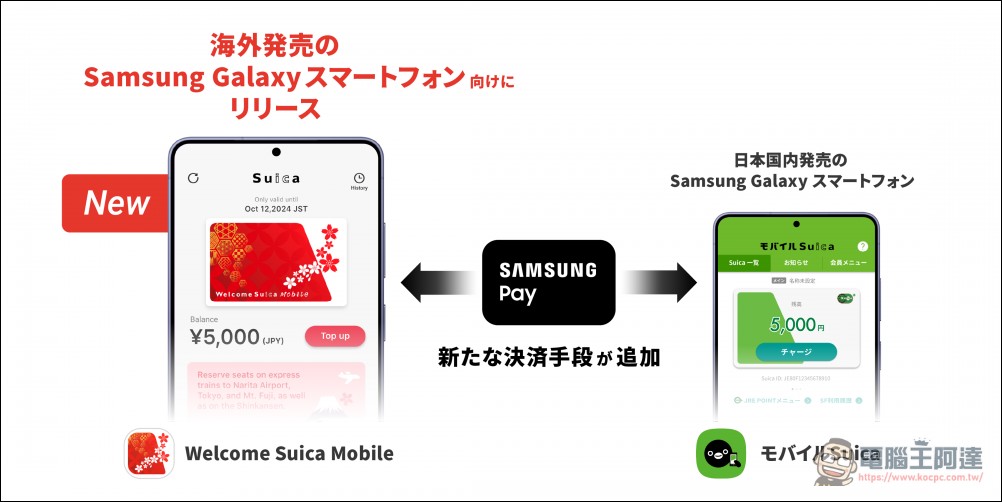
Samsung Galaxy smartphones sold overseas from the first half of 2027 will have built-in FeliCa secure elements, and Suica can be issued and used through the “Welcome Suica Mobile” App. Passengers do not need to queue up at the station to buy a physical card. They can use their mobile phone to open the card after entering Japan.
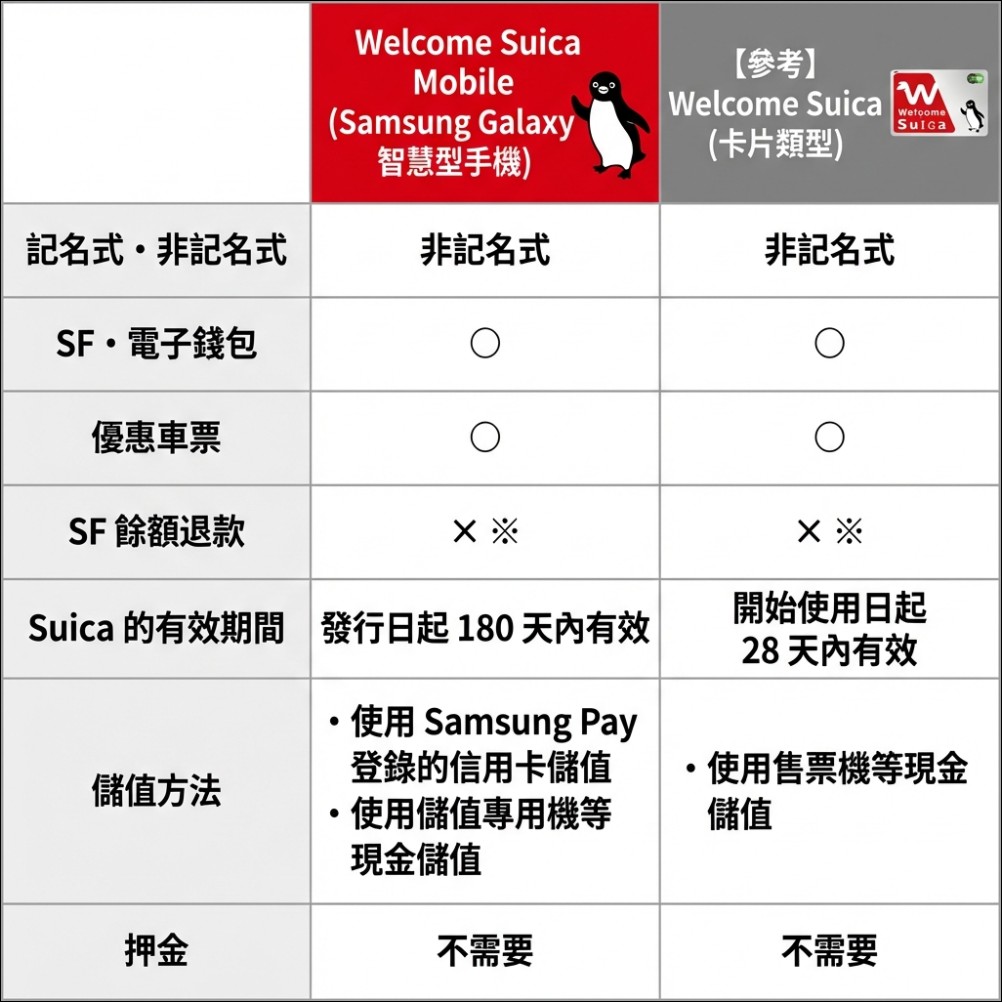
Welcome Suica Mobile is valid for 180 days from the date of issuance (physical Welcome Suica card is only 28 days), no deposit is required, and can be topped up via credit card or cash at station stored value machines. But please note: the balance is not refundable and will become invalid upon expiration.
2. Samsung Pay joins Suica stored value channel
Whether it is Welcome Suica Mobile corresponding to the overseas version of Galaxy, or モバイルSuica corresponding to the domestic version of Galaxy, Samsung Pay will be added as a payment option. Users can use Samsung Pay to store value and purchase green carriage tickets, discount tickets and commuter passes for regular trains.
3. The domestic version of Galaxy is not affected
Galaxy phones sold in Japan already support おサイフケータイ and モバイルSuica. This cooperation will not change the existing functions. Whether there are any differences in FeliCa implementation details between the overseas version and the domestic version, Samsung said it has not yet been announced.
Differences from iPhone: catching up, but still different
While Samsung seems to have finally caught up with the iPhone in terms of transit card functionality, there are still some notable differences between the two:
Hardware level: finally aligned
The biggest breakthrough is that Samsung is willing to install FeliCa secure element in overseas versions of Galaxy. In the past, this chip only existed in Japanese versions of Android phones, and was omitted in overseas versions. Samsung’s decision this time means that the new Galaxy series (presumed models) after 2027 will be the first batch of international Android phones to truly support Japanese transportation cards at the hardware level.
Support scope: Welcome Suica only
iPhone users can issue the full version of モバイルSuica in Apple Wallet and enjoy exactly the same functions as Japanese users (including regular coupons, Shinkansen express coupons, etc.). However, the plan announced by Samsung this time is currently limited to “Welcome Suica Mobile”. This is a simplified version specially designed for tourists visiting Japan. It has a 180-day usage limit and does not support advanced features such as time passes.
ecosystem integration
The depth of Apple’s Suica integration is the industry benchmark: Suica cards are directly embedded into Apple Wallet and support Express Transit (no need to unlock, no Face ID, direct induction through the gate), automatic top-up, Apple Watch synchronization and other functions. Although Samsung has also included Suica into the Samsung Wallet ecosystem, the specific user experience, especially whether it supports the Galaxy Watch watch version Suica, has not been announced yet.
Time difference: iPhone is nearly ten years earlier
The iPhone has fully supported FeliCa since 2017, and Samsung’s overseas version of Galaxy will not catch up until 2027. This nearly ten-year time gap has allowed Apple to establish unshakable brand loyalty in the Japanese market. Suica’s seamless experience is one of the key reasons why many Japanese users insist on using iPhones (because I often go to Japan, I always take my iPhone with me whenever I go abroad).
Impact on Taiwanese users
Taiwan is one of the popular source countries for tourism to Japan. According to statistics from the Tourism Administration, the number of tourists from Taiwan to Japan will continue to remain high in 2025. In the past, Samsung mobile phone users could only purchase physical Suica cards or use the PASMO App (some models have limited support) when arriving in Japan, which was far less convenient than iPhone users. After 2027, as long as they hold an overseas version of Galaxy mobile phone released in that year or later, Taiwanese users can also directly use their mobile phones to swipe gates, take buses, and make purchases at convenience stores and vending machines in Japan, greatly improving the convenience of traveling to Japan.
However, it should be noted that existing Galaxy phones (such as the Galaxy S25 and S26 series) are not equipped with FeliCa chips and cannot be supported through software updates. This is a hardware specification upgrade that is only applicable to new machines after 2027. It means that Taiwan’s own Taipei MRT EasyCard is still unable to directly use the iPhone transportation card function due to a certain unit’s unwillingness to replace the gate system.
Bigger Significance: The Beginning of the Android Global Transportation Card Era?
As the world’s largest Android mobile phone manufacturer, Samsung’s implementation of FeliCa in the overseas version of Galaxy may have a demonstration effect. If other Android manufacturers, such as Google Pixel, Xiaomi, and OPPO, also follow suit and install FeliCa in international models (Japanese phones of these brands are equipped with it), then the Japanese transportation card function will no longer be an exclusive advantage of the iPhone.
However, FeliCa has almost no use in markets outside Japan, which means that the additional hardware cost may not be felt by most consumers around the world. Samsung is willing to take this step, to some extent, to capture the Japanese market, one of the largest and most mature mobile payment ecosystems in the world.
Conclusion
This cooperation between Samsung and JR East finally allows Android users to see the dawn of “card-free” travel in Japan. The 2027 Galaxy S27 series will (presumably) be the first international Android phones equipped with FeliCa, allowing travelers to Japan to use Suica on their phones just like iPhone users.
However, from the scope of support (only Welcome Suica, not full Suica), the integration of the ecosystem, to the time difference (the iPhone is nearly ten years earlier), Samsung still has a long way to go in its “catch-up journey”. For Samsung users in Taiwan, the good news is that they can finally say goodbye to physical tickets when traveling to Japan in the future; but if you are looking for the most complete mobile Suica experience, iPhone is still the irreplaceable choice for the time being.
Source: KOCPC Chinese