


Anthropic launched not too long ago Claude Design Later, the tool that allowed this AI to directly produce beautiful design drafts quickly aroused heated discussion in the developer community. However, due to its closed source code and limited use of paid cloud services, many people feel regretful. Recently, a developer named Tom Huang (@tuturetom) published a similar version he developed on the X platformOpen sourceapplication Open Design(formerly known as Open Claude Design), claims to have reverse-engineered the core experience of Claude Design with a restoration degree of more than 95%. The post accumulated more than 380,000 views and more than 1,600 likes within 24 hours.
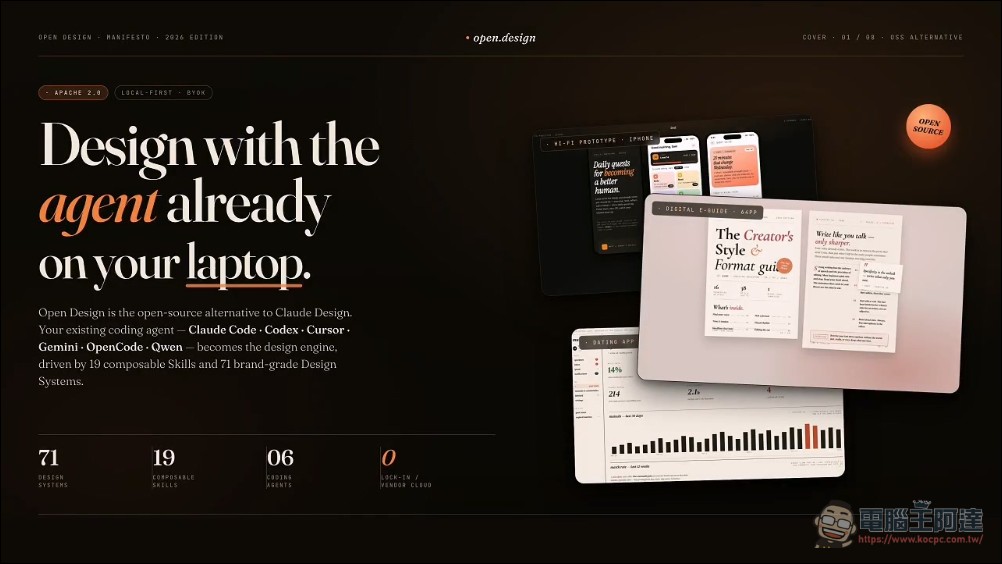
72 hours, 18,700 lines of code reverse engineered
According to Tom Huang’s description on the X platform, the Open Design project was time-consuming by the nexu-io team 72 hours, wrote more than 18,700 lines of codeFinish. The project includes 30+ design skills(eventually streamlined to 19 core skills), supporting more than 71 design systems, and is compatible with all major programming proxy tools currently on the market, including Claude Code, Codex, OpenCode, OpenClaw, Cursor, Gemini CLI, Qwen and GitHub Copilot CLI, etc.
正式开源 open claude design 🚀 超 95% 以上的还原度!
浓缩和逆向所有 claude design 最先进的设计,最好看的模板💥
历时 72 小时,18700+ 行代码,30+ 设计 Skills,支持超过 71 套 设计系统,支持所有的 code agent,包括 claude code、codex、openclaw 等 🔥 pic.twitter.com/MkukjgSbmh
— Tom Huang (@tuturetom) April 28, 2026
In fact, this type of open source application of Claude Design is not the first. There was also a Chinese developer’s “Huashu Design” is also well received by other developers, but currently Open Design has a better evaluation. GitHub It has received 5000+ star reviews on the website.
Claude Design 剛推出就被逆向開源!Huashu Design:一句 Prompt 就能生出原型、簡報與 MP4 動畫
What is Open Design?
Open Design is a “local-first, open source deployable” alternative to Claude Design. According to the project description on GitHub, the core idea is: Anthropic’s Claude Design shows the shocking effect when LLM shifts from “writing articles” to “publishing finished designs”, but it is closed, paid, cloud-only, and locked in Anthropic’s model and skill ecosystem: while Open Design is a completely open version.
Unlike Claude Design’s built-in dedicated AI agent, Open Design chooses not to build its own agent, but instead allows the user’s own code agent (Claude Code, Codex, Cursor, etc.) to directly become the design engine. This “BYOK (Bring Your Own Key)” architecture means that users can use their own API Key and preferred models to perform design tasks in a familiar development environment.
Six core design concepts
Open Design’s architecture is built on six key design decisions:
1. There is no built-in proxy, yours is enough. When the system starts, it will automatically scan Claude Code, Codex, Cursor Agent, Gemini CLI, OpenCode, Qwen and Copilot in PATH, and use whichever one is found as the design engine, driven through standard input and output (stdio).
2. Skills are files, not plug-ins. Each design skill is a folder containing SKILL.md plus assets/ and references/. Just drop the folder into the skills/ directory and restart the daemon, and the new skills will appear in the selector.
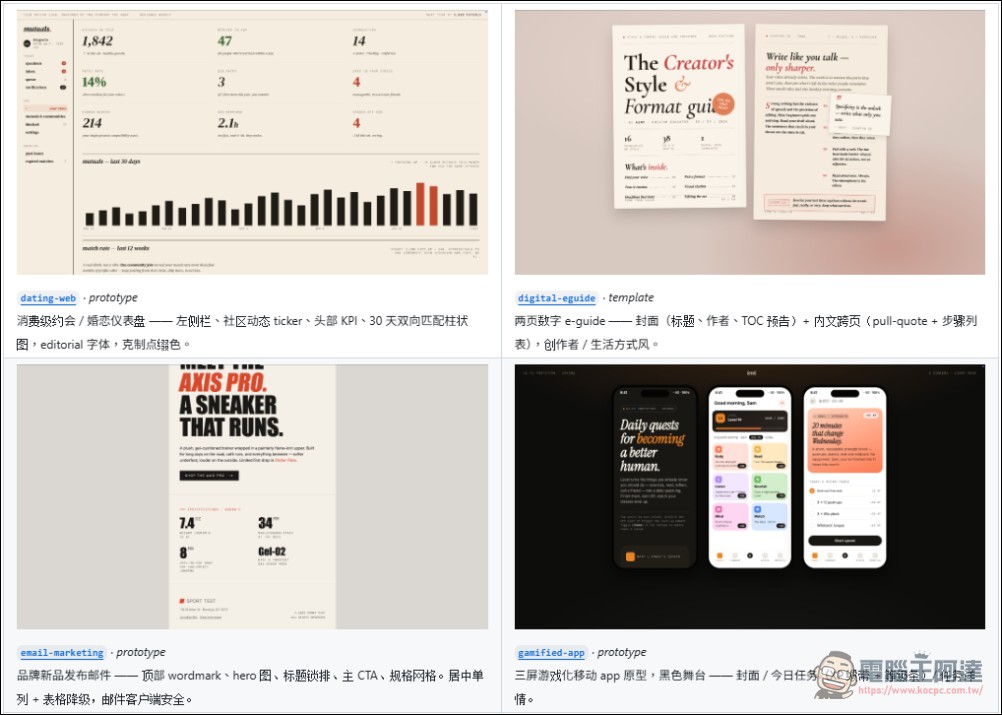
3. The design system is portable Markdown, not JSON theme file. Adopting the 9-section DESIGN.md specification (color, font, spacing, layout, components, dynamics, tone, brand, anti-pattern) from VoltAgent/awesome-design-md, it comes with 71 sets of design systems from well-known brands – from Stripe, Linear, Vercel to Apple, Tesla, Spotify, covering AI, financial technology, e-commerce, automobiles and other fields.
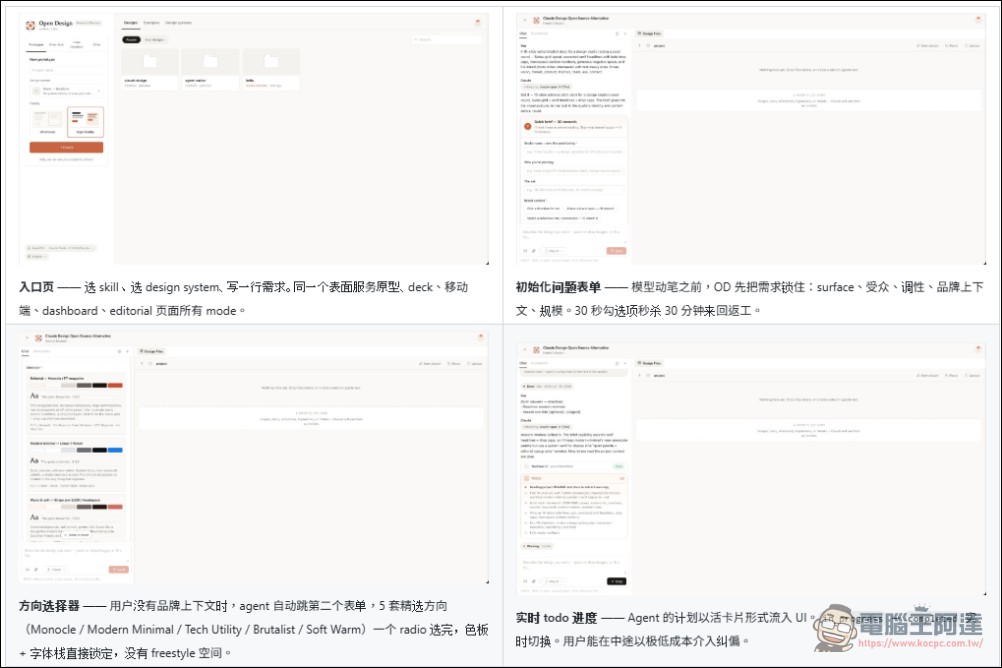
4. Interactive questionnaire forms avoid 80% of redirects. The first round of each design task is not to directly generate code, but to collect requirements through a questionnaire form: usage context, target audience, tone, brand background, scale and constraints. After locking in key parameters within 30 seconds, the agent begins producing the design.
5. Daemon makes the agent feel like it’s working on your computer, because it is. Daemon creates real files in the .od/projects/ directory of the project. The agent has real tools such as Read, Write, Bash, and WebFetch. It can read templates, search CSS, create brand specification files, generate image files, and finally output them into HTML, PDF, PPTX, or ZIP.
6. The cue word stack is the product itself. What is combined each time is not just “system prompt + user prompt”, but the final prompt that is synthesized by system prompts, workflow (discovery phase, skill instructions, design system, direction guidance, anti-AI-slop checklist) and user input. Each layer is an editable file.
Anti-AI-slop mechanism: ensuring output quality
One of the most eye-catching features of Open Design is the built-in quality mechanism of “anti-AI-slop” (preventing AI from generating cheap garbage), inspired by alchaincyf/huashu-design, which is also an open source project:
- Questionnaire form is preferred: In the first round, only requirements are collected, without thinking, using tools, or describing.
- Brand specification extraction: When a user uploads a screenshot or URL, the agent needs to execute a five-step agreement (locate → download → extract color code → write brand specifications → verbal confirmation) before starting to write CSS, and will never guess the brand color from memory.
- Five dimensions of self-criticism: Before outputting the finished product, agents need to self-score (1-5 points) from five aspects: concept, level, execution, concreteness, and restraint. Any item with a score lower than 3 must be corrected and re-scored.
- P0/P1/P2 Checklist: Each skill has built-in references/checklist.md. If the P0 gate is not passed, it cannot be output.
- taboo blacklist: Common AI design routines such as purple gradients, universal emoticons, rounded-corner cards with left color blocks, hand-drawn SVG characters, Inter as title font, fictitious data, etc. are explicitly prohibited
Quick start guide
According to the official instructions, you only need to start it for the first time (or you can ask AI Agent to install it yourself):
git clone https://github.com/nexu-io/open-designpnpm install && pnpm dev- Daemon automatically detects the code agents in PATH and selects one as the design engine
- Loaded 19 Skills and 71 design systems
- Enter the design prompt → receive the questionnaire form → fill it out → watch the finished product rendering
All data is stored in a local SQLite database, and previous work can be continued after closing and reopening.
Open Design GitHub project official website
Conclusion
From the time Anthropic launched Claude Design to the open source community, it took 72 hours to reverse engineer it, but only 11 days. The emergence of Open Design not only proves the replicability of Claude Design’s core workflow, but also demonstrates the agile response capabilities of the open source ecosystem in the field of AI tools. For those users who do not want to be locked into a specific platform and want to retain the right to choose models and data autonomy, Open Design provides an attractive alternative that friends with design needs can try for themselves.
Source: KOCPC Chinese