


AMD has previously provided its users with the most advanced FSR upscaling technology through the driver. This technology is considered to be similar to NVIDIA’s DLSS technology but has different principles. The similarity is that it can provide users with higher-resolution and delicate game images when the hardware performance is not enough to bear the load pressure of high-resolution games. Currently, FSR technology has been updated to version 2.0. AMD announced while the iron is hot that it has cooperated with Microsoft to use FSR 2.0 technology on Xbox game consoles. What is even more intriguing is that AMD also mentioned that this time FSR 2.0 technology not only supports AMD’s own graphics cards, but also some NVIDIA graphics cards.
Many people know that NVIDIA has a technology called DLSS. This technology mainly uses NVIDIA’s Tensor core to perform artificial intelligence machine learning, and optimizes performance by learning 3D materials and other rendering results in games, allowing players to utilize limited hardware resources and experience more special effects and higher-resolution graphics.
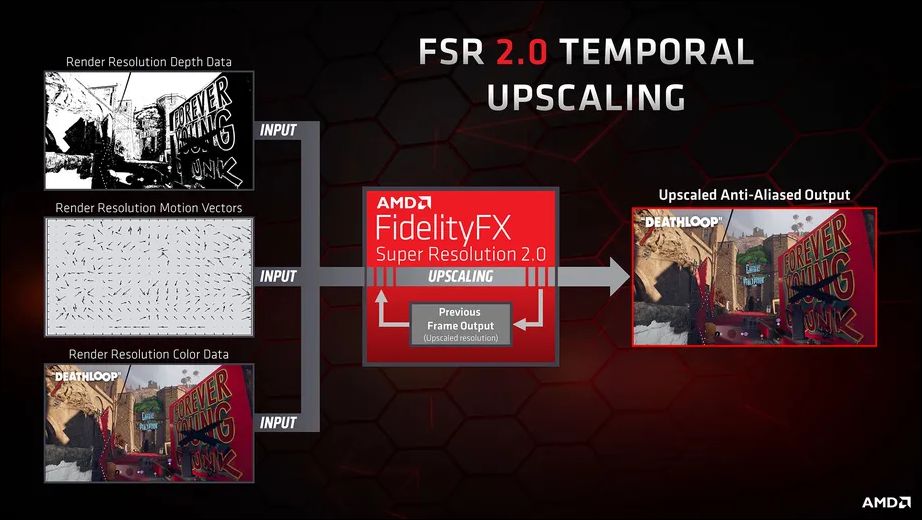
The principle of AMD FSR technology is different, at least it does not improve the picture quality through machine learning. AMD FSR mainly relies on algorithms, which use computing technology to turn low-resolution texture maps into high-quality images. In other words, this process will use the computing performance of the graphics card itself to some extent, which is different from DLSS switching to Tensor chips that specialize in processing AI data. Of course, the advantage of not requiring a dedicated chip is that its support is relatively wider and can be enabled on more platforms and hardware.
Although AMD announced its cooperation with Microsoft, it did not mention whether the current Xbox Series X/S will directly receive support, or whether the next generation Xbox game console will see the benefits of this technology. This may be where the original manufacturer hopes to sell off. The author believes that the Xbox Series X/S has only been launched for more than a year, and the chances of launching new features on the current console should not be low.
In addition, AMD FSR 2.0 technology is only an improved version of the first generation after all, and still maintains the feature of not requiring a dedicated hardware chip, so this time FSR 2.0 even has the opportunity to be enabled on opponent cards. Yes, it sounds bizarre that AMD technology can be used on NVIDIA graphics cards, but it is true, but considering the principle, this statement is not so difficult to accept.
Roughly speaking, NVIDIA DLSS still requires dedicated hardware to learn game scenes and other data in advance to calculate high-definition images while reducing the load on the graphics card, so that the graphics card can free up its hands and feet to calculate other more resource-intensive content, such as ray tracing. AMD FSR uses the graphics card’s own computing performance from the beginning. To “count” the low-resolution game screen into high-resolution. Even in FSR 2.0, this basic principle has not changed much.
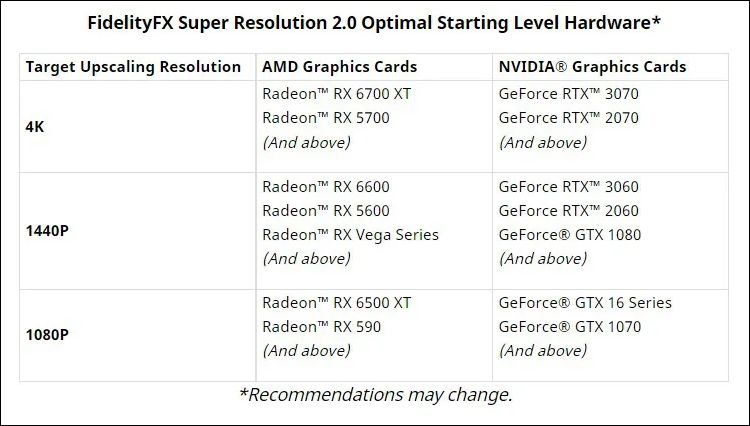
Therefore, in order to support FSR 2.0, AMD will require users to use a certain level of graphics cards, even GPUs from the opponent camp have the same requirements. According to the official statement, users need to have a GTX 1070 or above graphics card to enable AMD FSR 2.0 technology when using an NVIDIA graphics card. In addition, this technology also requires the cooperation of developers to implement, so we haven’t seen many supported games yet.
Currently, the only game that is confirmed to support AMD FSR 2.0 technology is “Death Loop”, and the other is “Forspoken” (or translated as Cursed Land, which will be released by SQUARE ENIX this year) that has not yet been officially launched and only has technology demonstration software. Other games still need to wait for announcements from the original manufacturer.

▲AMD FSR 2.0 technology display
I believe that the cooperation with Microsoft will still allow AMD FSR 2.0 technology to shine. Although it still has the high compatibility of the previous generation and can even be turned on with graphics cards from the opponent camp, and AMD said that if the game already supports DLSS technology, FSR 2.0 can be implemented within a few days. However, without these excellent innate conditions, such as using Unreal Engine 4/5, FSR 2.0 It will take a long time to implement it before players can enable this feature in the game. Perhaps, the long development time may be one of the biggest disadvantages of this technology.
Source: KOCPC Chinese