


A peculiar supermarket recently appeared on the Hung Hom waterfront in Hong Kong. There are no real clerks in the store. From replenishing the shelves, picking up goods to checking out, everything is done by a humanoid robot named “Xiao Gai”. This is Hong Kong’s first 24-hour unmanned supermarket operated full-time by a humanoid robot. It was built by Galbot, a Beijing-based artificial intelligence and robotics company, and funded by a Hong Kong investment management company. The Hung Hom waterfront area has been actively undergoing urban renewal in recent years, and this robot supermarket is regarded as one of the highlights that attracts crowds.
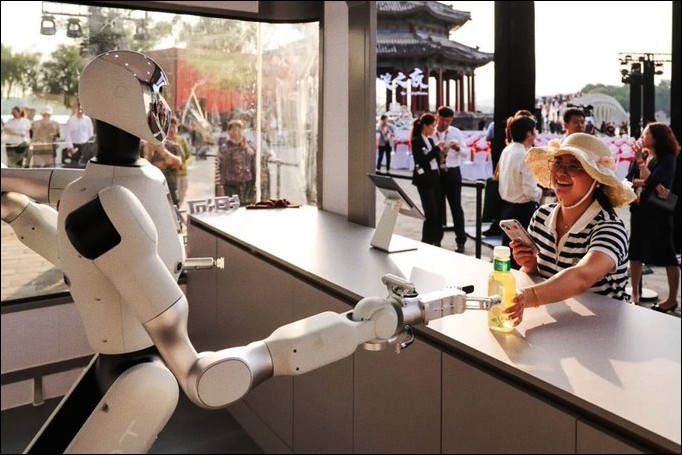
What can the robot “Xiao Gai” do?
This G1 humanoid robot “Xiao Gai” is about 173 centimeters tall and has arms spread up to 190 centimeters. It can move freely in a capsule store of only about 9 square meters. Its work scope covers shelf replenishment, product selection, checkout processing, and supports voice interaction and multi-language dialogue. According to Galbot’s explanation, Xiao Gai has visual and auditory perception capabilities, can identify target items, understand customer intentions, and actively initiate friendly conversations to guide customers to browse products. Galbot is a Beijing-based company specializing in body-based AI. Its robots use self-developed grasping and motion control systems that can operate accurately in small spaces. Xiao Gai is actually Galbot’s second-generation retail robot. The company’s early trial version around Peking University has set a service record of thousands of people per day.
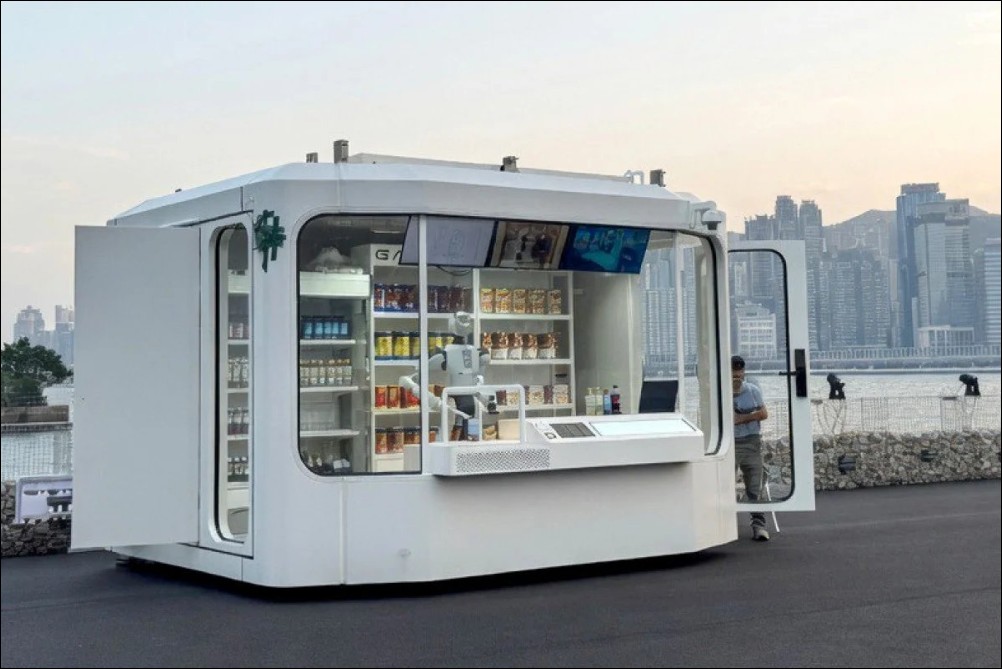
The types of products sold in the store include snacks, creative daily necessities, and over-the-counter medicines. The entire store is designed with movable capsule container modules, which can be quickly adjusted according to different locations and product categories. Galbot already has a similar “Galaxy Space Capsule” supermarket in operation in Beijing’s Haidian District. It is said to serve about 1,000 customers every day without interruption since its launch in August this year. The company also claims that this type of robot supermarkets can bring a 30% to 40% increase in foot traffic to surrounding areas, and plans to launch 100 capsule supermarkets in ten cities to export this model from China to the world.
Hong Kong Government: Let AI enter daily life
Hong Kong Financial Secretary Paul Chan Mo-po announced the plan in his weekly blog and positioned it as an important part of Hong Kong’s drive to popularize AI. He said that Hong Kong was chosen as Galbot’s first stop outside mainland China because of its advantages as an international showcase platform and its open attitude towards innovative technology. The Hong Kong Investment Management Corporation is the funder of this project. The company was established by the Hong Kong government and focuses on investing in innovative technology projects that can promote the future development of Hong Kong. Fong Baoqiao, honorary president of the Hong Kong Information Technology Chamber of Commerce, pointed out that it is difficult for ordinary people to come into contact with AI in daily life, and such robot supermarkets allow people to actually interact with AI. People can see how the robot responds to them and prepares their order, which is a very direct experience. He also mentioned that the current application of humanoid robots in retail scenarios is still in its early stages, but as an international city, Hong Kong has sufficient conditions and venues to test such new technologies.
This isn’t Galbot’s first foray into humanoid robot retail. Prior to this, the company had deployed similar automated capsule supermarkets in many locations in Beijing, including near the Summer Palace and Zhongguancun ART PARK, and accumulated a lot of operational experience. From Beijing to Hong Kong, humanoid robot retail is moving from experimentation to large-scale, and this supermarket in Hung Hom, Hong Kong will be a key indicator to verify whether this model can be implemented in international cities.
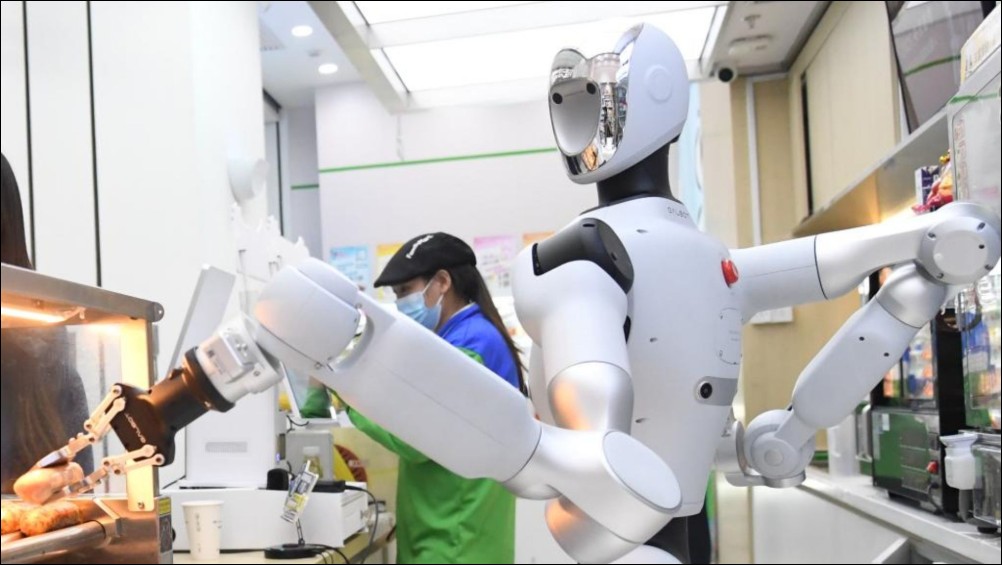
The reality test of humanoid robots entering the workplace
Although this supermarket is very topical, it also reflects the challenges of humanoid robots truly entering the workplace. Earlier this year, a video showed a restaurant robot suddenly malfunctioning and throwing dishes wildly, which employees could not control. In another case, a Stockholm cafe run entirely by an AI agent used up most of its budget in less than a month, even ordering 3,000 pairs of latex gloves. A humanoid robot has to deal with various emergencies at the retail site, from insufficient inventory to customer disputes, from payment failures to machine failures. Without human backup, this Hung Hom supermarket will be the most realistic stress test.
However, humanoid robots are not the only ones to enter the workplace. In May this year, Japan Airlines announced that it would test robot baggage handlers at Tokyo Haneda Airport, showing that all walks of life are actively exploring the possibility of robots replacing some human labor. The launch of this robot supermarket in Hong Kong can be seen as the concrete practice of this trend in the retail industry. Regardless of the final success or failure, every replenishment and every checkout made by Xiao Gai is accumulating valuable data for the commercialization of humanoid robots.
Conclusion
The humanoid robot Xiao Gai has now started 24-hour operation at the Hung Hom waterfront. For consumers, walking into a store and seeing a robot helping you get drinks and check out is a novel shopping experience in itself. For the industry, this supermarket is a real-world stress test for humanoid robots. Can it run continuously for 24 hours without downtime? Can it handle the crowds during peak hours? Is there a backup mechanism in place when products are out of stock or the system is abnormal? The answers to these questions will gradually emerge in the coming months. Whether you are attracted by robots and want to take a look, or you are curious about the future of fully automated retail, this supermarket is worth exploring. As for whether a robot can really support a store, time will tell the answer.
Source: KOCPC Chinese