


Anthropic officially released Claude Sonnet 5 in the early morning of July 1, Taiwan time. This is the most agent-capable version of the company’s mid-range model Sonnet series ever. Anthropic pointed out in an official statement that Sonnet 5 can plan tasks autonomously, use tools such as browsers and terminals, and independently execute complex workflows at a level previously only achieved by flagship Opus-level models.

Anthropic releases Sonnet 5: with flagship autonomous agent capabilities, the price is only 40% off Opus
The timing of this publication is of great strategic significance. OpenAI just launched the GPT-5.6 Sol preview version last week, and Google’s Gemini 3.5 Flash also emphasized the shift from conversational robots to agent-based tools in May. Anthropic chose to launch Sonnet 5 at this time, which is equivalent to announcing to the market that Agentic AI is no longer exclusive to high-end flagship models, and mid-range price bands can also have strong independent agent capabilities.
Performance performance: close to Opus 4.8, knowledge work or even beyond
According to evaluation data published by Anthropic, Sonnet 5 is significantly ahead of the previous generation Sonnet 4.6 in many key indicators, and the gap with the flagship Opus 4.8 has been narrowed to an unprecedented extent. In the Agentic Coding test, Sonnet 5 achieved a score of 63.2%, compared to Opus 4.8’s 69.2% and Sonnet 4.6’s 58.1%. In the Knowledge Work review, Sonnet 5 even slightly surpassed Opus 4.8, which is known for solving the most difficult problems.
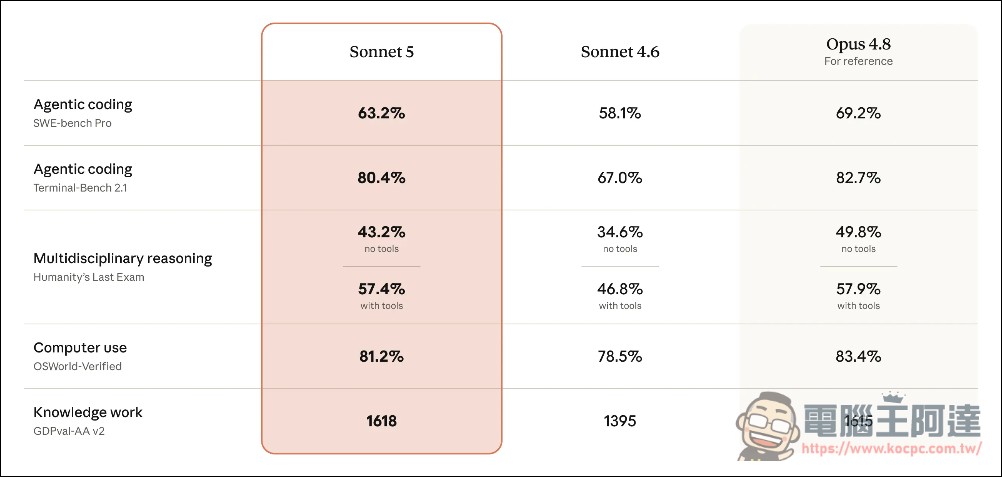
On the GDPval-AA v2 benchmark, which measures real economic output, the Sonnet 5 scored 1,618 points to the Opus 4.8’s 1,615 points, with the cheaper model outperforming the flagship in real-world performance.
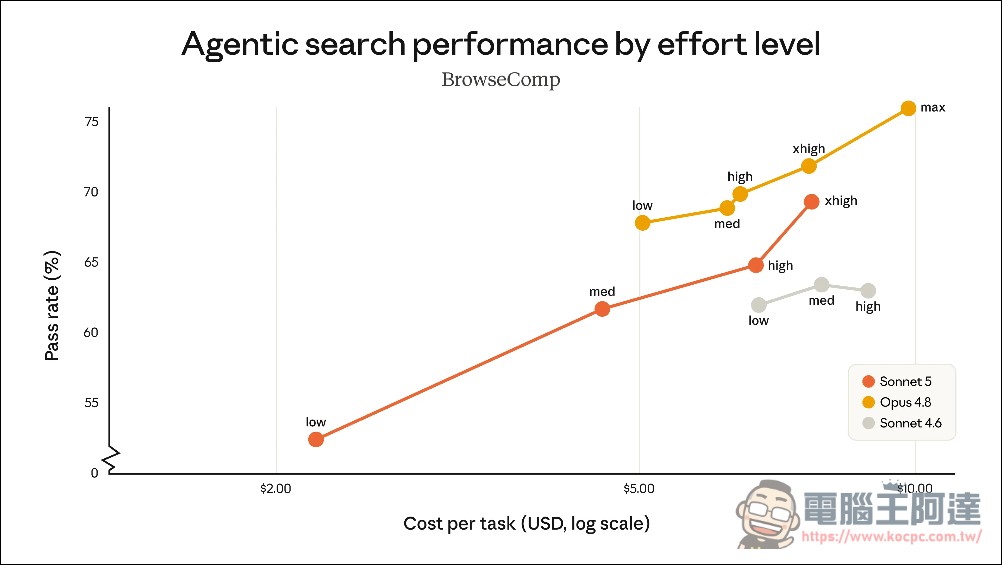
Anthropic also introduced an “Effort Level” mechanism that allows developers to adjust the balance of accuracy and cost between Sonnet 5 and Opus 4.8 based on task requirements. In the BrowserComp (agent search) and OSWorld-Verified (computer use) tests, the cost-effectiveness curve of Sonnet 5 at different levels of effort has formed a continuous band distribution with Opus 4.8, instead of the gap where the previous Sonnet series was obviously lagging behind.
Pricing strategy: The entry price is only 40% off Opus 4.8
One of the most compelling selling points of the Sonnet 5 is precisely its price. From now until August 31, 2026, API pricing is only US$2 per million tokens for input and US$10 per million tokens for output (approximately NT$65 and NT$325). After the promotion period, the price will be adjusted to USD 3 for input and USD 15 for output (approximately NT$98 and NT$488). Compared to Opus 4.8, which costs $5 for input and $25 for output, the standard price of Sonnet 5 is only about 40% off that of Opus, and even more so during the promotion period. When compared with competitors, Sonnet 5 is cheaper than OpenAI’s GPT-5.5 and Google’s Gemini 3.1 Pro, but still higher than Gemini 3.5 Flash. However, considering Sonnet 5’s level of agency capabilities, this price band is extremely competitive.
In addition, Sonnet 5 uses an updated version of the tokenizer (similar to the changes in Opus 4.7), and the same input will correspond to about 1.0 to 1.35 times the number of tokens. Anthropic says promotional pricing already takes this change into account, with the cost of switching to Sonnet 5 being roughly the same as before.
Self-verification: a key breakthrough in Agent reliability
Judging from feedback from early test partners, one of the most praised features of Sonnet 5 is its “Self-Validation” capability. The model will automatically check its own output results, without the need for users to ask “Please confirm again” in the prompt word. This capability solves the core bottleneck of Agent reliability: in the past, everyone had to rely on external guardrails (Guardrail) to remedy the problem. Now Anthropic has internalized this capability into the model itself.
Daniel Shepard, senior engineer at Zapier, said in a statement: “We gave Sonnet 5 a two-part task: update the Salesforce customer tier and send a launch notification to the enterprise contact, and it completed it independently from start to finish. In the past, this type of task often got stuck halfway through. For daily automation, this is a no-brainer.”
Ryadh Dahimene, Director of AI/ML at ClickHouse, pointed out: “Claude Sonnet 5’s reasoning steps are more streamlined, and users get answers significantly faster. This speed is a difference that our customers can actually feel.”
Security: reduced hallucinations, improved ability to resist jailbreak
In terms of security evaluation, Sonnet 5 is overall better than its predecessor Sonnet 4.6. It performs better in rejecting malicious requests and resisting hint injection attacks, and the hallucination to sycophancy ratio is also lower than the previous generation. However, in the autonomous behavior audit, the abnormal behavior rate of Sonnet 5 is still slightly higher than that of Opus 4.8 and Mythos Preview.
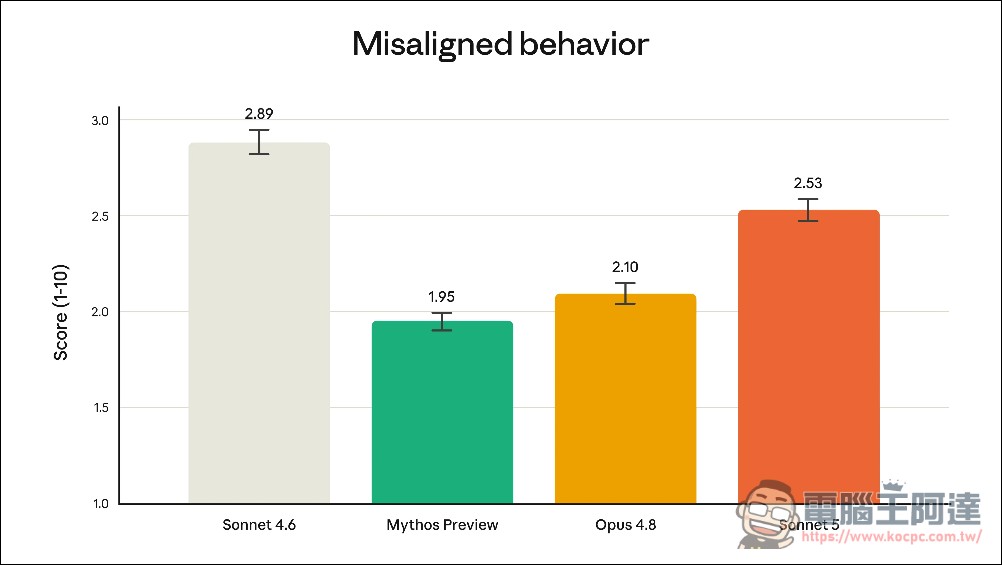
Anthropic specifically emphasizes that Sonnet 5 is far inferior to the Opus series in terms of dangerous network security tasks, and it has never successfully developed a complete Firefox exploit. Despite this, Anthropic still enables Sonnet 5 by default with the same network security protection mechanism as Opus 4.7/4.8, which instantly detects and blocks dangerous network security uses.
Usability and ecological integration
Claude Sonnet 5 is available on all plans starting today: This model is preset for Free and Pro users, and is available for Max, Team, and Enterprise users. It also supports Claude Code, Claude API (model ID: claude-sonnet-5), and integration with third-party platforms such as Perplexity and Notion. Anthropic has also increased the rate limits for all plans simultaneously to account for the increased token usage associated with higher effort levels.
Perplexity has been the first to announce that Sonnet 5 is available for Pro and Max subscribers and can be selected as an orchestration model in the Computer Use feature.
Claude Sonnet 5 is now available in Perplexity for Pro and Max subscribers.
You can also select it as an orchestrator model in Computer. pic.twitter.com/UktzCrUZU6
— Perplexity (@perplexity_ai) June 30, 2026
Conclusion
The release of Claude Sonnet 5 marks a new level of price-performance for Agentic AI. When OpenAI’s GPT-5.6 Sol, Google’s Gemini 3.5 Flash, and Anthropic’s Sonnet 5 all push autonomous agent capabilities into the mid-range price range within the same month, the focus of competition will no longer be “who can make the agent”, but “who can use the lowest cost and most reliable way to make the agent run.” This is good news for developers and enterprises. High-quality AI agents are becoming economically viable and the barriers to entry continue to lower. Rust engineer Neel Chotai’s test is the best example: he asked Sonnet 5 to investigate a bug, and the model automatically wrote a reproduction test without instructions, implemented the fix, and stashed it to confirm the bug regression, all at once.