


Unexpectedly, Nano Banana 2 also has a Lite version. When Nano Banana 2 was launched, it was already focused on ultra-fast image generation. The Lite version is even faster this time, producing a picture in as little as 4 seconds, and the cost is also cheaper, giving developers and creators an option that is more suitable for generating a large number of images, quick drafts, and low-cost testing.
Nano Banana 2 Lite is officially launched: Google focuses on 4 seconds of image generation, 1K images cost about US$0.034, and mass generation is more cost-effective
Earlier Google official blogannounced the launch of new models Nano Banana 2 Lite and Gemini Omni Flash, which respectively focus on lower-latency image generation, cost-effective video generation and conversational video editing. .
The API model name of Nano Banana 2 Lite is gemini-3.1-flash-lite-image. Google officially positions it as the “speed and cost” priority model in the Nano Banana family. According to Google, Nano Banana 2 Lite’s text output takes about 4 seconds, and a 1K resolution image costs about $0.034. It is suitable for interactive prototyping, quick visual drafts, and developer workflows that require a large number of images.
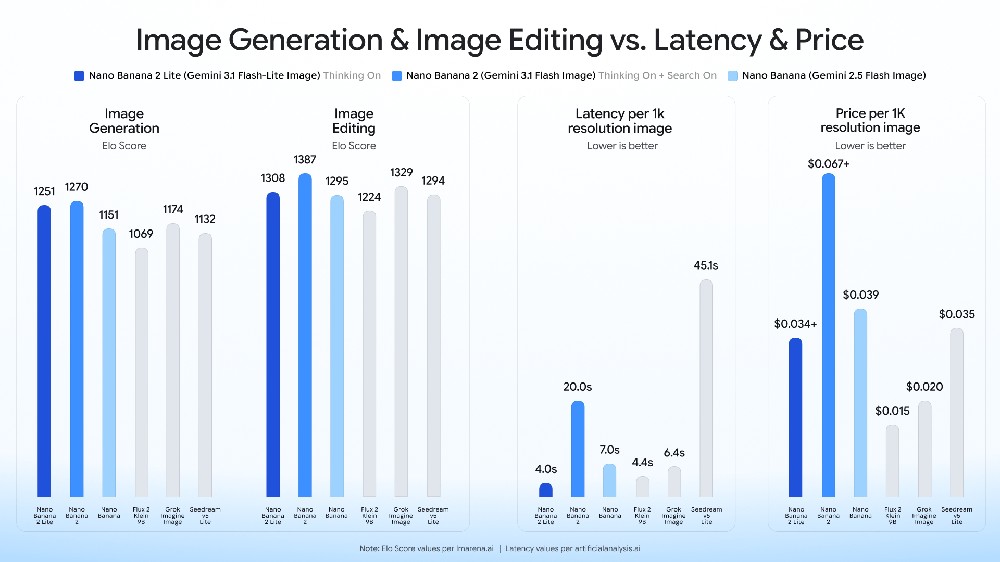
Therefore, Nano Banana 2 Lite can be thought of as a model that strives to be fast first and then to be good enough. It is not that it cannot be used as formal materials, but the product positioning is more inclined to try quickly. For example: today you want to generate 50 different styles of product situation pictures, social post drafts, and game prop concept drawings. At this time, 4 seconds of drawing and low cost will become very important.
Nano Banana 2 Lite supports text and image input, image and text output, and supports image generation and editing. It is optimized for lower resolutions such as 1K, which is 1024 x 1024px, and supports 14 fixed ratios, but it currently cannot output 2K and 4K images. The editing part is also a light modification, such as changing colors, making textures, adjusting backgrounds, etc.
Google also added that Nano Banana 2 Lite is a recommended alternative for developers who are still using the first generation Nano Banana, which is gemini-2.5-flash-image. Upgrade to Nano Banana 2 Lite for better quality, faster speed and lower cost.
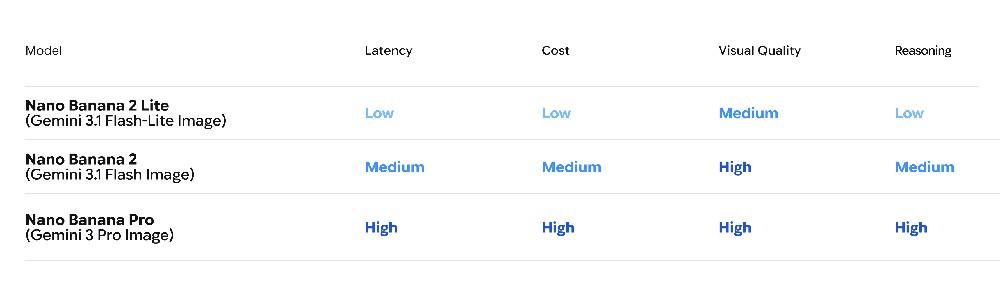
Here are the differences between Nano Banana 2 Lite, Nano Banana 2 and Nano Banana Pro
| Model | API name | core positioning | fit for purpose |
|---|---|---|---|
| Nano Banana 2 Lite | gemini-3.1-flash-lite-image |
Prioritize speed and cost | Massive sketches, quick drafts, interactive prototypes, 1K images |
| Nano Banana 2 | gemini-3.1-flash-image |
Balanced model | General formal materials, high-quality generation and editing, work that requires 2K / 4K or search results as the basis for generation |
| Nano Banana Pro | gemini-3-pro-image |
Professional control and accuracy are priority | Complex design, product mockups, infographics, precise text and professional output |
Nano Banana 2 Lite will be available in Google AI Studio, Gemini API and Gemini Enterprise Agent Platform from June 30, 2026. Google also confirmed that it will gradually introduce consumer products such as search AI mode, Gemini app, NotebookLM, Google Photos, Stitch, Google Flow and Google Ads.
Gemini Omni Flash is a high-quality, cost-effective model that supports video generation and conversational video editing.
Google AI Studio and Gemini API are currently available in public preview, and can also be used through Gemini Enterprise Agent Platform. It supports multi-modal input such as text, images, and videos for video generation or editing. The official price is approximately US$0.10 per second for video output, which is the same as Veo 3.1 Fast.
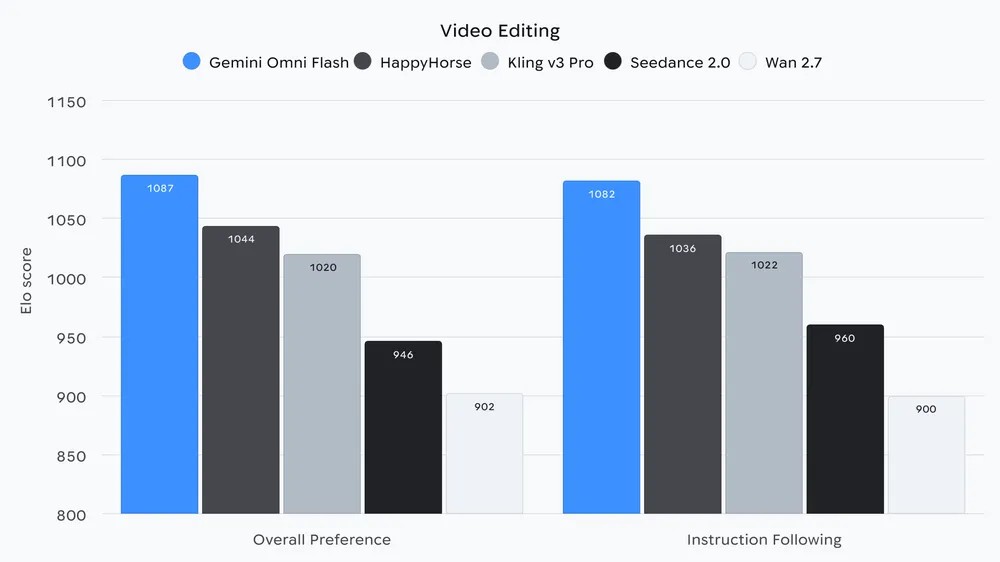
The picture below is the video editing benchmark test of Gemini Omni Flash, comparing the performance of “overall preference” and “command compliance”. As you can see from the figure, Gemini Omni Flash scored the highest in both ratings, ahead of HappyHorse, Kling v3 Pro, Seedance 2.0 and Wan 2.7:
Source: KOCPC Chinese