


Compared with rival camps that have had many brand revisions, I believe many people are familiar with Intel’s processor naming principles. On consumer products, as long as you see the beginning of Core and the suffix codes of i3, i5, and i7, you will know the basic positioning of the processor. The larger the number, the better the performance. This is an Intel rule that many people are familiar with. However, this Core, which has been used for many years, may be replaced by a new brand recently, or used simultaneously. This new brand is called “Evo”, and as the name suggests, it means revolution, change, etc. Generally speaking, when you see the word Evo, you will definitely think of a feature that is quite suitable for change. For Intel, this new architecture probably has the best chance of using this brand name:
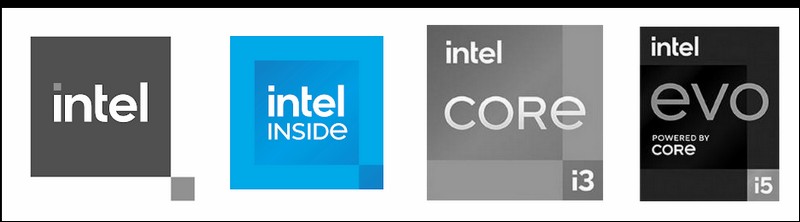
▲The new logo design is flat and square, and the new brand will have an extra line of words Powered by Core (Image source)
The new brand EVO comes with the prestige of its Core predecessors
The brand was created by netizens on Twitter “No. 188 (@momomo_us)” exposed. It is currently understood that although Intel is preparing to launch a new brand logo design, it is still unclear where Evo will be used. It can only be speculated that this brand is likely to be used on the new architecture. And this time the new structure can actually bear the description of “change”. Because the most important change in this Alder Lake architecture is that Intel is applying the large and small core design that is already quite common on ARM processors to its new processors for the first time. How efficiently the new architecture actually operates, and whether the large and small core architecture can truly achieve full performance and take into account energy saving, are all open to question.
At least, Intel seems to change the tradition of logo design style with each generation of Core, and it should be inherited. Although the next generation is not necessarily called the Core 11th generation processor, it may also incorporate the word Core into the Evo brand logo, such as adding words such as “Powered by Core”.
The design of the new logo has become quite flat. Suffix codes such as i3, i5, i7, etc. are hidden in the box in the lower right corner. Although not obvious, it can be recognized theoretically. The Evo Logo also appears behind the new series of logos, which seems a bit abrupt. After all, Core has not been replaced yet, and Intel has added an Evo brand. It makes people feel that Intel seems to want to use new models or logos to divert the impact of their past delays in the production process:
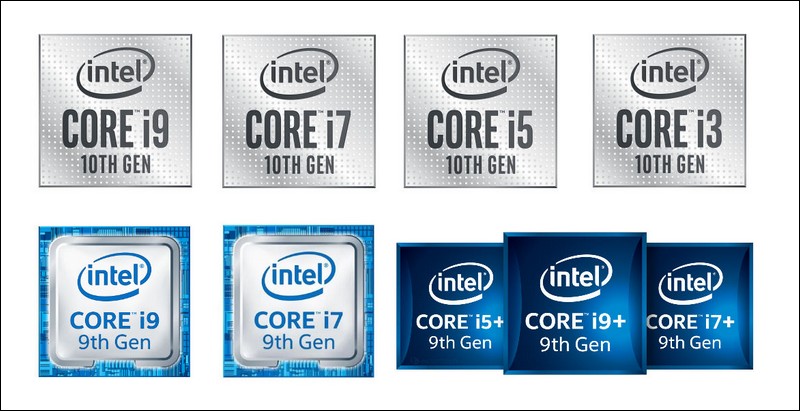
▲The logo design changes between the tenth and ninth generation processors. Naturally, this new generation of processors also has to have a new design (Image source)
Now that there is a new brand, as the possible first user of the new brand, the Alder Lake architecture is currently known to use a combination of large and small cores. This is also the first time Intel has designed such an architecture for x86 processors. The highest-end desktop version uses 8 performance cores and 8 energy-saving cores, and is paired with a GT1 GPU. Other platform processors also have different permutations and combinations, as follows:
- Alder Lake-S
- 8 big (performance) cores + 8 small (power-saving) cores, and GT1 GPU
- 6 big cores + 0 small cores, and GT1 GPU
- Alder Lake-P
- 2 big cores + 8 small cores, and GT2 GPU
-
- 6 big cores + 8 small cores, and GT2 GPU
- Alder Lake-M
- 2 big cores + 8 small cores, and GT2 GPU
By convention, the suffix S must be a desktop processor, and M is a low-voltage processor for laptops. The P part may be a processor for high-end laptops, or it may be a processor for servers. These have yet to be confirmed. It is worth mentioning that although not every processor uses large cores and small cores, there are considerable opportunities to combine them.
As for how the Evo brand will be presented in these processors, or will it be added to the existing naming system? Until there is further news, we can still only continue to care about Intel’s dynamics with this new brand. Maybe we’ll know more soon:
▲No matter what, Alder Lake is indeed a generation architecture that has undergone considerable changes (Image source)
Source: KOCPC Chinese