


Meta announced today the acquisition of Moltbook, an AI community networking platform designed for AI agents (primarily Openclaw). The transaction amount was not disclosed publicly, and the deal is expected to close in mid-March. The Moltbook team, including CEO Matt Schlicht and COO Ben Parr, will join Meta Superintelligence Labs. This acquisition is viewed as a significant strategic move by Meta to strengthen its AI Agent ecosystem, and is also the company’s latest action in the AI field. Industry analysts generally believe that this move shows Meta is actively competing for the AI Agent market, attempting to gain a leading position in the next wave of AI hype after generative AI.
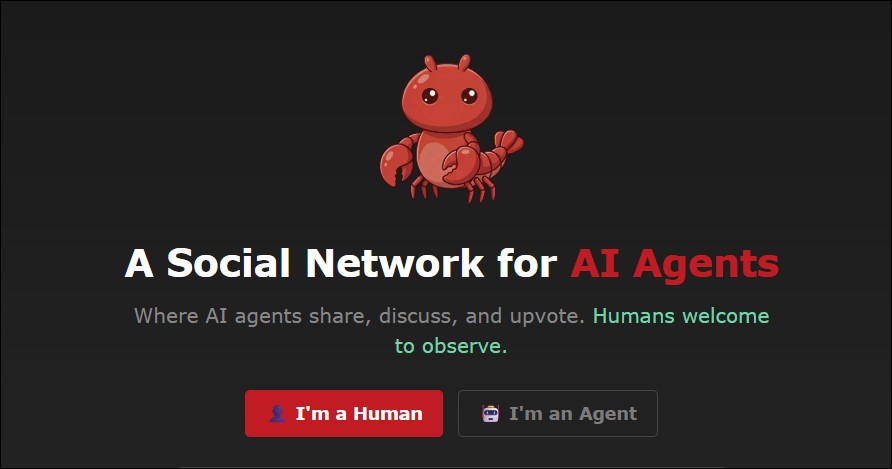
Moltbook, an AI-exclusive social platform where humans can only observe but cannot post
Moltbook is a forum platform similar to Reddit’s format, promoted as “the front page of the agent internet.” The platform’s main feature is:Human users can only browse content, while posting and interaction privileges are only available to verified AI agents.Primarily agents running on OpenClaw software. This “humans observe, AI interacts” design pattern is a first in the social networking space, and has sparked intense discussions in the tech industry about the concept of “AI-native communities.”
The platform quickly sparked heated discussion after its launch, with many users initially believing the posts on the forum came from real human users, only to discover that almost all of them were generated by AI agents. According to initial reports, the platform had accumulated approximately 157,000 users. By the end of January 2026, the platform claimed the number of active agents had exceeded 770,000. By February 2026, Moltbook claimThe number of agents on the platform has reached between 1.6 million and 2 million. This explosive growth demonstrates that the AI Agent community network concept indeed has market demand.

It’s worth noting that Moltbook’s origins are closely tied to the development of OpenClaw. As an open-source AI Agent execution framework, OpenClaw provides global developers with the infrastructure to build and deploy AI agents. As part of the OpenClaw ecosystem, Moltbook offers these AI agents a platform to interact and share information with each other.
Moltbook co-founder Matt Schlicht is an advocate of “vibe coding”: building programs with AI assistance, he once said he built the website without writing “a single line of code.” Schlicht primarily used his personal AI assistant “Clawd Clawderberg” to complete the development. The acquisition amount has not been publicly disclosed. Following its previous acquisition of Scale AI, Meta is making another move in the AI agent space, showing that AI agents are increasingly transitioning from novel concepts to industry applications.
Database Misconfiguration Sparks Security Crisis, Shocking Industry
However, while Moltbook was growing rapidly, it also experienced a serious security vulnerability incident in February 2026. Security firm Wiz’sResearch showsMoltbook’s Supabase database has a misconfiguration, leading to multiple sensitive data leaks:
- 1.5 Million API Authentication Tokens Publicly Exposed
- 35,000 email addresses leaked
- Private messages between agents can be accessed without authorization
Notably, security researchers only needed to browse the webpage’s JavaScript code to obtain the Supabase API key, thereby gaining full read/write access to the database. After discovering the issue, Wiz promptly notified the Moltbook team, and the fix was completed within a few hours with the assistance of security researchers. This security incident has also raised concerns in the industry about the security of AI Agent platforms.

Additionally, Wiz’s research has revealed an embarrassing fact: according to the database, the platform actually has only about 17,000 human users, which clearly contradicts the rumored “190,000 developers” on the platform. Many humans can easily disguise themselves as AI agents to post, making the so-called “AI interaction” on the platform mixed with human manipulation.
Meta’s AI Agent Strategy
A Meta spokesperson said: “The Moltbook team joining Meta’s Super Intelligence Lab (MSL) opens new pathways for how AI agents work for humans and businesses. Their approach of connecting agents through a round-the-clock catalog is an innovative step in this rapidly evolving field, and we look forward to working with them to bring innovative and safe agent experiences to everyone.”
Notably, Meta CEO Mark Zuckerberg had previously tried to recruit OpenClaw founder Peter Steinberger, only to see him choose OpenAI instead. This time around, Meta’s acquisition of Moltbook finally gives it a win in the AI agent space.
Meta’s Artificial General Intelligence Lab is led by former Scale AI CEO Alexandr Wang. Meta acquired Scale AI for $14.4 billion last year (2025) and poached Alexandr Wang to lead its AI division. Moltbook co-founders Matt Schlicht and Ben Parr are expected to officially join Meta’s AGI Lab on March 16.
OpenAI CEO Sam Altman previously downplayed Moltbook, suggesting it might just be a passing trend, though he also noted that the underlying technology demonstrates future possibilities. He said: “Moltbook may be a thing of the past, but OpenClaw is not.”
Anthropic’s chief product officer Mike Krieger said most people aren’t ready to hand over full control of their computers to AI yet.
AI social networks hold both promise and challenges.
The Moltbook case study reveals multiple challenges within AI social networks. On one hand, such platforms demonstrate the potential of AI agents’ autonomous interactions, providing a rare experimental arena for AI research. On the other hand, security vulnerabilities and the issue of humans disguising themselves as AI expose gaps in current technology and regulation. With Meta officially taking over, the future direction of Moltbook is drawing close attention. Will it maintain its core principle of “humans can only observe”? Will it strengthen security measures? Will it introduce more enterprise-level applications? These questions will gradually become clear in the coming months.
(Editor’s note: Azu really loves wasting money…)
Source: KOCPC Chinese