


Unexpectedly OpenAI Launch GPT-5.4 Just over a month later, GPT-5.5 just made its debut, following Claude Same here — the speed of new model iterations is really accelerating, which goes to show just how intense the competition is right now. While it hasn’t been that long, GPT-5.5 has made impressive strides, with upgrades across coding, computer operation, creating presentations and documents, and the response speed has hardly slowed down at all. Compared to competitors like Claude Opus 4.7 and Gemini 3.1 Pro, it leads the pack in multiple benchmark evaluations.

GPT-5.5 officially launches! Same speed as before, massive intelligence upgrade, outpacing in coding, computer operations, and math reasoning across the board.
This time, OpenAI describes GPT-5.5 as “better understanding what you’re doing and being able to take on more work on its own.”
Simply put, in the past you might need to break down tasks step by step and write them out clearly to get the results you wanted. Now GPT-5.5 will plan on its own, call tools, check the process, and keep pushing forward even when things are unclear, until the entire task is complete.
OpenAI particularly emphasized that this update isn’t simply about making the model larger, but also focusing on speed. GPT-5.5’s per-token latency in actual execution is nearly identical to GPT-5.4, yet it offers a higher intelligence level and is more token-efficient when handling the same Codex tasks compared to the previous generation. Achieving this was primarily done through OpenAI’s collaboration with NVIDIA, redesigning the entire inference pipeline specifically for GB200 and GB300 NVL72 systems. They even had GPT-5.5 analyze several weeks of traffic data and write a new allocation algorithm, ultimately increasing token generation speed by over 20%.
Coding capabilities are the most notable improvement in this upgrade. OpenAI says GPT-5.5 is their most powerful agentic coding model to date, handling long-running, multi-step engineering tasks more reliably, maintaining context across large systems, debugging failures on its own, and顺手 fixing surrounding affected code after making changes to a section.
In terms of computer use and knowledge work, GPT-5.5 with Codex brings computer use capabilities that feel more like having the model work alongside you on your computer compared to the previous generation—it can see the screen, click, type, and switch between different tools, and it’s also better at working with documents, spreadsheets, and presentations.
Scientific research has also seen progress. OpenAI used a customized version of GPT-5.5 with a specialized architecture to help prove a long-standing asymptotic conclusion about Ramsey numbers, and completed verification in Lean. This marks the first time GPT-5.5 produced a discovery-level mathematical result, not just writing code or explaining things.
OpenAI shared a large number of test cases, and here are some key highlights.
In the agent-based terminal operation section of Terminal-Bench 2.0, GPT-5.5 scored 82.7%, GPT-5.4 only 75.1%, while Claude Opus 4.7 scored 69.4% and Gemini 3.1 Pro 68.5%—a significant lead. BrowseComp’s agent-based browsing also performed quite well, with GPT-5.5 Pro taking first place at 90.1% and GPT-5.5 at 84.4%, while competitor Gemini 3.1 Pro scored 85.9%, considerably higher than Opus 4.7’s 79.3%:
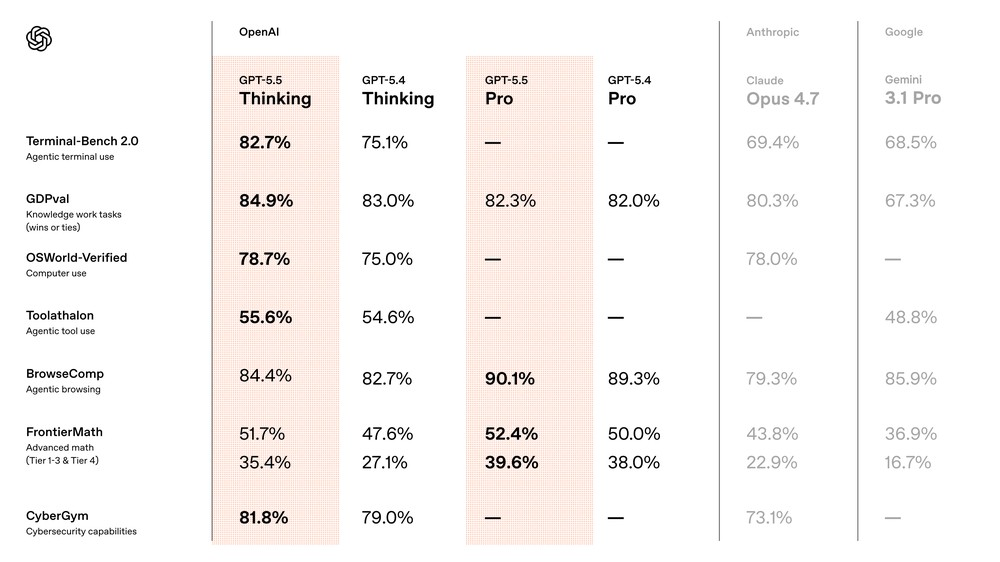
OSWorld-Verified: Real-world computer operation shows GPT-5.5 narrowly ahead at 78.7%, edging past Opus 4.7’s 78.0%, with its predecessor GPT-5.4 at 75.0%.
On SWE-Bench Pro’s real GitHub issue solving, GPT-5.5 scores 58.6%, beating GPT-5.4’s 57.7%, but Claude Opus 4.7’s 64.3% still performs better.
GPT-5.5 is now live on ChatGPT and Codex, available to all paid users including Plus, Pro, Business, and Enterprise. In ChatGPT it’s called GPT-5.5 Thinking, while GPT-5.5 Pro is exclusive to Pro, Business, and Enterprise users.
According to the official, the API section will be available soon. For pricing, GPT-5.5 is $5 per million input tokens and $30 per million output tokens, while GPT-5.5 Pro is more expensive at $30 and $180 respectively.
OpenAI also admits that GPT-5.5 is indeed more expensive compared to GPT-5.4, but emphasizes that because it’s better at saving tokens, the actual total cost may not differ all that much in practice.
Due to the addition of GPT-5.5, Codex has also evolved into an AI agent capable of cross-browser, file, and computer operations, autonomously clicking, testing processes, analyzing screens, and continuously iterating until tasks are completed. It also supports automatic Excel/spreadsheet operations and generating presentations.
Source: KOCPC Chinese