


If the smartphone in your hand were not just a mobile communication device, but a mini-computer capable of running a full-fledged desktop operating system, what kind of wide-ranging use cases would that open up? Recently, Duy Tran, a veteran hardware expert from abroad, inSocial Media Platform X It was announced that Apple (Apple) The latest entry-level model iPhone 16e Upward Movement macOS The Sequoia 15.6 system has also sparked considerable discussion among users of related hardware.
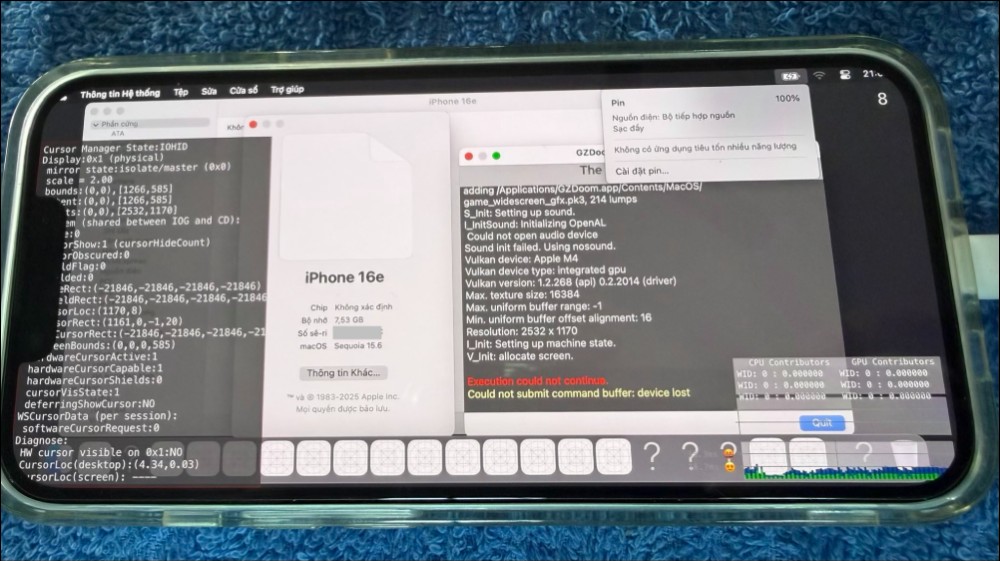
macOS Sequoia 15.6 Successfully Ported to iPhone 16e
Duy Tran’s “porting” feat in this instance is not merely running the system via an emulator, but involves deep integration with low-level drivers. According to the technical details he released, the macOS Sequoia 15.6 running on the iPhone 16e actually uses core drivers derived from Apple’s desktop M4 chip. Taking advantage of the high architectural similarity between the A18 (found in the iPhone 16e) and the M4 (found in the iPad Pro and Mac), he modified and patched the M4’s native drivers to make them compatible with the A18 mobile chip in the iPhone 16e.
Happy new year! Here is a 167gr iPhone driving macOS 15.6, with native M4 driver partially patched for A18 pic。twitter。com/daTNlbdUu5
— Duy Tran (@khanhduytran0) January 1, 2026
From the in-action footage shared by Duy Tran, we can clearly see that several key hardware metrics have been recognized by the system:
-
Memory Identification: The system successfully recognized 7.53 GB of memory, which means that macOS’s memory management mechanism is now able to take control of the iPhone’s hardware resources.
-
Graphics Processing: The Vulkan driver for the M4 chip has been loaded into the system. As a cross-platform 2D and 3D graphics application programming interface, the successful loading of the Vulkan driver indicates that initial communication with the GPU has been established.
-
Internet Connection: The Wi-Fi driver has been successfully enabled—which has often been one of the most difficult hurdles to overcome in previous cross-architecture porting experiments—indicating that the device’s network module is now functioning properly.
Current Limitations and Challenges
Duy Tran admitted that this ported version of macOS Sequoia still has numerous functional limitations. The most obvious issue lies in the rendering of the graphical user interface (GUI): aside from the Finder window, the icons for other applications on the desktop fail to load properly, giving the system a “half-finished” appearance. Furthermore, although the Vulkan driver has been loaded, the overall driver stack is not yet complete and lacks optimization for touch input, so the vast majority of applications—including games—currently fail to run. Duy Tran noted that to replicate these operations, the phone must be jailbroken.

Reasons Why the iPad Pro Can’t Run macOS
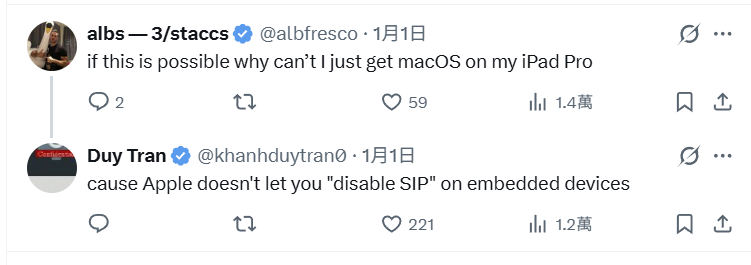
In response to this remarkable achievement, some netizens asked: Since even the lower-end iPhone 16e can run macOS, why not try running it on the iPad Pro, which has a larger screen and more powerful performance? In response to this question, Duy Tran provided a key explanation: the crux of the issue lies not in “hardware capabilities,” but in “security policies.” All of this points to Apple’s “System Integrity Protection” (SIP).
SIP is a core security feature in macOS designed to prevent malware from modifying protected system files and folders. On Mac computers, while users are protected by SIP, Apple allows them to disable SIP in certain modes (such as Recovery Mode), which gives developers and hackers some leeway to install specialized software or make system-level modifications.
However, Apple has implemented stricter controls on products like the iPad, which are classified as “embedded devices.” Apple does not allow SIP to be disabled on these devices at all. This means that even though the iPad Pro is equipped with the same M-series chip as the Mac and has more than enough performance, developers cannot bypass SIP to inject macOS system files, as they can on the iPhone using specific jailbreak methods. This is the fundamental reason why the iPad Pro, despite its formidable capabilities, remains locked behind the digital walls of iPadOS.
This research is still in a very early stage, and it’s not something the average person can easily master, so just treat it as a bit of new information for now and look forward to updates from the experts (if there are any).
The Star of the Show: iPhone 16e—An Underrated Performance Beast
As the device used in this experiment, the iPhone 16e’s performance is also worth re-examining. Although this model, released last February, is positioned as an affordable entry-level device, its core specifications are by no means lacking.
-
A Strong Heart: It’s equipped with the A18 chip, which, while not the top-of-the-line processor, is actually more than capable of running macOS.
-
Design and Specifications: Although it retains the 60Hz refresh rate and notch design from the iPhone 14 era, it features an aluminum alloy frame, keeping the weight at 167 grams (3 grams lighter than the standard iPhone 16).
-
Decentralization of Functions: It features an Action Button, typically found only on flagship models, and comes with 128 GB of storage.
-
Market Positioning: Currently priced at just21,900 New Taiwan Dollars… is the most affordable option in Apple’s product lineup.
The next models in the iPhone 17 series have not yet been announced; if they are coming, we should hear news about them in the first half of the year (perhaps as early as next month). Rumors suggest they will feature more chips developed in-house by Apple.

In fact, Apple’s hardware specifications have always been more than sufficient to run a full-fledged computer system. Previously, a tech expert managed to run the ARM version of Windows 11 smoothly on an iPad (jailbreak required); without a jailbreak, however,You can only run a very low-performance version of Windows XP in UTM SE., but it takes over ten minutes just to boot up (because Apple strictly limits the performance of the UTM emulator). So if Apple were willing, running a full version of macOS or Windows 11 on an iPhone or iPad wouldn’t be a problem—but given Apple’s approach and track record, that’s highly unlikely. However, a genius in mainland China previously managed to port Windows 11 toXiaomi PhoneIt’s used on the Xiaomi tablet.
Source: KOCPC Chinese