


Intel In the latest generation Panther Lake At the mobile platform launch event, the company emphasized that its GPU Integrated graphics performance outperforms AMD,The hands-on gameplay demos at CES 2026 were indeed quite impressive.…Meanwhile, AMD—which has long dominated the integrated graphics market—seems unable to swallow this defeat. In addition to its previous…In a media interview, he criticized Intel for comparing CPUs of different tiers, and recently released another internal forecast report indicating that Ryzen AI outperforms Panther Lake in the vast majority of categories.
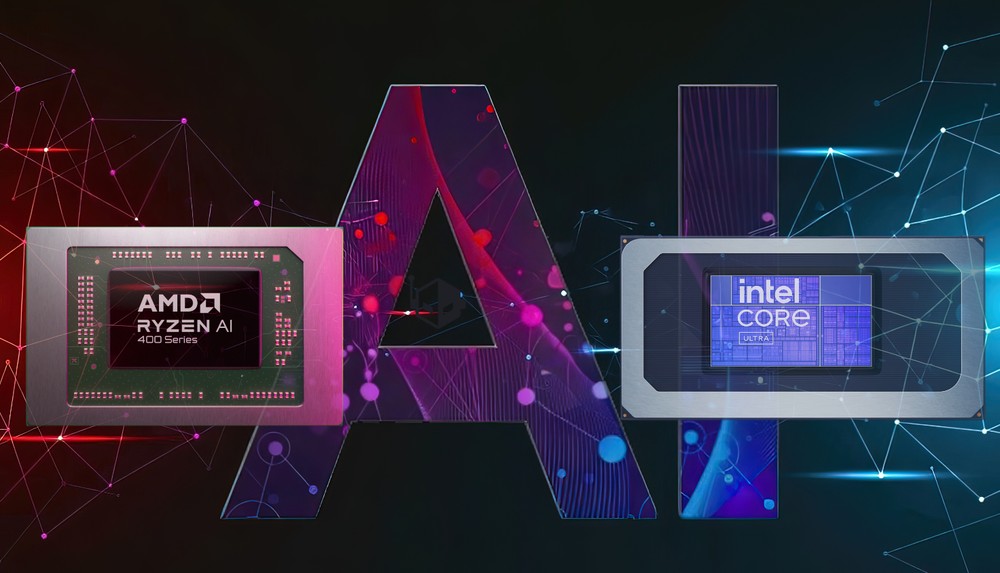
Image source: Wccftech
AMD Takes on Intel Panther Lake Once Again, Unveiling a Comprehensive Comparison of Ryzen AI Against Expectations
According to a report by the foreign media outlet Wccftech, AMD recently released a report detailing projected performance figures for its Ryzen AI processors and Intel’s latest Panther Lake processors.
First, you should know that AMD categorizes its laptop processors into four tiers, with the top-tier being the Ryzen AI MAX series, which includes models such as the “Ryzen AI MAX+ 392” and “Ryzen AI MAX+ 388.” When comparing AMD to Intel’s Panther Lake “X” series models (X9/7/5 368H), the latter feature the highest-end integrated graphics, including the Arc B390 or Arc B370.
AMD states that Ryzen AI MAX outperforms Panther Lake’s X-series in content creation, gaming performance, and AI computing; the NPUs are likely comparable, making it almost a complete victory. AMD even believes there is currently no need to launch a successor to the Strix Halo, as its existing high-end products are already capable of competing with the competition:
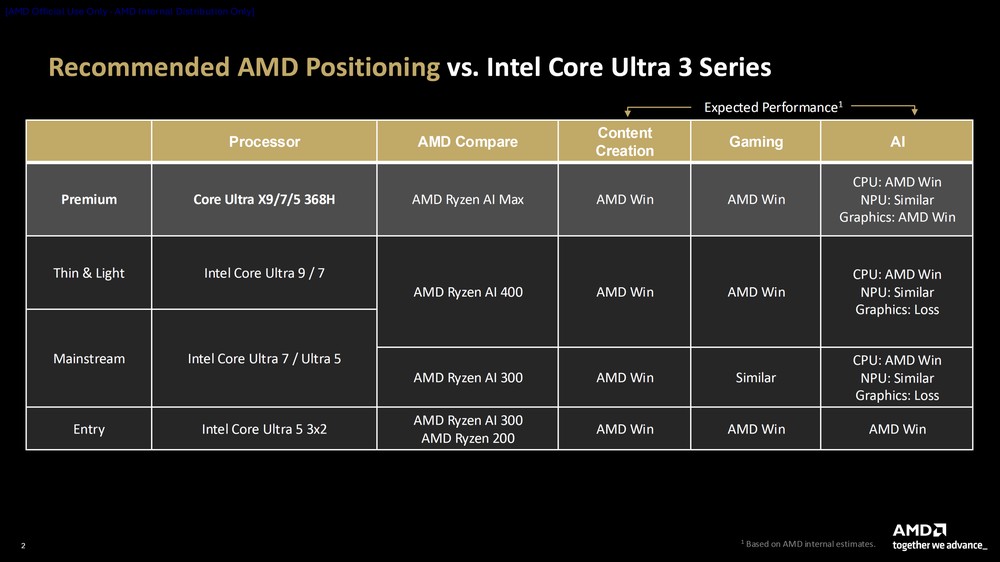
Image source: Wccftech
In the mainstream market segment (Thin & Light and Mainstream, as shown in the figure above), AMD pits its Ryzen AI 400 and 300 series against Intel’s Panther Lake Core Ultra 9, 7, and 5 series. AMD outperforms Intel in content creation across the board, and gaming performance is comparable, with only the entry-level Ryzen AI 300 models showing similar results. In terms of AI performance, the CPU comes out on top, the NPU is comparable, but the integrated graphics lose out to Intel.
It is worth noting that Intel Panther Lake processors in this price range are almost exclusively equipped with only 4 Xe3 graphics cores—just one-third of the full Xe3 architecture. In contrast, AMD continues to use the Radeon 890M/880M integrated graphics, which feature 16 to 12 compute units and offer higher clock speeds.
Finally, in the entry-level segment, AMD’s Ryzen AI 300/200 series goes head-to-head with Intel’s Wildcat Lake, and AMD comes out on top in content creation, gaming performance, and AI computing.
In addition, AMD highlighted several advantages of the Ryzen AI Max 395+ over the Core Ultra X9 388H. First is the integrated GPU; AMD claims that the Ryzen AI Max 395+ delivers graphics performance that is 37% faster than Intel’s published figures:
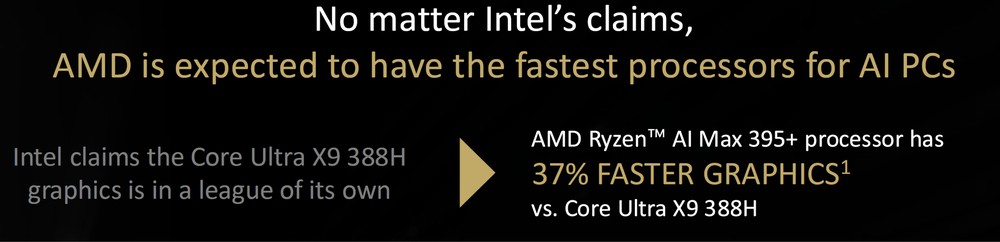
Image source: Wccftech
It also has twice as many threads. For reference, the Core Ultra X9 388H is rated at 16 cores and 16 threads. The Ryzen AI Max 395+, on the other hand, has 16 cores and 32 threads:

Image source: Wccftech
Intel claims that Panther Lake offers “industry-leading x86 energy efficiency,” but AMD argues that Intel’s official data shows there is actually no significant improvement compared to Lunar Lake:

Image source: Wccftech
Wccftech took another look at the presentation provided by Intel and indeed found that the SoC power consumption of some models is close to or higher than that of Lunar Lake. However, one slide shows that, compared to the AMD Ryzen AI 9 365, the Core Ultra X9 388H’s SoC power consumption is up to 78% lower:
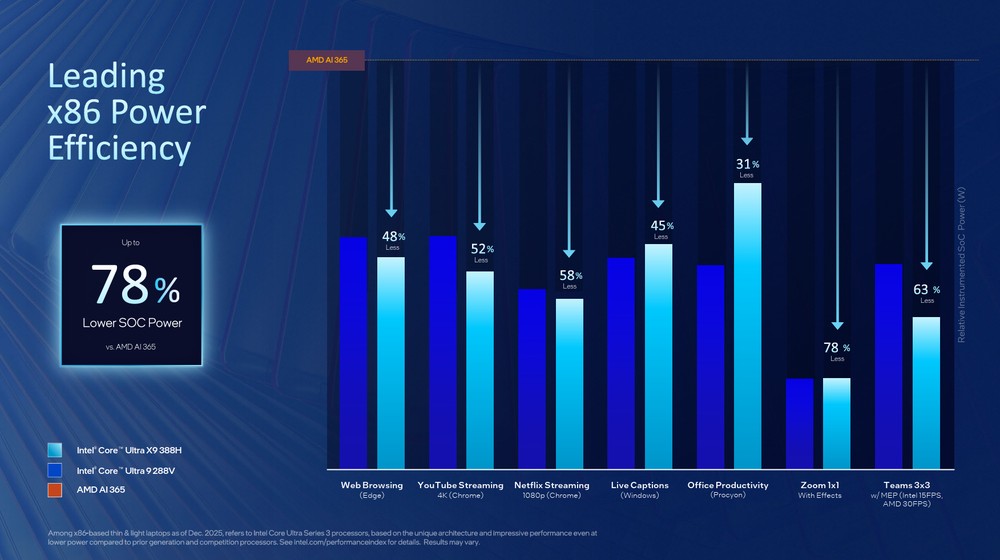
Image source: Wccftech
In any case, laptops equipped with Intel’s Panther Lake processors will hit the market next week, and we’ll see how they actually perform then. For now, all the data comes from the two companies’ internal sources, and the test environments have been optimized to some extent.
Source: KOCPC Chinese