


Google has been quite frequently launching new models recently, following yesterday’s [model] specifically designed for real-time voice translation Gemini 3.5 Live Translate Later, it also released an experimental open model called DiffusionGemma 26B. Unlike the original Gemma 4 26B, it’s not smarter—instead, through a completely different text generation method, it boosts local inference speed, allowing users to get results faster.
According to Google, DiffusionGemma’s text generation speed can reach up to 4x faster on dedicated GPUs, with a single NVIDIA H100 exceeding 1000 tokens/s and the RTX 5090 also reaching 700+ tokens/s.
Google Launches DiffusionGemma 26B: Up to 4x Faster Text Generation, Runs on 18GB VRAM After Quantization, But Positioned as a High-Speed Experimental Model, Not a Gemma 4 Replacement
This time, Google launched DiffusionGemma It is a 26B Mixture of Experts (MoE) model that only activates 3.8B parameters during inference, released under the Apache 2.0 license. One particularly attractive feature is that Google states this model can run with just 18GB of VRAM after quantization.
The key difference between DiffusionGemma and standard Gemma is that it doesn’t use the autoregressive generation approach typical of conventional large language models. Standard Gemma 4 or most LLMs work more like a typewriter, generating one token at a time, with the next token computed only after the previous one is produced. While this approach yields stable quality, when running locally, GPUs tend to hit memory bandwidth bottlenecks, causing compute resources to not be fully utilized.
DiffusionGemma, on the other hand, is more like converting text generation into a “text-version diffusion model.”
It first creates a 256-token text canvas starting with random placeholder tokens, then through multiple rounds of denoising and correction, gradually converges the entire passage into the final output. Since each forward pass can process an entire passage in parallel, all tokens can reference each other simultaneously, enabling bidirectional attention and self-correction.
These properties make DiffusionGemma better suited for real-time editing, code hole-filling, non-linear text structure generation, and even tasks like Sudoku that require global constraints.

However, it’s important to note that DiffusionGemma will not replace the standard Gemma 4 model. Google also mentioned that the standard Gemma 4 remains the recommended choice for high-quality formal output. DiffusionGemma is positioned for “fast response and low latency,” but it’s not superior to Gemma 4 in every capability.
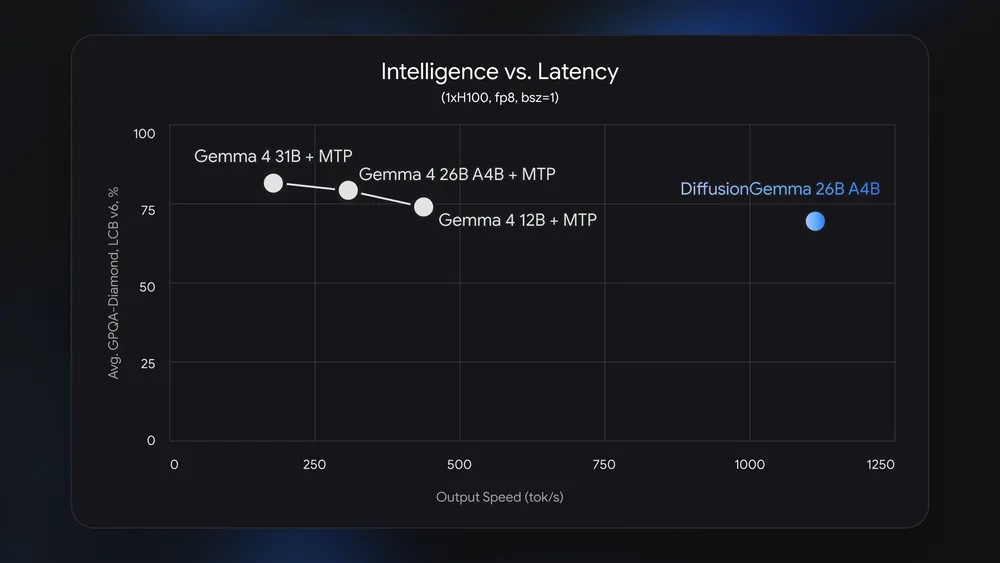
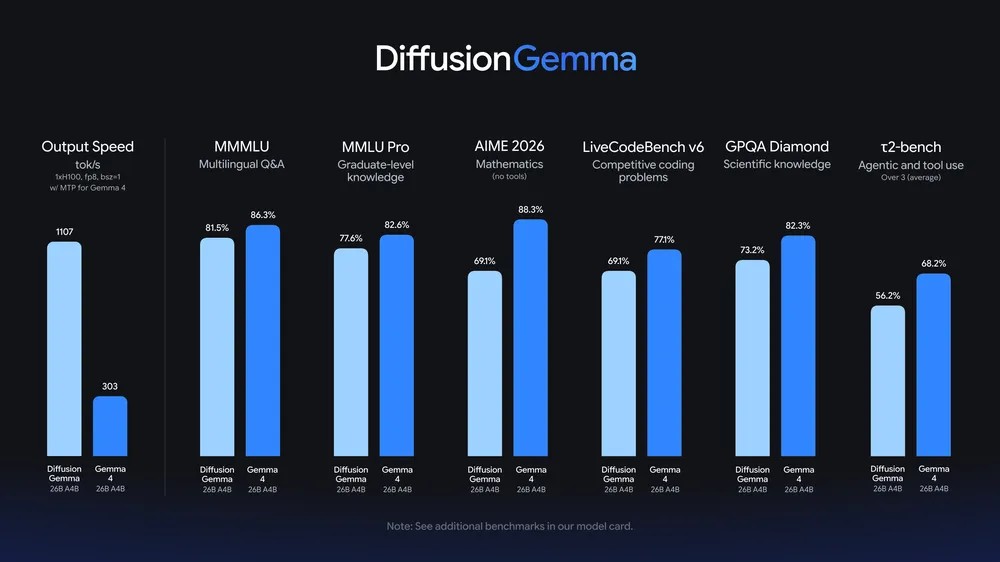
In the test data section, looking at the chart shared by Google below, DiffusionGemma is indeed significantly faster. However, it doesn’t comprehensively lead in capability scores.
- Output Speed: DiffusionGemma 26B A4B reaches 1107 tok/s, while Gemma 4 26B A4B achieves 303 tok/s, approximately 3.65x faster, close to the officially stated 4x.
- MMMLU multilingual question answering test: DiffusionGemma is 81.5%, Gemma 4 is 86.3%.
- MMLU Pro Graduate-Level Knowledge Test: DiffusionGemma at 77.6%, Gemma 4 at 82.6%.
- AIME 2026 math test: DiffusionGemma is 69.1%, while Gemma 4 reaches 88.3%.
- LiveCodeBench v6 programming competition tasks: DiffusionGemma at 69.1%, Gemma 4 at 77.1%.
- GPQA Diamond Scientific Knowledge Test: DiffusionGemma at 73.2%, Gemma 4 at 82.3%.
- t2-bench Agent and Tool Use Test: DiffusionGemma at 56.2%, while Gemma 4 reaches 68.2%.
Google has already released the DiffusionGemma weights to Hugging FaceThe model name is google/diffusiongemma-26B-A4B-it. Developers can test it using tools like Hugging Face Transformers, vLLM, SGLang, and MLX.
Source: KOCPC Chinese