


Google’s cloud technology channel (Google Cloud Tech) recently released an 8-minute tutorial video that uses Google’s open-source ADK framework to build a blog post generation Agent from scratch, featuring planning, verification, writing, and automatic retry mechanisms. This video not only demonstrates how to use ADK, but also clearly explains the operating principles of modern AI Agents and three basic design patterns. The content is insightful and beginner-friendly, making it well worth learning. Here is a simple summary and translation for everyone.
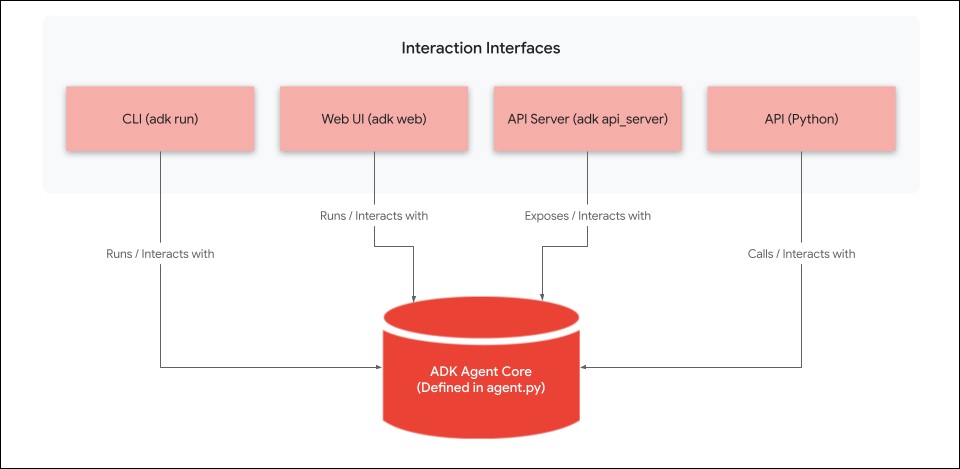
Google ADK (Agent Development Kit) was launched by Google Cloud at the 2025 NEXT conference.open-source frameworkPositioned as infrastructure for building multi-Agent collaboration systems, it adopts a Pythonic, clean design that supports hierarchical Agent structures, and provides four interaction methods: CLI, Web UI, API Server, and Python API. ADK is also the underlying framework behind Google’s own products Agentspace and Customer Engagement Suite.
Unlike many frameworks on the market that emphasize a “single super Agent,” Google ADK’sCore PhilosophyThe approach is to have multiple specialized small agents each responsible for a single task, with a root agent (Root Agent) coordinating and dispatching them. This architecture can effectively prevent instruction overload and output quality degradation.
The Essence of AI Agents: Beyond Chat to Decision-Making and Action
The video opens by clarifying the fundamental differences between AI Agents and traditional chatbots. Traditional chatbots only generate single-shot responses, while Agents analyze user requests, determine what steps are needed, may call APIs, execute code, observe results, and then decide what to do next.
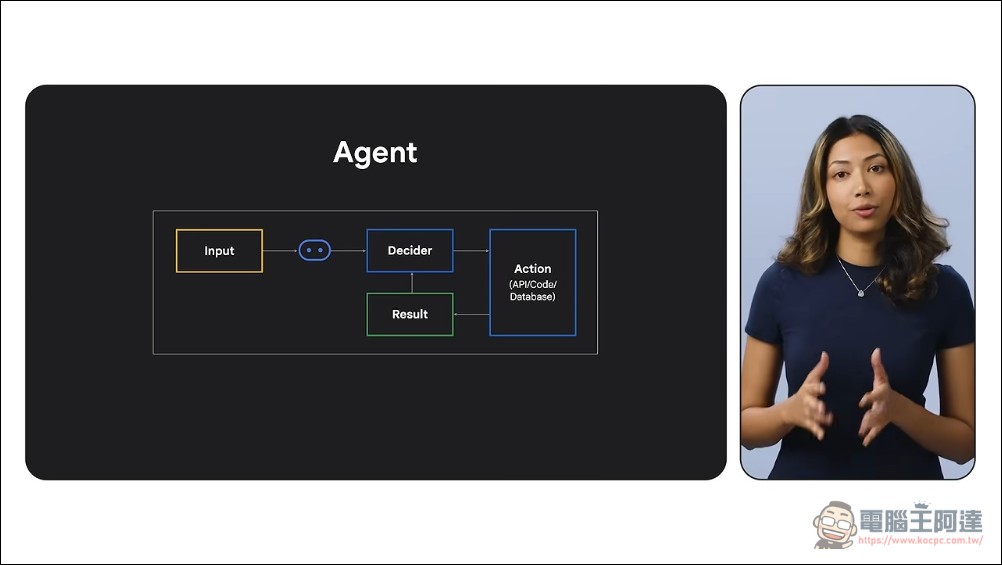
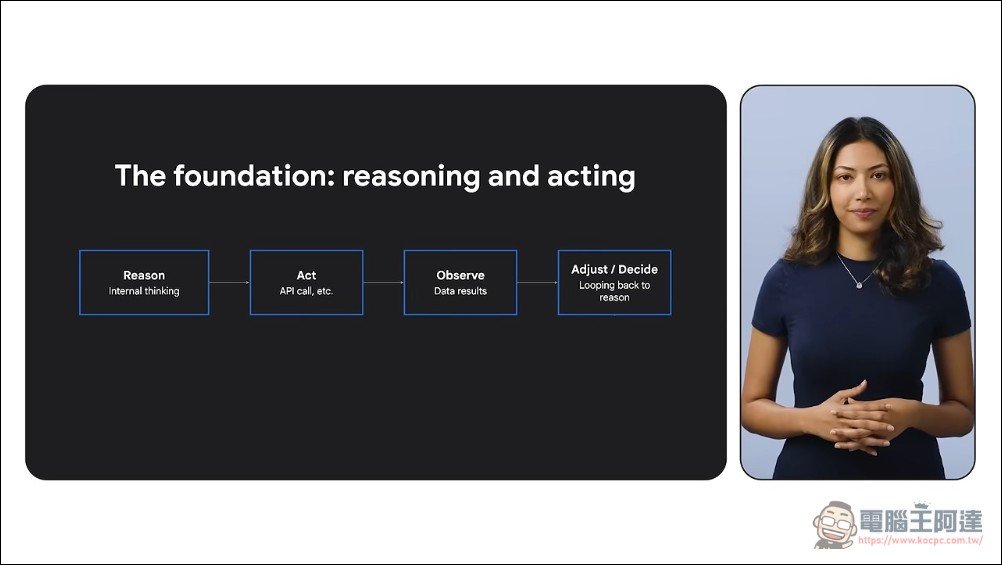
The core framework of this loop comes from the seminal paper “ReAct: Synergizing Reasoning and Acting in Language Models.” Its central insight is that language models shouldn’t generate all text at once—they should reason step by step, take actions (like calling tools or APIs), observe the results, and then decide on the next step. This “reasoning → acting → observing → adjusting” cycle is precisely the foundation of how modern AI agents operate.
The video classifies the behavior patterns of AI Agents into three basic types:
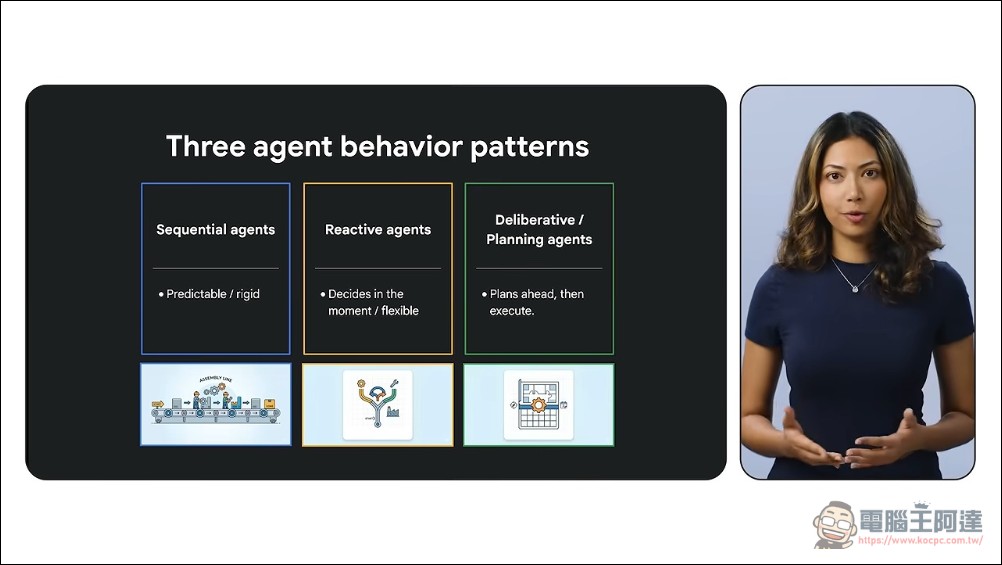
- Sequential AgentExecute step by step like an assembly line, completing step one, step two, and step three in order. The advantage is predictability, but it lacks flexibility.
- Reactive AgentDecide the next step in real-time based on the current situation—using Tool A one time, Tool B the next. This approach is flexible but lacks advance planning.
- Deliberative/Planning AgentPause to make a plan before executing. For example, when booking a flight ticket: you wouldn’t buy a random ticket. Instead, you’d first confirm the dates and hotel, then proceed in order. This applies to tasks with multiple dependent steps.
Google ADK’s Core Design: Lightweight, Pythonic, Extensible
Google ADK’s design philosophy is remarkably simple: developers only need to define an Agent’s logic, the tools it can use, and how data is processed. ADK then automatically handles state management, tool call coordination, and interactions with the underlying LLM. This “Pythonic simplicity” makes building multi-Agent collaboration systems intuitive and easy to maintain.
ADK supports multiple types of Agents. The video uses three of them:LlmAgent(Core Agent powered by LLM)LoopAgent(workflow-based Agent that automatically handles retry and validation loops), and through agent_tool.AgentTool Wrap sub-agents as tools for the root agent to invoke. These three combinations are already sufficient to cover most common agent application scenarios.
ADK is also scalable; if more complex behavior is needed, developers can create custom Agents by extending BaseAgent, without being limited to built-in types.
Practical: Build a Blog Writing Agent in 8 Minutes
The implementation section of the video thoroughly demonstrates how to use ADK to build a multi-step blog writing agent. The entire system consists of three layers:
Layer 1: Planning and Verification LoopFirst, create a Blog Planner Agent whose task is to transform a user-provided topic into a structured Markdown outline (including title, introduction summary, 4-6 sections with key points, and conclusion). To ensure output quality, add an Outline Validation Checker Agent dedicated to checking whether the outline is complete: if any elements are missing, return “retry” along with the reasons; if it passes, return “OK”. These two agents are wrapped inside a LoopAgent (Robust Blog Planner) with a maximum of three retry attempts.
Layer 2: Writing and Verification LoopNext, establish a Blog Writer Agent that reads the outline just generated from the shared state and converts it into a complete Markdown blog post. The instructions explicitly require: default audience is software engineers, skip basic knowledge, focus on practical insights, and explain both the “how” and the “why”. Also add a Blog Post Validation Checker to form a second LoopAgent (Robust Blog Writer), ensuring the post quality meets the standards.
Third layer: Root Agent integration.Finally, wrap the two LoopAgents above as tools, giving the root Agent (Blogger) two tool entry points. The root Agent’s instructions are straightforward: when a user provides a topic, first call the Planner Tool to generate an outline, then call the Writer Tool to produce the complete article, and finally attach three alternative titles along with two promotional copy snippets in Twitter-length format.
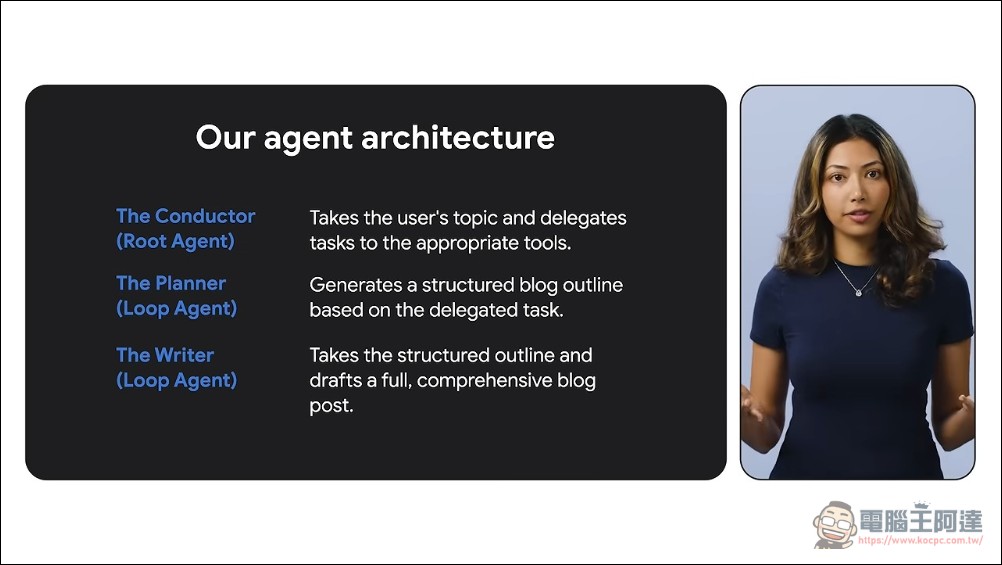
The key to this design is that through LoopAgent’s validation retry mechanism, even if the model occasionally misses some requirements, the system has fault tolerance to self-correct. Additionally, wrapping sub-agents as tools makes the root agent’s workflow clean and controllable. For more details, check out the official Google Cloud Tech tutorial video (remember to enable CC subtitles, which include Chinese explanations).
From Single-Agent to Multi-Agent Collaboration
Although this example only has one main Agent and its subtasks, the true advantage of Google ADK lies in building multi-Agent collaboration systems. The Google Cloud official blog demonstratesAnother more representative caseThe “Travel Planning System” consists of three specialized agents: FlightAgent (for booking flights), HotelAgent (for booking hotels), and SightseeingAgent (for planning attractions), coordinated by a root TripPlanner agent.
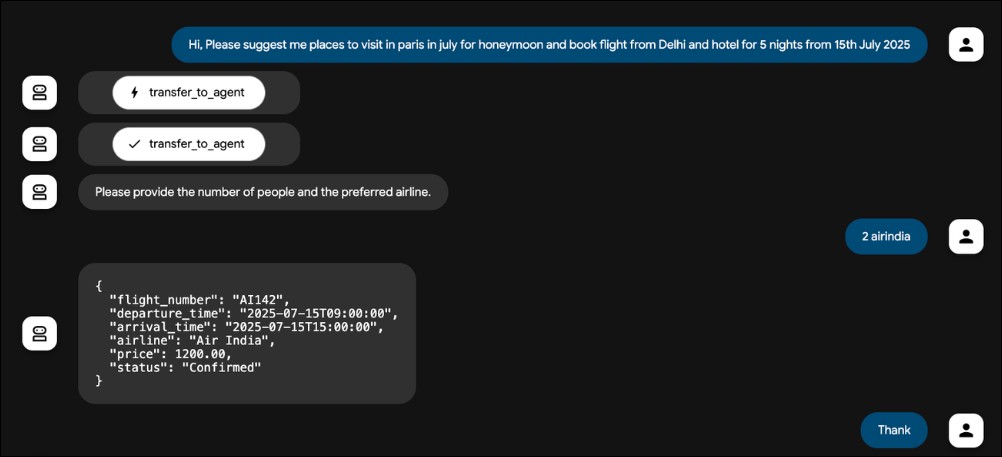
In the initial design, the root Agent calls each sub-Agent sequentially (book flights first, then hotels, then plan the itinerary), but these tasks are actually independent and can be executed in parallel. ADK’s flexible architecture allows developers to freely choose serial or parallel execution strategies based on task dependencies, maximizing system efficiency.
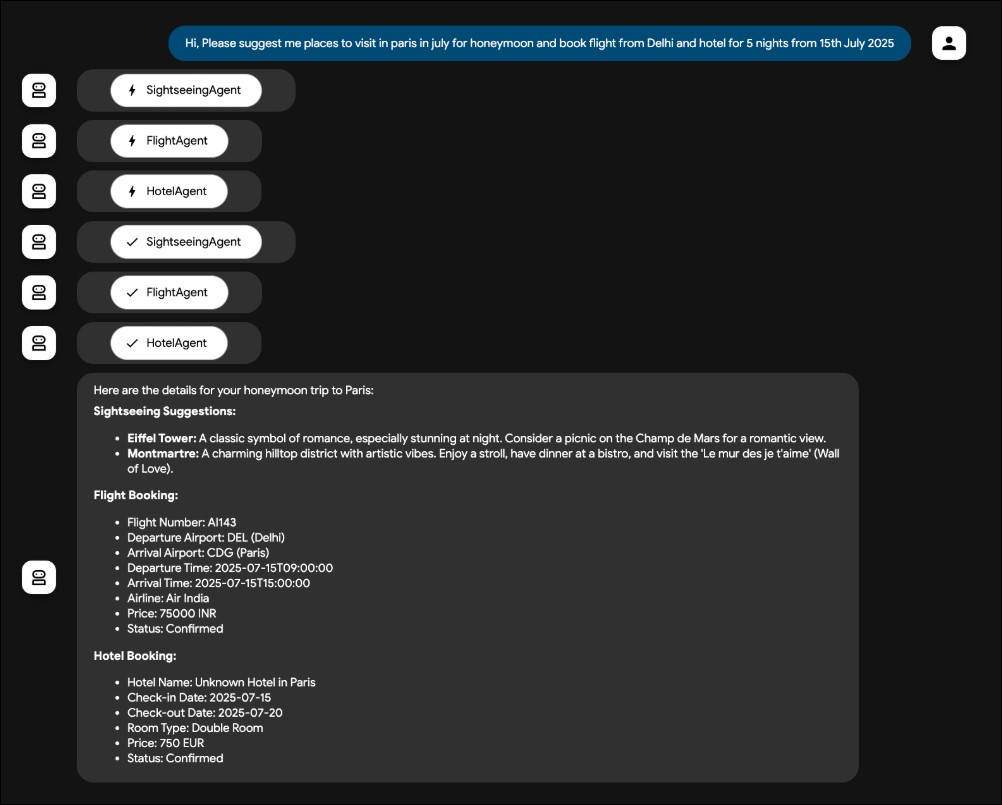
ADK also supports hierarchical delegation: the root Agent can automatically determine which sub-Agent should take over control based on the user’s query. The key lies in the description field of each Agent: the LLM uses these descriptions to decide task routing. This also means that writing clear, explicit Agent descriptions is a critical skill in ADK development.
Google ADK Open-Source Ecosystem and Resources
ADK’s GitHub repository and complete documentation are now live at adk.dev, with SDKs available in both Python and TypeScript. The PyPI package is named google-adk and can be installed directly via pip. Developers can choose from four interaction methods to communicate with Agents: CLI, Web UI, API Server, or Python API—the only difference is how they’re launched, as the Agent’s core logic code remains identical across all options.
Conclusion
This 8-minute tutorial video, though short, covers all key aspects from Agent theory to ADK implementation: the principles of ReAct architecture, three types of Agent behavior patterns, ADK’s LoopAgent verification and reproduction mechanism, and practical techniques for wrapping sub-agents as tools. For developers evaluating or just starting to use the Agent framework, this is a great starting point. As an open-source framework, Google ADK’s lightweight design and endorsement from Google products give it a clear positioning in competition with existing frameworks like LangChain and CrewAI — particularly well-suited for enterprise applications requiring deep integration with the Google Cloud ecosystem.
Source: KOCPC Chinese