


Telegram founder Pavel Durov warned in an X post on November 27 that iPhone users are being targeted by large-scale hacking, and that if iOS is even slightly out of date, simply opening a website could get you hacked. He also revealed that Telegram is pushing update notifications to all users running older versions of iOS, with the attached official notification titled “Update iOS to protect your phone.” The warning itself contained no details. Durov did not specify which vulnerabilities, which hacker group, or how many people were affected; Telegram likewise did not define which version “older” refers to. Receiving the notification does not mean Telegram has detected that your iPhone has already been hacked; it only means your OS version falls within the push criteria they set. Whether there is a real attack campaign behind this is the key question to pursue.
🚨 iPhone users are being hacked on a massive scale. If your iOS is even slightly outdated, all your data is at risk. Just opening a website can be enough to get you hacked. We’re sending this warning to all our users on older iOS versions: https://t.co/k2BKf5N5ua
— Pavel Durov (@durov) November 27, 2026
The answer is yes—and in the same month. Two iOS supply chain and malicious advertising attacks disclosed in quick succession in November both used a “get hit just by opening a webpage” approach, making off with iPhone users’ cryptocurrency wallets and password manager data in their browsers.
A single piece of third-party code became a common entry point for 178 websites.
The first occurred on November 16. Researcher Scott Helme and the Report URI teamDiscoveryA vulnerability exists in digital experience platform Optimizely’s Web Experimentation product; attackers exploited it to inject malicious code into customer projects and spread it through Optimizely’s own content delivery network. The tainted JavaScript snippets are widely present on the websites of brands such as BBC, CNN, Zoom, Salesforce, GitLab, IKEA, HSBC, Equifax, and Ledger, and these companies’ own servers were not compromised.
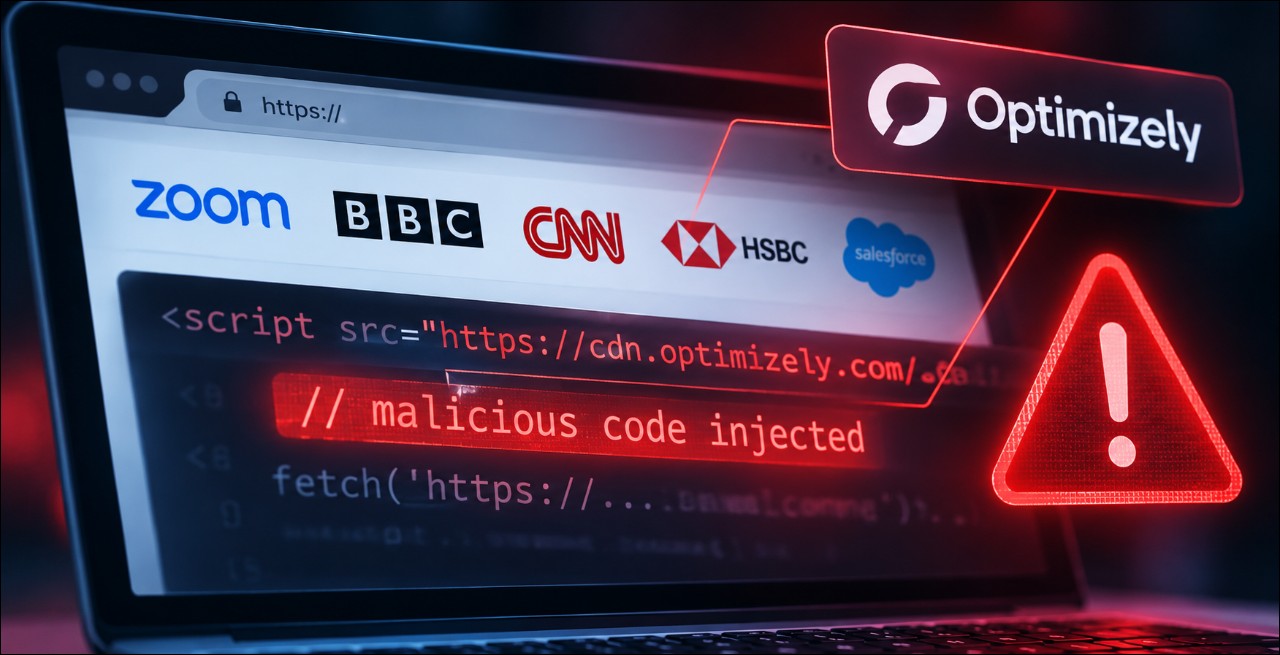
Report URI examined 1,611 Optimizely code snippets, 188 of which were infected and belonged to 178 organizations. The malicious file track.js replaces cryptocurrency wallet addresses on pages with the attacker’s, covering page text, form fields, links, images, the clipboard, and outgoing requests; when a user copies an address from any affected page and pastes it into a wallet, it already belongs to the attacker. The code also intercepts card numbers, expiration dates, and CVVs, and exfiltrates cookies and page screenshots. The attacker received about $7,040 in about nine hours that day.
In its analysis, Veracode highlighted the structural problem behind this incident: the scripts came from a trusted vendor, and both browsers and websites treated them as legitimate code. Optimizely’s snippet is widely deployed across roughly 190,000 online sites, meaning a vulnerability in a single vendor can cause a large number of unrelated websites to deliver malicious code at the same time.
The same set of tools, targeting older versions of iOS.
For iPhone and iPad users, the attack script reads the iOS version and then loads a different exploit chain into a hidden iframe depending on the version. Report URI’s mapping is as follows: iOS 13 through 17 uses Coruna, 18.x uses DarkSword, and 26 is another chain that currently only collects device characteristics. Coruna’s loader is byte-for-byte identical to a sample the team analyzed in another campaign in October, and comments in the tool itself state that it has been patched after iOS 18.7.3 and after 26.3. Pages on iOS 18.6 or earlier reload every 60 seconds to retry the exploit, which is a symptom users can see.
Neither of these two toolsets is new. On March 3, the Google Threat Intelligence Group (GTIG)Expose Coruna, which is said to be an exploit kit targeting iOS 13.0 to 17.2.1, containing 5 complete attack chains and 23 exploits, with its most advanced parts using non-public exploitation techniques and mitigation bypasses. GTIG recorded the spread path of this toolkit: in February 2025 it first appeared in the attack chain of a surveillance vendor’s customer, then was used to launch watering hole attacks against Ukrainian users, and finally ended up in the hands of a China-based, profit-motivated organization. GTIG also found the same toolkit on a large number of pages disguised as Chinese financial websites, including fake cryptocurrency exchanges.
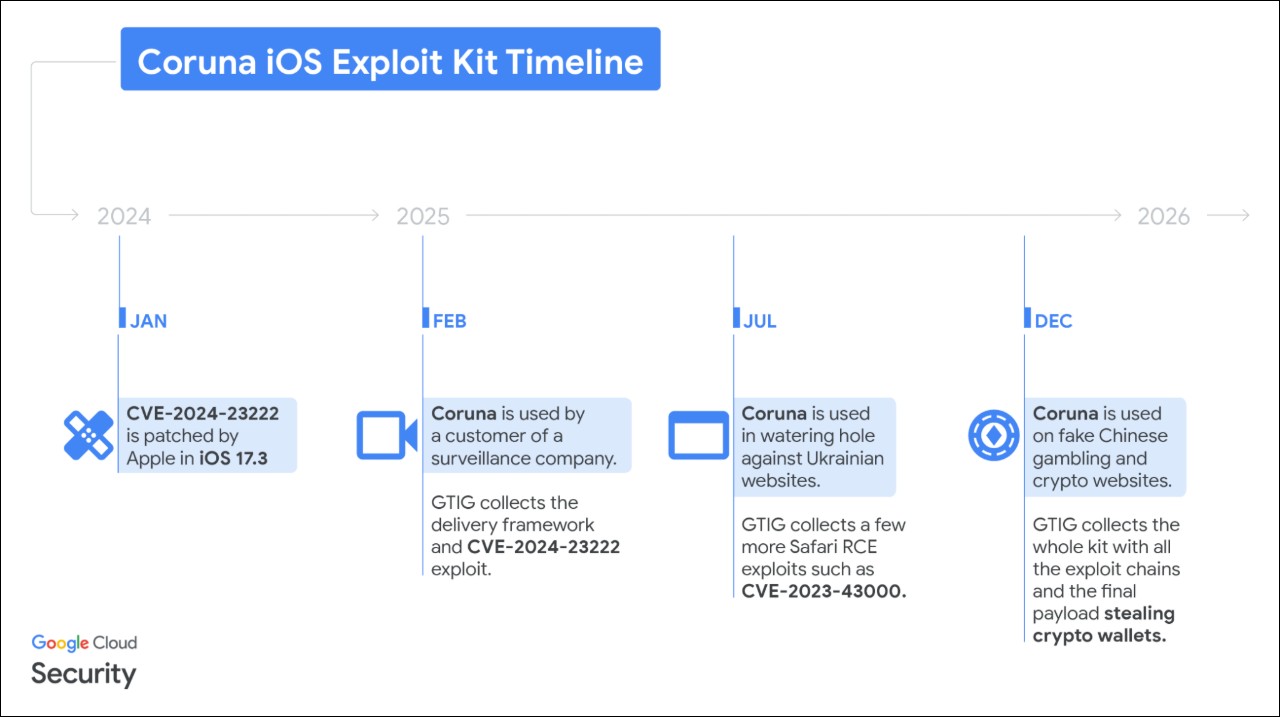
DarkSword was jointly disclosed on March 18 by GTIG, Lookout, and iVerify. It supports iOS 18.4 through 18.7 and uses six different vulnerabilities to carry out a complete chain attack; after a successful takeover, it deploys three malware families: GHOSTBLADE, GHOSTKNIFE, and GHOSTSABER. GTIG observed that at least since November 2025, several commercial surveillance vendors and suspected nation-state organizations have used this chain in different attack campaigns, targeting entities in Saudi Arabia, Turkey, Malaysia, and Ukraine.
Case Two: One click on an ad and you’re hit.
On November 20, ad security company Confiant Uncover another malicious ad campaign named MoldyRoost.This batch of ads was delivered programmatically and hid its landing pages behind cloaking; every ad click amounted to a silent exploit attempt against the visitor’s iPhone. The attack had already executed the moment the landing page loaded—no fake download button was needed, and there was no command to paste. Confiant tracked more than 480 ad domains between May 12 and November 17, 2026, divided into six subgroups, A through F, targeting more than 47 countries.

The exploit kit used by MoldyRoost comes from the Coruna and DarkSword families, plus SilkPath and GhostWave. These tools are designed to exfiltrate cryptocurrency wallet seed phrases, password manager (keychain) data, messages, and photos. Confiant noted that these tools came from outside and originated in the original surveillance industry chain, before being taken over by criminals.
Updated Paths and Alternatives
On November 9, Apple released iOS 27.2.1 and iPadOS 27.2.1, and on the same day also released iOS 26.7.3 and iOS 18.7.12 for older models; the latter is for iPhone XS, XS Max, and XR, which cannot upgrade to the new system. Apple’sSecurity release page display, none of these versions has any item marked “possibly exploited.” In its Coruna disclosure, GTIG explicitly states that Coruna is ineffective against the latest version of iOS and strongly recommends that users update to the latest version of iOS; if they cannot update, it recommends enabling Lockdown Mode to enhance protection. The DarkSword article likewise recommends updating and states that the relevant vulnerabilities were all patched when iOS 26.3 was released.
Lockdown Mode’s protective effect has a technical basis. Coruna’s framework will immediately exit and stop executing when it detects that the device is in Lockdown Mode or the user is using private browsing. Apple’s official documentation lists the items that will be restricted once it is enabled: most message attachments are blocked; some complex web technologies in web browsing are disabled, causing websites to load slowly or function improperly; incoming FaceTime calls are blocked (unless you have called that contact in the past 30 days); and invitations from Apple services are also restricted. Durov also gave this advice in the original post and reminded users that Lockdown Mode will disable quite a few web features.
Conclusion
This incident makes it very clear how low the bar for hacking is. These two campaigns in November make the answer clear: no download is needed, no button needs to be clicked—simply opening a webpage is enough to set the exploit chain in motion and make off with wallet addresses, credit card data, and seed phrases along the way. The attack surface has shifted from the application layer to the browser layer. This is one of the hardest categories of problems mobile device security has faced for years, and it is no wonder both GTIG and Confiant point to the same set of tools that have leaked out of the surveillance industry.
There are only two practical recommendations for users: update iOS to the latest version available, via Settings, General, Software Update; if you can’t update, turn on Lockdown Mode via Settings, Privacy & Security, Lockdown Mode, at the cost of limited web functionality and some communication features. The parts Durov didn’t write in that post are fully documented on Apple’s own security updates page.
Source: KOCPC Chinese