


On November 23, IEEE released the draft program for ISSCC 2027, and Huawei had 4 papers accepted, among whichOne articleThe topic is self-developed high-bandwidth memory (HBM). Judging from the information revealed in the title, this self-developed chip uses 64 channels and 4096 DQ pins, the memory controller is directly integrated on the chip, and the stacking method uses 5-layer wafer-to-wafer (W2W) hybrid bonding, replacing the TSV stacking of mainstream HBM. The new HBM specification is expected to bring 2x bus width, enabling Ascend 960 memory bandwidth to reach 9.6 TB/s, exceeding the 8 TB/s of NVIDIA Blackwell B300.
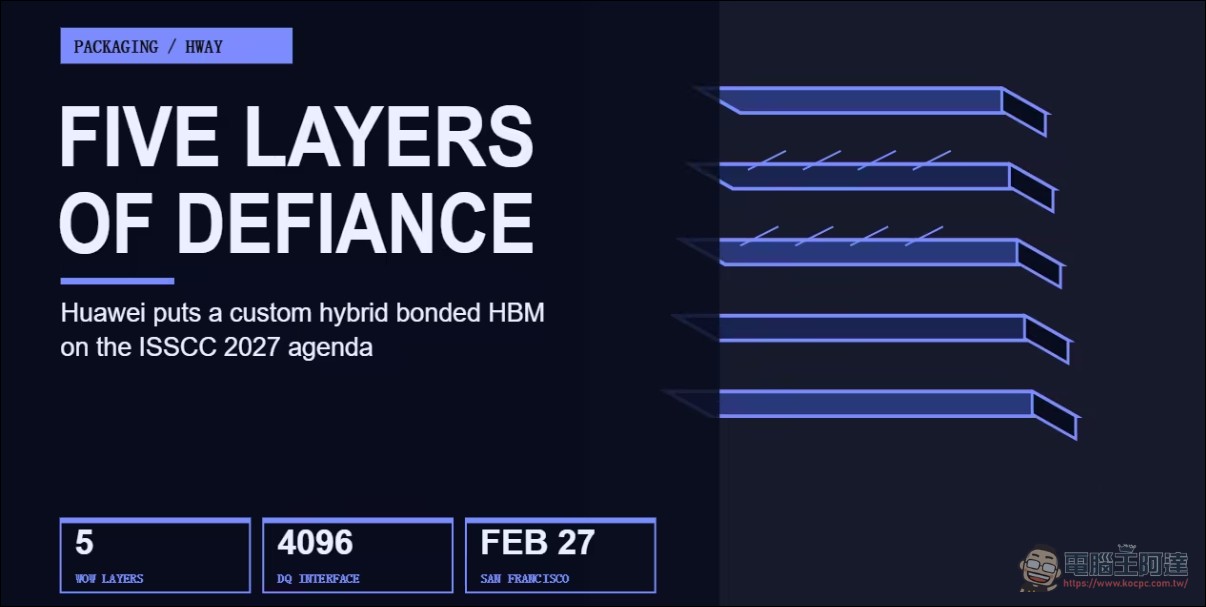
Huawei’s 4,096 pins take a different route.
The official JEDEC HBM4 standard JESD270-4 describes the bus straightforwardly: a 2048-bit interface, a maximum per-pin data rate of 8 Gb/s, and a maximum total bandwidth of 2 TB/s per stack; the number of independent channels doubles from 16 in HBM3 to 32, with each channel further paired with 2 pseudo-channels. HBM3 itself has a 1024-bit interface, 64 bit per channel, and 16 channels.
Huawei’s chip takes a different path. Its 4096 DQ pins mean the bus width is twice that of HBM4, the controller is integrated on the chip, and 5-layer W2W hybrid bonding directly bonds the main controller chip with five wafer layers. W2W wafer bonding itself is not easy, and 5-layer bonding is even more complex. Technically, it is more advanced and more aggressive than the TSV route; whether the sacrifices in yield and cost are worth it can only be assessed once actual products are available.
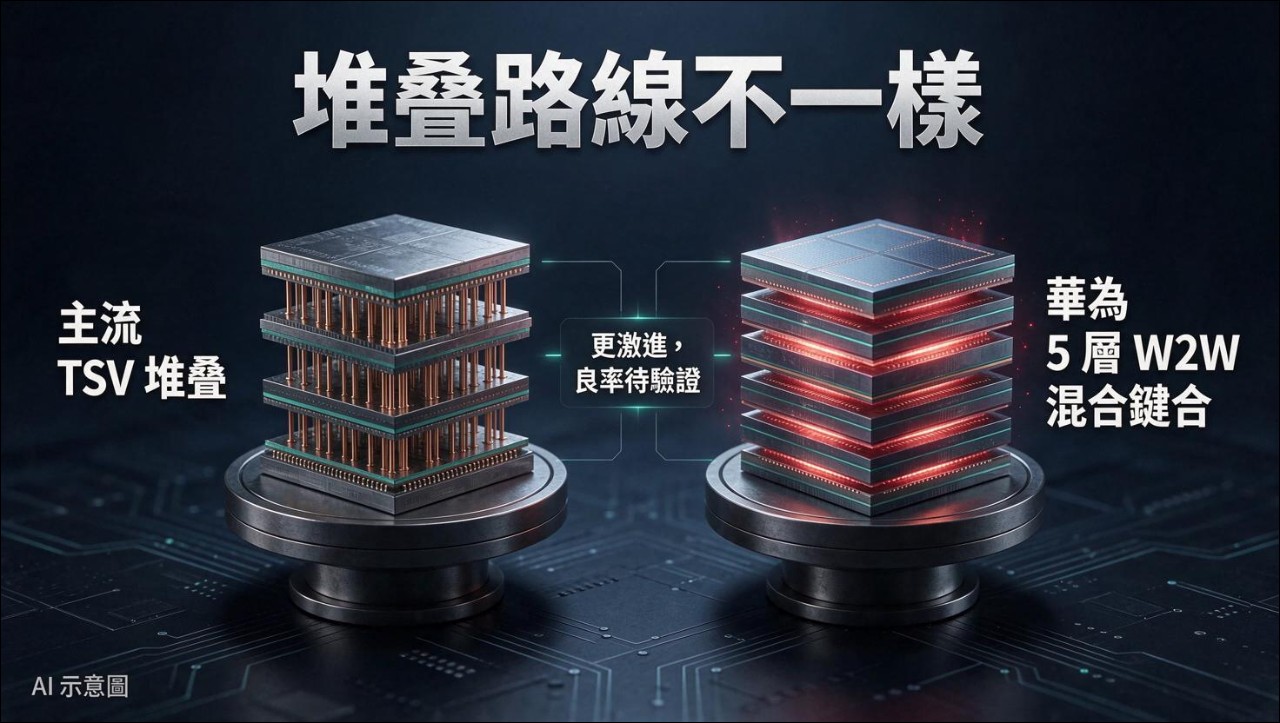
Huawei’s four accepted papers are not only about HBM. The other three are LogicFolding, a flagship mobile SoC using full-chip intra-module partitioning; a reliability-enhanced 33A three-dimensional stacked integrated voltage regulator targeting kiloampere-level power delivery; a design that reduces AI processor system power consumption by 59 watts; and a 71.3-femtosecond fractional-N ring PLL targeting 212.5 Gb/s line transmission. Of the four papers, the HBM paper is the only one directly related to self-developed memory.
Bus width and bandwidth are two different things. 4096-bit refers to the interface width; actual bandwidth also depends on the transfer rate and controller design. The 9.6 TB/s of the Ascend 960 is the memory bandwidth specification for the entire package. Currently, publicly available information remains at the level of paper titles; complete technical details, yield figures, and the productization path will have to wait until ISSCC 2027, held in San Francisco from February 14 to 18, 2027, to be revealed.
In-house developed HBM has reached its third generation.
This is not the first time Huawei has publicly discussed its self-developed HBM. HiBL 1.0 is paired with the Ascend 950PR, with 128 GB capacity and 1.6 TB/s bandwidth; HiZQ 2.0 is paired with the 950DT, with 144 GB capacity and 4 TB/s bandwidth, close to the 4.8 TB/s of NVIDIA H200. The 950PR adds support for low-precision data types such as FP8, MXFP8, and HiF8, focusing on improving vector compute and interconnect bandwidth, while the 950DT focuses on improving inference decoding performance and training performance.
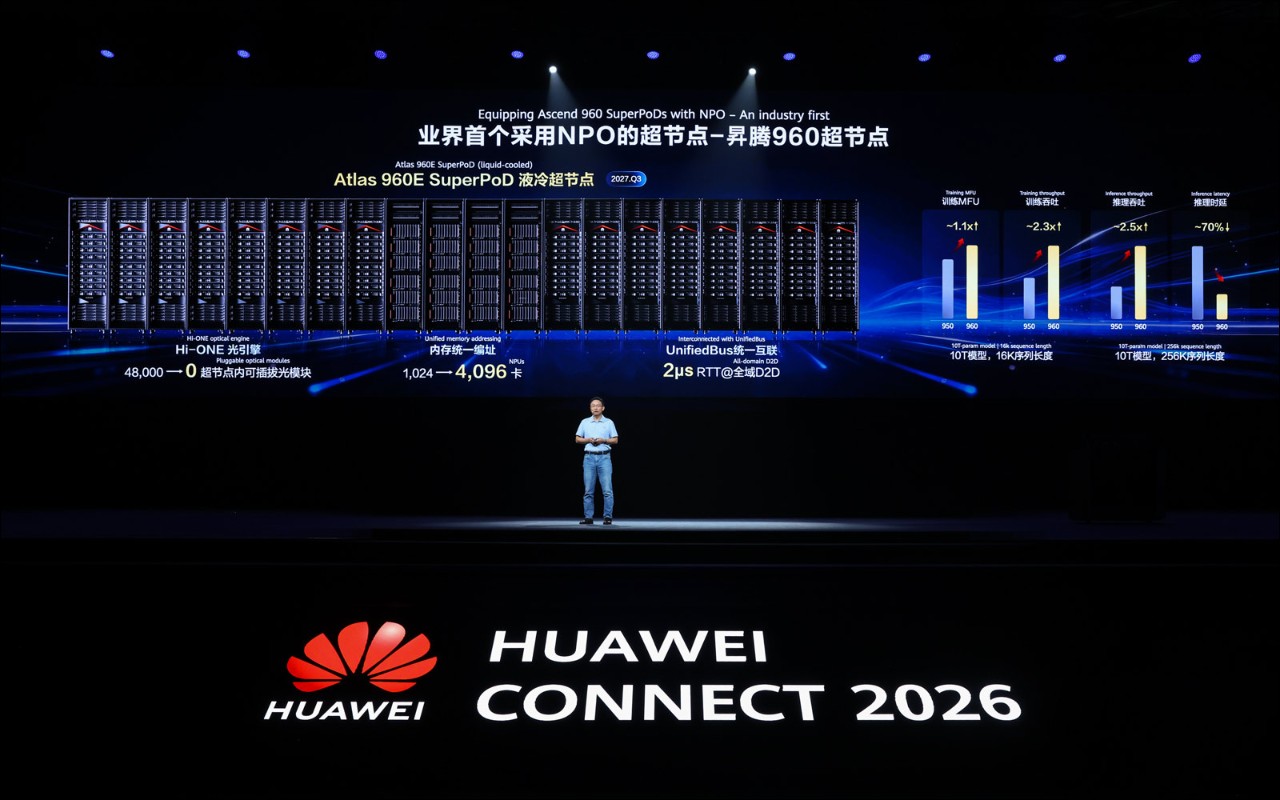
The specs for Ascend 960 were announced by Huawei at Huawei Connect on September 17, 2026. Rotating Chairman Wang Tao said Ascend 960’s development is ahead of schedule and its performance has doubled. The 960DT supports 2 PFLOPS FP8 and 4 PFLOPS FP4 compute, with on-chip HBM capacity of up to 288 GB and memory access bandwidth of up to 9.6 TB/s; its schedule is three quarters earlier than the original target, landing in Q1 2027. The 960PR offers 2 PFLOPS FP8 and 8 PFLOPS FP4 and will be ready in Q3 2027, also one quarter earlier than originally planned. Huawei is maintaining a one-generation-per-year cadence, with Ascend 970 and 980 set for 2028 and 2029 respectively. The 970’s memory bandwidth target is 14.4 TB/s, still a gap compared with NVIDIA Rubin’s 22 TB/s.
The same batch of 960DT still uses memory made by Samsung and SK Hynix.
The Information ReportHuawei has told some customers that its flagship Ascend 960DT will use a significant proportion of HBM manufactured by Samsung and SK Hynix. U.S. controls effective December 2024 prohibit the sale of advanced HBM to Chinese customers, and BIS guidance also determines that any use of Huawei Ascend chips constitutes a violation of export controls.
Huawei’s statements about HiBL and HiZQ have never gone beyond the word “self-developed”; Huawei has not said where these memory chips are manufactured or by whom. The report cited sources as saying that Chinese chipmakers are increasingly relying on gray-market channels to obtain HBM, and that such memory typically sells for several times the price paid by overseas buyers. Memory accounts for a large share of AI accelerator card production costs; with gray-market prices several times those overseas, this amounts to giving up both the ceiling on shipment volumes and the ceiling on costs.
The two figures in the memory market
Semiconductor analyst Jim Handy (founder of Objective Analysis), in an interview with The Korea Times, pointed out that hyperscalers such as Google, Meta, Amazon, and OpenAI spend about 40% of their revenue on capital expenditures; the demand growth is temporary, and prices will eventually return to 2024 levels; if past memory cycle patterns hold, gross margins could fall from above 80% to near zero in about two quarters. As of last Friday, Samsung Electronics and SK Hynix shares had fallen about 33% and 34%, respectively, over the past three months.
The source of the figure “70% price drop” is someone else. Korea’s Daeye Securities put together a set ofSimulationTesting operating profit under scenarios where memory prices fall by 10% to 70%. If prices fall 10%, Samsung’s operating profit would still be KRW 605.2 trillion, and SK Hynix’s KRW 438 trillion; in the most extreme scenario of a 70% drop, the two would still have KRW 81.5 trillion and KRW 85.4 trillion, equivalent to about RMB 404.5 billion and RMB 422.4 billion, still nearly twice Samsung’s full-year 2025 operating profit of KRW 43.6 trillion.
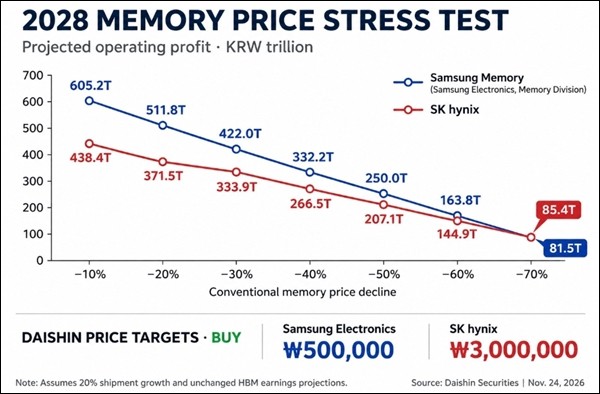
The assumptions of this set of models are that shipments maintain 20% annual growth and HBM profits remain unchanged. But if AI demand can maintain rapid growth, prices cannot fall sharply; the two are contradictory. The outcome will either be a sudden weakening of AI demand, a crash in memory prices, and the consequent disappearance of HBM’s high premium, or demand remains persistently tight and there is no room for prices to fall. Huawei’s path of developing HBM in-house logically corresponds to a third option other than the latter.
Bottlenecks Beyond Memory
HuaweiThe official statementFocusing on supernodes, the Atlas 950 SuperPoD actual system is deployed with 1,024 cards, delivering 1 EFLOPS FP8 and 2 EFLOPS FP4 compute, 256 TB of globally unified memory addressing space, and 3 μs ultra-low RTT latency; more than 750 Ascend 384 supernodes have been deployed worldwide. In the product line announced at Huawei Connect 2025, Atlas 950 SuperPoD has 8,192 Ascend NPUs, Atlas 960 SuperPoD can connect up to 15,488, Atlas 950 SuperCluster exceeds 500,000, and Atlas 960 SuperCluster exceeds one million. Huawei’s Peerium computing architecture announced in September 2026 uses nested parallelism, unified memory addressing, and peer-to-peer interconnection to scale to one million processors. The 256,000-card version of Atlas 950 SuperCluster is already being deployed, while the Atlas 960 system using near-packaged optics is still in testing.
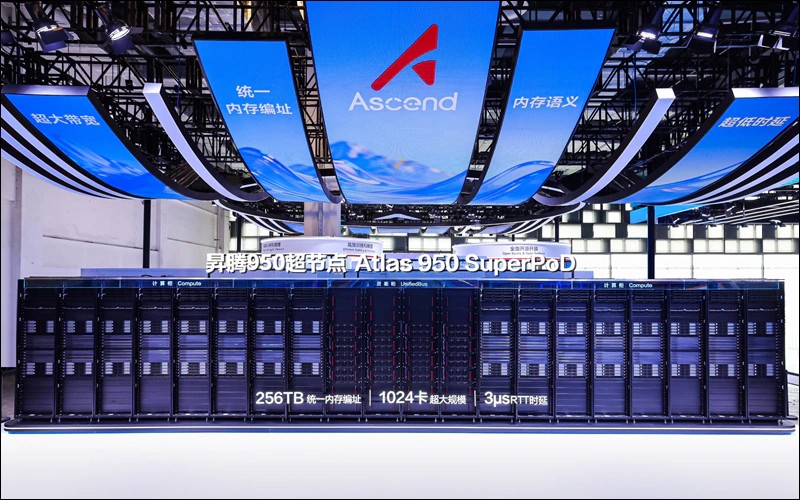
Another official Huawei figure is the Atlas 850E air-cooled supernode, equipped with 4.0 TB/s high-speed memory bandwidth. It can be racked directly in standard cabinets and scaled from a single unit to a 96-card commercial deployment, targeting inference scenarios with 10-millisecond-level latency. Once in the 8 to 10 TB/s range, training and inference will no longer be bottlenecked by bandwidth, and memory will no longer be the weakest link in China’s domestic AI compute; next, interconnect at the 100,000 to 1,000,000-card scale will be key. From this perspective, looking back at self-developed HBM, its value lies not in benchmark numbers but in turning memory from an external supply bottleneck into an internally controllable link.
Conclusion
Specifications such as 4096 pins and 5-layer hybrid bonding will not get full papers and reports until ISSCC 2027 in February 2027; there are still no answers on yield, who will manufacture it, or whether it can become a mass-produced product. Huawei’s move should be viewed in light of two facts: it has indeed put an alternative onto the agenda of the world’s most advanced engineering conference, while the 960DT scheduled to ship in Q1 2027 still uses memory from Samsung and Hynix. Self-developed HBM is a bargaining chip that can only be cashed in after 2027; in the current batch of chips, Huawei is still buying memory from Samsung and SK Hynix.
Source: Huawei Puts Custom HBM on the ISSCC 2027 Agenda
Source: KOCPC Chinese