


The U.S. Federal Communications Commission (FCC) announced on November 25 local time that it had approved SpaceX to deploy up to 1 million orbital computing modules to establish data centers in Earth orbit. This is the first license the United States has issued for a space data center constellation. FCC Chairman Brendan Carr relayed the news in a post on the social platform X. The project, called Starmind, will be distinct from the Starlink satellites that primarily provide internet connectivity. Starmind satellites themselves carry computing chips, process large amounts of data in orbit, and then transmit it back to Earth, with the satellites exchanging information via laser communications. The FCC statement noted that the system is solar-powered and complies with the commission’s orbital debris regulations.
DATA CENTERS IN SPACE🇺🇸 Today, in a historic first, the FCC approved SpaceX’s request for 1 million satellites (orbital compute modules) to create data centers in space The Starmind & competitor constellations will use solar power to extend America’s lead in Super Intelligence https://t.co/VJinjK5e5E
— Brendan Carr (@BrendanCarrFCC) November 25, 2026
Approval Details and Deployment Timeline
According to the FCC press release, this authorization allows SpaceX to establish up to 1 million orbital data centers to meet the rapidly growing demand for artificial intelligence computing. In communications, the FCC approved SpaceX’s use of radio frequencies as backup and emergency telemetry, tracking, and command (TT&C) links, using the 18.8 to 19.3 GHz downlink band and the 28.6 to 29.1 GHz uplink band to supplement optical inter-satellite links.
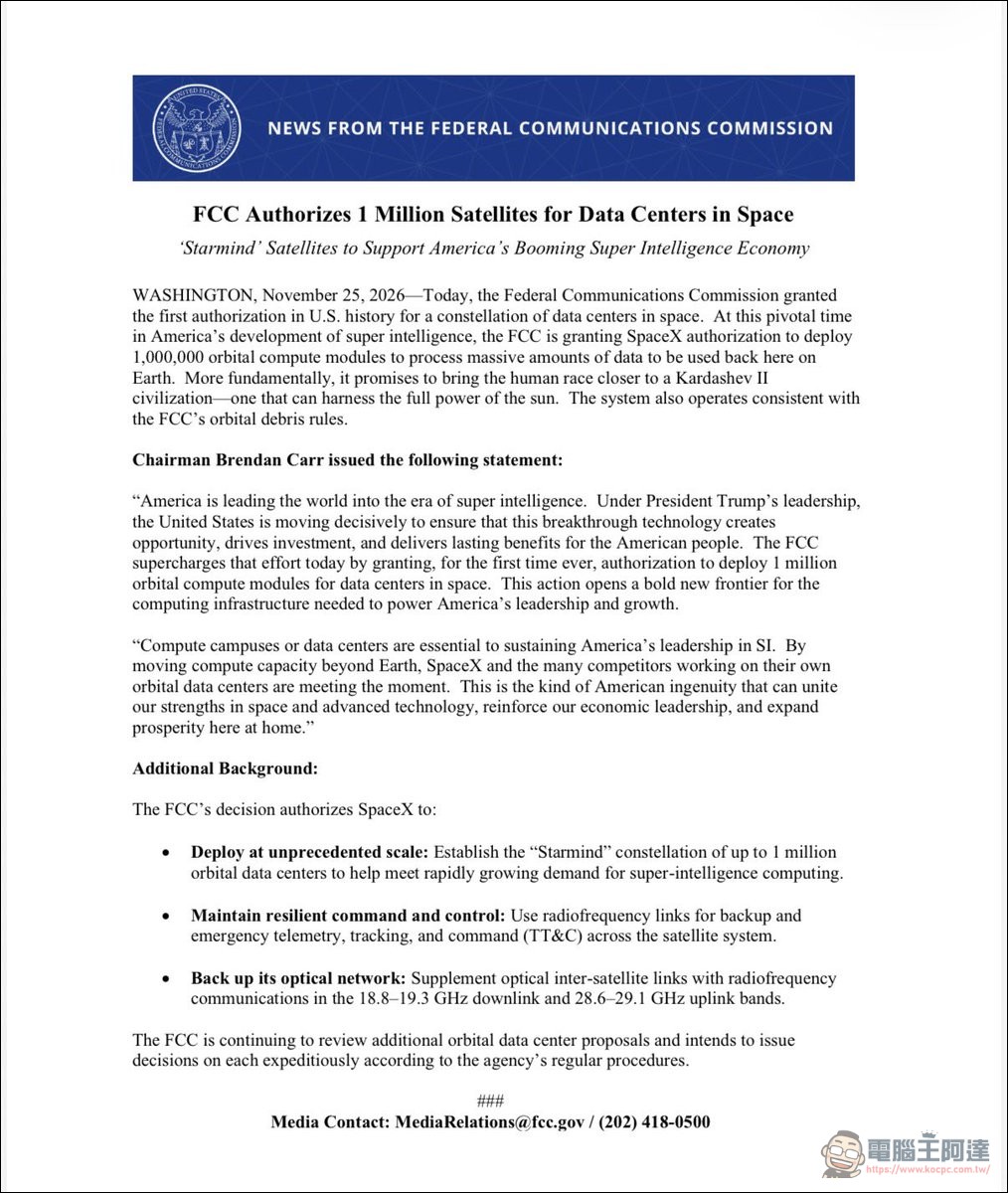
licenseIt also came with a clear deployment deadline: the FCC requires SpaceX to launch at least one satellite by November 2033, deploy 10% of the total—100,000 satellites—by November 2035, and reach the goal of 1 million satellites by 2040. However, the FCC also put off processing another SpaceX request. The company had wanted satellites operating above 600 km to remain in the so-called “graveyard orbit” when retired, rather than burn up in the atmosphere. The FCC said SpaceX had not provided enough information about the disposal method, so it held that part of the application.
Carl and Musk’s public response
In a press release, Carr said the U.S. is leading the world into the era of super intelligence (SI), and that the FCC today issued its first licenses for the deployment of 1 million orbital computing modules, opening a new frontier for the computing infrastructure that underpins U.S. leadership and growth. He also said that by moving computing capacity beyond Earth, SpaceX and other competitors investing in orbital data centers are responding to this demand and can strengthen U.S. economic leadership and expand domestic prosperity.
The press release even compared the project to a Kardashev II (Kardashev Type II) civilization, saying humanity would move closer to a civilization capable of fully harnessing all the Sun’s energy. Musk replied to Karl’s post on X: “Thank you very much; this will be a tremendous asset for the United States and the world.”

Why send data centers into space?
Power has become one of the biggest bottlenecks in the AI industry. Companies are investing billions of dollars to build data centers and buy chips, only to often find that local power grids cannot supply enough electricity. According to Google research, satellites in certain orbits can receive sunlight almost continuously, and solar panels can generate electricity up to 8 times more efficiently than similar facilities on Earth.
SpaceX told the FCC that obtaining nearly uninterrupted solar power directly in orbit, with extremely low operating and maintenance costs, will enable these satellites to achieve transformative cost and energy efficiency and significantly reduce the environmental impact of ground-based data centers. The company said Starmind will transmit data to Starlink via high-speed laser links.
This application was filed after Musk merged the artificial intelligence company xAI into SpaceX in February of this year. SpaceX plans to produce the chips needed for satellites at its soon-to-open Terafab plant; the facility is located in Grimes County, Texas, with an initial investment of US$16.8 billion (approximately NT$529.2 billion), and the chips produced will also be used in Tesla’s Optimus robots and Cybercab vehicles.
Competitors and Technical Challenges
SpaceX is not the only company involved in orbital computing. Google’s Project Suncatcher launched its first AI server satellite for testing last month, and Blue Origin, owned by Amazon founder Bezos, is expected to carry out the project’s first dedicated heavy-lift launch mission in 2029. The FCC said other orbital data center applications are still under review and will be decided case by case under normal procedures.
The technical challenges remain considerable. Although space is extremely cold, the vacuum makes it difficult for heat to dissipate through the air, so satellites must rely on radiators to expel the heat generated by AI chips, and the chips themselves must withstand cosmic radiation. On the environmental side, the Center for Space Environmentalism warned in September that manufacturing, deploying, and ultimately deorbiting such a massive satellite constellation could significantly worsen atmospheric pollution.
Note that obtaining permission and putting satellites into orbit are two different things. Currently, about 17,000 satellites are operating on Earth. SpaceX originally applied for licenses for 42,000 satellites for Starlink, but only about 11,000 are actually in orbit. A common industry practice is to apply for more than is actually needed in order to preserve design flexibility. Amazon’s satellite division Leo once opposed the plan, arguing that it was unlikely SpaceX would deploy the full fleet and that it might even take hundreds of years; Carr rejected such concerns in March. Earlier this month, at an investor meeting, Musk estimated that the first batch of Starmind compute devices might launch in the third quarter of 2027. SpaceX’s securities disclosure documents have also warned investors that the orbital computing business has not yet demonstrated commercial viability and may ultimately fail.
Conclusion
This FCC approval has opened the first door for space data centers, but the cap of 1 million satellites, the deployment timeline from 2033 to 2040, and the controversy over graveyard orbit disposal all show that this remains a long-term project spanning more than a decade. Issues such as heat dissipation, radiation, atmospheric pollution, and commercial viability also remain to be verified. As for whether Starmind, this AI computing center of a million satellites, will become a reality, let’s wait and see.
Source: KOCPC Chinese