


Developer Joshua Warren published on November 22.Hands-on testApple’s machine learning framework MLX (Apple’s own matrix computation framework) drives NVIDIA GPUs in a Linux environment via the Vulkan graphics interface, reaching an inference decoding speed of 124 tokens per second on the same RTX 5060 Ti, surpassing NVIDIA’s own CUDA software stack, which achieves about 101 tokens per second on the same card. This result comes from a change in pull request (PR) #1 for the open-source project omarchy-mlx, which he maintains: replacing the “full pipeline barrier” used by the Vulkan backend (backend, the module that actually executes computations behind the software) between dependent compute kernels with a narrower “compute-to-compute barrier”; on the same card, same build, and same model, decoding speed jumped from 99 tokens per second to 124, an increase of 25.8%.

Measured data: same card, four combinations.
The test hardware is a 16GB RTX 5060 Ti connected externally via USB4 to a 16-inch M1 Max MacBook Pro running Omarchy Linux (an Arch Linux derivative maintained by Warren’s team), with a 4-bit quantized Qwen3-4B-Instruct-2507 model using greedy decoding (choosing the highest-probability token at each step). The results for the four software combinations, in order, are: omarchy-mlx’s Vulkan new barrier at 124 tokens per second, llama.cpp’s CUDA at about 101, omarchy-mlx’s Vulkan old barrier at 99, and llama.cpp’s Vulkan at 85.
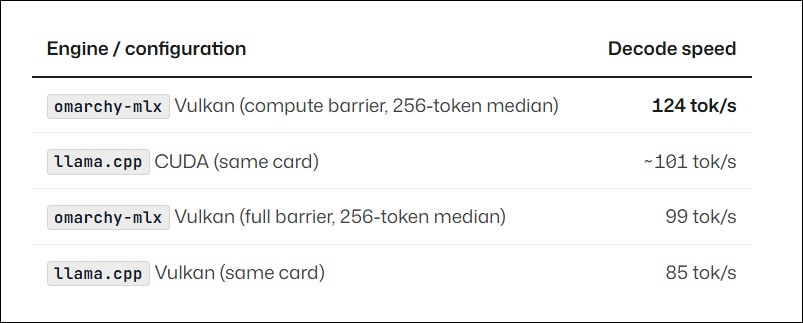
The author ran five interleaved A/B comparisons; the new fence won all five, and ten runs produced exactly the same token ID sequence (verification code f0684b4aa9b35796), ensuring the speedup did not change the output. The median speed measured from the 6th token onward was 131 tokens per second, 27.4% faster than the old fence’s 103; per-token latency dropped from 9.72–9.79 ms to 7.62–7.77 ms.
Why can a single fence create a 25.8% gap?
Autoregressive (token-by-token) decoding is a long chain of short, interdependent compute kernels. The authors reveal the underlying numbers: when Qwen3-4B runs 256 tokens in one pass, the Vulkan backend issues 90,003 dispatches spread across 1,525 command buffer submissions. The dependency tracker has already skipped 10,678 non-conflicting fences, leaving 82,238 still to be issued—an average of 321 per token.
Before the change, each of these 82,238 barriers was a full Vulkan pipeline synchronization (VK_PIPELINE_STAGE_ALL_COMMANDS_BIT), meaning the GPU had to synchronize all pipeline stages, even though the actual dependency was only “the tensor written by the previous compute kernel is read by the next compute kernel.” Each time, a few extra microseconds of pipeline drain time, multiplied by 321 barriers per token, consumed nearly 2 milliseconds. After switching to narrow barriers that cover only the compute stage, the number of barriers, number of skips, and number of submissions remained completely unchanged, and GPU busy time per token dropped by 1.87 milliseconds.
The safety conditions for narrow barriers are written very strictly. record_dispatch_barrier(), newly added in PR 604, enables a narrow barrier only when four conditions hold simultaneously: the node is a compute dispatch, the encoder has passed the start of the batch, no data movement has occurred since the last full barrier, and wave scheduling is disabled. All direct buffer copy, fill, and immediate-update instructions are marked as “movement after barrier,” forcing a fallback to a full barrier to ensure compute cores do not read stale transfer data.
It has been merged into the default value, but only takes effect on a dedicated graphics card.
PR 604 was merged into … in the early hours of November 22. omarchy-mlxFor discrete GPUs, narrow barriers are enabled by default; Apple integrated GPUs and software Vulkan still maintain full barriers until their respective A/B tests are complete, and any device can manually switch using the MLX_OMARCHY_COMPUTE_BARRIER environment variable.
The omarchy-mlx project was established on August 31, 2026, positioned to provide MLX-compatible Vulkan and ANE (Apple Neural Engine, Apple’s dedicated neural network circuit) backends in environments running Linux on Apple silicon. It is not a fork-and-rewrite of MLX; the upstream source code is pinned to a specific commit, and its own code is placed in the overlay and patches directories, maintaining a small set of patches. The underlying GPU driver is Mesa’s Honeykrisp Vulkan stack, with no use of Metal throughout and no CPU fallback path.
What Is Omarchy: DHH’s Linux Distribution Comes to Apple Silicon
Omarchy is an Arch Linux derivative led by Basecamp founder DHH (David Heinemeier Hansson, creator of the Ruby on Rails framework). Earlier this year, Omarchy 4.5 marked the project’s first step beyond the x86_64 architecture, officially supporting AArch64 hardware, with Apple chips as the primary target. It can actually run on M1, M2, M3, and Neo MacBooks, and also supports NVIDIA N1X laptops and DGX Spark desktops; Snapdragon X laptops are listed for later plans. This wave of Apple chip support builds on years of reverse-engineering work by the Asahi Linux community.
At the end of the blog post, author Warren wrote: “Getting MLX running on Linux is just the first step. Watching an Apple framework beat CUDA via Vulkan on an NVIDIA GPU connected externally to a MacBook Pro over USB4—that’s where the interesting part begins.”
Moat debate: This is self-test data and has not been verified by a third party.
The core claim of Warren’s tweet is that the CUDA ecosystem’s defensive effect against Apple chips—the advantage NVIDIA built over the years by using a closed computing platform to lock developers in—is overestimated. For now, this claim is supported only by his own testing: the test involved just one card, one small 4-bit model, and one workload (short-sequence decoding), with no third-party reproduction, and it did not cover training, large models, or high-concurrency server scenarios; moreover, llama.cpp CUDA is not necessarily the upper limit of CUDA performance.
CUDA is not the moat for NVIDIA over Apple Silicon that people think it is. An Apple machine-learning framework (MLX) running on Linux through Vulkan just outran CUDA on NVIDIA’s own silicon. Just shipped an update to Omarchy-mlx that puts MLX 25% faster than CUDA on an RTX 5060 Ti. https://t.co/kTI8Iev3uc
— Joshua Warren (@JoshuaSWarren) November 22, 2026
As far as the verifiable parts are concerned, the facts do hold: an Apple framework does not need CUDA or Metal; using only the open Vulkan interface, it can achieve decoding speeds on NVIDIA hardware that exceed the CUDA reference implementation. Vulkan is a cross-platform open compute and graphics API, and NVIDIA’s official drivers already support Vulkan 1.4 on Windows and Linux. When an open interface is sufficient to saturate hardware performance, the switching costs brought by software lock-in lose half their justification. The significance of this route for local inference (running models on one’s own machine rather than in the cloud) is most direct: on the same USB4 eGPU path, multiple engines such as mlx-lm and llama.cpp Vulkan have already been tested and proven under Linux.
Source: KOCPC Chinese