


In the past two days, Tesla has launched FSD v15 Update: This update enables real-time rendering of the external scenery on the in-car system, just like GTA graphics. Recently, Elon Musk posted aPost, indicating Tesla How to generate driving visuals in real time on the car. He says Tesla already has a pixel-perfect world model, which it has used since last year for synthetic data generation; the in-car version is a smaller conditional mean-flow model that takes Tesla Universal Vision Encoder (UVE) feature sequences as input.
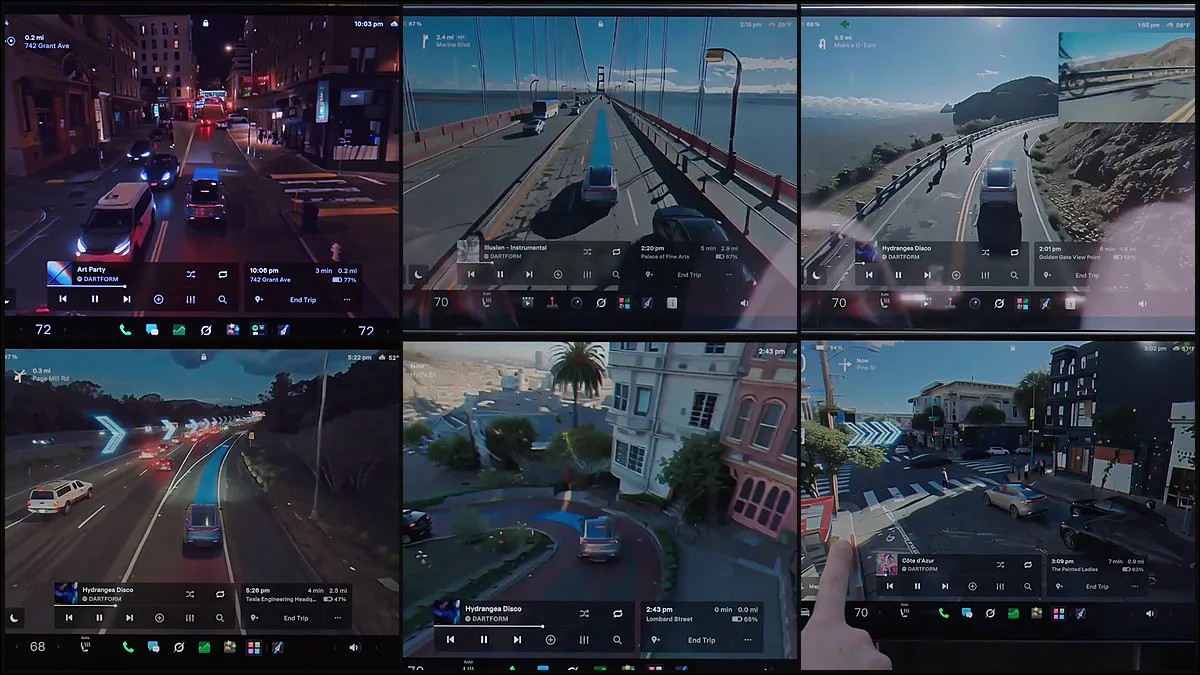
From Synthetic Data to Automotive Imagery: The Dual Use of the Same Set of UVE Features
Elon Musk said Tesla had already built a pixel-perfect world model last year for synthetic data generation. The in-car version is a scaled-down version of this world model: it is a conditional mean-flow model based on the latest UVE feature sequence.
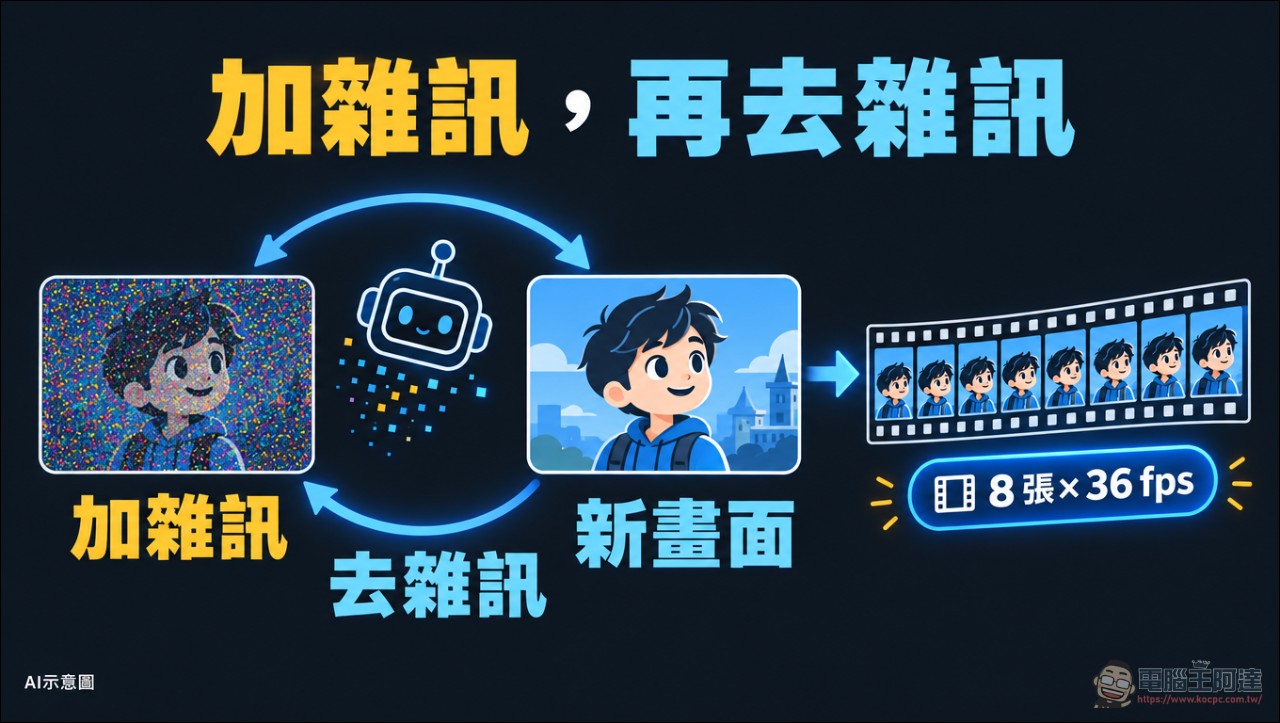
In case anyone is curious: We’ve had a ~pixel-perfect world model since last year, which is critical for synthetic data generation. The (much) smaller version of that in the car is a conditional mean-flow model, based on the recent sequence of Tesla Universal Vision Encoder features, which are the same ones that are plugged into the 3B encoder model that produces the driving actions. We fork off from these UVE features, then run a separate ~1B diffusion model. This takes in the previous reality-view generation with added noise and then denoises it to the current visualization. It then produces a small video chunk (8 images at 36 fps, at the resolution of the UI screen). This work is done by 1/2 of a TRIP engine every UVE frame at 18 hz and is spread over 4 cycles. Currently, the latency is a bit high due to compute constraints, but we have ways to interleave newer UVE features along the diffusion transformer layers to cut roughly 35% of the latency.
— Elon Musk (@elonmusk) November 22, 2026
UVE (Universal Vision Encoder) is the new vision encoder for FSD v15. Tesla originally planned to share the same set of UVE features across FSD, Robotaxi, and Optimus (the humanoid robot), with training data consisting of millions of internet videos. Musk revealed that these features are also used by the 3B encoder model to generate driving actions. Tesla then branched off an independent diffusion model with about 1B parameters from this UVE feature sequence, specifically responsible for generating Reality View frames.
The scripts for the screen visuals and steering wheel control come from the same visual summary source, but each runs its own independent neural network. Driving actions are generated by a 3B encoder, while the Reality View is rendered by a diffusion model with about 1B parameters. The two branch at the UVE features but run separately.
Real-time generation mechanism: adding noise, denoising, divided into 4 cycles
Musk described the generation process as follows: the diffusion model takes the generated result of the previous frame, adds noise, and then denoises it to produce the current visualized image. This is how the image stays coherent from frame to frame, generating coherently frame by frame. The output is a short video clip: 8 images, 36 fps, at the same resolution as the UI screen. Each UVE frame is handled by half a TRIP engine, 18 times per second, in 4 cycles. TRIP is an accelerator in the in-car AI4 computer. At 18 Hz, 4 cycles mean each 8-frame clip takes about 0.22 seconds, which exactly corresponds to 36 fps.
Musk admitted that currently, due to compute resource constraints, visual latency is relatively high—slightly slower than the real road. Tesla plans to address this by interleaving new UVE features into the layers of the diffusion transformer during video generation. Musk expects this to reduce latency by about 35%.
Background of the FSD v15 release and the controversy over the “25x improvement”
FSD v15 began rolling out to Early Access Program (EAP) members on November 21. Tesla officially claims that reworking the vision encoder improved the critical intervention rate by a factor of 25—that is, the number of interventions/takeovers by the driver or safety operator dropped to 1/25 of the original. Tesla has not disclosed which version this is compared with, how many kilometers were used, or how an intervention is defined as “critical.”
It should be noted that 25x is Tesla’s own claim and does not directly equal a reduction in crash rates or safety surpassing human drivers. The critical intervention rate and the actual crash rate are different metrics. Tesla’s published Full Self-Driving Vehicle Safety Report focuses mainly on crash counts, classifying crashes in which the airbag or pyrotechnic restraint is deployed as a “major collision,” and any FSD activation within five seconds before a crash is counted; it is updated quarterly. Tesla AI head Ashok Elluswamy revealed that the FSD v15 neural network parameters increased from about 1 billion (previous version) to about 10 billion, a 10x scale upgrade.
Tesla also disclosed in its Q2 2026 earnings report that the Early v15 build has accumulated over 380,000 kilometers of unsupervised driving, operating in six cities across two U.S. states, with no major accidents.
What does Reality View mean for drivers?
Reality View is a core feature of FSD v15.0.1, and its visual style can change as the vehicle moves: Tesla says drivers can see what FSD is about to do and control it. Reality View offers four layouts: full-screen visualization, map, split screen, and a muted, minimalist version.
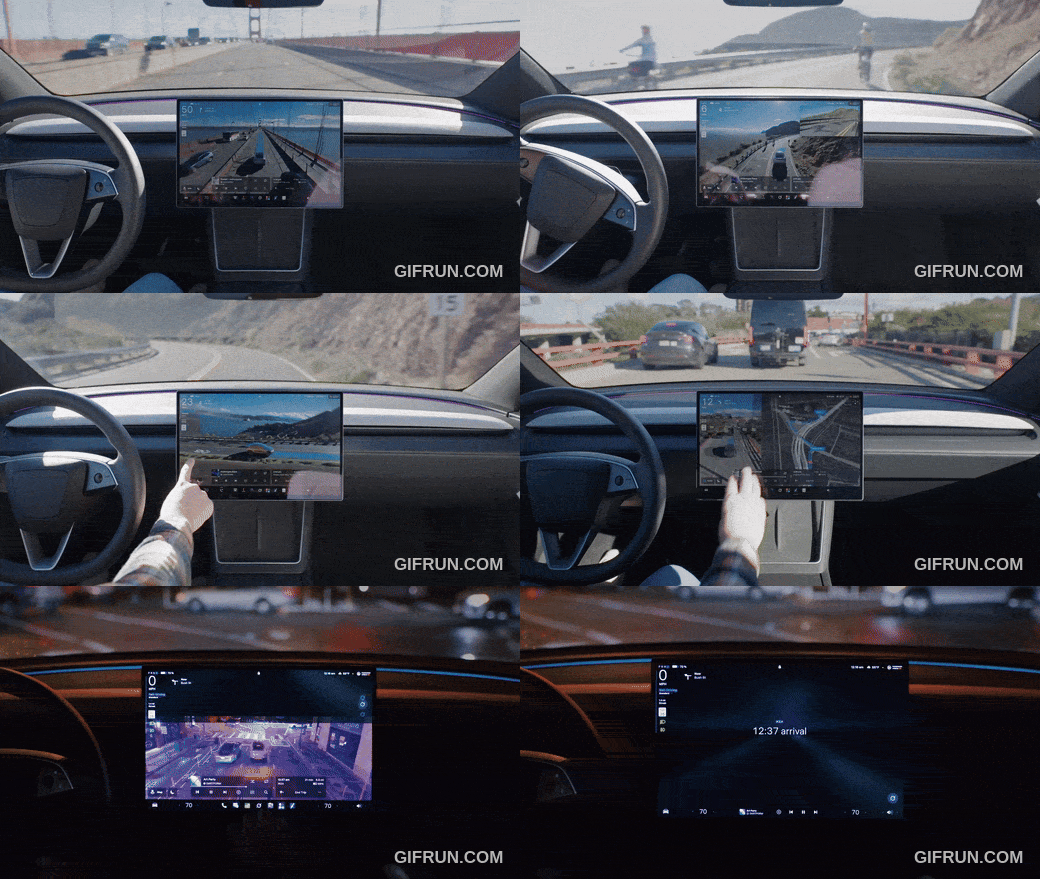
Tesla claims Reality View replaces the previous generation’s approach of rendering vehicles and roads entity by entity with less total computation. The reality remains: the system stays supervised; the driver is responsible and must be ready to take over. The screen helps the driver understand the car’s intentions but does not replace watching the road. In addition, the FSD v15 Reality View feature will not be offered in Europe; the European system is called Assisted Driving and has been approved in 12 European countries.
Conclusion
Tesla’s world model has evolved from last year’s limited-purpose synthetic data generation to real-time in-vehicle image generation. This system ties visual encoding, driving decisions, and the consumer interface into a shared foundation; Reality View specifically represents Tesla pushing FSD’s visual capabilities into mainstream AI4 vehicles. The next things to watch are the full rollout before the December Christmas holidays and the publication of real-world kilometers. At that point, whether drivers and reviewers can verify on their own cars that Reality View truly surpasses the previous generation’s display and whether the “25x” improvement holds will determine whether this technology accelerates FSD progress or is merely an overpackaged interface update.
Source: KOCPC Chinese