


Running a complete Linux environment on an Android phone used to be possible in only a few ways: Termux requires you to assemble installation sources from F-Droid or GitHub yourself; iSH is an x86 emulator on iOS; and tools like UserLAnd rely on the PRoot emulator for user-space system call interception. Now there is another option: developer Matthew Lee open-sourced Appine on November 17. It is an Android Linux terminal that does not require root, does not need PRoot, and is not a QEMU virtual machine. The version published on Google Play was updated on the 18th.
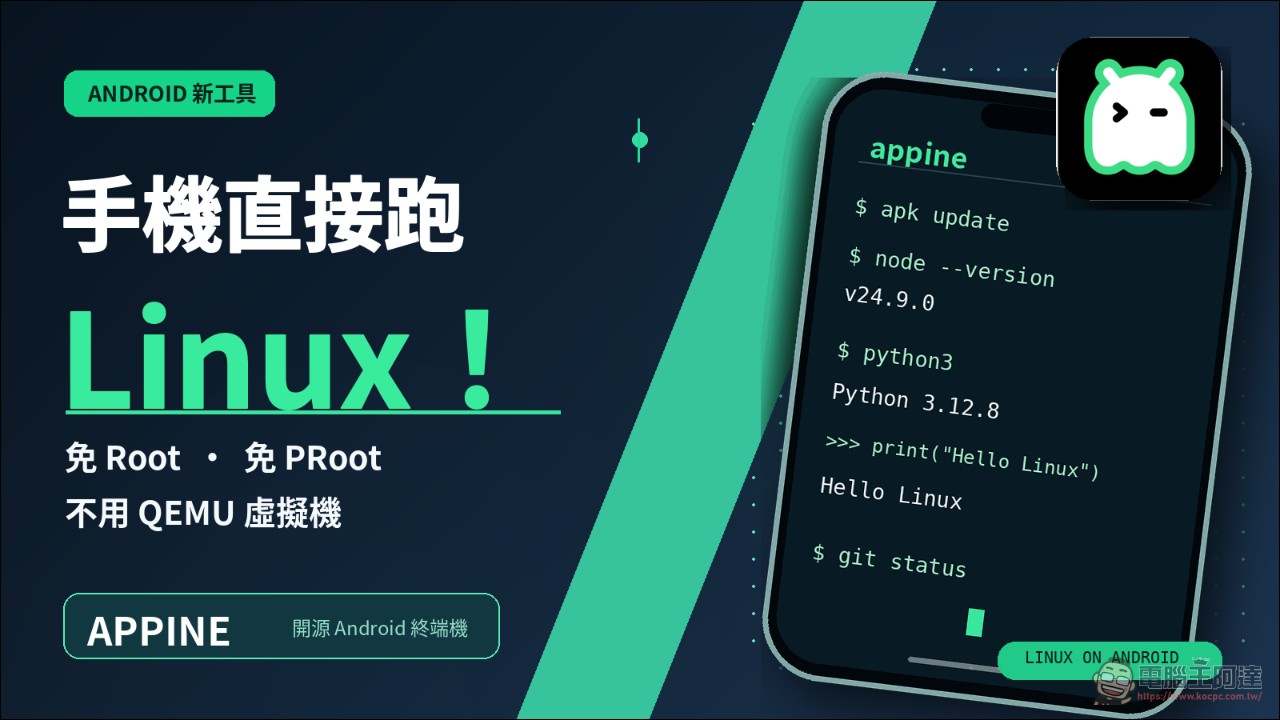
The author stated on X that this is the craziest project he has ever worked on, and emphasized that it can “directly run Codex CLI in a Linux environment locally on Android, run Node.js, compile Rust, or run Docker.” Appine is licensed under AGPL-3.0 and written in Rust; the project’s technical approach is different from common Android Linux solutions. To understand how it differs, one first needs to see how it makes unmodified Linux executables run inside an Android process.
开源一个迄今为止我做过的最疯狂的项目 Appine,现在你可以直接在 Android 本地使用 Linux 环境运行 Codex CLI、跑 Nodejs、编译 Rust,亦或是运行 Docker… 项目地址 👉 https://t.co/axThtcgGOB 这是一套全新的在 Android 上运行 Linux 的高性能方案,不需要 root 权限或者 PRoot,不是 QEMU 虚拟机,也不需要 Android 16 的 AVF 虚拟化框架,没有 Google Play 审核限制的烦恼,包体积也仅有 15MB 左右,直接下载安装就能使用。 Play 链接 👉 https://t.co/OPseCZ1QqD 你甚至能直接把 libappine so 嵌入到自己的 App 里,作为 Agent 的 Linux Runtime 使用🥵
— 李明亮等 100 万人 (@mth_li) November 18, 2026
It is not a virtual machine: it uses an instruction translator instead of a CPU.
Appine runs unmodified ARM64 Linux binaries. The README describes the operating mechanism: its CPU engine translates ARM64 instructions into ARM64 code, and passes instructions it cannot translate to an interpreter; Linux system calls are handled by a user-space kernel, and the terminal uses Ghostty’s libghostty-vt. The project’s own design document makes its positioning clear: it is a single-process Android app that runs unmodified Alpine Linux aarch64 userspace programs, and the author directly draws an analogy to iSH, calling it the Android counterpart to the iSH idea.
What can it actually run: from busybox to Docker containers
The project divides workloads into four categories and publicly commits to their scope. All everyday command-line tools are available, including busybox ash, apk, coreutils, vim, git, curl, and the OpenSSH client; compute-intensive workloads such as python3 and compiling a medium-sized C project with gcc/make must be able to complete; difficult runtime environments such as statically linked Go programs, Node.js, and the JVM are required to behave correctly, but speed is not guaranteed; containers, init systems, kernel modules, and the X11 graphical interface are outside the committed scope.
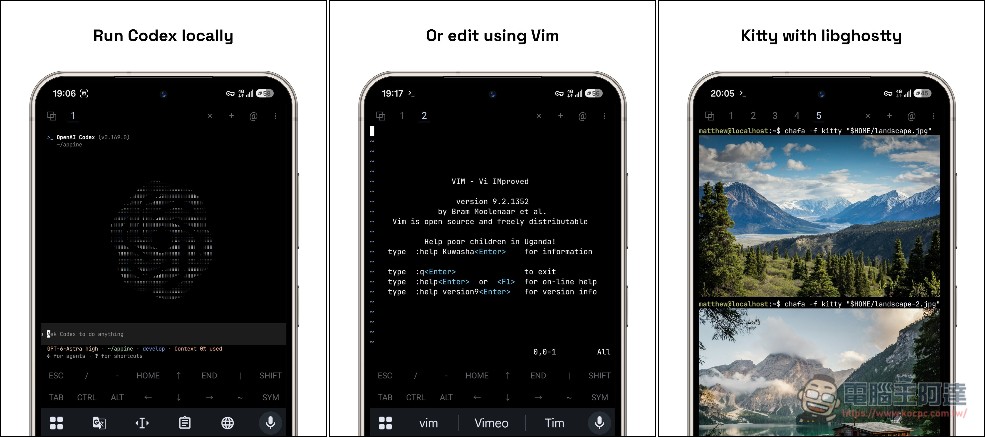
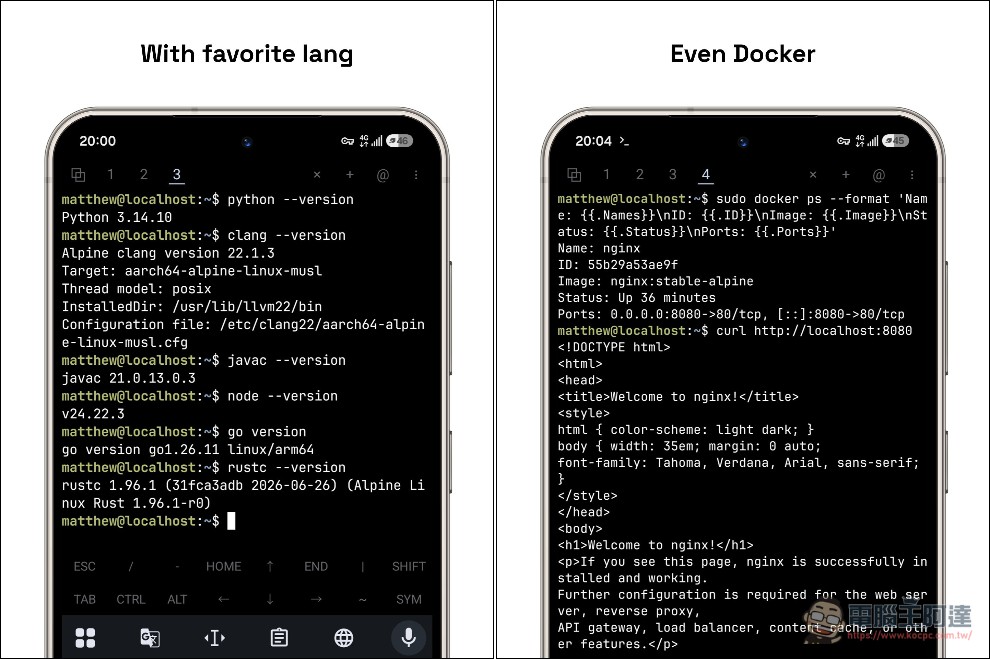
The design document’s notes mention that in the not-guaranteed category, podman and docker (simulated through namespaces) as well as OpenRC (as PID 1) can actually work, while systemd, kernel modules, and GUI are indeed out of scope. strace and gdb are likewise available.
Appine’s design document mentions that podman and docker are implemented through namespace emulation, and the Android-side instrumented tests also install tmux and screen for browser bridging tests. Apps like Termux have long been restricted on Google Play precisely because of exec restrictions and policy issues. In a June 2024 announcement, the Termux maintenance team explicitly stated that the PlayStore version is functionally equivalent to v0.108, that the official distribution sources remain only F-Droid and GitHub, and that this version may be delisted at any time.
Performance Testing: Official Figures and Their Measurement Conditions
All of Appine’s performance numbers are documented, which is uncommon among similar projects. The project’s target is for CPU-intensive work to stay within 3 to 5 times native, and the design document states that the priority is interactive latency; ls and tab completion must not feel laggy.
The measured multiples for each workload are as follows. All numbers are time multiples relative to native Linux; smaller is faster:
- Gradle hot compilation: 9x (the memory access check and translation table round measured 9.4x; after subsequent optimization, the figure landed at 9x)
- Maven hot compilation: 4.0x, and the JIT workload round measured 3.6x
- Compile lvm.c with gcc: 3.2x (early tests reached 6.1x, later decreased due to test environment corrections)
- Python execute loop: 4.6 times
- go build cold compilation2.8x, another round measured 2.6x, single-threaded 5.6x but multi-threaded scaling was poor.
- Node’s JIT-generated code: 1.9 times
- git status1.3 to 1.4 times
- File operations such as find and du.: approx. 1x
This set of numbers has a measurement condition that must be stated clearly. The measurement conditions section of the project document states that the test host is an ARM64 Linux virtual machine running colima on Apple Silicon (4 cores, with 8 cores for some tests); the native control is an Alpine 3.24 container on the same virtual machine, and warm cache is used, with each workload run twice within the same Appine session and the second run counted. Another set of numbers was run on GitHub’s ubuntu-24.04-arm runner, which is a 2 vCPU Azure Cobalt 100 machine; the official description says its cores are “closer to the big and medium cores of phones.”
What this means for AI Agents: treating libappine.so as a Linux runtime
Appine may be more significant for AI agents than for general users. The README says that Appine runs unmodified ARM64 Linux binaries, so a phone can directly run a full development toolchain instead of a cloud sandbox. The code repository’s Cargo workspace structure also illustrates this: the core is split into three crates, core/engine (CPU engine), core/kernel (userspace kernel), and core/hal, while hosts/android and hosts/cli are two hosts; the latter is the command-line version of the runner, appine-run.
The Android build instructions are more straightforward: the terminal emulator libghostty-vt is linked into libappine.so, the Rust side interfaces with the Native class through JNI, and both APKs will build an arm64-v8a version of libappine.so. The author also said on X that you can embed libappine.so into your own app and use it as an Agent’s Linux Runtime.
This direction has practical value for developers who want to run local agents on their phones. Codex CLI plus Docker means an agent can complete a full development and testing workflow on a single Android device, without relying on cloud containers or turning the phone into a heavy Termux user. However, Appine is still positioned as a developer tool; games and general consumer apps are not comparable, and the performance figures have not yet been verified on real phones.
Appine – GitHub / Play Store
Conclusion
Appine has untangled three conditions that had always been tied together: no root required, no emulator required, and it can go through Google Play’s official review process. Technically, it uses an instruction translator plus a userspace kernel to replace a virtual machine; both the 208 rounds of development records and the LTP syscall tests leave verifiable figures, which is quite rare in an individual developer’s project.

Before you try it, there are two things you should know first. All performance numbers come from an ARM64 Linux virtual machine on Apple Silicon and an Azure 2 vCPU runner; none are measurements from a real phone, so actual performance on a real device needs to be verified yourself. The design document itself also states that real-device validation for M9 has not yet been completed, and the community has no third-party hands-on feedback at all. Currently GitHub has 126 stars and 10 forks, and the Play Store download count shows 0+ (these figures are as of the query on November 18). This is a project that has just launched and is still in its early stages, but has a fairly serious technical foundation.
Source: KOCPC Chinese