


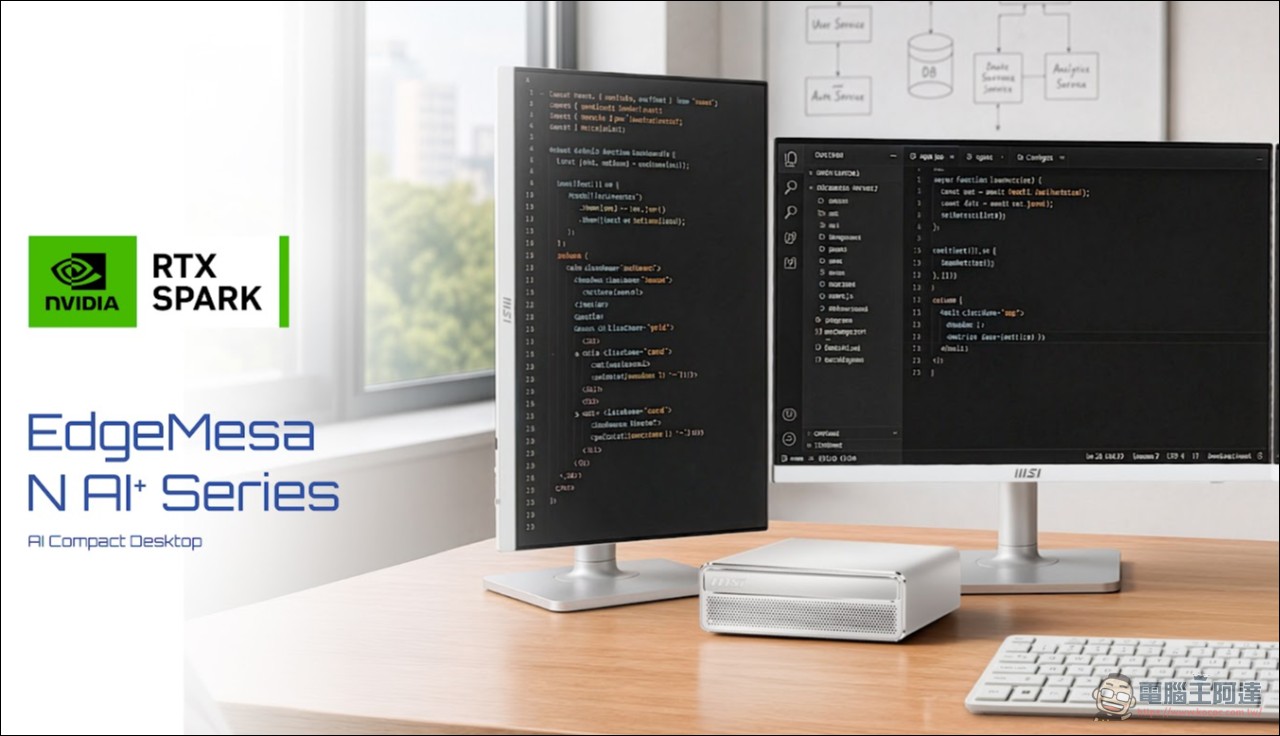
MSI today announced the “MSI EdgeMesa N AI+ Series” compact AI desktop computers, powered by the NVIDIA RTX Spark platform.Combining advanced AI-accelerated computing technology with MSI’s carefully designed hardware engineering, it helps developers, creators, and AI enthusiasts build, run, and deploy AI applications directly on local devices. The product comes with the Windows 11 operating system., putting local AI computing into a 1.3-liter chassis. Two versions are available in the Taiwan market: 128GB memory plus 4TB storage priced at NT$279,000, and 64GB plus 1TB priced at NT$169,000.
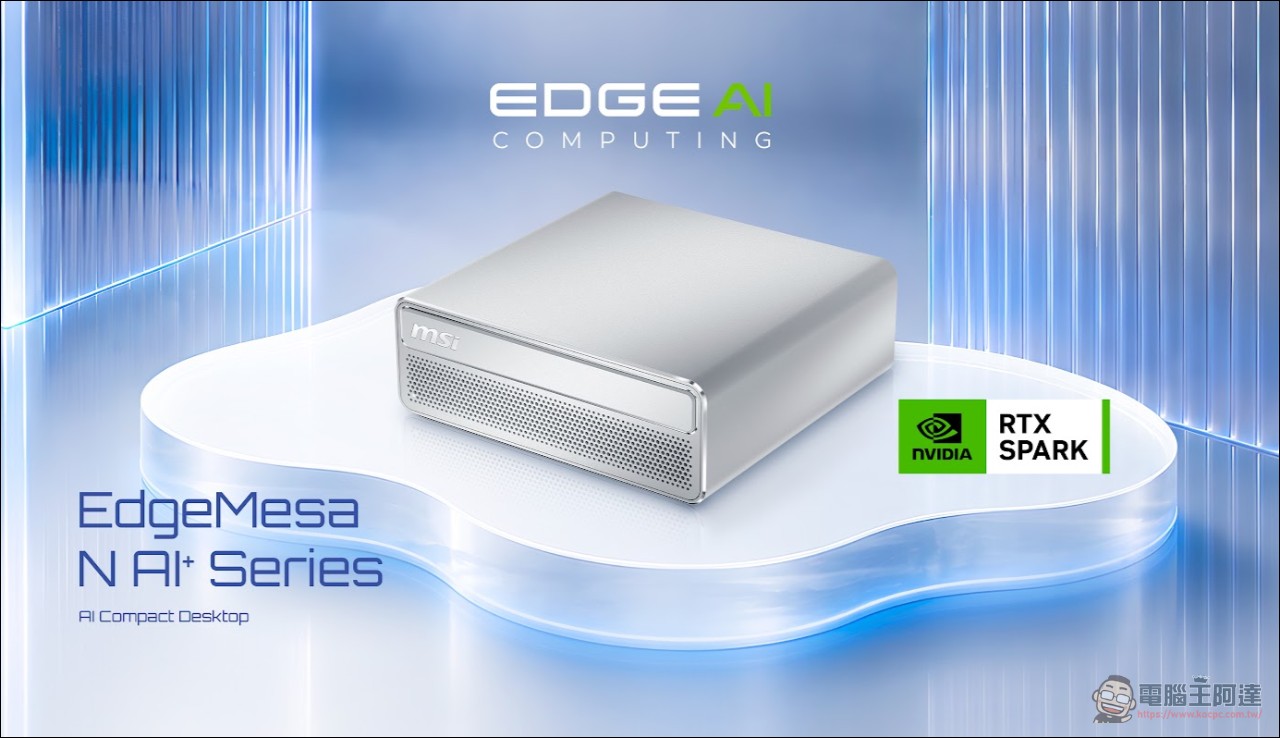
MSI EdgeMesa N AI+ key specs: N1X superchip, 1 petaflop FP4
The core of the system is the NVIDIA RTX Spark N1X superchip, integrating a 6,144-core Blackwell RTX GPU and a 20-core NVIDIA Grace CPU, with AI computing performance up to 1 petaflop (FP4). Memory is up to 128GB of LPDDR5X unified memory shared by the CPU and GPU; the maximum capacity is 128GB, with no expansion slots.
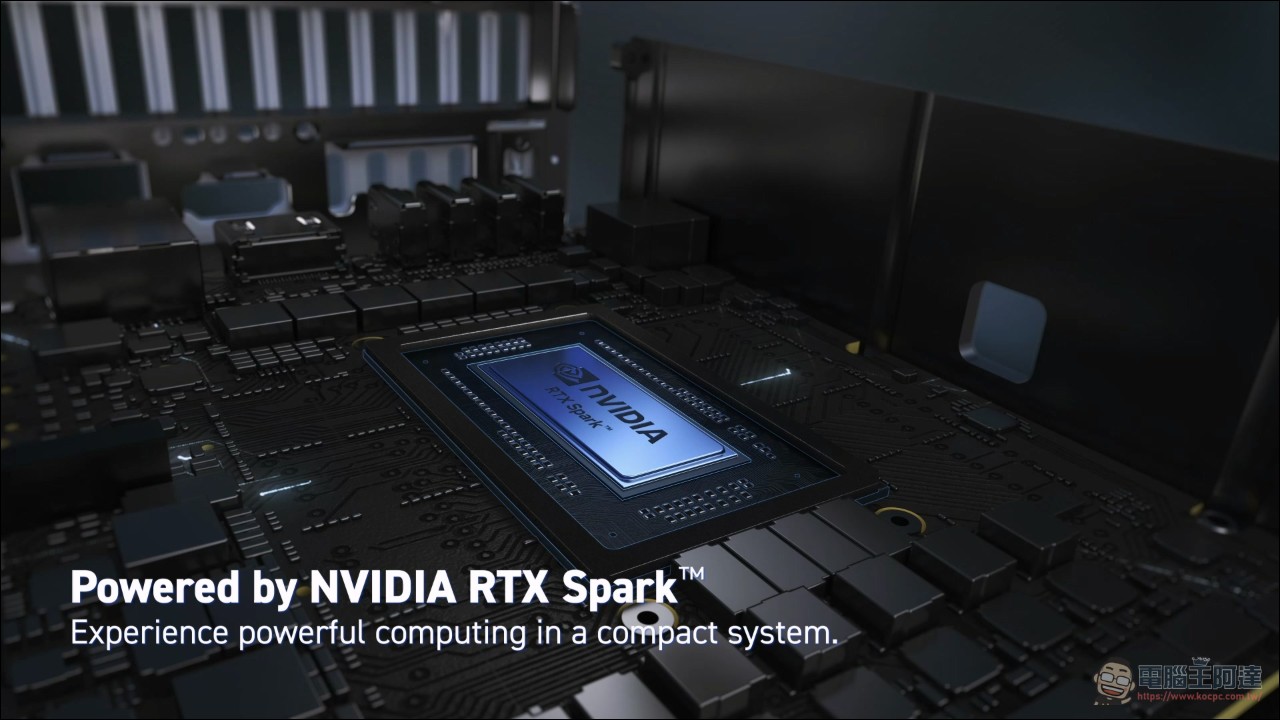
The RTX Spark N1X sits in the larger tier of NVIDIA’s product lineup. The same series also offers an 18-core CPU paired with a 5,120-core GPU configuration; MSI chose the 20-core plus 6,144-core version, with total system TDP set at 140W.
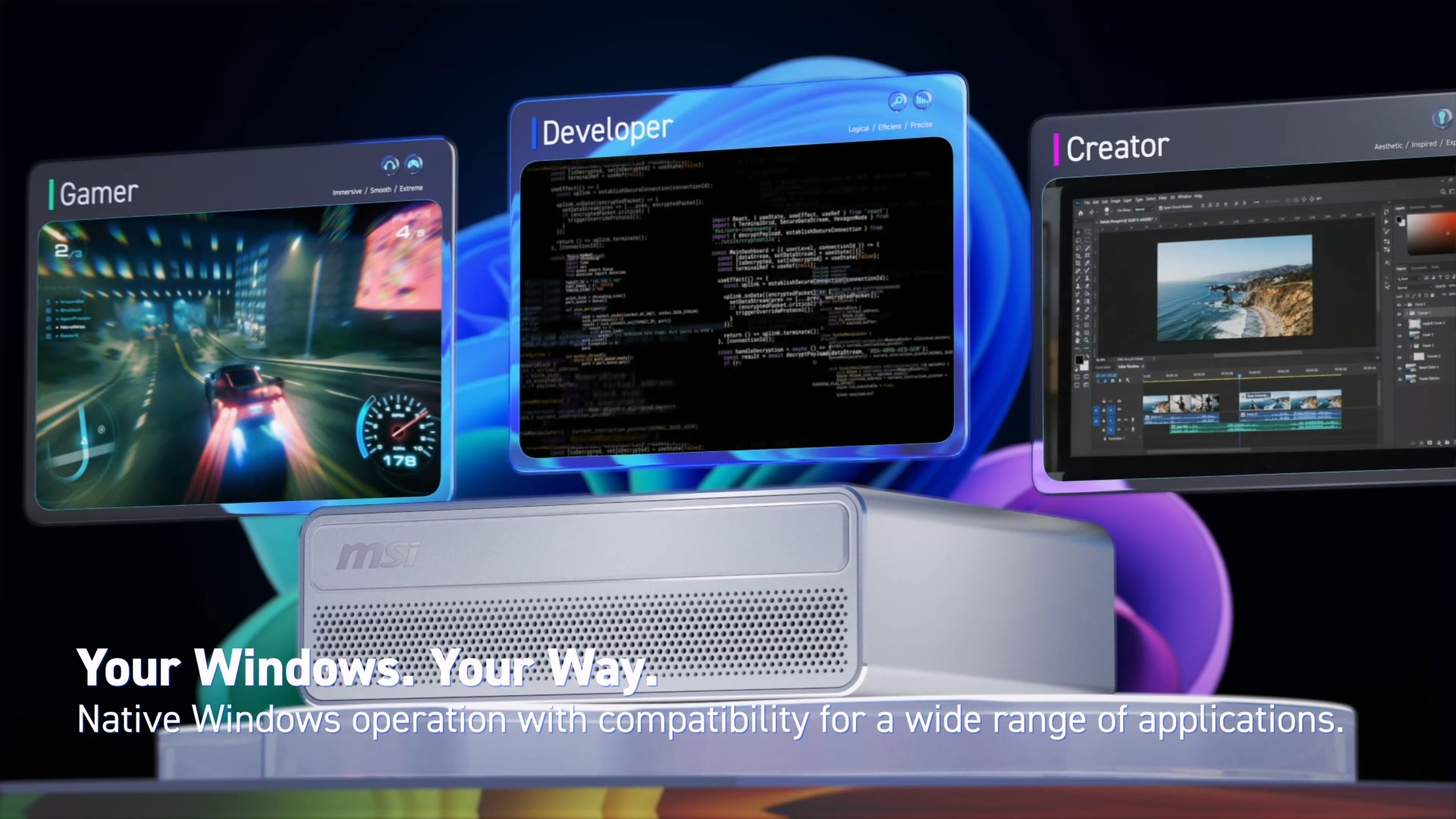
Unlike NVIDIA’s own DGX Spark, the RTX Spark runs on the Windows 11 platform and supports standard NVIDIA graphics drivers and features, including DLSS 5, Reflex 2, RTX Remix, G-SYNC, as well as Game Ready and Studio drivers. For developers, it is both a development machine and a gaming machine. The official specifications list the platform’s compute as 1000 TOPS, corresponding to 1 petaflop of FP4 performance; this figure is the combined total for the entire superchip, covering both the GPU and CPU.
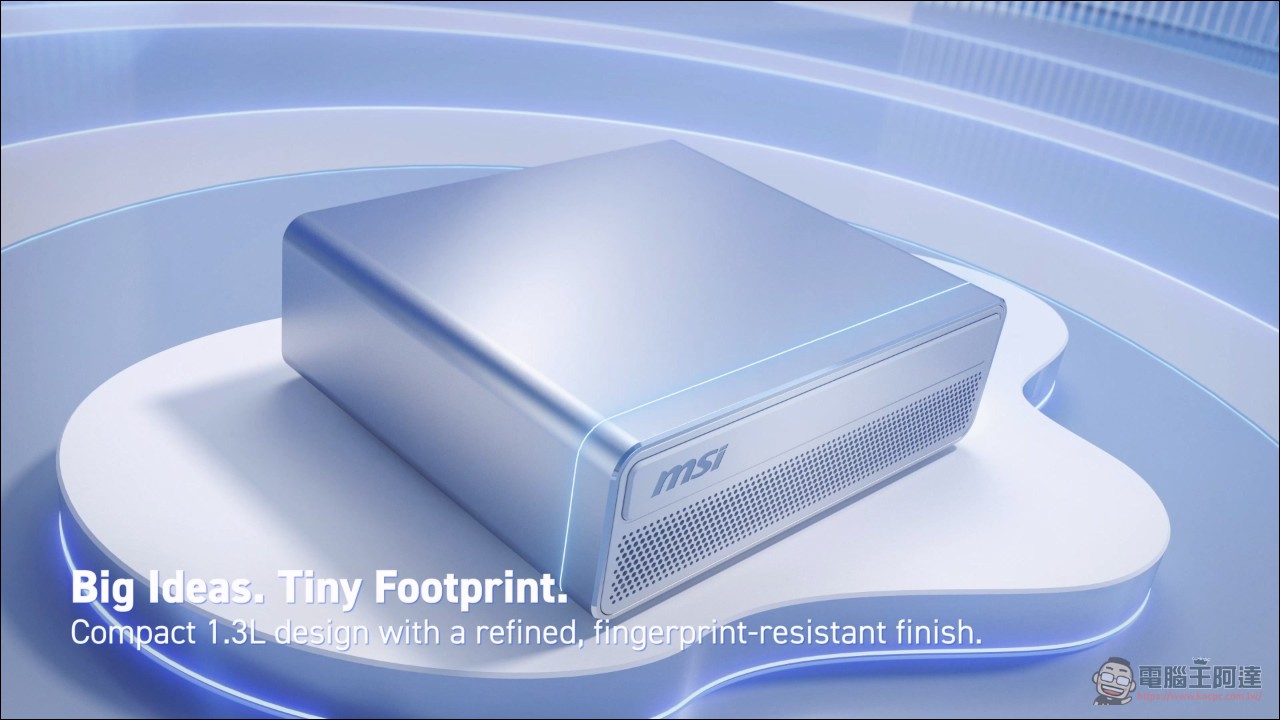
1.3-liter chassis and cooling
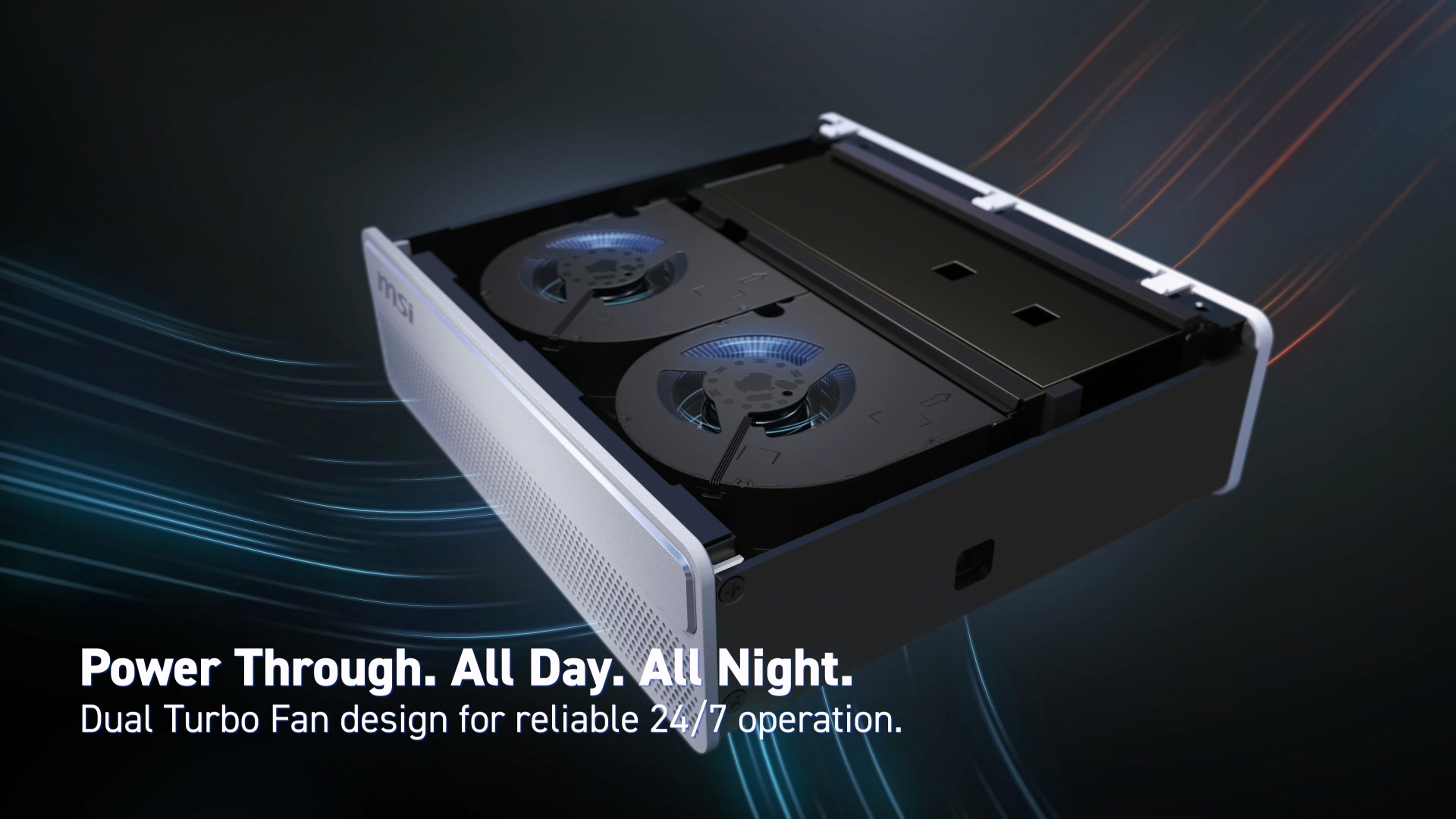
The chassis is made of aluminum alloy with an anti-fingerprint coating on the exterior. It has a volume of 1.3 liters and dimensions of 152 x 147 x 53 mm, with a net weight of 1.32 kg. Cooling is handled by the MSI AI Pulse Cooling System, which combines a vapor chamber and dual turbo fans, aiming to keep the system at full power output under a 140W TDP to meet the demand for 24-hour continuous operation.
The power supply uses a 240W external adapter, the operating temperature range is 0°C to 35°C, and the warranty is 36 months. The chassis also has a Kensington security lock slot and TPM 2.0. Cooling design is especially critical at this size. Mini PCs tend to throttle under sustained full load, while AI agents and model services require stable output over several consecutive hours, so MSI made 140W full-power output a core metric, paired with a 240W adapter. Noise is another factor enterprises consider in deployments. The official positioning lists low noise as a product feature; for environments such as offices and labs that need to stay powered on for long periods, whether a machine can run quietly all day often affects adoption more than peak performance.
Connection and Output
For networking, it is equipped with 10Gb wired networking (Realtek RTL8127-CG) and Wi-Fi 7 wireless networking, Bluetooth version 5.4, and the wireless module is AzureWave AW-EM637.[2]The display outputs can simultaneously drive four 4K monitors, provided by one HDMI 2.1 (supporting 4K@120Hz and 8K@60Hz) and three USB 20Gbps Type-C ports with DisplayPort Alt Mode.
There are four USB ports on the rear of the chassis, all USB 3.2 Gen 2×2 (20Gbps) Type-C, and one of them is used for power input. For storage, there is only one M.2 slot; the 128GB version comes with a 4TB PCIe Gen5x4 SSD, while the 64GB version comes with a 1TB PCIe Gen4x4 SSD, and both shipping configurations fully populate the slot. MSI also adds NVIDIA Personal AI Router (PAIR) technology, allowing compatible devices to form a personalized AI cluster and distribute different compute requests to available local nodes. When one unit is not enough, you can chain another one, without offloading work to the cloud.
Target audience: two tracks—enterprises and developers.
MSI divides this machine into two market segments. On the enterprise side, it targets model evaluation for schools and laboratories, retrieval-augmented generation and model fine-tuning for enterprise AI teams, and edge AI all-in-one appliances built by system integrators; on the developer side, it targets machine learning engineers, full-stack AI developers, and AI creators, with applications covering model quantization, local fine-tuning, and ComfyUI workflows.
The selling point is memory capacity. The VRAM on typical graphics cards mostly sits around 24GB, so models with more than 70B parameters require quantization or the cloud; 128GB of unified memory allows the model and the long-context KV cache to remain on the local machine at the same time. Storage follows the same logic, and the official mention that the 4TB version can hold vector databases, datasets, and containerized environments.
Price and version
- 128GB + 4TB: NT$279,000, PCIe Gen5x4 SSD, model X-011TW
- 64GB + 1TBNT$169,000, PCIe Gen4x4 SSD, model X-012TW
Both versions are the same machine with a 128GB memory maximum; the differences are the factory-installed memory and hard drive capacity. The models launched in Taiwan are EdgeMesa N AI+ X-011TW and X-012TW, respectively. Both come preloaded with Windows 11 Pro, have a 36-month warranty, and the chassis has passed certifications including BSMI, FCC Class B, UL, and VCCI.
Positioning: Local AI agent host
MSI is positioning this product for agentic AI applications—that is, AI agents capable of reasoning, planning, and executing tasks autonomously. The officially listed use cases include intelligent coding assistants, retrieval-augmented generation applications integrated with private knowledge bases, and using AI agents to automate repetitive work, spanning document processing, knowledge management, visual AI, and voice interaction.
128GB of unified memory is the main difference between it and ordinary AI PCs. This capacity allows models to be loaded directly into memory without relying on the cloud. MSI’s listed application scenarios include running models with more than 70B parameters, handling long contexts with a 128k KV Cache, and storing vector databases and containerized environments locally. On the creator side, NVIDIA Studio accelerates 3D rendering, video editing, and AI content generation; on the gamer side, it offers ray tracing, DLSS, and low-latency technology.
MSI EdgeMesa N AI+ Specifications (Official website):
|
Processor / OS |
NVIDIA RTX Spark N1X / Windows 11 Pro |
|
GPU |
Up to 6,144-core NVIDIA Blackwell RTX GPU |
|
CPU |
Up to 20-core NVIDIA Grace CPU |
|
AI Performance |
Up to 1 petaflop FP4 AI performance |
|
Memory |
Up to 128 GB unified memory (LPDDR5X) |
|
Storage |
1x NVMe M.2 slot |
|
Network |
10 Gb LAN / Wi-Fi 7 (Bluetooth 5.4) |
|
Rear I/O |
4x USB 20Gbps Type-C (3 with DP Alt Mode 2.1, 1 for power-delivery input), 1x HDMI 2.1 (FRL), 1x RJ45 (10 Gb LAN) |
|
Security / Power |
TPM 2.0 / 240W AC adapter |
|
Cooling |
Fan cooler with vapor chamber |
|
Weight (N.W. / G.W.) |
|
Source: KOCPC Chinese