


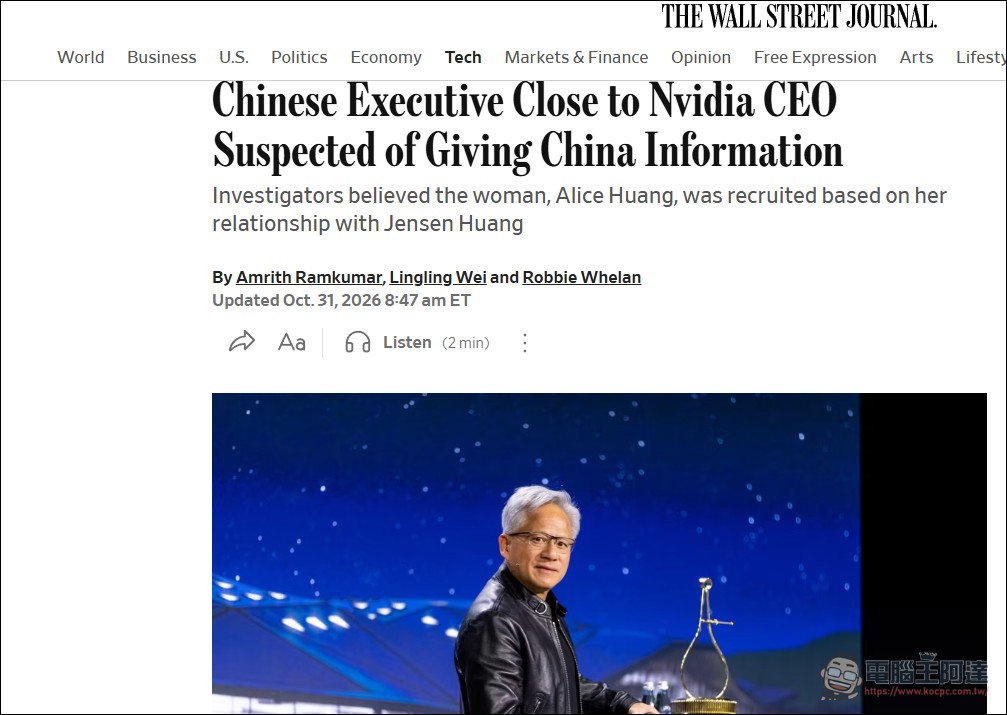
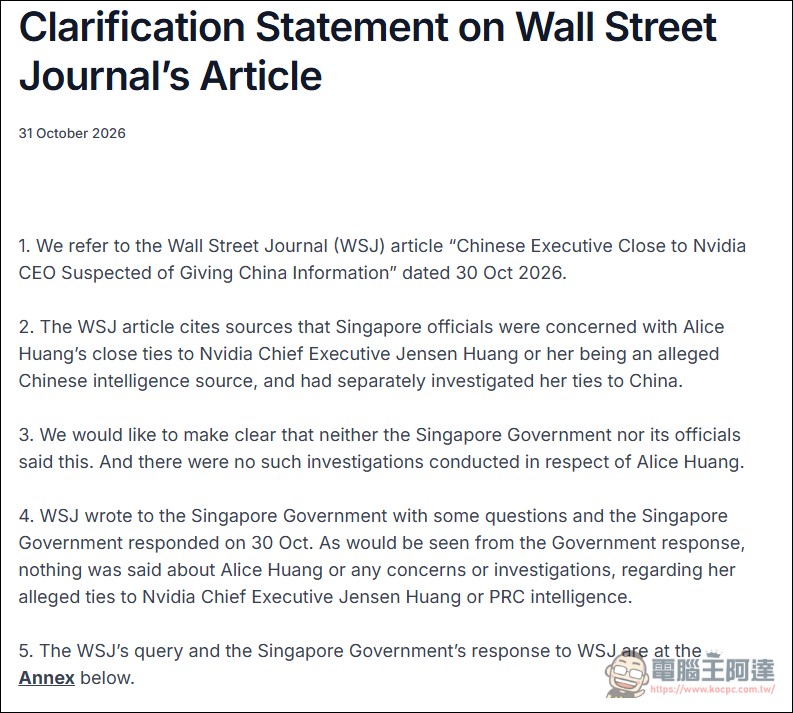
The Wall Street Journal published a report on October 30 whose headline placed a senior executive at a Singapore data center company alongside Nvidia’s CEO, implying that she might have used personal ties to obtain information for Beijing. The report cited sources as saying that Singapore officials were concerned about Huang Le’s close dealings with Jensen Huang, or that she had been alleged to be a Chinese intelligence source, and had separately opened an investigation into her China connections. The next day, Singapore’s Ministry of Home Affairs issued a clarification statement directly rejecting the claim. The official text said that the Singapore government and its officials had never said such things, nor had they conducted such an investigation into Huang Le.
More importantly, Singapore’s Ministry of Home Affairs attached toStatement…, made public as an attachment. The police response discussed only the progress of the Megaspeed investigation, Singapore’s non-enforcement of foreign unilateral export controls, and the fact that four individuals and four companies had been charged; throughout, it made no mention of Huang Le, made no mention of Jensen Huang, and made no mention of Chinese intelligence.
On November 12, Singapore’s Ministry of Home Affairs again issuedSecond statementThis time, the entire investigation process is documented in meticulous detail, including every point in time, every legal basis, and every exchange with the U.S. government. Looking back through the official documents, this affair—which was hyped as an international espionage case—is merely a criminal investigation into a false server declaration in Singapore’s local judicial records.
The complete timeline in the official documents
According to a statement from Singapore’s Ministry of Home Affairs on November 12, the matter began in February 2025. At that time, the Singapore Police Force and Singapore Customs launched independent investigations into several companies and their key persons in charge, focusing on possible false declarations made when purchasing servers. The companies under investigation include Singapore-registered Megaspeed International Pte Ltd and the company’s controller.
The statement specifically pointed out that this investigation was not requested by any country or sovereign entity. Minister for National Security and Home Affairs K Shanmugam said the same thing at a press conference on March 3, 2025. The reasons for including Huang Le in the investigation were clearly stated. At the time, she was Megaspeed’s CEO and chairwoman, and one of the company’s main controllers. She is a Hong Kong resident, was not in Singapore, and the investigation was not directed at espionage at all.
The core dispute in this case is the movement of the servers. The physical servers purchased by the company under investigation were shipped via Singapore to Malaysia and did not enter Singapore’s local market. Singapore police want to investigate whether these servers were later transferred from Malaysia to destinations inconsistent with the declaration. Police said that relying solely on declarations by companies in Singapore is not enough to establish the facts; they must also verify with other jurisdictions, such as the servers’ place of origin and final destination.
June 24, 2025 was the turning point in the entire timeline. The U.S. Bureau of Industry and Security (BIS) conducted a voluntary post-sale verification at Megaspeed, with Huang Le present. Singapore’s Ministry of Home Affairs wrote that this was the first time Singapore learned of U.S. interest in Megaspeed and Huang Le. On the same day, the police also interviewed her on the grounds that they were investigating Megaspeed, and under Section 112 of the Criminal Procedure Code 2010, seized her passport to ensure she would cooperate with the investigation.
Nine Months of Seeking U.S. Assistance
To determine where the servers went, Singapore needs information from the United States. The police specifically sought information related to server supplier Supermicro, but the official statement was blunt: Supermicro provided only limited cooperation. On July 7, 2025, the Singapore Police Force and the Attorney-General’s Chambers asked the U.S. side during a meeting for assistance in obtaining the company’s cooperation. From September 2025 onward, this request was repeatedly reiterated to the U.S. Department of Justice and the Federal Bureau of Investigation. The Ministry of Home Affairs concluded that despite repeated requests, Singapore has so far received only limited information or assistance from the U.S. side.
The Straits Times’The report points outIn February 2026, after consulting with the Attorney-General’s Chambers, the police determined that the available evidence was insufficient to prove that Huang Le committed offences related to the inaccurate filings investigated in the Megaspeed case. The police also assessed that during the investigation, Huang Le provided information she knew to be inaccurate in order to downplay her role in Megaspeed.
The penalty was a stern warning plus a ban on re-entry. Her passport was returned on February 26, 2026, and she left Singapore that day. Singapore’s Ministry of Home Affairs specifically noted that the same approach had been used in other past cases. The case as a whole was not closed. Investigations into Megaspeed and six other individuals are still ongoing; none of the six has re-entered Singapore since the investigation began in February 2025. From February 2025 to July 2026, Singapore has prosecuted four individuals and four companies in court on charges including fraud by false representation, which carries a maximum sentence of up to 20 years.
Background outside official documents
《Singapore Commercial DailyThe figures compiled by 》 show that the actual scale of this case is on the order of hundreds of millions of dollars. On February 26, 2025, police searched 22 locations based on an anonymous tip, and the next day three men were charged with fraud. The case involved Dell and Supermicro servers, and prosecutors said the transactions amounted to $390 million. The New York Times reported that Megaspeed bought more than $4.8 billion worth of Nvidia chips in two years. Megaspeed has consistently denied illegally transshipping Nvidia chips to China, and the company also declined to comment before the Megaspeed name became public in March 2023.
On November 12, Megaspeed CEO and Chairman Tan Yong Pong issued a statement saying the company has hired a US law firm to review its compliance with US export control regulations, conduct a comprehensive inventory of the graphics cards it holds, and independently audit its export control compliance. Singapore’s Ministry of Home Affairs also stated that Singapore does not enforce export controls unilaterally imposed by foreign countries, but will not allow companies to use their Singapore connection to evade other countries’ export controls through fraud or dishonest practices.
Regarding the position of the Chinese authorities, AFP reported that Beijing said on October 30 that the relevant New York Times report was nonsense. As for Huang Le herself, no official institution has so far determined that she is a spy.
This controversy is still escalating.
Looking at the broader timeline, this is no longer a single news event. Nvidia announced on November 8 that a committee composed of independent directors would conduct an investigation, and the board said it had no reason to believe that national security or Nvidia’s confidential information had been leaked. On November 12, Jensen Huang resigned as CEO, president, and board member, with CFO Colette Kress serving as interim CEO. The chairs of three U.S. House committees requested that Jensen Huang give a closed-door briefing on November 18.
This site’s previously published report documented the internal reaction at the time of the resignation, including that more than 97% of employees voted for him to return and that Nvidia had lost about $1 trillion in market value since the relevant allegations surfaced. The report at the time also noted that, beyond the extramarital affair scandal, the flow of chips linked to Huang Le and Megaspeed was also under scrutiny. Two statements from Singapore’s Ministry of Home Affairs have filled in this most critical gap.
Conclusion
Looking at the official documents together, the skeleton of this case is quite clear. In February 2025, Singapore police and customs launched their own investigation into false server declarations, with Megaspeed and Huang Le among those under investigation; the focus was server declarations and had nothing to do with espionage. On June 24, 2025, a post-sale verification by the U.S. BIS made Singapore aware of U.S. interest for the first time. In February 2026, the evidence was insufficient to establish a declaration offense, but Huang Le was given a stern warning and banned from re-entering the country for providing information he knew to be inaccurate to downplay his own role. The investigation is still ongoing, and four other individuals and four companies have been charged.
As for whether the Wall Street Journal report itself was not fabricated? It claimed to quote “anonymous sources,” not a spokesperson for the Singapore government. Singapore’s Ministry of Home Affairs rebutted it in an official-document manner: it released the full text of the inquiry letter and the reply, using a comparison of the contents to show that the government had never discussed those matters. Whether the Wall Street Journal had ulterior motives in reporting this has also sparked very intense discussion in the United States, and various “conspiracy theories” are now rampant. Ordinary people like us can only believe in Jensen Huang’s innocence and hope that he can return to NVIDIA and continue to lead the AI industry.
Source: KOCPC Chinese