


Google’s Gemini team has recently shown an impressive pace in model iteration. After launching “Gemini 4 Carbon” and “Gemini 4 Argon,” which focus on deep, long-range reasoning, a few weeks ago, Google today officially released a new member of the series: “Gemini 4 Hydrogen.” In its blog, the company positions it as “the workhorse for everyday agent workflows,” providing compute support for massive high-frequency tasks while remaining lightweight and highly efficient.

Google’s new model Gemini 4 Hydrogen debuts: 23% fewer tokens, fully integrated into Search and Workspace
Compared with the previous mainstream model, Gemini 3.8 Flash, Gemini 4 Hydrogen improves task execution speed under default settings by 2.5x, and the model’s most troublesome “hallucination (false information)” problem is reduced by more than 5x. Regarding inference costs, which enterprises care about most, Google points out that in partner tests involving complex charts, SQL queries, and data-intensive workloads, Hydrogen not only demonstrates a speed advantage of up to 2.8x but also reduces Token consumption by up to 23%, making its price-performance ratio highly competitive.
In officially released benchmarks, Gemini 4 Hydrogen performs impressively in agentic coding and successfully surpasses OpenAI’s GPT 6.1 Terra and Anthropic’s Claude Sonnet 5.5 on knowledge-based tests and multimodal understanding tasks such as images, audio, and video. However, in pure scientific and mathematical computation, Computer Use, and the Terminal-Bench 4.1 test, Hydrogen still trails the two aforementioned rivals by a very narrow margin, reflecting Google’s precise product-line segmentation—leaving heavy logical reasoning to Carbon and Argon while focusing Hydrogen on speed and multimodal processing.
Meet Gemini 4 Hydrogen: built for rapid coding, multimodal synthesis, and everyday workflows. It finishes tasks 2.5x faster than 3.8 Flash and surpasses Argon on the @ArtificialAnlys Intelligence Index.
— Google DeepMind (@GoogleDeepMind) November 12, 2026
At the feature level, Hydrogen significantly strengthens multimodal knowledge digestion, quickly parsing PDFs and spreadsheets and even converting recorded audio and video directly into structured reports. Developers and advanced users can now freely switch among four “Thinking Levels,” with xhigh being the newly added highest thinking-intensity option. In addition, regarding the risk of agents going out of control while executing tasks, Google emphasizes that Hydrogen has made a major breakthrough in safety: it not only reduced AI “over-intervention” in agentic tasks by 81%, but also reduced the probability of attempting to bypass permission boundaries when tasks are blocked by a factor of 2.
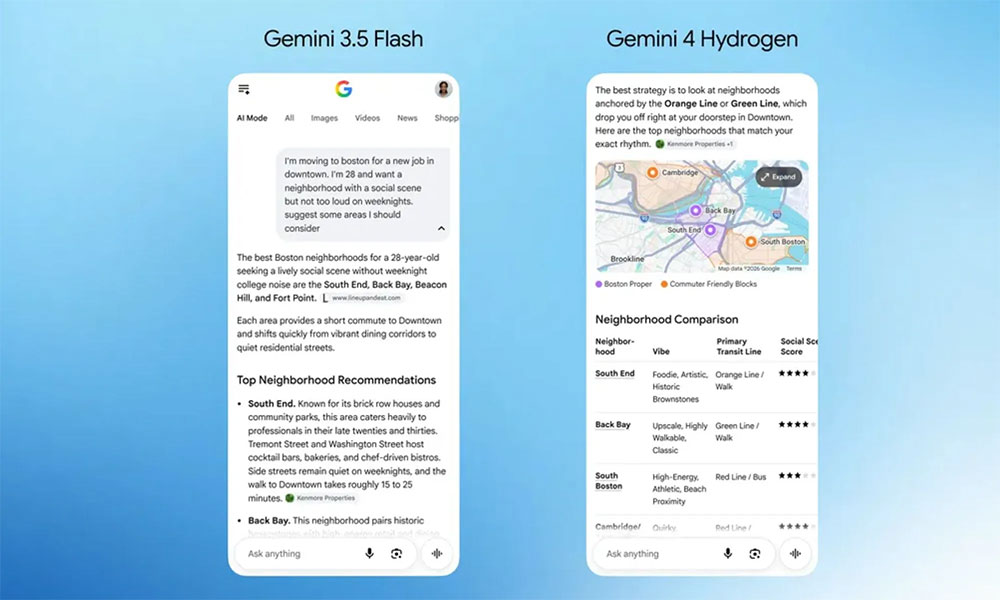
With the release of the new model, Google has also launched an ecosystem-wide deployment plan:
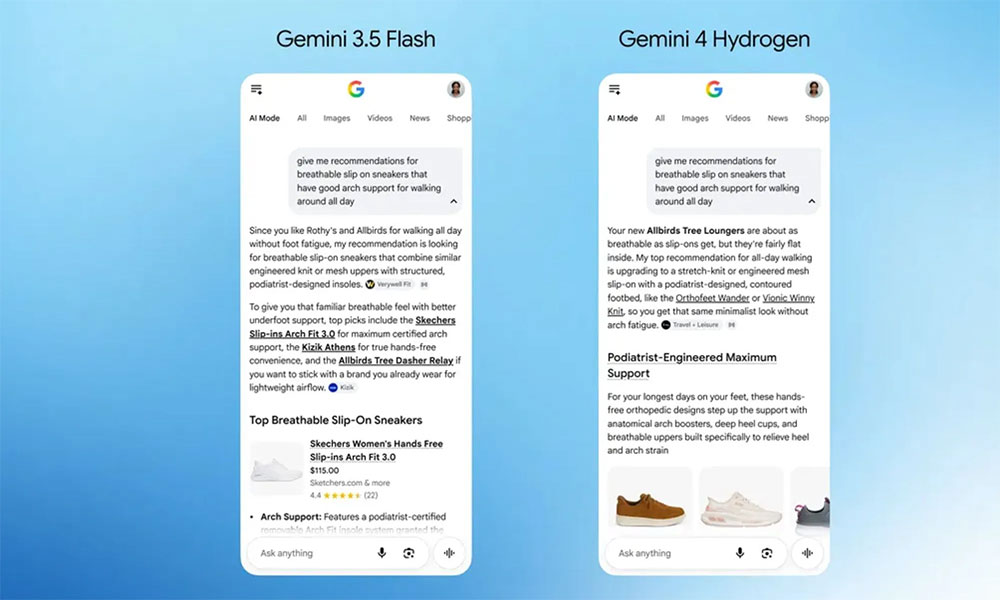
- General users and Search: Starting today, it is fully rolled out in the Gemini app. For free users, the system will automatically invoke it when they enter suitable prompts; paid subscribers can switch manually. At the same time, Hydrogen has also been integrated into Google Search worldwide, delivering more precise intent understanding, richer visual feedback, and broader recommendations of web links.
- Workspace integration: Gemini support in Google Sheets is available first to Google AI Pro and Ultra subscribers; in the Gemini app, Gmail and Google Drive can also be connected more seamlessly to pull in context, helping with everyday document work and research.
- Developers and enterprises: Full access through the Gemini API, Android Studio, all tiers of Google AI Studio, and Google Antigravity; enterprise customers can also select it directly from the model menu in Gemini Enterprise.
Source: KOCPC Chinese