


Alibaba’s Tongyi Qianwen team will officially launch in January 2026 Qwen3-TTS, this open source speech synthesis model is called a “nuclear bomb” level product of speech AI by the industry. It only takes 3 seconds of audio to clone anyone’s voice, even better than paid subscription services like ElevenLabs, putting an end to high-priced voice cloning (VoiceClone) era.
3 Seconds Cloning: Technical Threshold Returned to Zero
The most astounding feature of Qwen3-TTS is its extremely low voice cloning threshold. Traditional voice cloning technology usually requires minutes or even hours of training audio, while Qwen3-TTS only requires 3 secondsReference audio can generate highly similar clone sounds. This means that a person’s voice characteristics can be extracted and copied from a short voice message, a video clip, or even a phone call recording.
According to the official technical report, Qwen3-TTS performed well in the Seed-TTS-Eval benchmark test: the Chinese word error rate (WER) was only 2.12%, the English WER was 2.58%, and the speaker similarity reached 0.89. In the multi-language TTS test, its performance is better than commercial competitors such as ElevenLabs and MiniMax.
Some netizens on the X platform shared the amazing effect of Qwen3-TTS cloning Sam Altman’s voice, which would be very scary if used for fraud:
开源语音 AI 的“核弹”来了
刚发布的 Qwen3-TTS 彻底终结了昂贵语音克隆的时代
1.7B 参数量,效果直接干翻市面上的付费订阅
3秒克隆,只要你一段 3s 的录音,你的声音就“开源”了
毫秒级延迟,97ms 响应,比你眨眼还快
WER 暴打竞品
发音比 ElevenLabs 更像真人,完全听不出机器人感
最可怕的是… pic.twitter.com/gxjU6LuoMg
— 比特币橙子Trader (@chengzi_95330) February 18, 2026
Millisecond latency: faster than the blink of an eye
Qwen3-TTS adopts the innovative Dual-Track dual-track streaming generation architecture to achieve 97 millisecondsend-to-end synthesis delay. By comparison, a human blink takes about 100-150 milliseconds, meaning Qwen3-TTS reacts faster than a blink. This breakthrough makes it suitable for real-time interaction scenarios, such as AI voice assistant, online customer service, live broadcast interaction, etc.
The model supports 10 major languages: Chinese, English, Japanese, Korean, German, French, Russian, Portuguese, Spanish and Italian, and has cross-language voice cloning capabilities: you can speak English with a Chinese voice, or speak Japanese with an English voice, while maintaining timbre consistency.
| Model | Features | Language Support | Streaming | Instruction Control |
|---|---|---|---|---|
| Qwen3-TTS-12Hz-1.7B-VoiceDesign | Performs voice design based on user-provided descriptions. | Chinese, English, Japanese, Korean, German, French, Russian, Portuguese, Spanish, Italian | ✅ | ✅ |
| Qwen3-TTS-12Hz-1.7B-CustomVoice | Provides style control over target timbres via user instructions; supports 9 premium timbres covering various combinations of gender, age, language, and dialect. | Chinese, English, Japanese, Korean, German, French, Russian, Portuguese, Spanish, Italian | ✅ | ✅ |
| Qwen3-TTS-12Hz-1.7B-Base | Base model capable of 3-second rapid voice clone from user audio input; can be used for fine-tuning (FT) other models. | Chinese, English, Japanese, Korean, German, French, Russian, Portuguese, Spanish, Italian | ✅ | |
| Qwen3-TTS-12Hz-0.6B-CustomVoice | Supports 9 premium timbres covering various combinations of gender, age, language, and dialect. | Chinese, English, Japanese, Korean, German, French, Russian, Portuguese, Spanish, Italian | ✅ | |
| Qwen3-TTS-12Hz-0.6B-Base | Base model capable of 3-second rapid voice clone from user audio input; can be used for fine-tuning (FT) other models. | Chinese, English, Japanese, Korean, German, French, Russian, Portuguese, Spanish, Italian | ✅ |
Three core functions
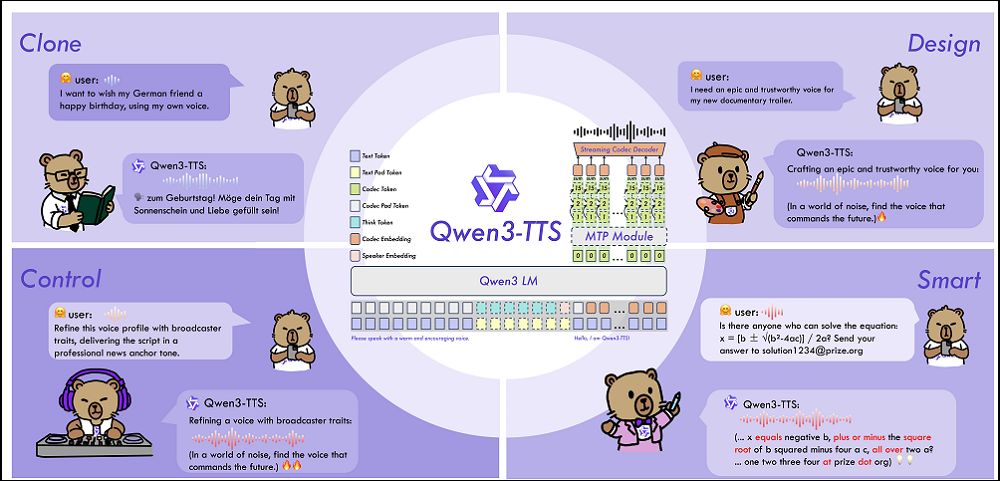
Qwen3-TTS provides three main functional modes:
- VoiceClone (Voice Clone): Clone a specific speaker’s voice based on 3 seconds of reference audio, supporting up to 10 minutes of continuous speech generation
- VoiceDesign (voice design): Create a new voice through natural language description, such as “a low and hoarse male voice with a slight British accent”
- CustomVoice (custom voice): Built-in 9 high-quality preset sounds, supporting multi-dimensional control such as emotion, intonation, speaking speed, etc.
Free open source vs expensive subscription
Qwen3-TTS adopts the Apache 2.0 open source license and provides two parameter sizes of 0.6B and 1.7B. The 1.7B model requires 6-8GB VRAM, and the 0.6B model requires only 4-6GB VRAM to run on consumer-grade graphics cards. This is in stark contrast to ElevenLabs’ monthly subscription fees of $5-330: developers and content creators now have access to cutting-edge speech synthesis capabilities at zero cost.
The self-developed Qwen3-TTS-Tokenizer-12Hz speech coder achieves efficient acoustic compression while retaining paralinguistic information (emotion, intonation) and acoustic environment characteristics. The non-DiT lightweight architecture allows the model to achieve high-speed, high-fidelity speech reconstruction on ordinary hardware.
Qwen3-TTS huggingface / GitHub
Technology dividends coexist with risks of abuse
The open source release of Qwen3-TTS is undoubtedly a major breakthrough in the field of voice AI, but as mentioned at the beginning: “It only takes 3 seconds of audio to clone anyone’s voice, and it has no ethical restrictions”, which means that this technology can be easily abused by interested parties (in fact, it can still be done now, but the threshold is lower). When a scammer can use your 3-second voice clip to generate a complete conversation, and when a loved one receives a voice call from “your” asking to transfer money, how can you prove that it is really you? Existing voice verification, bank phone confirmation, and even legal evidence may be affected.
The technology itself is neutral, but the open source and unrestricted release strategy does increase the risk exponentially. This requires all sectors of society to think together: How to establish a new identity verification mechanism? How to develop a legal framework for the use of AI voice? When technology develops faster than regulatory capabilities, increasing personal protection awareness may be the last line of defense.
Source: KOCPC Chinese