


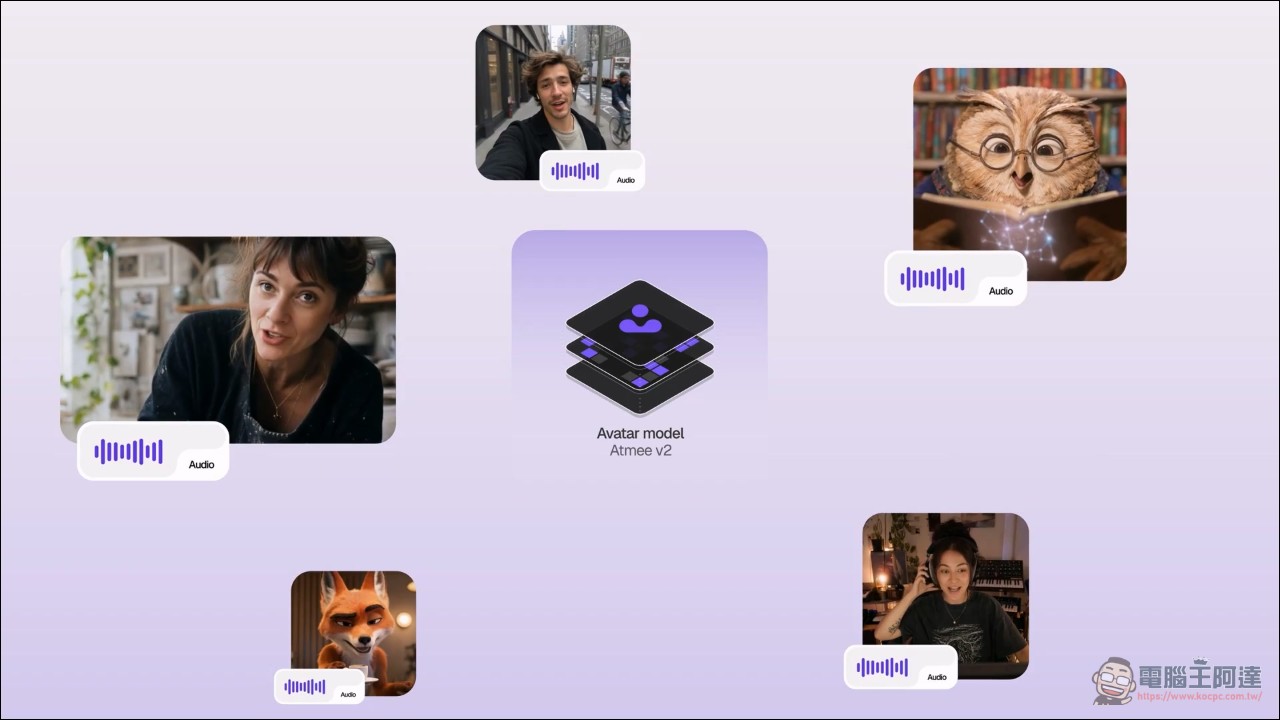
Now even real-time video conversations may no longer be trustworthy, because the bar is about to be lowered another notch. Recently, Atmanity co-founder and CEO Chen-Ping Yu, on XPublish Atmee v2, an avatar model designed specifically for “real-time video agents.” Atmee v2’s pitch is quite concrete: one image plus a short audio clip can generate a character capable of real-time video calls. According to the official statement, this model runs on a single GPU and is 50 times faster than general-purpose video models like Seedance 2.5 and Wan 3.0, with operating costs 10 to 100 times lower.
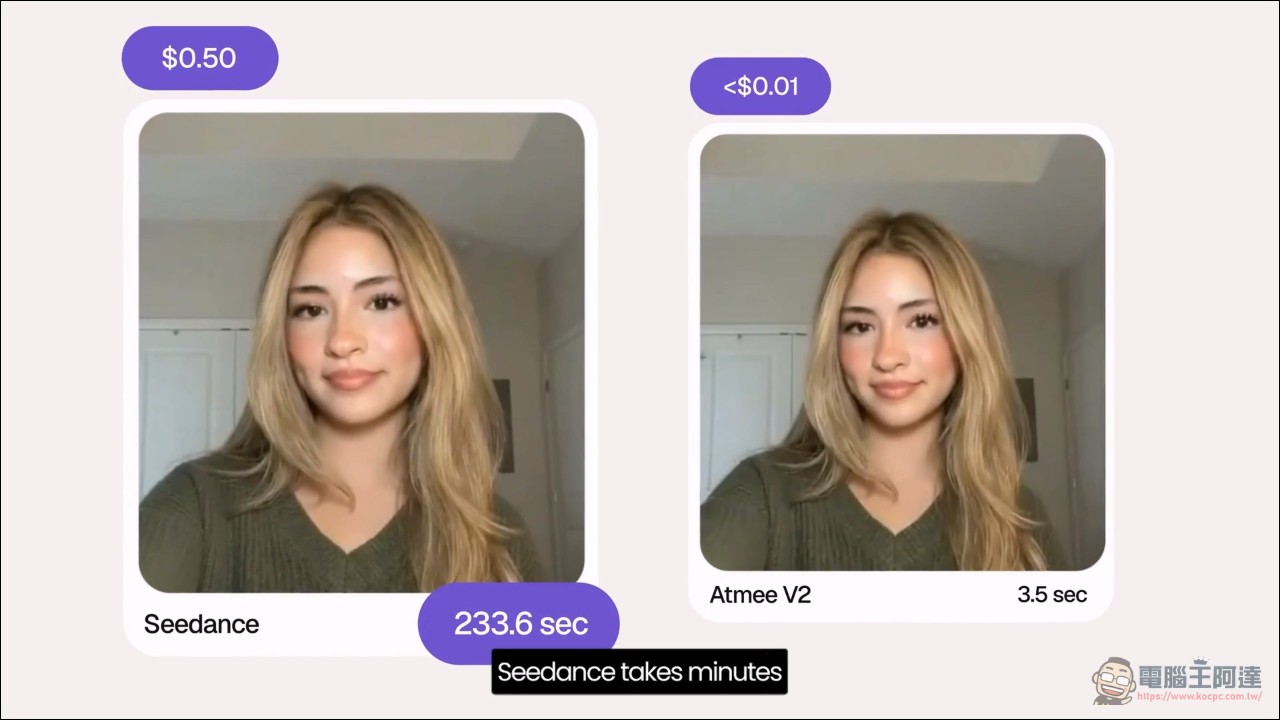
Division of labor between the two models: Causeur decides, Atmee v2 renders.
Atmanity splits a real-time video agent into two halves. As stated on the official website, “Causeur decides, Atmee v2 renders.” Causeur is the behavior model, responsible for personality, emotion, timing, and active listening, determining what the character should do while you are speaking and while it is speaking; Atmee v2 is the rendering side, officially defined as “a real-time full-frame video foundation model for real-time avatars,” covering face, body, micro-expressions, emotion, and environment.
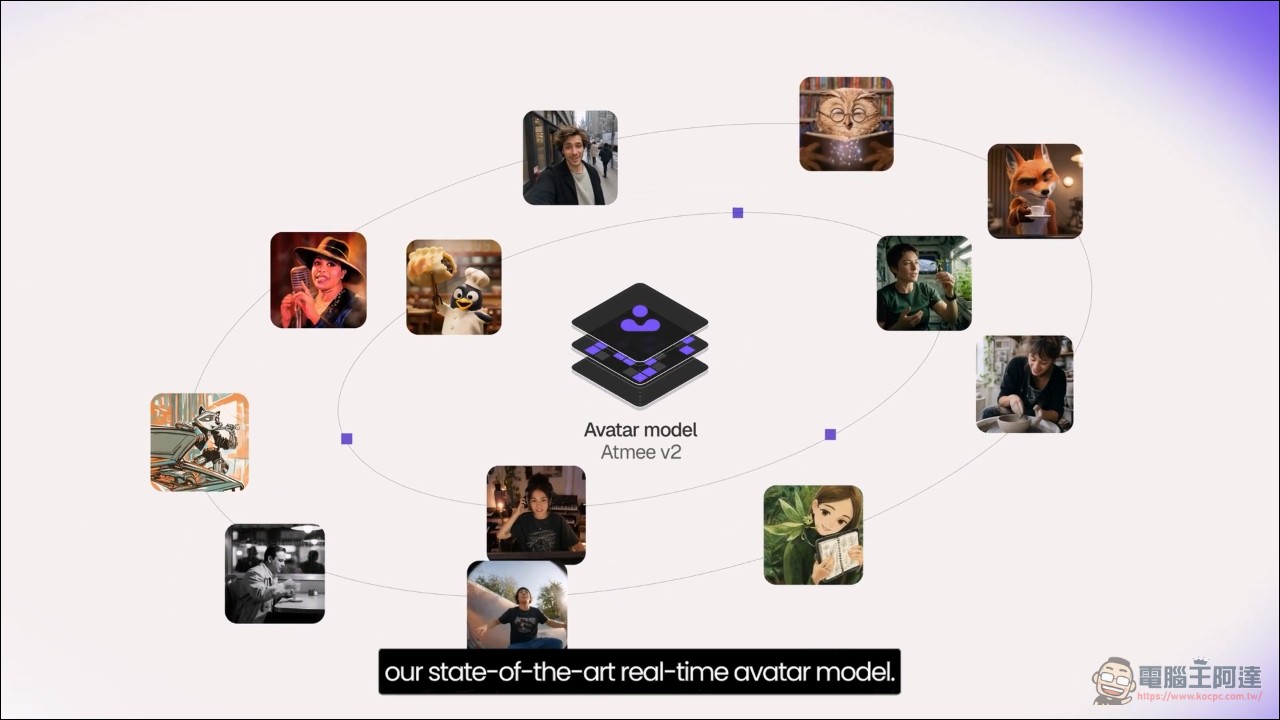
This division of labor points to a real technical threshold. An avatar that moves its lips is easy to make, but getting a character to nod at the right moment, react to your tone of voice, and maintain a consistent personality is an order of magnitude harder. A voice agent can stream audio and tolerate small delays; a video agent must continuously render the full frame—commonly at 24 or 30 frames per second—while also staying aligned with the audio and responding to the user in real time.
Atmanity also mentioned four design features: real-time rendering on a single GPU, support for realistic or stylized and even non-human appearances, independent personalities for each character, and its own data engine; the company says its consumer-facing app atmee.ai receives thousands of hours of real conversation feedback each month.
Officially published benchmark results
The Atmee official website lists two sets of comparisons. The first set compares Atmee v2 against other real-time avatar models, where higher values are better:
- Liveliness (vividness)Atmee v2 is 1.31, Runway 1.21, Kling AI 1.05, LemonSlice 0.96, LiveTalk 0.77.
- LipSync (lip synchronization): Atmee v2 is 7.61, Runway 7.16, LemonSlice 6.74, LiveTalk 3.14, Kling AI 2.98
- Preserve ID (identity preservation)Atmee v2 is 0.881, LemonSlice 0.821, Runway 0.811, Kling AI 0.642, LiveTalk 0.543
- Naturalness (自然度)Atmee v2 is 0.741, with Runway at 0.629, LemonSlice at 0.575, Kling AI at 0.526, and LiveTalk at 0.503.
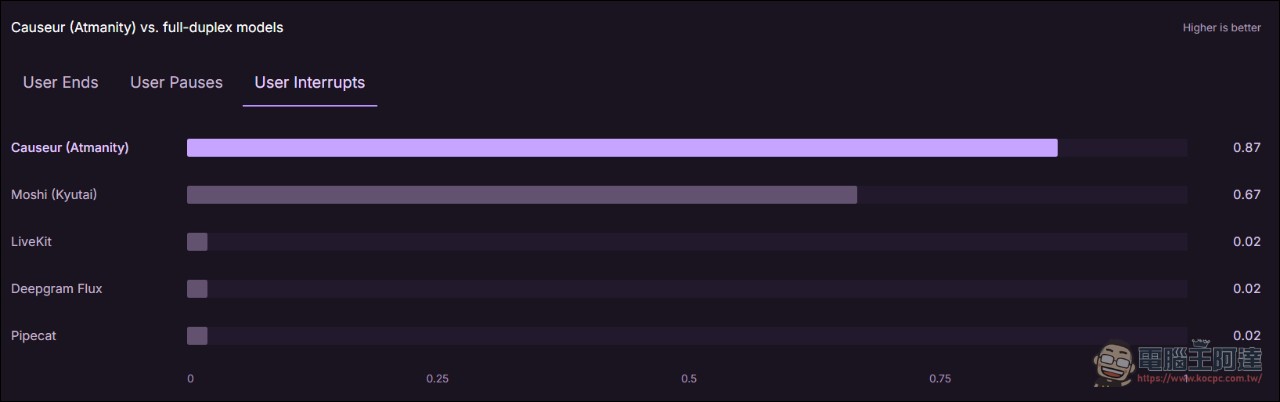
The second group pits the behavioral model Causeur against full-duplex speech models across three scenarios: the user finishes speaking, the user pauses, and the user barges in. Causeur scored 0.92, 0.92, and 0.87 on the three, respectively; in the comparison group, Moshi (Kyutai) scored 0.88, 0.87, and 0.67, LiveKit 0.74, 0.59, and 0.02, Deepgram Flux 0.68, 0.57, and 0.02, and Pipecat 0.56, 0.66, and 0.02.
The gap is most pronounced for user barge-in. LiveKit, Deepgram Flux, and Pipecat each scored only 0.02 on this item, while Causeur scored 0.87. In the control group, Moshi is Kyutai’s open-source full-duplex model, with a score of 0.67.
How do I use it, and how much does it cost?
The Atmee v1 API is currently publicly available; v2 is invite-only, and an invite code must be requested through a form on the official website. In addition to the API, atmee.ai also provides a no-code creation interface where users can upload, record, take photos, or automatically generate characters, set the voice, personality, and knowledge base, and then share the link or embed it in a website. The platform already features real characters, including 17-time World Series of Poker champion Phil Hellmuth, physicist Newton, Sun Wukong, and others. Atmanity has also designed a revenue-sharing mechanism: verified creators can earn a share of revenue based on the number of minutes viewers talk with their avatar (the official pricing table has not yet been published). 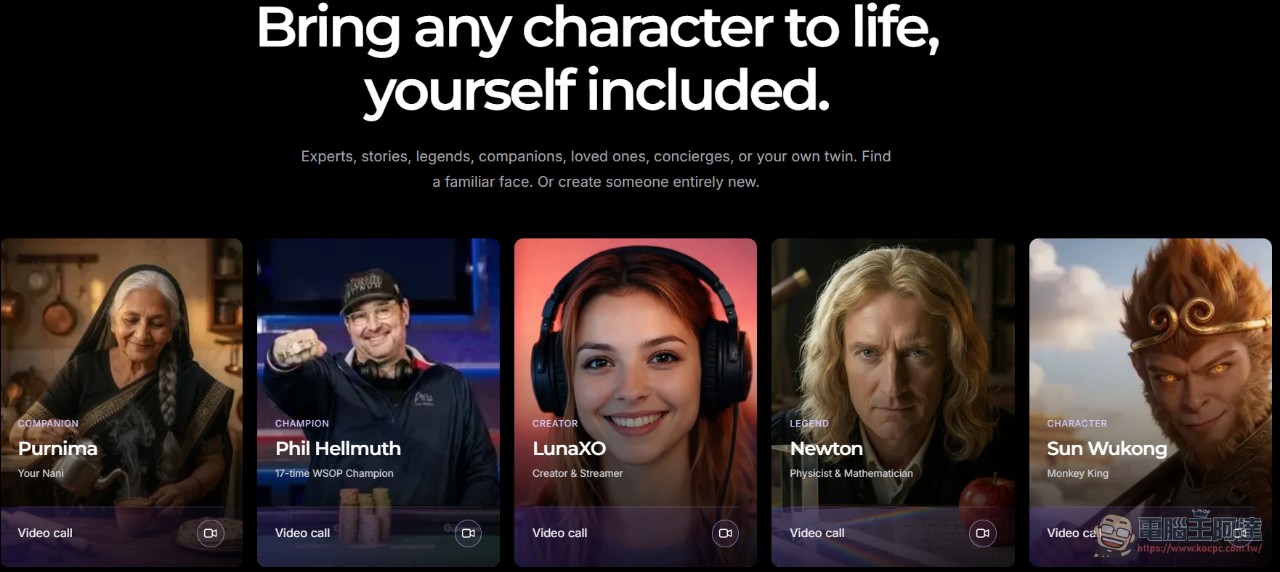
Conclusion
Atmee v2 takes the approach of splitting the real-time video agent into two layers, “behavior” and “rendering,” and compressing rendering to run on a single GPU. From a cost-structure perspective, replacing general-purpose models with specialized models is a reasonable direction, and it is also a recurring pattern in the recent image-model field. However, although this kind of service is said to add more fun to video calls, the cost and difficulty of scams or Deepfake impersonation of others will also decrease accordingly—and that is another difficult problem to solve.
Source:Atmee Official Website
Source: KOCPC Chinese