


Jan Broersen, professor of philosophy, logic and AI at Utrecht University in the Netherlands, posted on X in a tone of disappointment rather than anger: “I have very little respect left for Elon Musk, but I had thought he was at least a competent engineer. But after hearing him say it is easier to ‘cool things down’ in space, even that last bit of respect has dissipated. The facts are exactly the opposite. Vacuum is the best insulator. In space, you can only carry heat away by radiation. These space data centers are extremely unlikely to become reality, and certainly not in our lifetimes.” Elon Musk’s response to him was just one sentence: “You are a complete idiot.”
@broudsov You are fully retarded
— Elon Musk (@elonmusk) November 3, 2026
What did the philosophy professor get right, and what did they get wrong?
Actually, Professor Broersen’s physics isn’t wrong. In a vacuum there is no air and no water, so both heat conduction and convection are closed off, leaving only radiation. Both SpaceX and the critics agree on this point. The problem is that he treats this observation as the conclusion. Replies from the engineering community quickly followed. Tom Mueller, a core early SpaceX technical figure, only replied “philosophy professor” along with an eye-roll; James Stephenson asked what he thought of Google’s Sundar Pichai, saying “they already have a data center in space that dissipates heat through radiation in vacuum,” referring to Google’s Project Suncatcher prototype satellite, which has already powered on a TPU in orbit and sent back results.
Sequoia Capital partner Shaun Maguire, a Caltech physics PhD, wrote underneath:A lengthy replyHis core argument is: the overall difficulty of space heat dissipation is indeed far higher than on the ground, but most of the difficulty lies in Starship. Once large payloads can be sent to space cheaply, heat dissipation actually becomes easier than on the ground. The cooling system can be passive: a large piece of metal that is both lightweight and highly thermally conductive, with aluminum being a good candidate, with a working fluid circulating inside. Ammonia has long been the industry standard for space radiators. Near the chip, the working fluid changes from liquid to gas, and the density difference drives the hot gas to circulate through the loop. The aluminum draws heat away from the working fluid and then dissipates the heat into space through black-body radiation.

The three numbers Musk gave
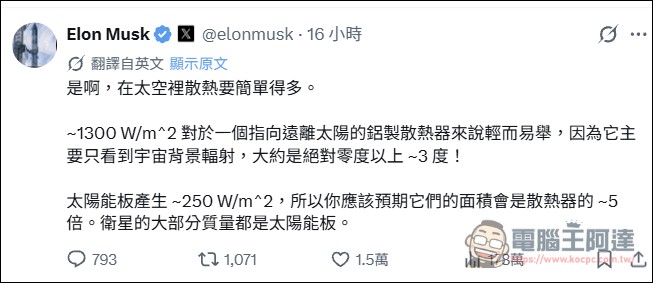
Musk then agreed with Maguire’s statement and gave a set of numbers. He said 1,300 watts per square meter is easy for an aluminum radiator facing away from the sun, because what it sees is mainly cosmic background radiation, about 3 degrees above absolute zero. Solar panels produce 250 watts of electricity per square meter, so the solar panel area would be about 5 times that of the radiator, and the largest piece on the satellite would be the solar panels.
Behind this set of numbers is the Stefan-Boltzmann law: radiated power is proportional to the fourth power of temperature. The fourth power means that a slight increase in temperature causes heat dissipation capacity to jump substantially. Plugging in the numbers: a panel at about 65°C dissipates roughly 2.03 times the heat of a panel at 10°C, which is roughly double. Chips already run at high temperatures, and high temperatures happen to be exactly the condition radiators like best. Cosmic background radiation is about 2.725 K, which converts to about minus 270°C; this number is not controversial. The controversial part comes later: whether a satellite in orbit sees only this temperature.
The numbers for the International Space Station
The evidence most often cited by the opposing side is the International Space Station.NASA document recordsThe space station’s external active thermal control system has two ammonia cooling loops, each capable of rejecting 35 kW, for a total of 70 kW. The space station has 48 radiator panels, each about 3.33 meters by 2.64 meters, totaling about 422 square meters. Dividing 70 kW by 422 gives about 166 W per square meter. Compared with Musk’s 1,300, the difference is close to one-eighth. On the surface, this looks unfavorable to Musk, but these two numbers are not measured on the same scale:
The first discrepancy is temperature. The space station’s cooling loop has to serve the astronauts, so the radiators run at very low temperatures. Working backward from the figure of 166 watts, the radiator surface temperature is about minus 34 degrees. Musk’s figure corresponds to panel temperatures between 50 and 80 degrees Celsius. Under the fourth-power law, this temperature difference alone accounts for most of the gap.
The second discrepancy is the number of radiating surfaces. The 1,300 watts Musk mentions is calculated based on the entire panel radiating from both sides simultaneously. The space station’s 422 square meters is the actual radiating area, and its back is covered with insulation, so only one side is emitting. Comparing one side to one side, the difference is about four times, not eight times.
AI1’s actual specifications
The specific subject of this debate is AI1, SpaceX’s publicly disclosed orbital AI satellite concept. Public information shows that AI1 has a wingspan of about 70 meters when deployed, peak computing power of about 150 kW and sustained computing power of about 120 kW, a power density of 70 kW per ton, and flies at an altitude of about 600 kilometers. Heat dissipation relies on a deployable liquid-cooled radiator with an area of about 110 square meters, equipped with redundant pump loops.
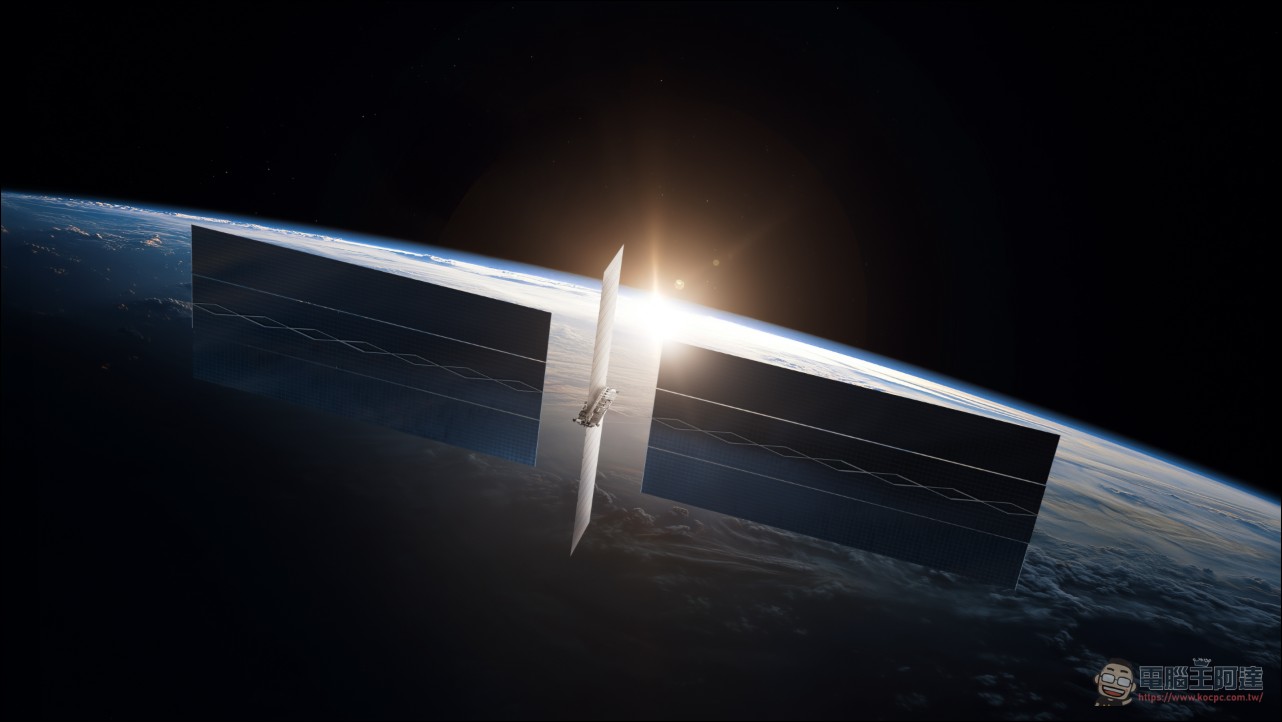
110 square meters multiplied by 1,400 watts per square meter gives about 154 kilowatts. This number matches the 150-kilowatt peak rather than the 120-kilowatt sustained compute power, but the order of magnitude does indeed line up. Someone independently recalculated from first principles and got the same result. As for the radiator’s working fluid, the prevailing outside assessment is ammonia rather than water. Hugh Lewis, a space debris expert at the University of Birmingham, judged that water’s freezing and boiling points are unsuitable for a system in vacuum, unpressurized, and subject to drastic temperature changes, while ammonia can remain liquid at low temperatures; the International Space Station uses the same setup.
But the satellite isn’t actually pointing at deep space.
There is an idealized premise in Musk’s statement, and it is also the part most easily overlooked in this debate. He says the radiator “mainly sees cosmic background radiation,” but AI1 will fly in a sun-synchronous orbit, not deep space. A satellite in orbit receives three heat sources at the same time: direct sunlight of about 1,361 watts per square meter, Earth’s infrared radiation on the side facing Earth of about 200 to 240 watts, and albedo. The radiator will indeed orient its knife-edge face toward the Sun to avoid sunlight as much as possible and radiate from both sides, but one side will still receive heat reflected from Earth.
Therefore, the actual heat dissipation efficiency depends on the effective cold-source temperature after coating and attitude control, rather than simply 3 K. This does not overturn Musk’s argument; it merely revises his number downward somewhat and makes the engineering requirements more demanding.
The threshold lies in launch costs.
The point Maguire raised in the reply is something both sides agree on: most of the difficulty in space cooling lies with Starship, not with radiation itself. Radiative cooling technology has long existed; what has held it back is cost and weight. This is also supported by an independent economic analysis. A cost model published by ABI Research in IEEE Spectrum shows that running one GPU in space for a year costs at least ten times as much as on Earth. The model assumes Nvidia H100 racks, vehicles similar to Starcloud’s pilot satellites, an extremely optimistic SpaceX Starship launch cost of US$44 per kilogram, and ground electricity at US$0.20 per kWh. This model is not an estimate for AI1’s dedicated design, but the order of magnitude is useful for reference.
Another challenge that keeps coming up is tonnage. To scale cooling capacity to the 1 GW level, the heat-dissipation area would need to be about 3,950 square meters; at an estimated 5 to 10 kg per square meter, the thermal management system alone would weigh 20,000 to 40,000 kg. Whether Starship can bring this cost down is the key to whether the space data center story holds up. That said, the professor being called an “idiot” by the world’s richest person is itself a kind of achievement (just kidding).
Source: KOCPC Chinese