


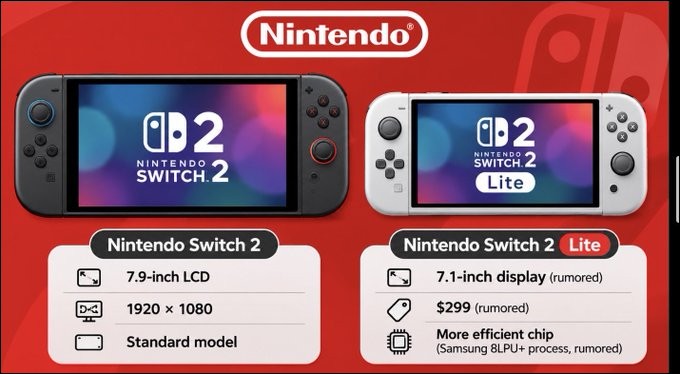
At a time when prices for the Switch 2, the original Switch, Switch OLED, and Switch Lite have also been raised due to memory shortages, a rumor about a “Switch 2 Lite” has begun spreading widely online, with very specific details and specs: a 2027 launch, a 7.1-inch screen, a price of about US$299, a switch to Samsung’s improved 8LPU+ process, and lower power consumption. Combined with recent related industry news, its credibility seems quite high.
Evidence 1: Samsung really is going to update its 8nm process; the numbers are real.
The strongest piece of evidence comes from Samsung itself. Samsung will present its second-generation 8nm process, 8LPU+, at the IEEE IEDM (International Electron Devices Meeting) on December 14, 2026. The figures listed in the official abstract are a 12% performance improvement, 15% lower power consumption, an 8% reduction in logic area, an approximately 10% reduction in I/O area, and an improvement in standby leakage. These are process-level figures, not the specifications of any completed game console.
Why do we say this may be related to Switch 2 Lite? First, 8LPU+ is a pure DUV process (a path outside EUV lithography), so it does not use the most expensive EUV; Samsung is targeting cost-sensitive areas such as automotive, robotics, and edge AI chips.]Second, the NVIDIA T239 processor used in Switch 2 is precisely a product of Samsung’s 8nm-class process. This chip has eight Arm Cortex-A78C cores, a GPU based on the Ampere architecture with 1,536 CUDA cores, and a die area of about 207 square millimeters. So there is a ready-made line to draw between the “new process” and “Switch 2.”
South Korea《Electronic Times》Quoting an industry insider, the “existing 8nm customers” in Samsung’s foundry ecosystem are possible adopters of the new process. The statement did not name any company, but the NVIDIA chip for Switch 2 is indeed on this list. As for Samsung’s own IEDM abstract, it does not mention Nintendo or NVIDIA at all.
Evidence 2: Nintendo’s R&D spending really is surging.
The second piece of the puzzle comes from Nintendo’s financial report. Data for the fiscal year ending March 2026 shows that marketing and general and administrative expenses rose 28.3% year over year to 548.8 billion yen, mainly due to increased advertising spending driven by the Switch 2 launch and higher R&D expenses. A specialized website that tracks Nintendo patents and R&D Nintendo Patents Watch A pattern emerges from the annual figures: R&D expenses have risen year by year since the Switch era, mainly due to increased software development costs, but there have been two jumps of more than 20%, in FY2020-03 and FY2024-03 respectively—that is, one to two years before the launch of the OLED version and Switch 2. And FY2026-03 marks another jump of more than 20%.
The website’s May assessment was that new hardware could arrive in the second half of 2027 or the first half of 2028. It also listed two possibilities itself: one is a refresh of a cost-cut version like Lite, which would require substantial new development; the other is a flagship specification upgrade.
Evidence 3: The timing forced by European regulations
There is another less-mentioned clue unrelated to the chip: the EU right-to-repair law requires replaceable-battery designs. Nintendo recently modified the Switch 2 console to make battery replacement easier, and the existing Switch Lite will cease production in Europe in February 2027. This timeline overlaps with the rumored 2027, and a new product could fill that gap.
However, making the Switch 2 Lite cheap doesn’t depend on the chip alone. When memory costs are several times those of the rest of the machine, launching a cheap model is impossible right now. There is another layer to the cost structure: Samsung raised its quotes for new 8nm wafer orders by nearly 10% in July. A smaller logic area may recover some savings from depreciation on existing DUV lines, but that alone cannot close the gap left by memory price increases.
A more promising direction is to keep the same SoC and focus only on the manufacturing process, reducing the number of GPU cores to lower production costs while maintaining game compatibility. The first-generation Switch Lite used this same logic to bring down the price: a smaller body, non-detachable Joy-Con, and no bundled dock.
Conclusion
If you lay out the evidence, this rumor is more solid on the industry-news front than most internet rumors: Samsung’s process numbers come from an official summary, Nintendo’s R&D spending is a financial-report figure, and the European discontinuation timeline is public information. By contrast, the rumored 7.1-inch screen and $299 price are pure estimates, and 2027 is not on any official schedule. For a console that has even raised its price amid a memory shortage, a smaller, more power-efficient, and perhaps cheaper derivative model does make commercial sense, but whether it will be a “Switch 2 Lite” or a “higher-spec version” is probably something even Nintendo itself hasn’t decided.
Source: KOCPC Chinese