


I never expected that Google would only just release at the beginning of this month the long-awaited… Gemini 4 Argon Barely a month after the flagship model, the next generation has already arrived. Earlier, the next frontier model, Gemini 4 Carbon, was officially announced, with improvements in software development, security protection, and long-duration autonomous task execution. On the Artificial Analysis leaderboard, Carbon took first place with 59 points, 9 points higher than Argon. In addition, its three security tests—finding vulnerabilities, verifying vulnerabilities, and patching vulnerabilities—also set new best scores.
But oddly, this time it remains at Gemini 4, with only the name changed to Carbon; it seems to be just the next new version of Argon rather than a truly all-new generation of the most powerful AI model.

Google Releases Gemini 4 Carbon: Tops Artificial Analysis Benchmarks, Major Leap in Cybersecurity Capabilities, and Can Work Autonomously for Days on End
Earlier, Google published on its official blog Gemini 4 Carbon, becoming the new flagship model in the Gemini 4 series after Argon.
This upgrade has four main highlights:
- Overall performance: scored 59 on the Artificial Analysis Intelligence Index v5.0 to take first place.
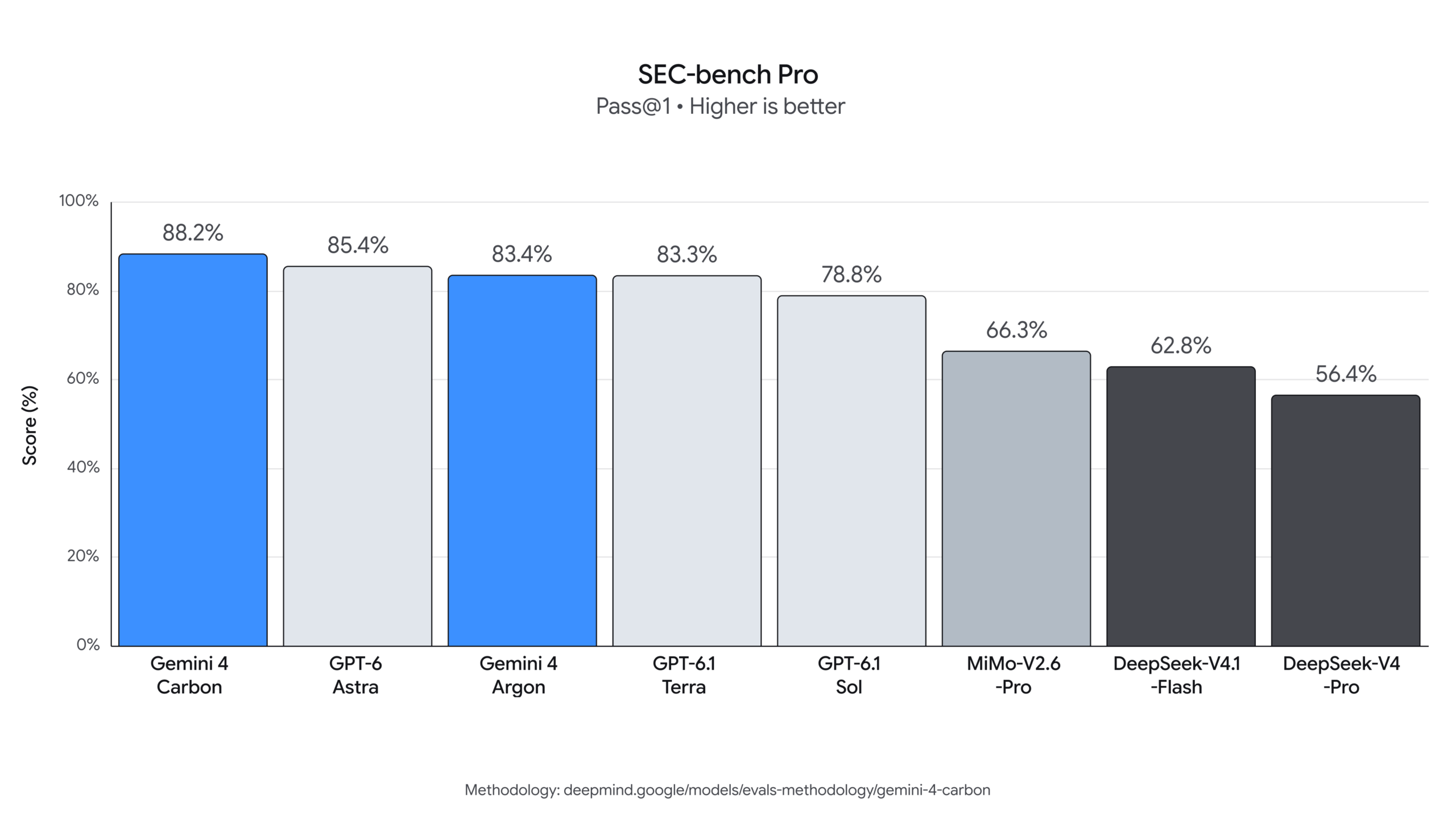
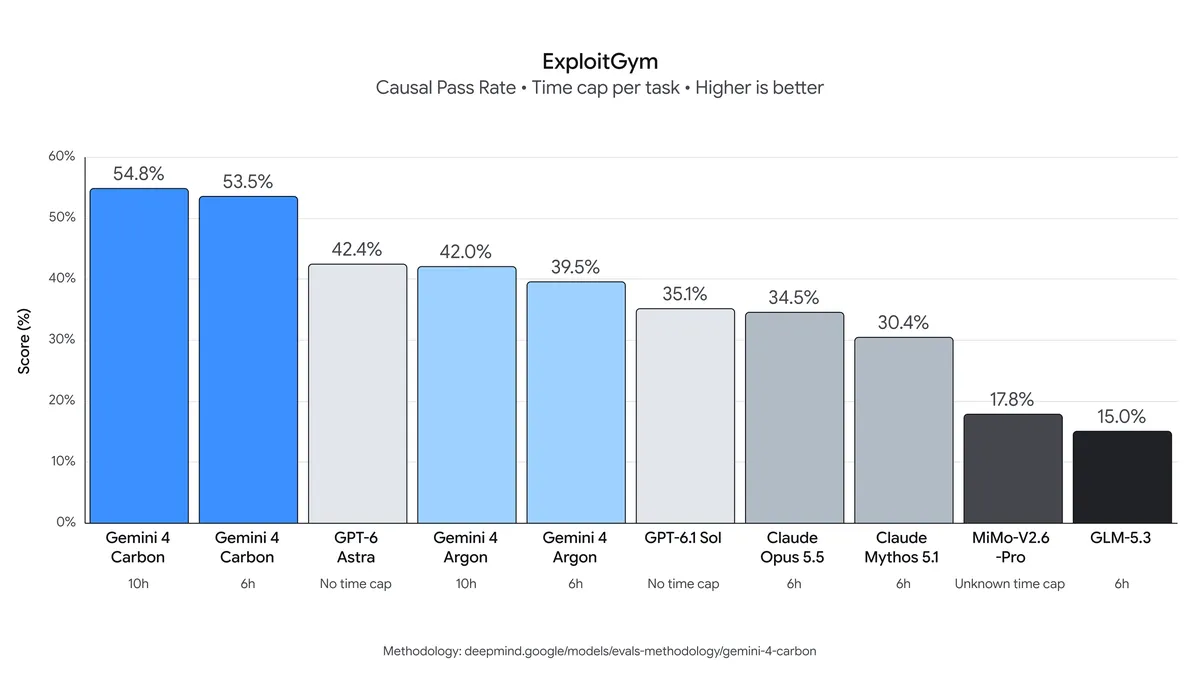
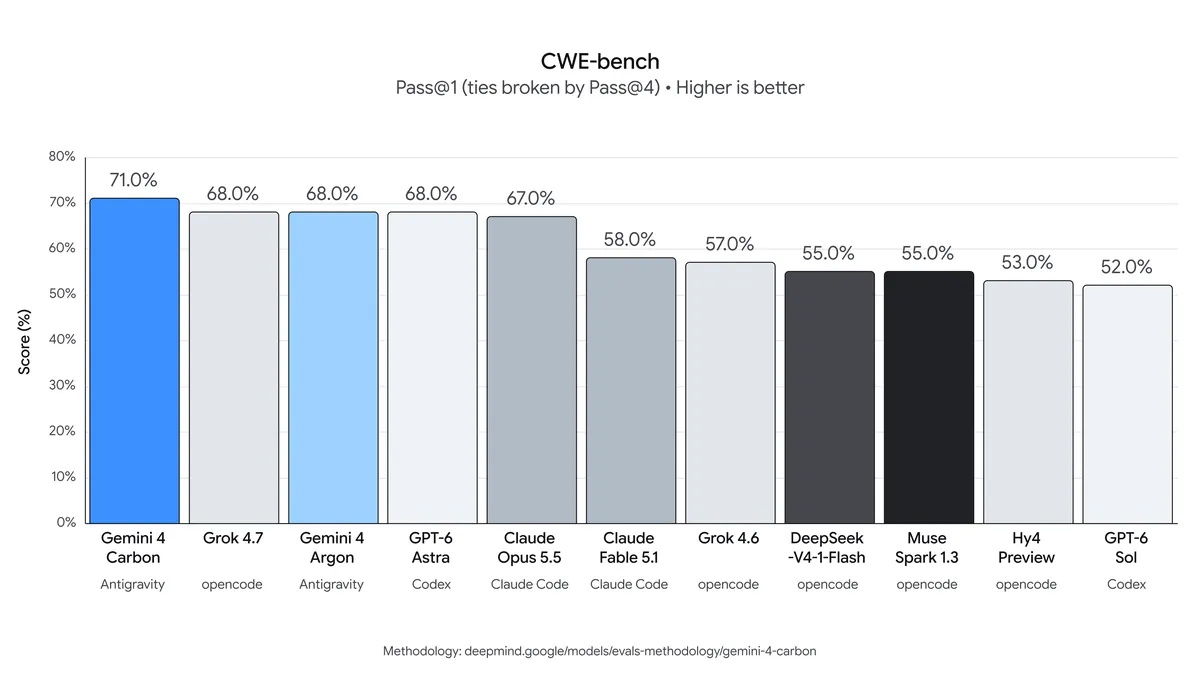
- Cybersecurity capability: It achieved the current best results in all three tests—SEC-bench Pro for finding vulnerabilities, ExploitGym for verifying vulnerabilities, and CWE-bench for patching vulnerabilities.
- Long-duration autonomous tasks: Google’s internal team observed that it can work continuously for several days.
- Reliability: unsupported claims decreased by about half, and the success rate of indirect prompt injection attacks dropped to 0%
Logan Kilpatrick, head of Google AI Studio, said on X that compared with Argon, which launched just two weeks ago, Carbon is a major leap forward.
First, looking at overall performance, on the Artificial Analysis leaderboard, Gemini 4 Carbon (High) scores 59, while the previous generation Argon scores 50, a 9-point difference between the two generations. Among competitors, Anthropic’s Claude Opus 5.5 scores 58, and OpenAI’s GPT-6 Astra scores 57. However, although Carbon tops the list, it leads the second place by only 1 point, and the gap among the top three is quite close, so as soon as Anthropic and OpenAI release new versions, it may be overtaken again:
| AI model | Artificial Analysis Intelligence Index v5.0 |
|---|---|
| Gemini 4 Carbon(High) | 59 |
| Claude Opus 5.5(Max with fallback) | 58 |
| GPT-6 Astra(Max) | 57 |
| GPT-6.1 Sol(Max) | 55 |
| Gemini 4 Argon(High) | 50 |
Google itself published results for 17 tests, and Carbon scored highest in 15 of them.
In the software development test FrontierSWE 2, Carbon scored 61.2%, while the previous generation Argon scored 55.0%. However, GPT-6 Astra scored 65.5% and Claude Opus 5.5 scored 62.3%, so Carbon is still behind all of them at present. In the computer operation test OSWorld-2.1, Carbon scored 81.5%, a considerable improvement over Argon’s 74.7%, but competitor Opus 5.5’s score is 87.2%.
| Category | Test item | Gemini 4 Carbon | Gemini 4 Argon | GPT-6 Astra | Claude Opus 5.5 | Claude Fable 5.1 |
|---|---|---|---|---|---|---|
| Comprehensive ability | AA Index v5.0 | 59 | 50 | 57 | 58 | 49 |
| Overall ability | Vals Index v2.2 | 70.4% | 69.2% | 65.0% | 70.2% | — |
| program agent | SWE-sweep | 9.6% | 4.3% | 9.5% | 3.6% | 2.9% |
| Program proxy | FrontierSWE 2 | 61.2% | 55.0% | 65.5% | 62.3% | 56.3% |
| Software agent | Terminal-Bench 4.0(AA) | 65.2% | 57.1% | 59.1% | 59.6% | 52.0% |
| Computer operation | Agents’ Last Exam v1.1 | 77.4% | 69.0% | 73.1% | 71.6% | — |
| Computer operation | OSWorld-2.1 Offline subset |
81.5% | 74.7% | 80.9% | 87.2% | 76.8% |
| Knowledge work | AutomationBench Zapier |
53.9% | 51.3% | 41.4% | 42.5% | 31.4% |
| Knowledge work | Vending-Bench 2 Account balance (USD) |
$16,484 | $13,718 | $15,515 | $9,235 | $5,422 |
| Multimodal understanding | Chartography | 72.5% | 71.6% | 71.0% | 66.3% | 46.2% |
| Multimodal understanding | Blueprint-Bench 2 Similarity score |
58.6% | 54.4% | 49.7% | 51.2% | 41.9% |
| Long-form reasoning | GraphWalks 256K–1M Token |
96.2% | 84.2% | 71.8% | 66.8% | 65.0% |
| Science and Mathematics | RiemannBench | 80.0% | 76.0% | 72.0% | 69.6% | 65.6% |
| Science and Mathematics | Terminal-Bench-Science 0.1(AA) | 64.8% | 52.9% | 63.3% | 59.0% | 43.3% |
Next is security capability. Google breaks security defense into three stages: finding vulnerabilities, confirming whether the vulnerabilities actually pose a risk, and fixing the vulnerabilities at the root cause. Carbon achieved the current best results in representative tests across all three stages.
Using home security as an analogy, AI in the past was more like walking around your house and telling you, “The lock on the back door seems a little off.” Carbon, by contrast, can go further and test whether a burglar could actually get in through that door, and once it confirms there is a risk, it can help you install a new lock and make sure it locks properly.
Testing whether AI can autonomously find deeply hidden, complex vulnerabilities in real-world software: in SEC-bench Pro, Carbon scored 88.2%, higher than both Argon and GPT-6 Astra:
In ExploitGym, which tests whether AI can actually exploit vulnerabilities, Carbon is also first. It not only leads Argon’s 42.0% by a wide margin, but also scores considerably higher than GPT-6 Astra and Claude Opus 5.5, improving by 12.8%, the largest gain among the three security tests:
The CWE-bench score was 71.0%:
Google also shared some internal figures: in Google’s own tests, Carbon’s success rate at generating secure code is more than twice that of Argon. The Google Chrome team reported that when it comes to generating high-quality patches, Carbon performs more than 10 times better than another AI lab’s large frontier model.
Regarding long-duration autonomous task execution, Google said its internal team observed that Carbon can run continuously for several days and, when it hits a dead end, tries other approaches instead of getting stuck and stopping. It handles multi-step engineering tasks such as tracing the root cause of subtle bugs in large codebases and low-level systems and fixing them.
This can also be seen from the test data. For example, in Terminal-Bench 4.0, Carbon improved from Argon’s 57.1% to 65.2%. In the computer-operation test Agents’ Last Exam v1.1, it rose from 69.0% to 77.4%. On GraphWalks, which requires reasoning over ultra-long content of 256,000 to 1,000,000 tokens, Carbon also scored 96.2%, leading all competitors.
As for the “reliability” that many people value, in Google’s internal tests, Carbon made about half as many unsupported claims as Argon. When data is insufficient, it will directly note the limitations in the output, or list what else is missing to complete it, rather than forcing an answer just to deliver something.
Other improvements include:
- When instructions are unclear, confirm first: When Carbon encounters ambiguous requirements, it first looks for relevant information, tells the user about any contradictions it finds, and then decides how to proceed, rather than guessing a direction and moving forward on its own.
- It neither oversteps its authority nor slacks off: overstepping behavior decreased by 26%, cases of required work being left incomplete decreased by 29%, and it stays within the task scope more reliably when executing multi-step plans.
- No exploiting test loopholes: In Terminal-Bench 4.0, the rate of successful cheating fell to 0.0%, and the rate of attempted cheating was only 0.4%; in Google’s internal real-world coding environment, high-severity behavioral deviation alerts also dropped by nearly 80%.
- Resisting prompt injection attacks: Prompt injection hides malicious instructions in web pages and documents to trick AI into following them. In Gray Swan’s indirect prompt injection tests, the attack success rate dropped from 0.7% for Argon to 0.0% for Carbon, blocking all tested attacks.
Unfortunately, however, general users cannot use it yet. This time, we are again taking a cautious, phased rollout approach and participating in the U.S. government’s voluntary pre-release testing for models. Starting this week, it will first be provided to some cybersecurity defenders, and later gradually expanded to other trusted partners through the Fairwind Program. Only after continuously collecting feedback and adjusting safeguard mechanisms will it be made available to developers, enterprises, and general consumers through Google products, but no date for full public availability has been announced.
Source: KOCPC Chinese