


The well-known Chinese tech channel Geekerwan recently released “Flagship Chip Mega Review: Apple, Qualcomm, MediaTek, or XRING—Who’s the Strongest?” This 57-minute video brings together the four major flagship smartphone chips of 2026…Retail machineApple A20 Pro, Qualcomm Snapdragon 8 Elite Extreme Gen 6 (abbreviated as 8EE6 in the video), MediaTek Dimensity 9600 Pro, and Xiaomi XRING O3, plus additional tests of Kirin 9050 Pro and Google Tensor G6. They also did not test engineering samples; Yunfei stated the reason plainly: the odds of engineering samples being specially selected and specially tuned are extremely high, and “some vendors’ engineering samples are real cheating champions.” The conclusion is spoiled right at the start: the A20 Pro is “the undisputed strongest king this year,” the XRING O3 “spared no expense and stacked the most hardware,” with multi-core efficiency topping all challengers, the Dimensity 9600 Pro made genuine progress, and as for the 8EE6, it is “the most baffling chip of the year.”
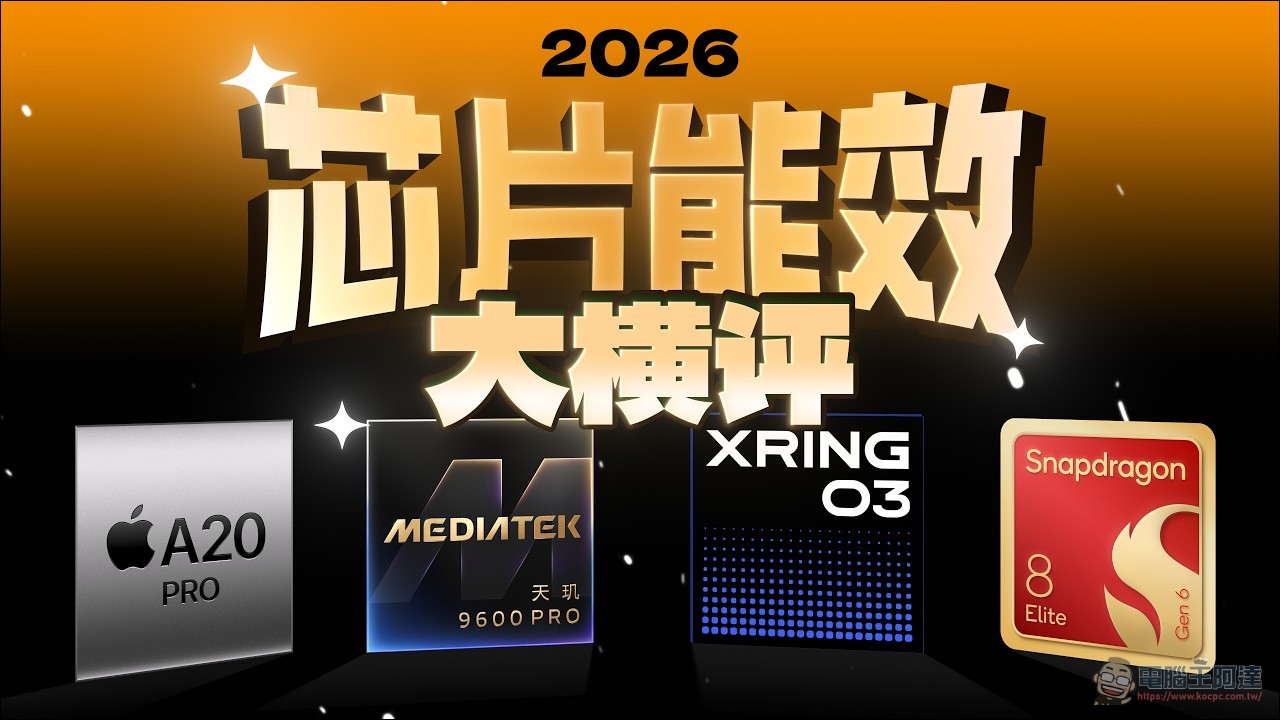
Geekerwan’s 2026 Flagship Chip Mega Comparison
Grind the package open to take a look.
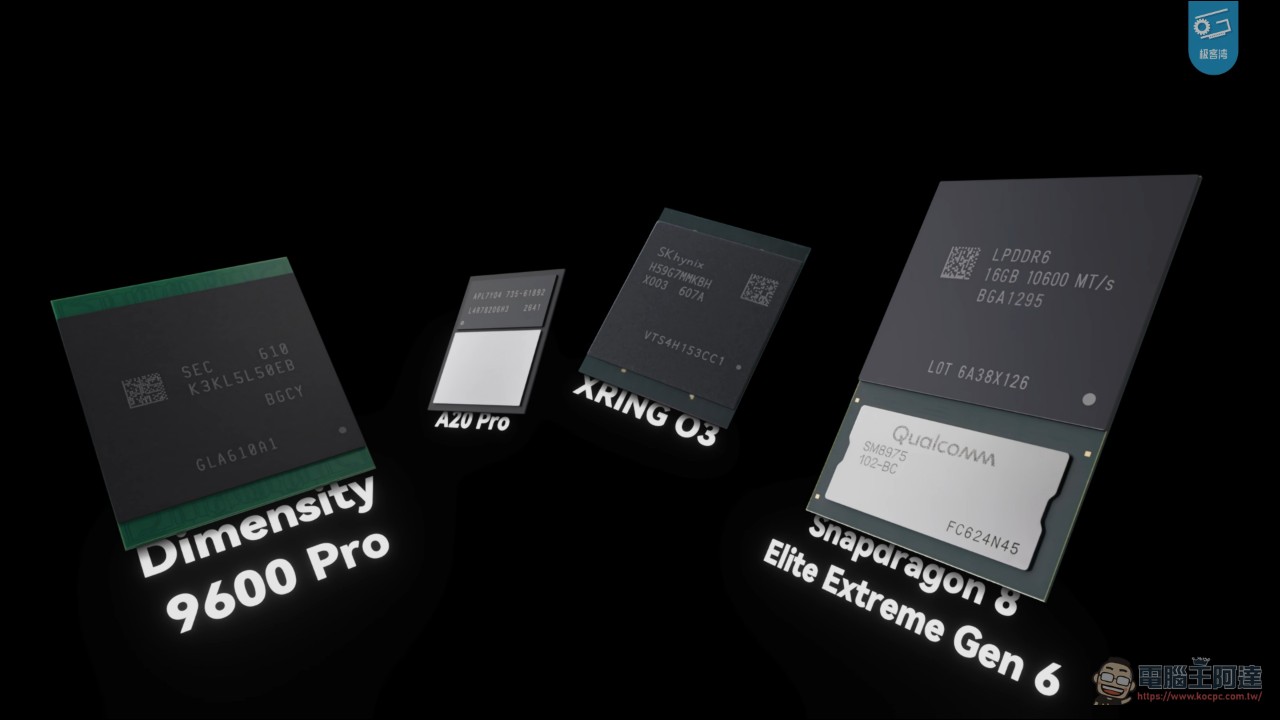
The tests begin with a hardware teardown: both the A20 Pro and 8EE6 have switched to new thermally conductive packaging. Apple’s WMCM moves the memory next to the SoC so heat is conducted away directly; it is billed as the best thermal conduction among phone chips, and the A20 Pro can deliver most of its performance at room temperature. Qualcomm’s Offset PoP staggers the memory and SoC and packs them into a thermal block; the effect is limited, and peak power consumption is very high—”somewhat useful, but not enough.” The XRING O3 and Dimensity 9600 Pro still use traditional PoP packaging.
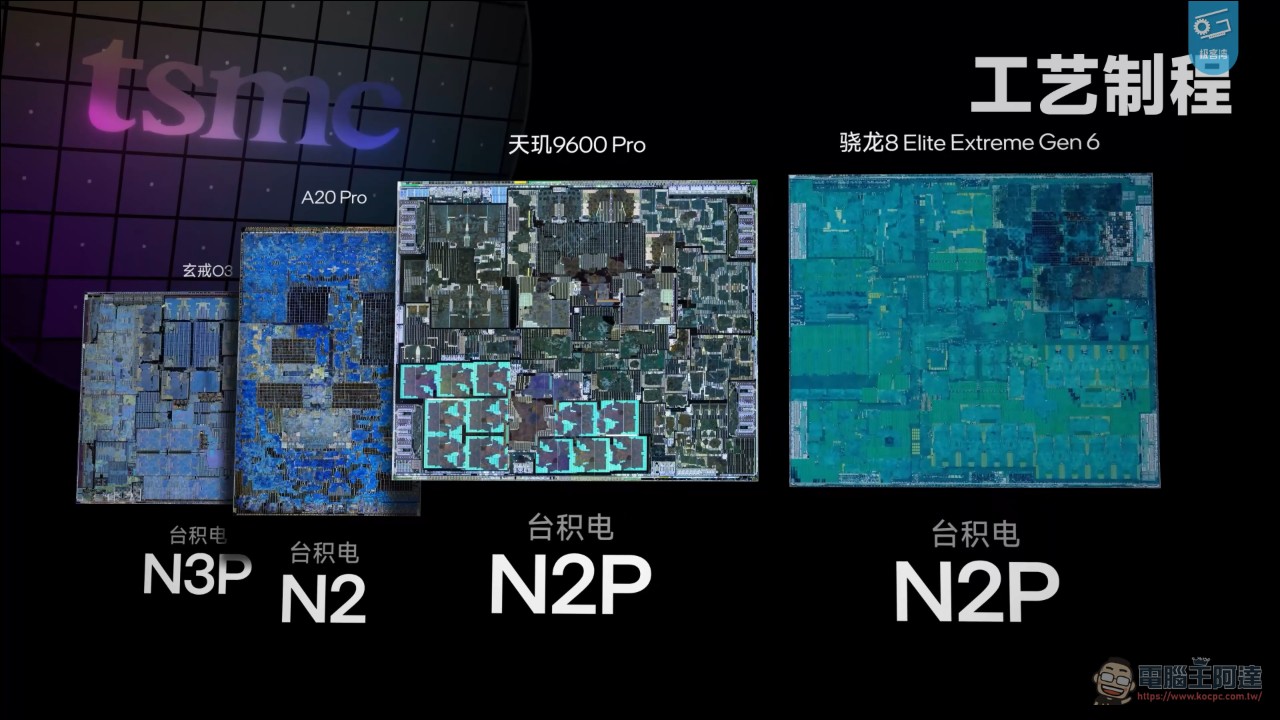
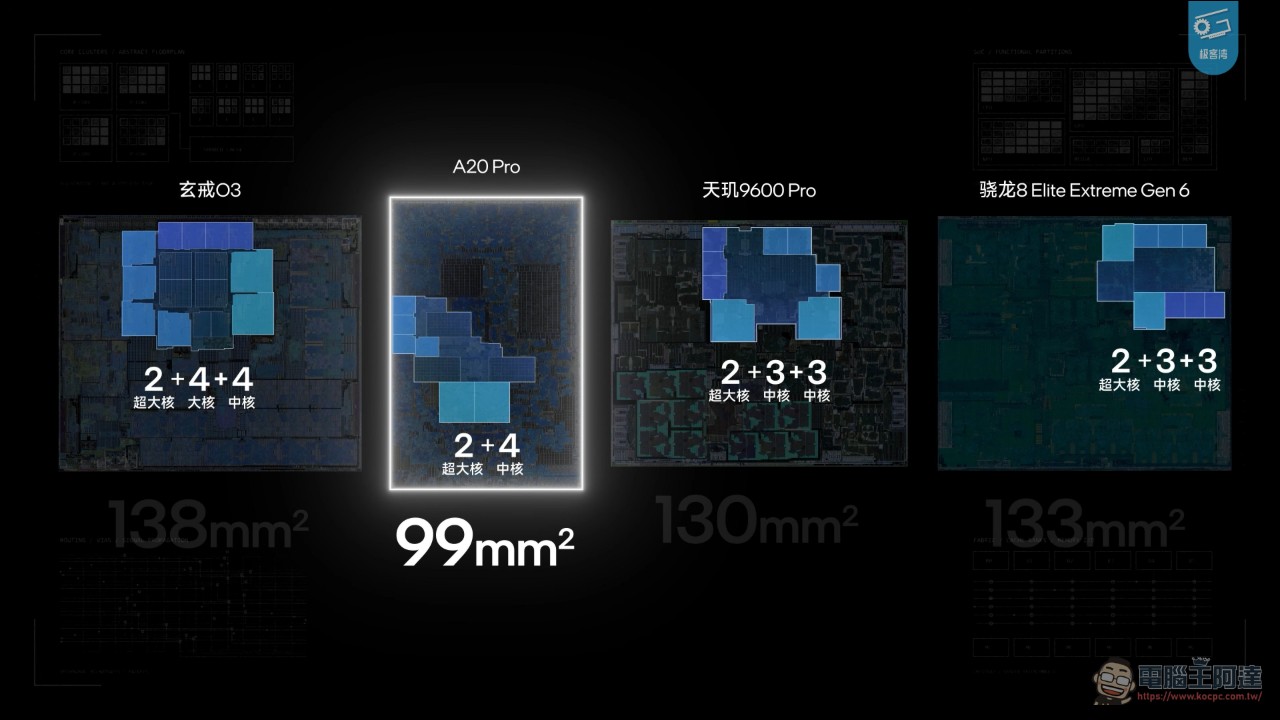
They sent four chips to the lab for FIB-SEM electron microscopy, and the truth about the process is quite interesting: Apple’s TSMC N2 barely improves in density compared with N3P, while Qualcomm’s and MediaTek’s N2P density library improves by about 10% and the performance library density is 22% higher, butIn terms of energy efficiency, N2P did not bring much of an advantage.The Dimensity mid-cores built on 2nm benchmark about the same as the previous generation on 3nm, which they jokingly call “as if upgraded.” The XRING O3 continues to use N3P (Chinese manufacturers can’t use N2), yet its area has grown to 138 square millimeters, with a 10-core CPU (2 super-large + 4 large + 4 medium) plus a 16-core GPU; “the specs are already close to Apple’s M-series laptop chips.”
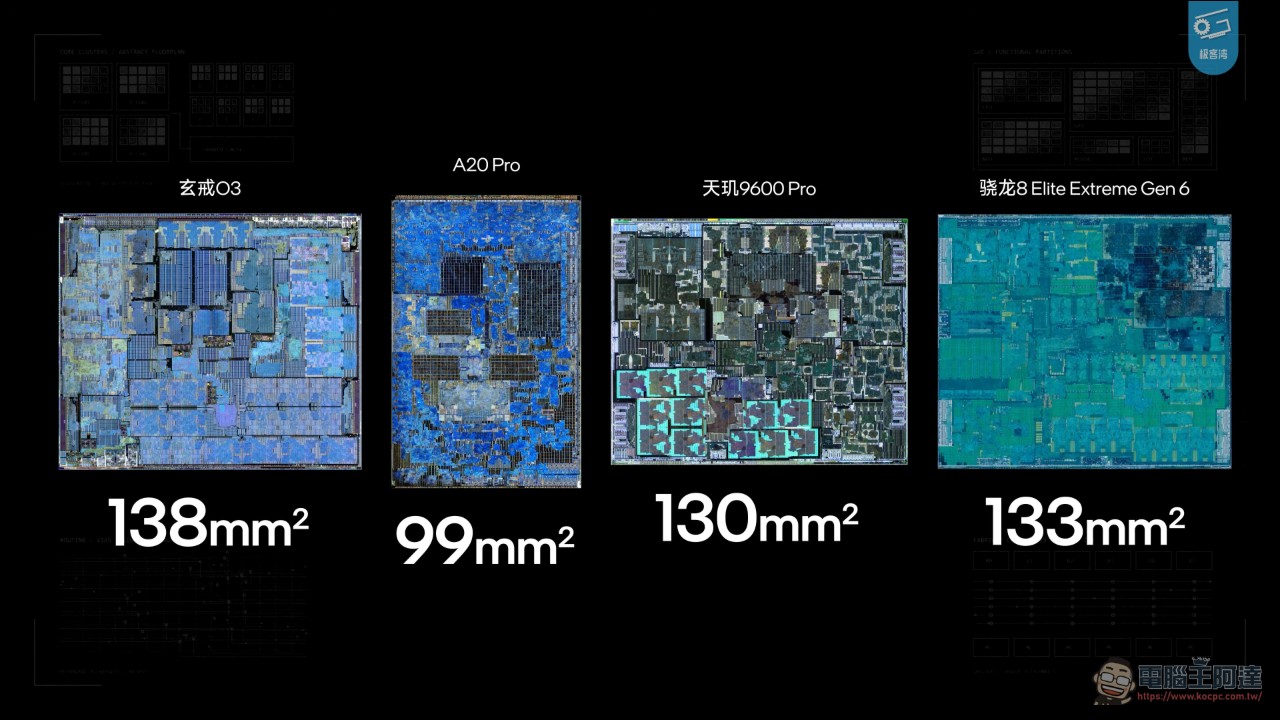
Apple’s compact approach is the opposite: the A20 Pro is under 100 square millimeters and its CPU has only 6 cores, but those 6 cores beat others’ 8 cores on energy efficiency; after slimming down, the prime core can still hit 4.9GHz, and memory comes standard as 96-bit LPDDR5X across the board, with bandwidth even higher than LPDDR6 on Android.
Single-core efficiency: Android is still catching up to the A17 Pro (⏱️ 10:28-18:35)
Once the SPEC CPU 2026 efficiency curves are spread out, the gap is obvious at a glance. The A20 Pro super core delivers Apple’s biggest efficiency improvement since A14: peak integer performance is up nearly 20%, and efficiency is up 10% at the same 1.8W; the mid core is even more extreme—just by adding cache and scheduling capacity, it raised peak integer performance by 24% and efficiency by 13%. Their comment was that Android’s super cores are still trying to catch up with the A17 Pro, and even mid cores are still chasing the A15 from five years ago.
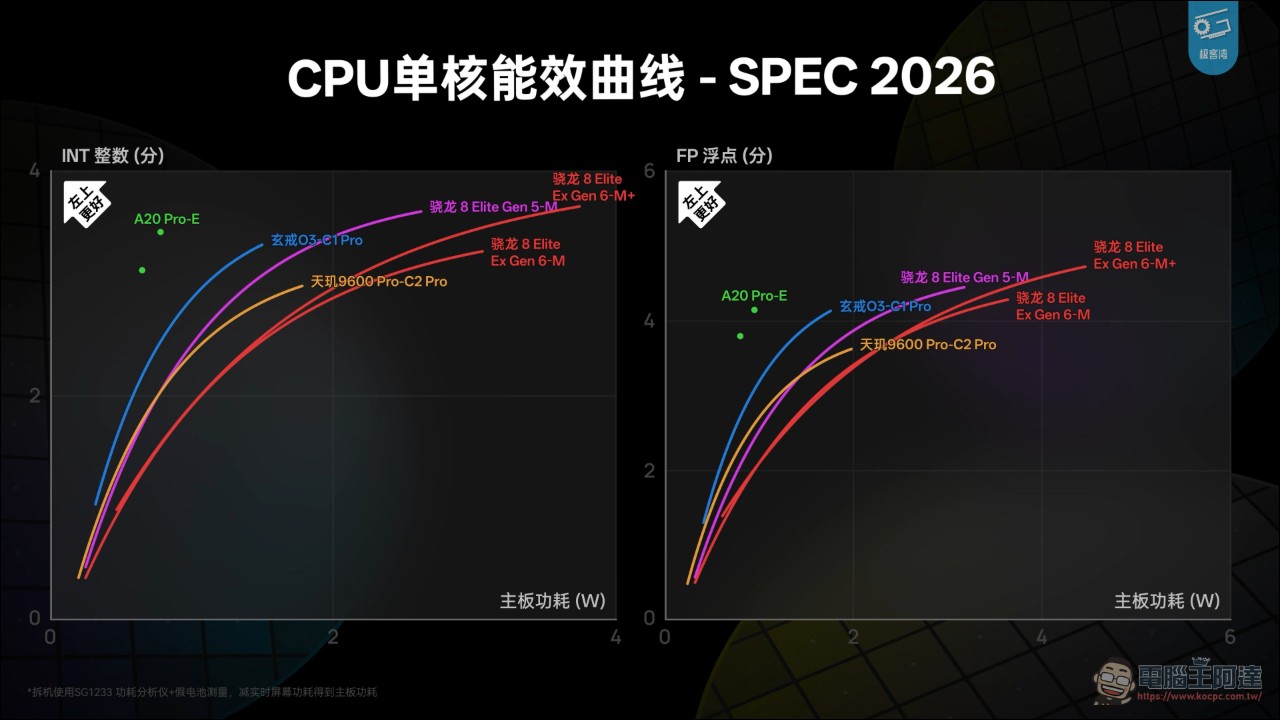
The Android camp’s showcase is held up by XRING O3 and Dimensity 9600 Pro. O3’s C1 Pro mid-core is the only Android mid-core close to the A17 Pro in energy efficiency; “building this with the reference architecture is still top-tier.” Dimensity’s C2 Ultra is currently Android’s strongest prime core, with energy efficiency catching up to the A17 Pro and approaching the A18 Pro, and the energy-efficiency continuity across the three core types is something MediaTek CPUs have never achieved before. MediaTek also pulled off a “mid-core acting as a big core” trick: it takes the C2 Pro, which is 40% smaller in area, and gives it a full 1MB cache to use as a big core; its integer energy efficiency is no worse than the previous generation’s true big core, while floating-point is actually stronger.
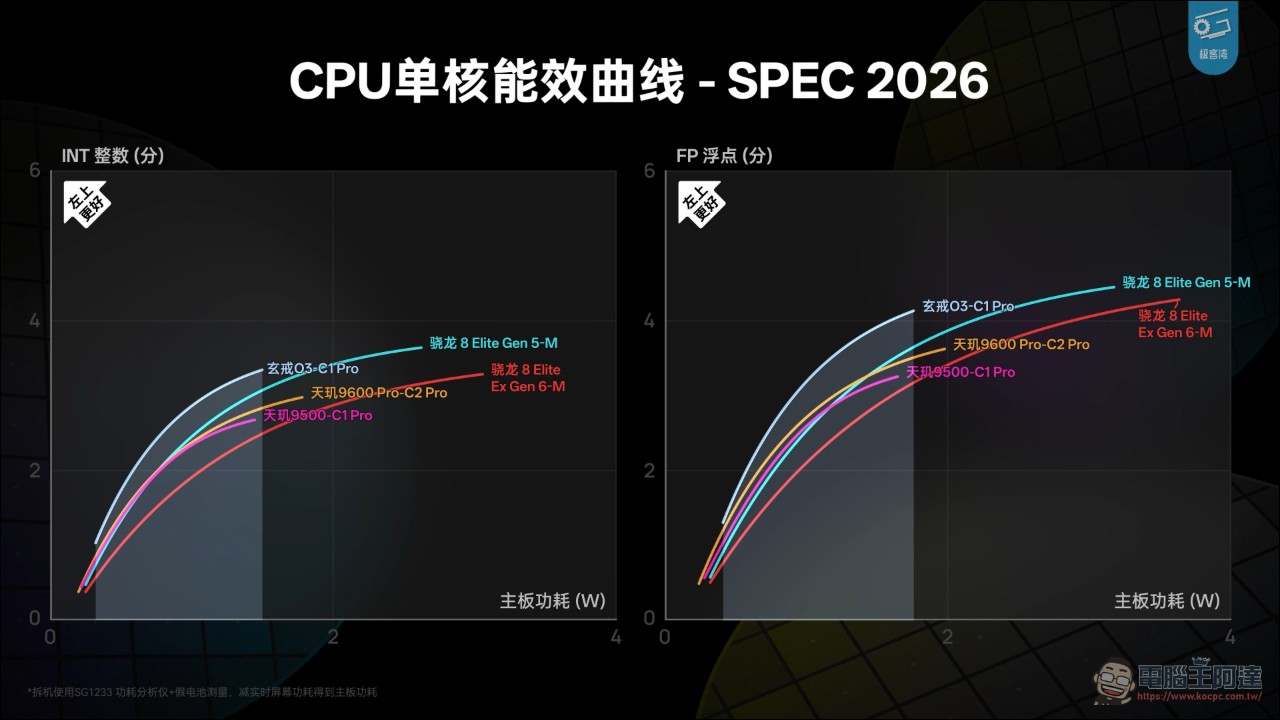
This part also planted a foreshadowing: this year MediaTek completely refused to provide retail media units for power-efficiency testing, and also asked OEMs to restrict the launch testing items, hoping everyone would use the specially tuned curves of engineering samples as the benchmark. At the time, Geekerwan directly throttled the reach of its own engineering-sample launch video and declared, “If this happens again in the future, we will decline review samples.” The gap between engineering samples and retail units will be settled in a dedicated section later.
8EE6 Rollover Investigation Report
The most hardcore part of the video was devoted to investigating the 8EE6’s failure. This chip’s mid-core efficiency has regressed sharply compared with the previous-generation 8E5; “it can’t even beat the A720 in 8Gen3,” and its integer efficiency is about on par with the mid-core of the Kirin 9050 Pro. Measured IPC dropped by nearly 11%, with lower performance at the same frequency and higher power consumption instead. The super core is not much better either: its mid-frequency efficiency is going backwards versus the 8E and even the 8E5, and “its efficiency still can’t beat the A15.”
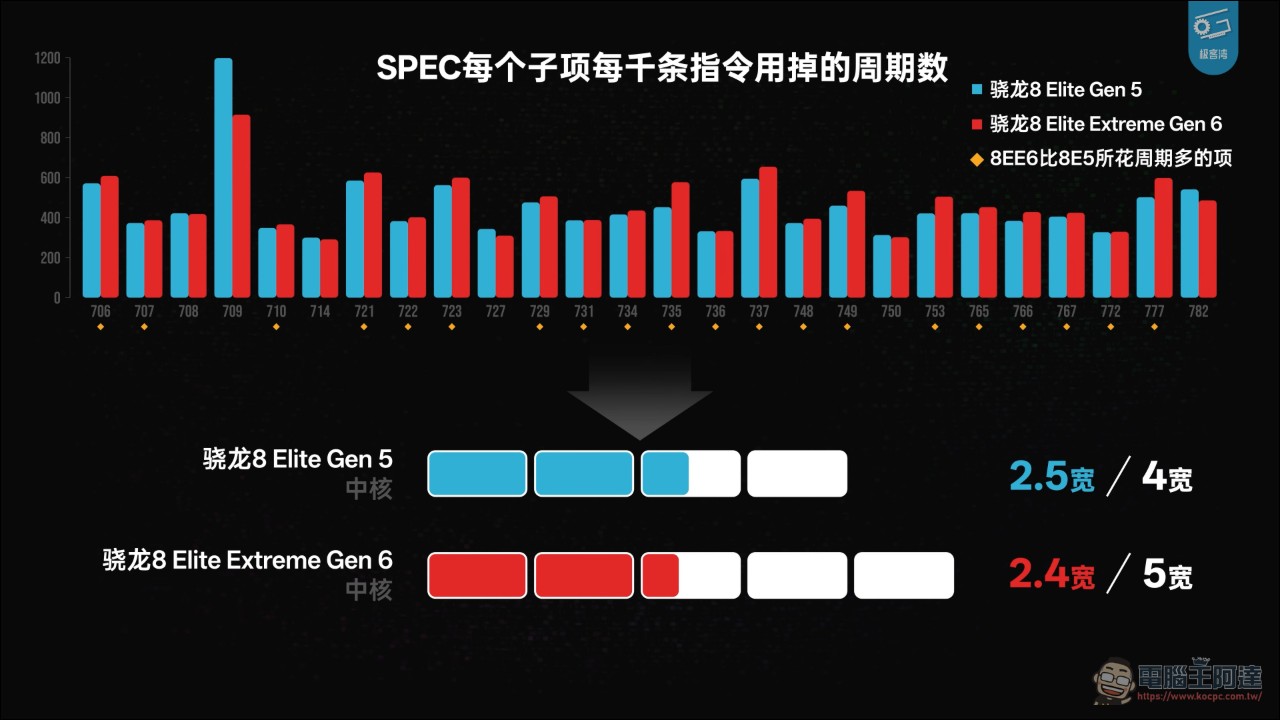
Geekwan uncovered three problem areas, each backed by actual measured figures:
- TLB design flopped.The address translation cache (TLB) was changed to a merged 32KB eight-page design. The merge conditions are extremely stringent; pages in the same block crowd each other out, and there is even the counterintuitive phenomenon that “the better the spatial locality, the slower it gets.” ECS-architecture games with tightly packed data suffer the most. In testing, 8EE6 has to walk the page table once it accesses more than 1MB of memory (8E5 avoids this within 16 to 32MB); a walk costs 77ns, and L2 TLB hit latency is 20ns versus 13.4ns for 8E5. In SPEC’s 777 subtest, the number of page-table walks is ten times that of 8E5, and the 709 subtest’s scores vary by 74% across runs at the same frequency—that is where the “performance lottery” comes from. They speculate that this is to accommodate Android’s upcoming 16KB pages: “for the sake of a cutting-edge standard, completely ignoring the user experience of the existing ecosystem.”
- Split-track linkage for shared L28EE6 removes the private caches of the prime and mid cores and makes L2 shared by all cores, but L2 shares a clock and power rail with the prime cores. When the mid cores are under heavy load, L2 frequency cannot ramp up, introducing massive latency; conversely, when the mid cores raise L2 frequency, the idle prime cores are dragged up with it and waste power. Measured differences range from 50mW to over 0.7W, while the frequencies reported by the system show no anomaly at all.
- The software optimization didn’t take effect.In Android’s C standard library, the Oryon memory optimization submitted by Qualcomm has a condition written as “variant starts from 1.” However, the 8EE6 prime core is variant 0, so the system does not recognize it as Oryon, and the optimization is completely ineffective. You can only wait for Qualcomm, Google, or OEMs to push an update.
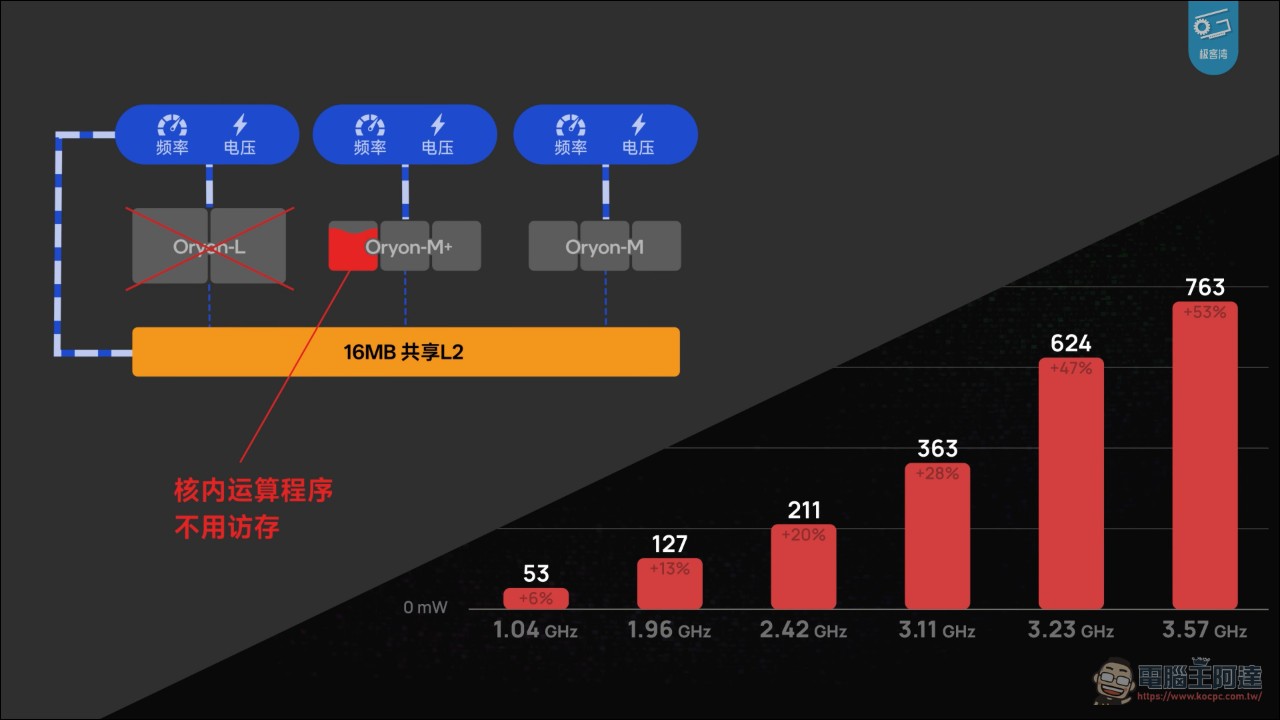
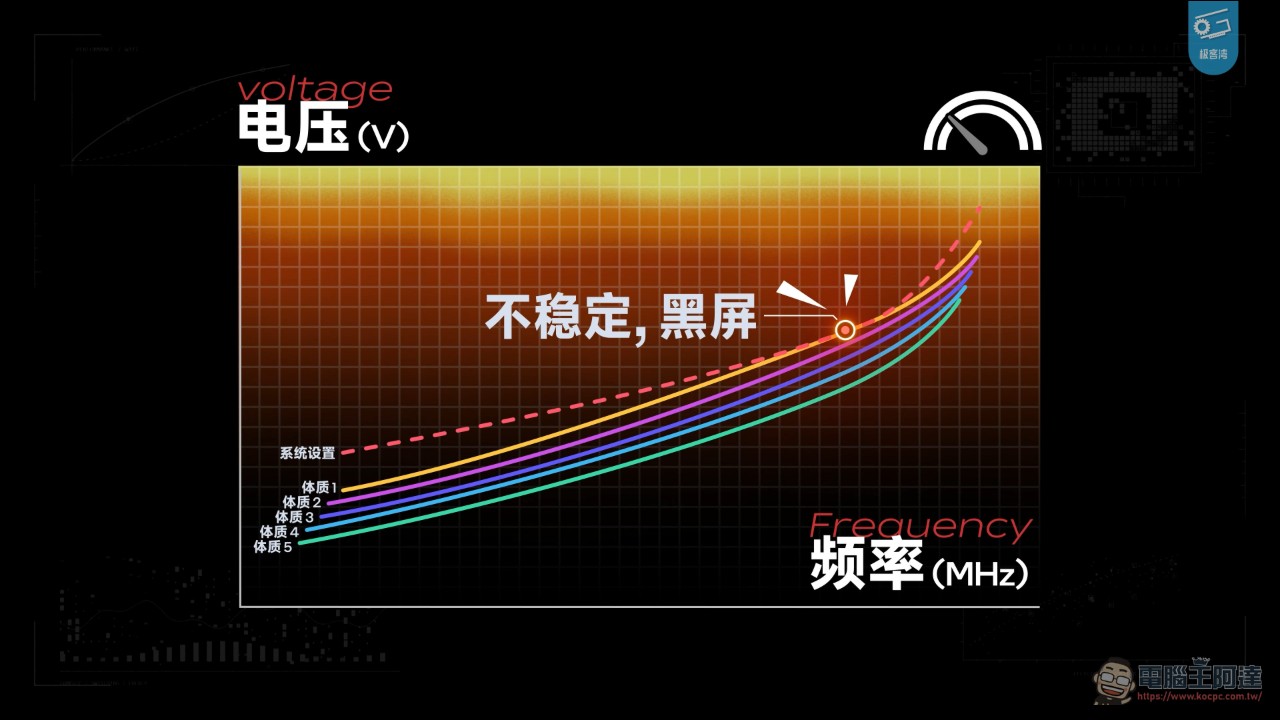
Making matters worse was stability. The 8EE6 models collectively reported black-screen and reboot issues, and Geekerwan itself got one affected unit. Their assessment was that “not enough voltage was supplied”: chips with poor silicon quality are prone to black screens at the edge of the VF curve, and it even has the flavor of the Snapdragon 888 from back then. When Chinese media previously reported this black-screen controversy, the manufacturer’s position was that it was due to insufficient software and hardware tuning and adaptation in the early stage of the new device, not a process or architecture defect, and that it had been fixed through system updates; Geekerwan’s bottleneck analysis, by contrast, pointed the finger at deeper design decisions.
Engineering Prototype Post-Mortem
With the retail units tested, it’s time to settle the score for the engineering samples. The XRING O3 dev board isn’t far off from the retail device (Xiaomi 18 Fold), which counts as honest; the 8EE6 QRD engineering sample was clearly specially cherry-picked and tuned—“on the engineering sample you can’t see any sign of regression,” and only the retail unit reveals its true form; the most brutal is the Dimensity 9600 Pro, where the power-efficiency curves of the engineering sample and retail unit “bear no resemblance whatsoever—they’re wildly off.” 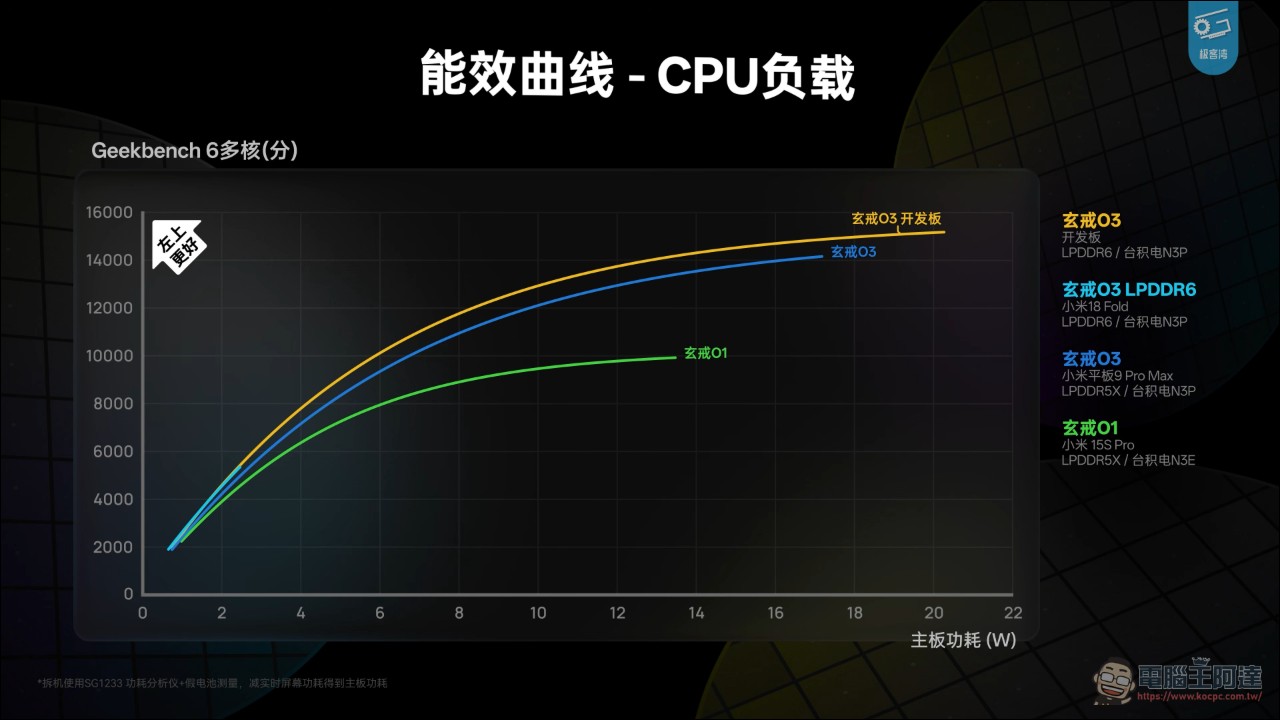
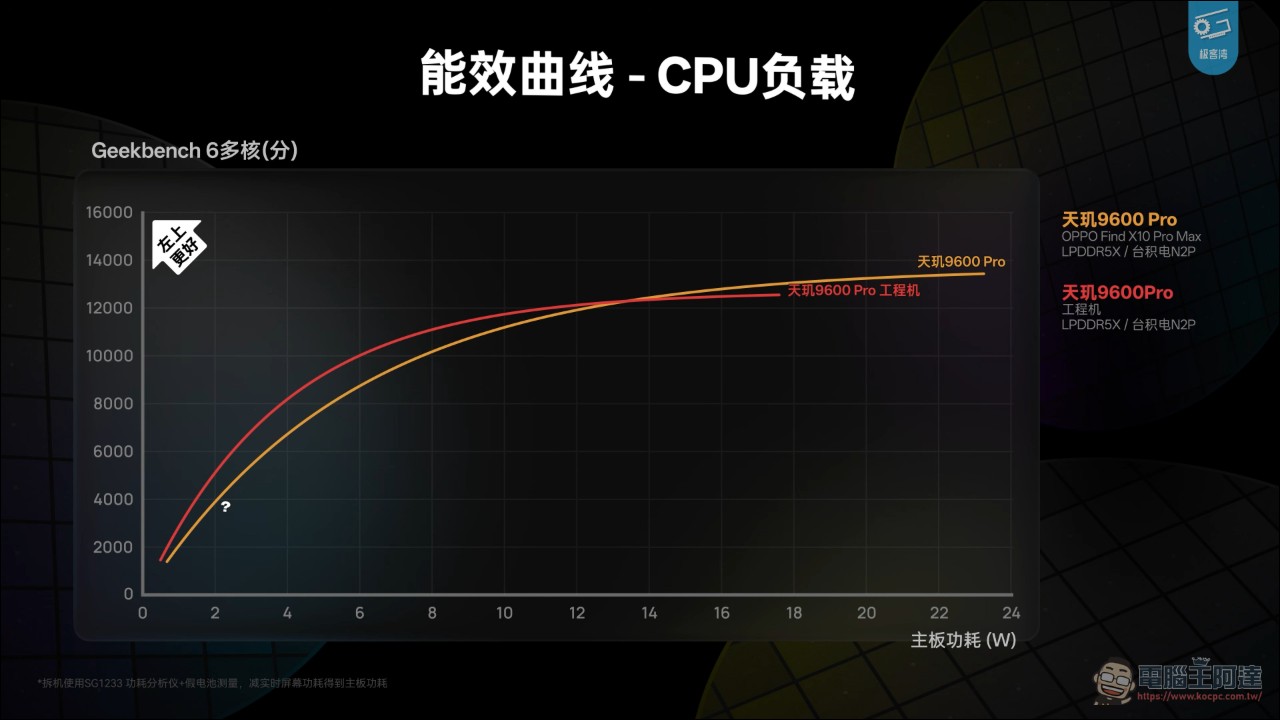
They speculate that MediaTek was trying to benchmark against the XRING O3 development board data (MediaTek people did inquire about O3 at the time), and in the mid-to-low power range specially binned and tuned chips to craft a “mixed wins and losses” story. The conclusion is just one sentence: don’t readily rely on tests of launch engineering samples; wait for retail units you buy yourself before drawing conclusions. The title “King of Cheating” was awarded to Dimensity in this section.
GPU and three games tested
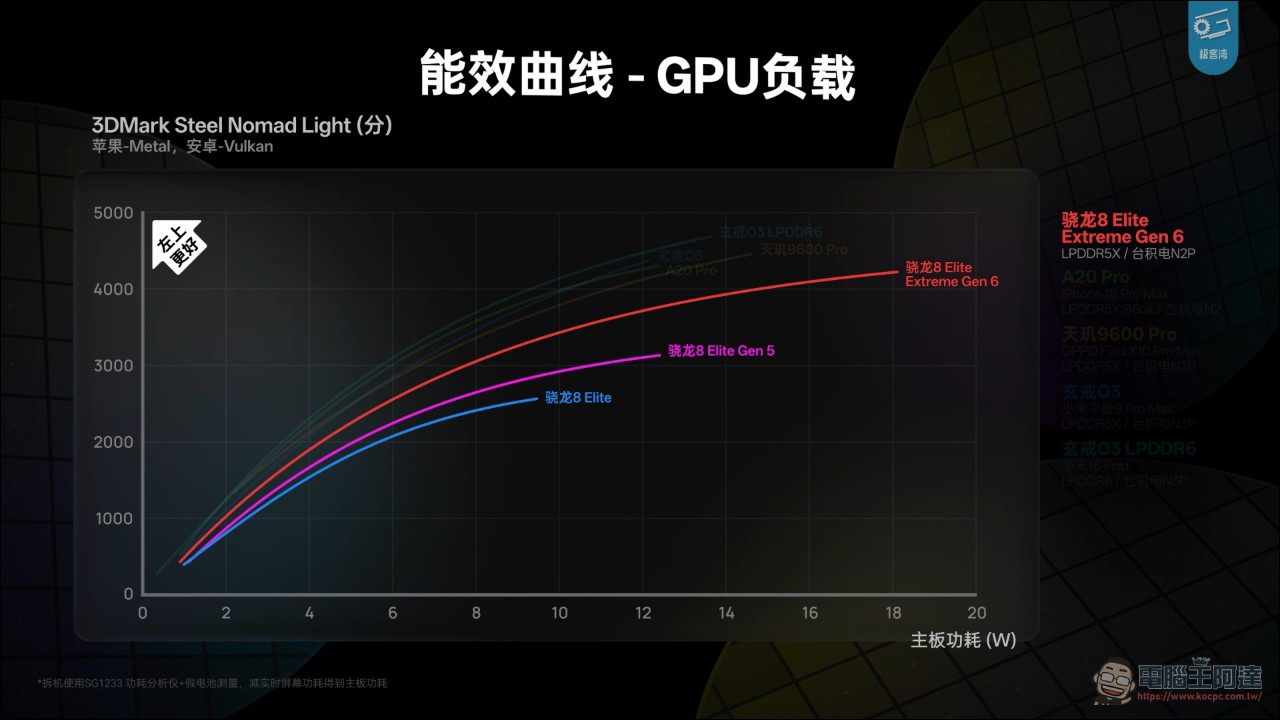
On the 3DMark Solar Bay Unlimited energy-efficiency curve, the XRING O3’s 16-core GPU takes first place by sheer scale, with a peak of nearly 4,700 points—“already at the level of high-end thin-and-light laptops from the previous two years”; the A20 Pro’s GPU shows huge gains over the A19 Pro and beats MediaTek and Qualcomm head-to-head; the Dimensity 9600 Pro’s 12-core GPU also improves on the previous-generation 9500. Although the 8EE6’s Adreno 850 improves over the 8E5, it ranks last against the other four, “just barely beating the Dimensity 9500.”
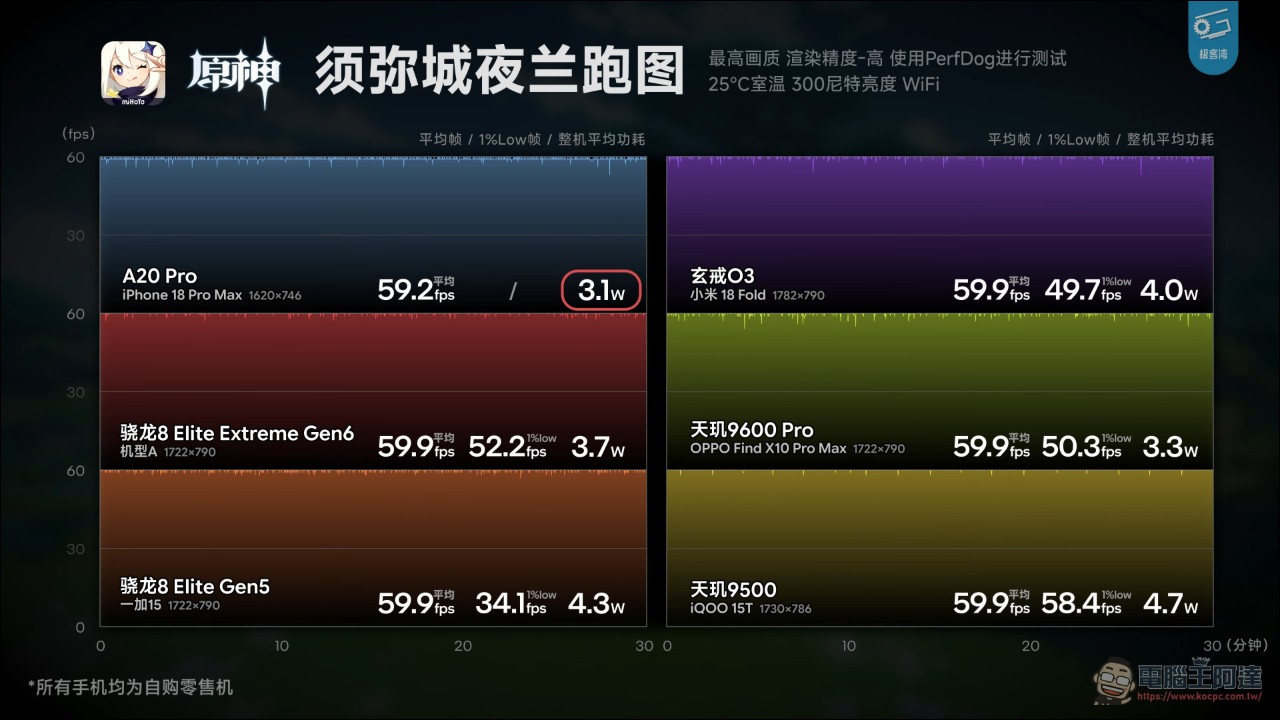
Three games tested in real gameplay; after aligning resolutions across the board, one representative device per chip:
- Genshin Impact(Approx. 770P, native 60 fps): iPhone 18 Pro Max (A20 Pro) at 3.1W is the power-efficiency king; the Dimensity 9600 Pro model at 3.3W is the best on Android; the 8EE6 model at 3.7W — “Thank goodness there’s progress and no regression”; the XRING O3 foldable at 4W running 60 fps exceeds expectations.
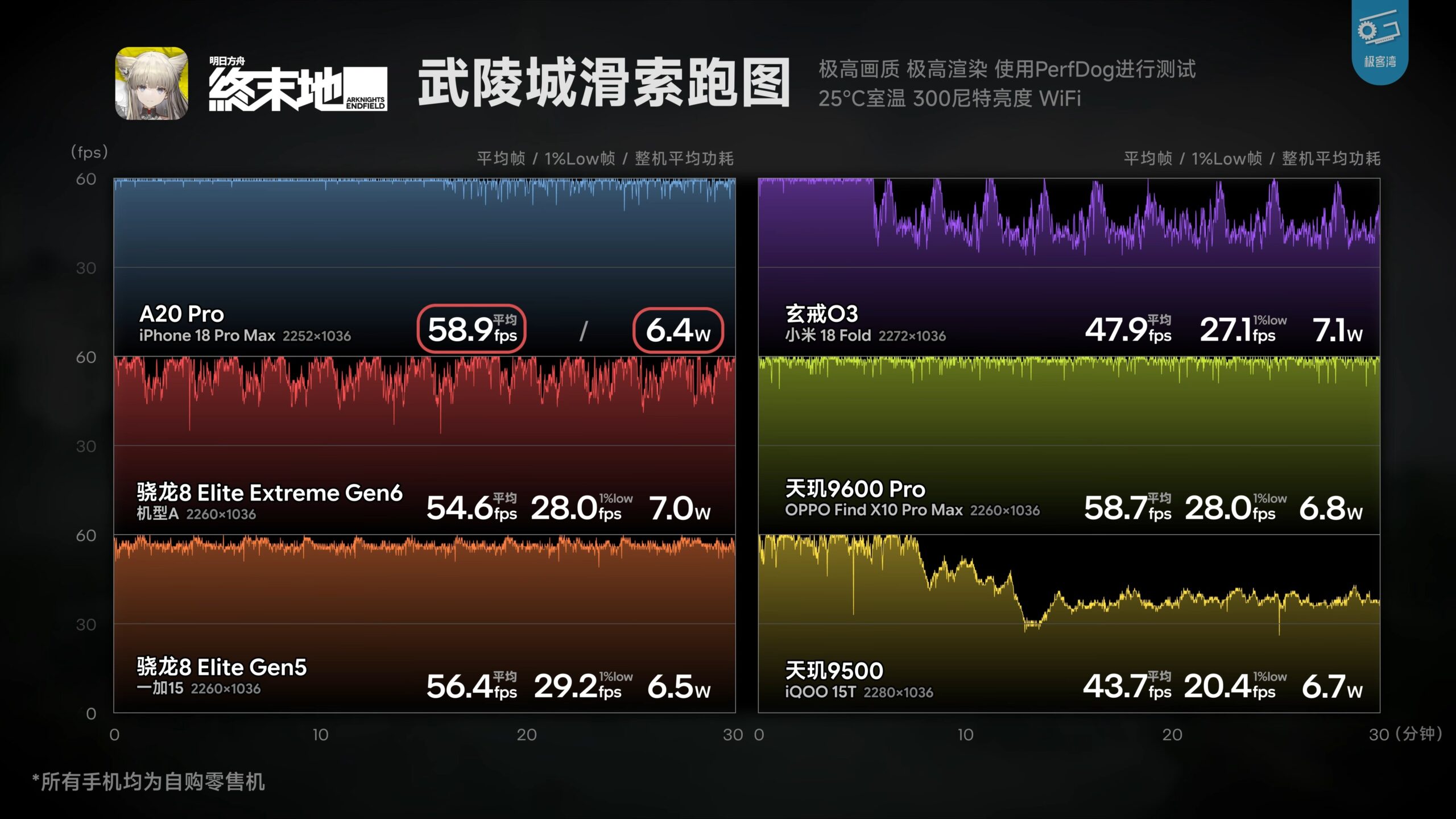
- Arknights: Endfield(1036P at full settings): A20 Pro at 6.4W wins with near-max frame rate; Dimensity 9600 Pro at 6.8W takes the Android crown with near-max frame rate; 8EE6 shows its true colors here—frame rate lower than 8E5 while power consumption spikes to 7W. “The problems seen in SPEC are manifested here.” Devices with poorer silicon quality look even worse.
- Wuthering Waves(Approx. 732P): The previous-gen 8E5 has the best frame rate (6.7W); the Dimensity 9600 Pro runs 56.5 fps at 6W with decent efficiency; 8EE6 regresses again, and the inferior models “didn’t even beat the Dimensity 9500.”
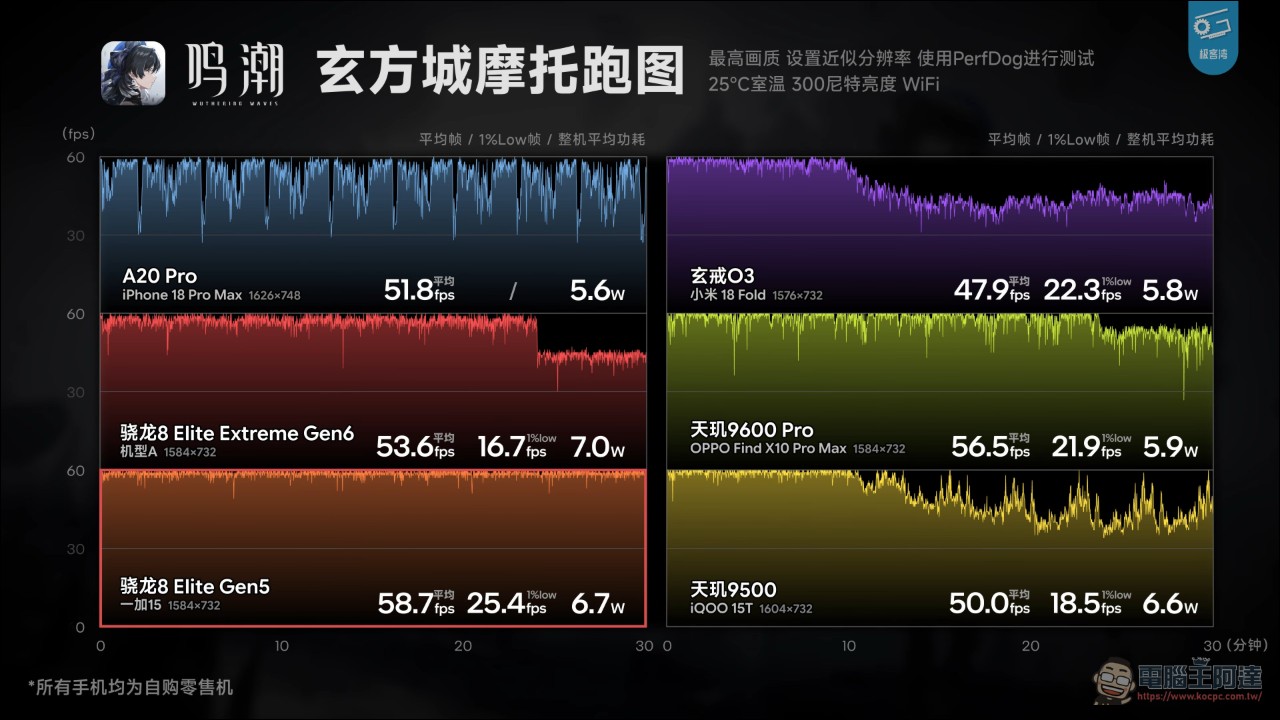
Of the three games, two regress on the 8EE6, which lines up perfectly with the SPEC bottleneck analysis. The HarmonyOS version of Genshin Impact on the Huawei Mate 90 Pro Max was also tested along the way: it lacks ambient occlusion (AO), but its other image quality is close to the Android version, and its power efficiency is close to that of Dimensity 9500 devices; Google Tensor G6, meanwhile, was singled out as “the one stuck to the sole of a shoe—not worth comparing.” If you’re interested in the other test items and content, check out this piece; the nearly one-hour large-scale comparison is quite excellent:
Summary: one king, one spec-stacking king, and one abstract award.
The final verdict was merciless. The A20 Pro is a “stronger Apple,” with comprehensive improvements in performance and efficiency, far ahead of the competition. As a newcomer, the XRING O3 spared no expense on hardware to achieve good efficiency; next year it will arrive on slab phones and then get additional gaming tuning. The Dimensity 9600 Pro was a pleasant surprise: “efficiency has steadily improved, and gaming is pretty good too.” The only complaint is that it should stop cheating. The 8EE6 took “the year’s only real shit,” and Yunfei gave direct buying advice: “Unless it sells cheaper than the 8E5, I don’t recommend buying it under any circumstances.” He also revealed that many new phones with the 8E5 or even the 8E will be launching next, which netizens joked was “the new gacha pool isn’t good, so they’re temporarily bringing back old characters for a rerun.”
All the energy efficiency curves from the tests have been uploaded to Geekerwan’s database website. socpk.com Open comparison. This video quickly went viral in China’s tech community, and outlets such as Sina and SMZDM followed up with summaries within hours, with headlines uniformly reading “Apple tops the charts, Xiaomi is the spec-stacking king, Qualcomm is the most absurd”; the XRING O3’s multi-core performance, in which “3nm beats 2nm,” also sparked a separate discussion.
There are just three practical takeaways for Taiwanese readers. First, if you’re buying a flagship this year, A20 Pro models have the highest energy-efficiency safety margin. Second, Dimensity 9600 Pro models are more worth considering than you might think—especially since their gaming efficiency is the best on Android. Third, unless 8EE6 models are on sale, waiting for refreshed 8E5 models is actually smarter. With the chip war running into 2026, benchmark scores have long stopped being the point; what matters is the real-world efficiency of retail devices.
Source: KOCPC Chinese