


At the end of September, an unfamiliar rabbit appeared on OpenRouter. The model was named Space Bunny Alpha, was free for all users, had a 1M context, and its inference speed was claimed to be blazing-fast. Over the next 10 days, it held the top spot on the leaderboard, racking up 4 trillion input tokens and 135 billion output tokens. Recently, the answer was revealed: Space Bunny is MiniMax’s latest model:MiniMax M3.1 Flash of the early preview version; officials said that rabbit ran more than 200 trillion tokens in anonymous mode.
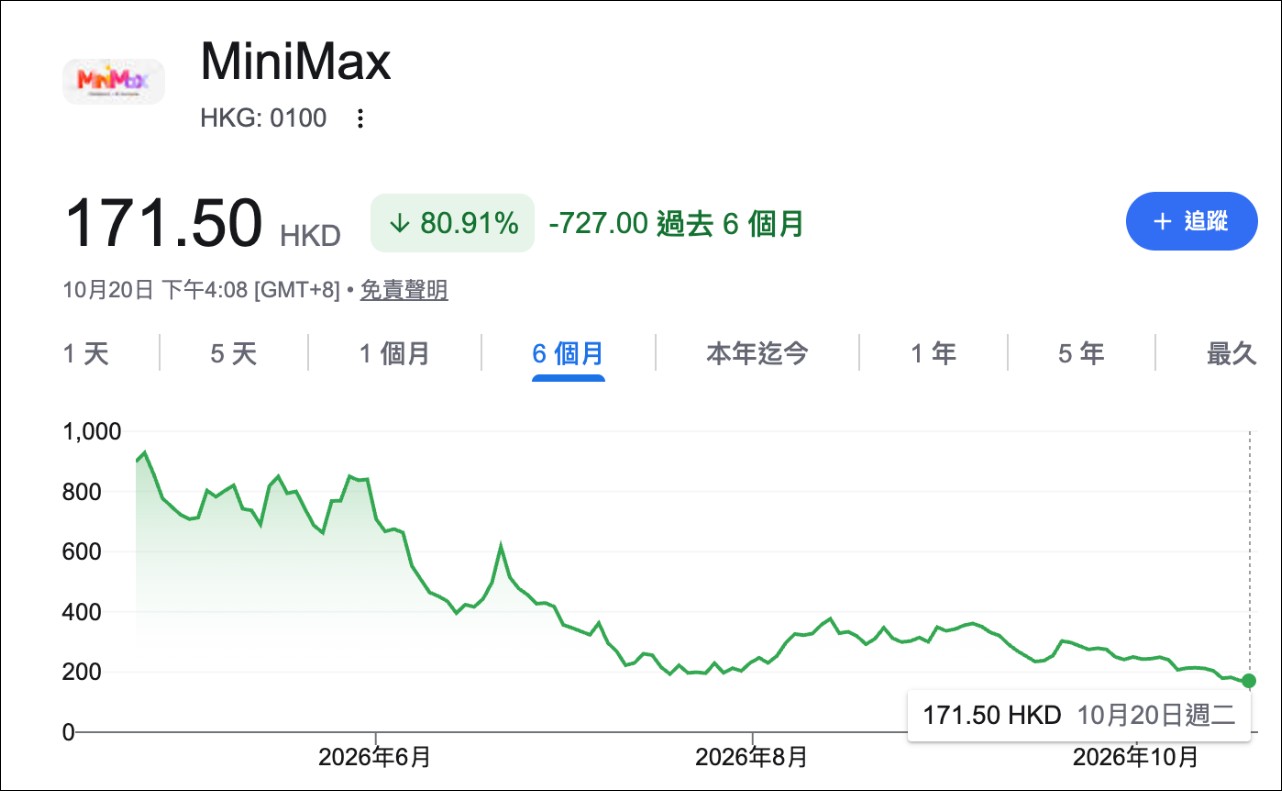
When MiniMax M3 was released in June, the official pitch was that it was the first open-weight model to simultaneously pack in frontier coding capabilities, a million-token context, and native multimodality. Actual third-party evaluations, however, were unsparing: Artificial Analysis’s Intelligence Index gave it only 29 points, far behind GLM-5.3’s 45, with hard reasoning a clear weakness; speed was about 106 tokens per second, which can only be described as barely fast. Also because reviews were not as expected, MiniMax’s stock price fell continuously from its high after M3’s launch, and has now fallen to less than 1/3 of its June level.
Why did Space Bunny turn over?
So when Space Bunny appeared on September 23, the official side did not release any benchmarks, model card, parameter count, or speed figures—not even the weights. It was simply quietly listed on OpenRouter as free and open. Yet it accumulated real volume through actual use: the OpenRouter page shows 4.06 trillion prompt tokens, 135 billion completion tokens, and 3.92 billion reasoning tokens.
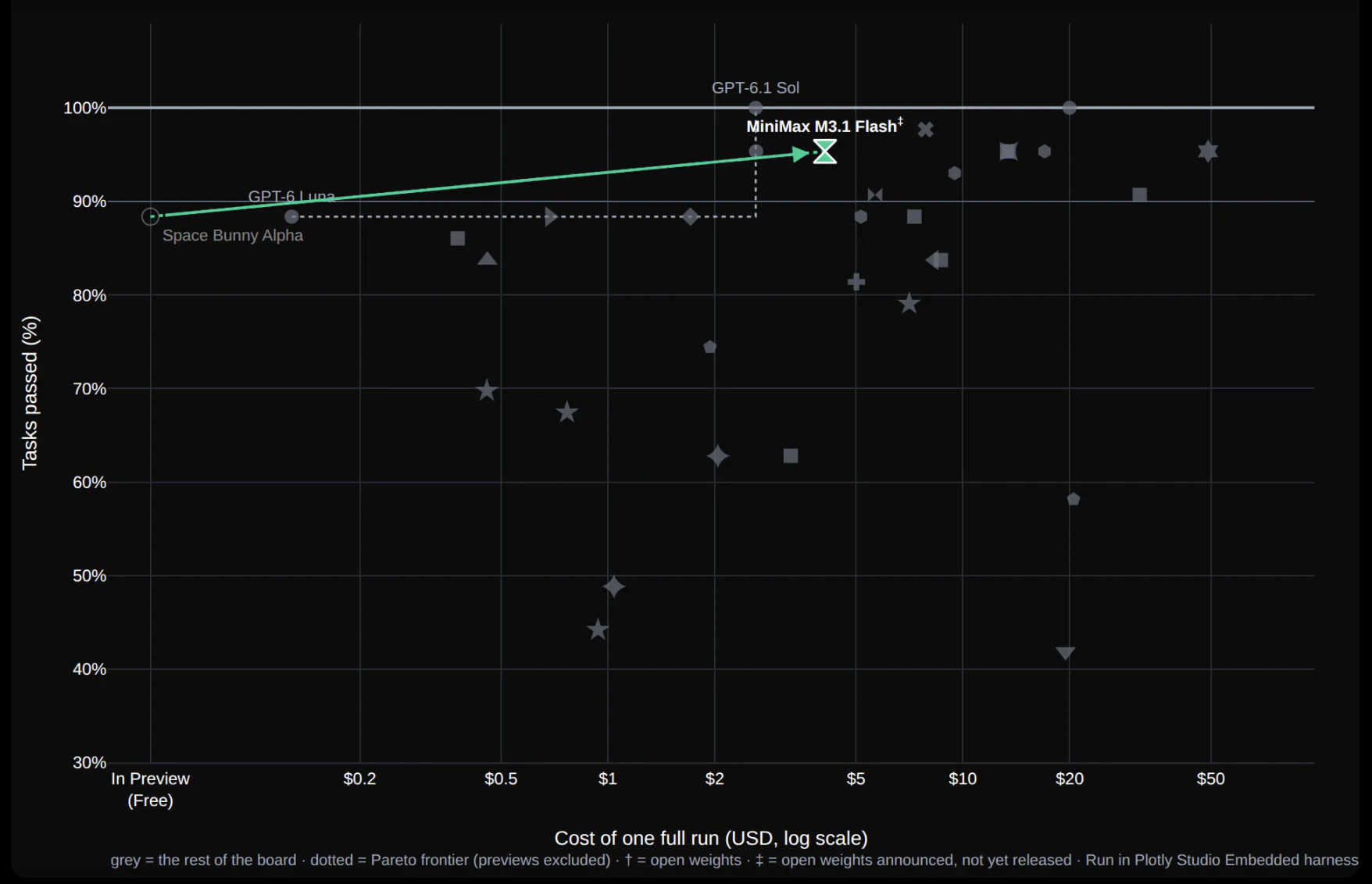
Plotly The data analysis test is one of the few institutions to have been included in the rankings from the very beginning. In September, that anonymous rabbit got 38 of 43 questions right, scoring 88%, tying the strongest open-weight model at the time, at a cost of only $0.82 per full run. The median time was 36 seconds per question, far faster than typical models. Free and fast—no wonder it held the top spot for ten days straight.
Official release takes over: Artificial Analysis jumps from 29 to 42 points.
On October 19, M3.1 Flash was officially released, and what Artificial Analysis gave Intelligence Index From 29 points on M3 to 42 points, a jump of 13 points at once, with average cost per question dropping from $0.51 to $0.22. Comparable rivals are GLM-5.3 Flash at 42 points and $0.28, DeepSeek V4.1 Flash-1017 at 45 points and $0.26, and Gemini 3.8 Flash at 41 points and $1.24.
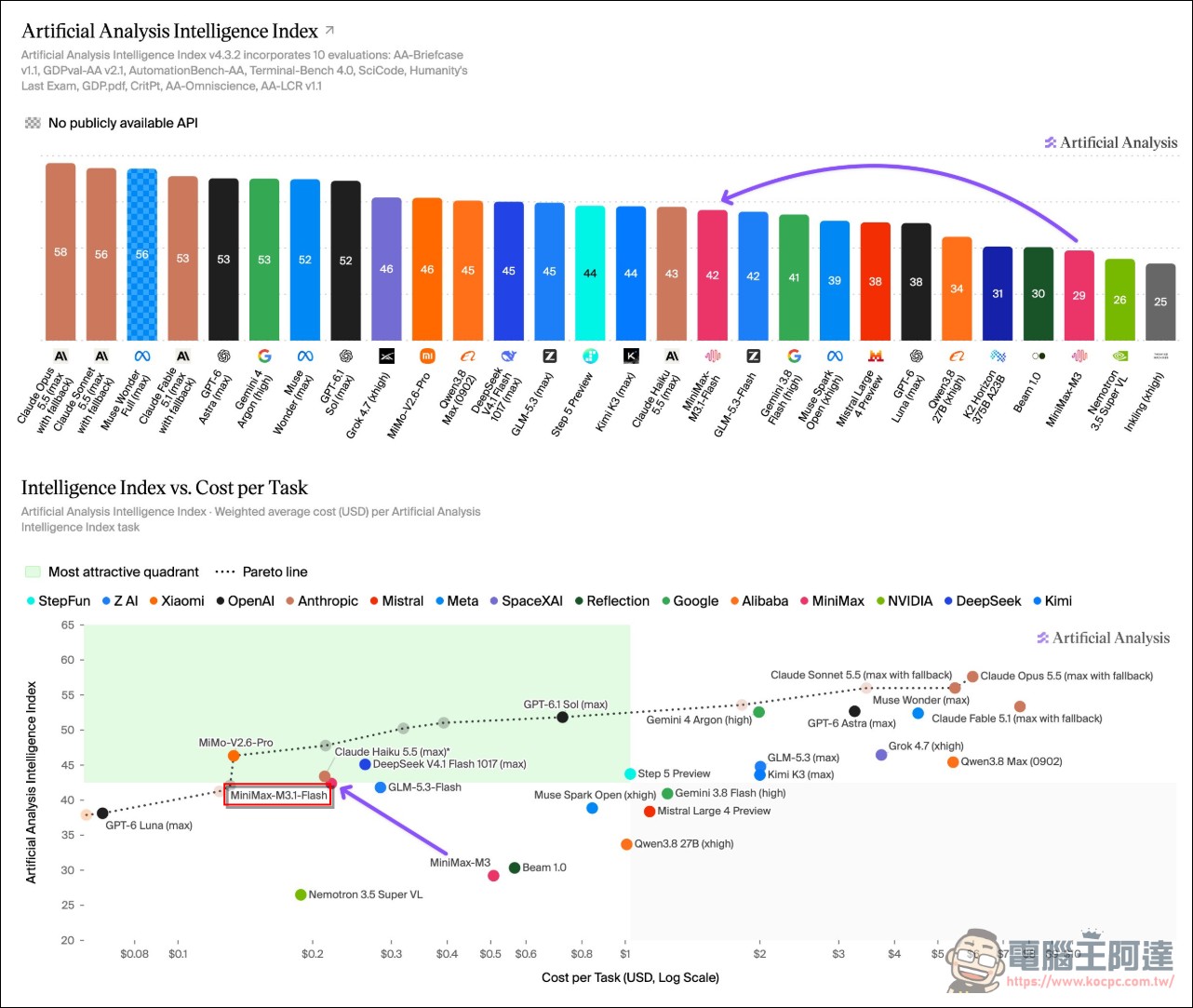
On the physical reasoning benchmark CritPt, it raised the score from M3’s 4% to 22%, surpassing GLM-5.3 Flash’s 15% and approaching DeepSeek’s 24%. The entire evaluation used only about 189 million output tokens, while GLM-5.3 Flash used 324 million and Gemini 3.8 Flash used 334 million. The savings are real, because these are the tokens developers pay for.
Specs: 428B MoE, 3x speed, price cut to one-third.
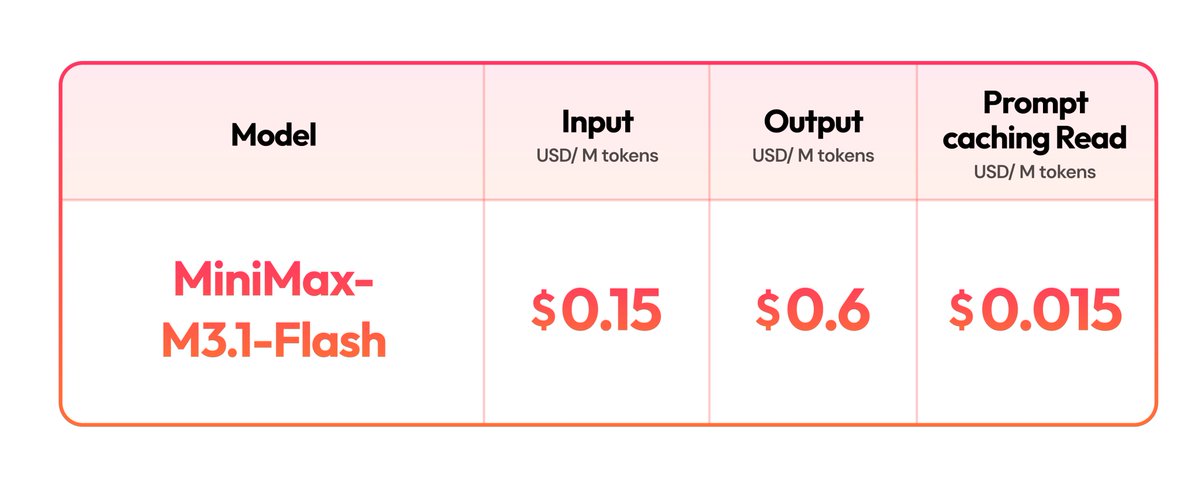
M3.1 Flash is an MoE with 428B total parameters and 23B activated, accepts text, images, and video, has a 1M-token context, and offers five reasoning-intensity levels from Low to Max. Through more aggressive sparsification, the official claims median output of over 170 tokens per second in everyday scenarios, with peaks above 200. API pricing is a single rate: $0.15 per million input tokens, $0.6 for output, and $0.015 for cache reads. In NT dollars, that is about NT$5 for input, NT$20 for output, and under NT$0.50 for cache. Overall usage cost for Agent tasks is 70% lower than M3.
Official full table of 15 benchmarks: more wins than losses.
The official comparison table spans 15 benchmarks across four categories—CoWork, Coding, Cyber, and General—and is clearly intended to compete for market share with the similarly priced DeepSeek V4.1 Flash. In CoWork, it took first place in two benchmarks, Automation-Bench at 62.2 and Banker ToolBench at 76.2; it also ranked first on LOCA-Bench 256K with 60.3. On Terminal Bench 4.0 it scored 38.1, trailing Opus 5’s 51.8 and the new DeepSeek version’s 42.3. In Coding, DeepSWE v1.1 scored 73.7, losing to DeepSeek V4.1 Flash-1017’s 77.0, while NL2Repo-Bench at 61.2 trailed Opus 5’s 75.3. In visual reasoning, BabyVision scored 91.0, losing to DeepSeek’s 92.5 and Opus 5’s 94.1.
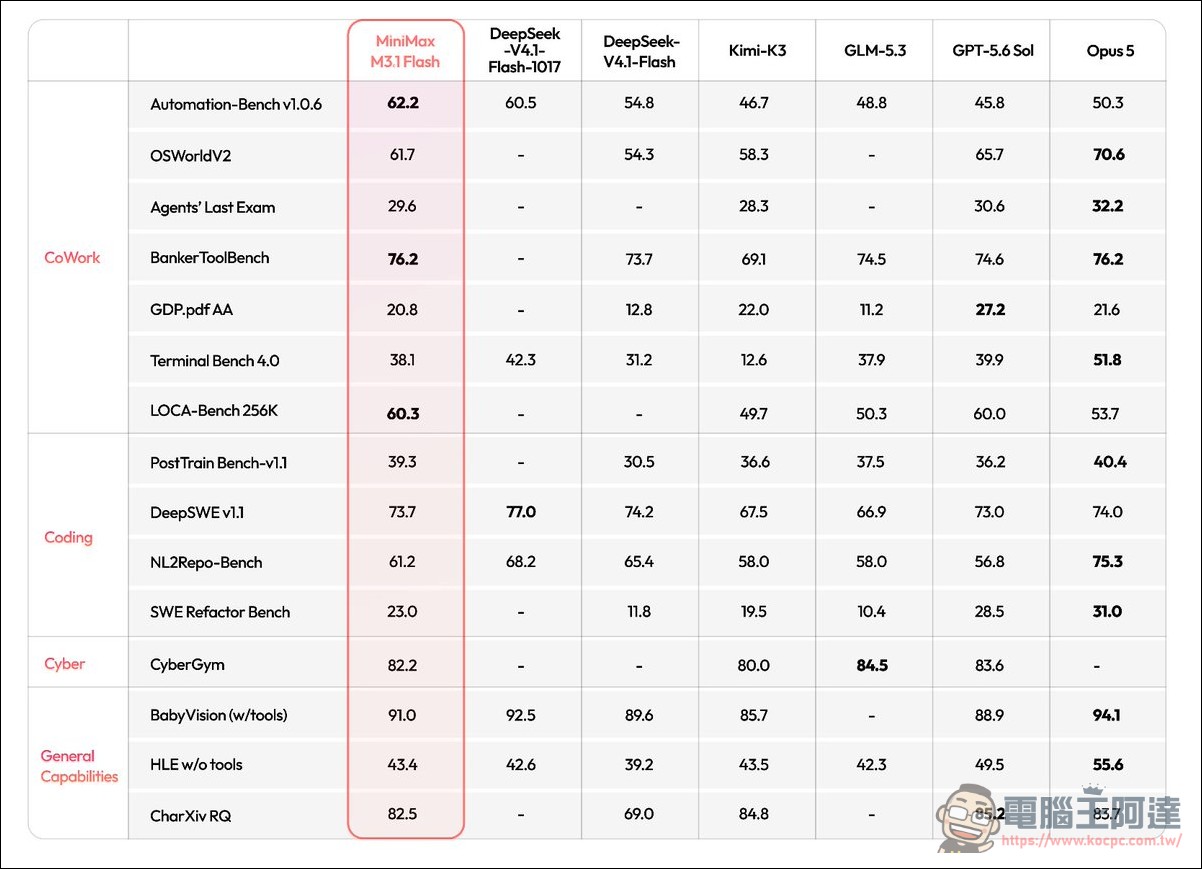
On the cybersecurity benchmark CyberGym, it scores 82.2, losing to GLM-5.3’s 84.5. On HLE without tools, it scores 43.4, almost tied with Kimi K3’s 43.5, but behind GPT-5.6 Sol’s 49.5 and Opus 5’s 55.6. The official documentation itself states that OSWorld V2 61.7 and ALE 29.6 are both first among Chinese models. Overall, agent and tool use are strengths, while pure reasoning and long-code refactoring still lag behind the top tier.
Third-party real-world test: Plotly 41/43, matching Opus 5.5
Plotly In the October retest, the official version answered 41 questions and scored 95%, matching Claude Opus 5.5, Gemini 4 Argon, Muse Wonder, and GPT-6 Sol—the highest score on that leaderboard from a Chinese lab; the next-highest, GLM 5.3 Flash and Qwen 3.8 27B, both scored 38. The exam contained five hidden patterns with no hints; M3.1 Flash found all of them, something only GPT-6.1 Sol, GPT-6 Astra, and Gemini 4 Argon also managed.
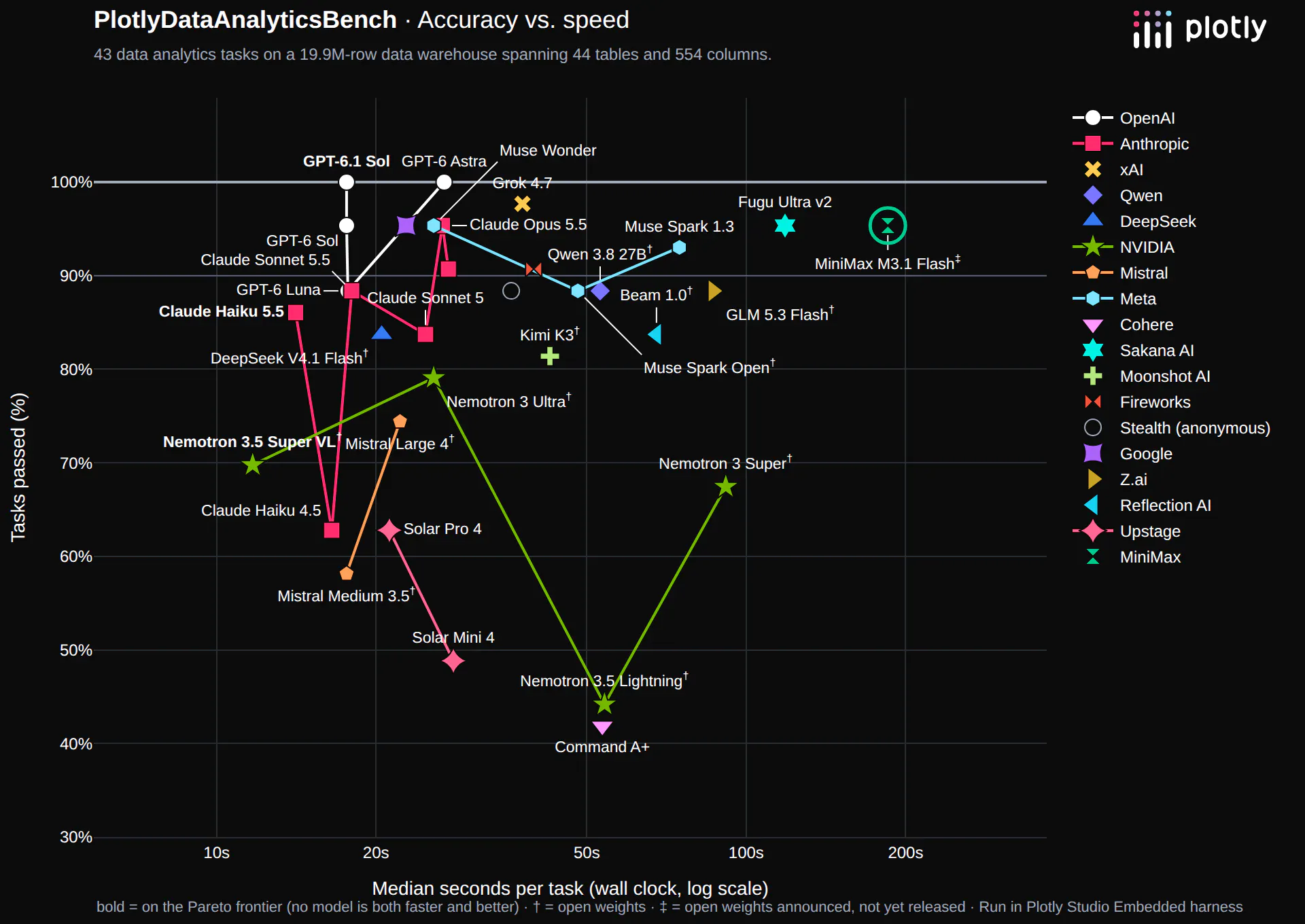
The trade-off is that it does more thinking. For the same question, model calls increased from 15 to 45, output tokens went from 8,500 to 32,000, median time went from 36 seconds to 3 minutes, and the full run cost rose from $0.82 to $4.09. 98% of inputs hit the cache, so with 4.2 million tokens read in, the full run cost only $4.09, averaging about 10 cents per question.
Price War: DeepSeek Just Cut Prices in Half, MiniMax Follows with Anchor Pricing
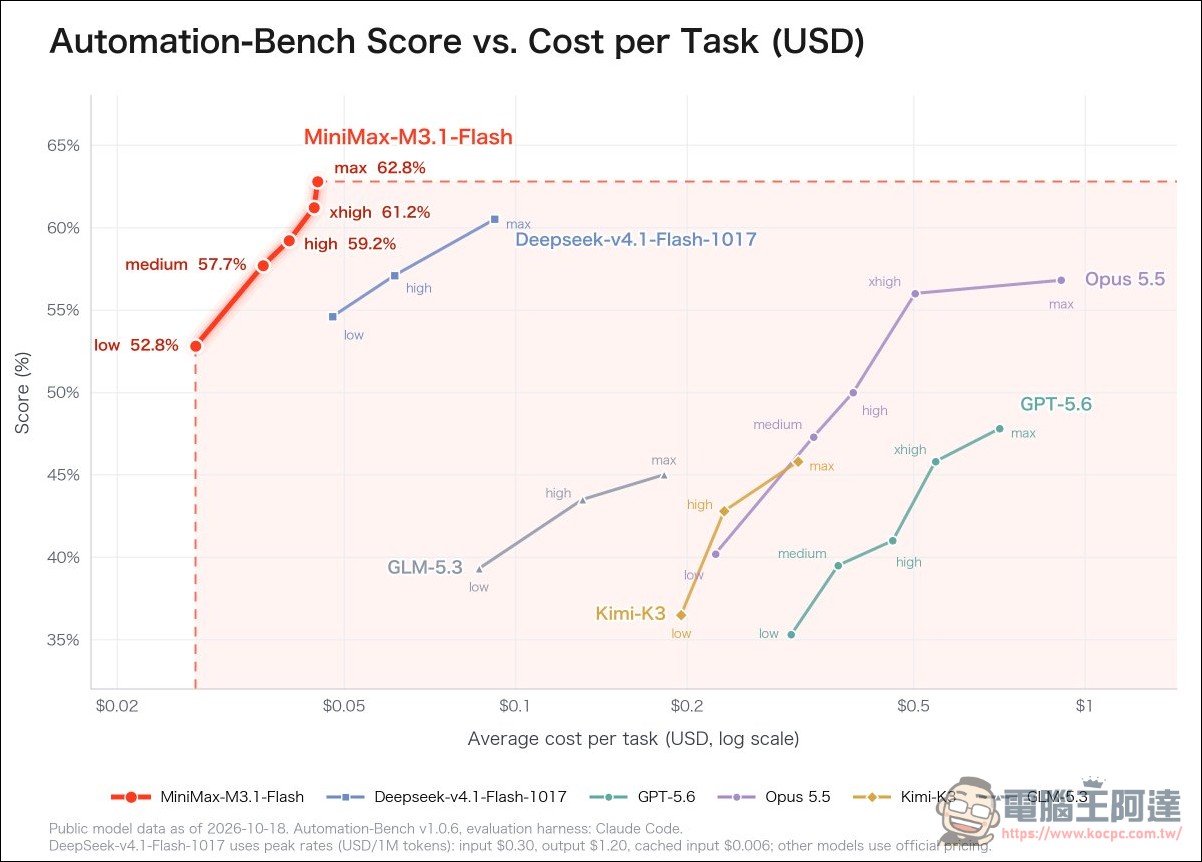
The day after MiniMax M3.1 Flash launched, DeepSeek V4.1 Flash, which had previously raised its prices, halved its official input price on October 20 from 0.3 to 0.15 and cut output from 1.2 to 0.6, setting exactly the same price as M3.1 Flash. Kimi K3’s official price is $3 input and $15 output; even after two cuts in October, it is still an order of magnitude more expensive. GLM-5.3-Flash is 0.15 input and 0.5 output, with output still a notch cheaper. The number 0.15 is becoming the anchor for Flash-class models—whoever sets it first has the say. DeepSeek V4.1 Flash-1017 was originally defined by Chinese media as sitting at the “kill line” on the cost-effectiveness curve, and M3.1 Flash has directly displaced it.
How to use: a three-pronged approach with the API, M Plan, and MiniMax Code
Three launch channels: MiniMax API, M Plan subscription, and MiniMax Code desktop version, plus OpenRouter free for 72 hours.M Plan After the rename, there are three tiers: Go at $22/month, Explore at $55, and Build at $132; annual billing is about 20% off, and usage limits run on a 5-hour plus weekly dual-window basis. Subscription keys can be plugged into common tools such as Claude Code, Cursor, Codex, OpenCode, and Hermes Agent. There is also a free tier, with limited M3.1 Flash Preview plus an image-to-speech model; no API key and no video model.
Officials say the weights will be available for download on October 23, but while the documentation calls M3.1 Flash an open-weight model, the license terms have not yet been announced; M3.1 Flash is currently still listed under a proprietary license. Those who are able to deploy it themselves can look forward to it.
Source: KOCPC Chinese