


Google The next-generation frontier model will officially launch on October 13. Gemini 4 ArgonIt is currently available to paid API customers, enterprises, and AI Ultra and Pro subscribers. The model was already released on September 30, but at the time it was initially made available only for trial use to cybersecurity defense partners in the Fairwind program. The official announcement stated that access would be expanded only after continued iteration of the guardrails, leaving nearly two weeks between its public debut and actual availability. The current promotional price of $2 per million input tokens and $10 per million output tokens lasts only until November 30; starting December 1, it will double to $4 and $20.
Roll out in two phases, with the security partners getting it first at the end of September.
Argon was initially released only to cybersecurity defenders in the Fairwind program. Google said frontier capabilities like this need to be released in phases, during which it will work with the U.S. government’s voluntary pre-access process and continue collecting tester feedback. When it launches on October 13, access will be fully opened up at once, covering the paid Gemini API (Google AI Studio and Android Studio), Google Antigravity for AI Ultra subscribers, the Gemini App and Search AI Mode (AI Ultra and Pro subscribers), and enterprises via Gemini for business. Google is also offering 10,000 scientific researchers free access to Antigravity’s highest usage tier for 6 months, and applications are now open.
The output limit has been raised from 64K to 1 million tokens.
The most noticeable spec is output length. Argon merges input, thinking, and output into the same 1,048,576-token window, with a default synchronous output cap of 65,536; after enabling long decode, it can generate all the way up to 1 million tokens. The API documentation calls this mechanism the continuation protocol, with the server side continuing generation in hops of up to 64K each; developers can also switch to client-side continuation and control retries and error handling themselves. Thinking levels come in three tiers—low, medium, and high—with medium as the default. The model itself is a large sparse MoE transformer, natively supports text, image, audio, and video input, outputs text only, has a knowledge cutoff of March 2026, and was trained on TPUs with JAX and ML Pathways. The support list includes code execution, computer use (preview), function calling, structured output, grounding with Google Search and Google Maps, URL context, and file search; caching is implicit-only, not explicit; image generation, audio generation, and Live API are not supported.
Pricing: Discounted price only until the end of November.
Gemini 4 Argon introductory pricing: input $2 per million tokens (about NT$65), output $10 (about NT$325), cached input $0.10 (about NT$3.25), all only until November 30, 2026; starting December 1, input rises to $4 (about NT$130), output to $20 (about NT$650), and cached input to $0.20 (about NT$6.5). The free tier does not offer Argon, and the paid tier will not use customer data to train or improve products. Search grounding has 5,000 free requests per month, with the quota shared across all models from Gemini 3 onward; after exceeding that, it costs $14 (about NT$455) per 1,000 requests.
Won first place in 13 out of 18 benchmarks.
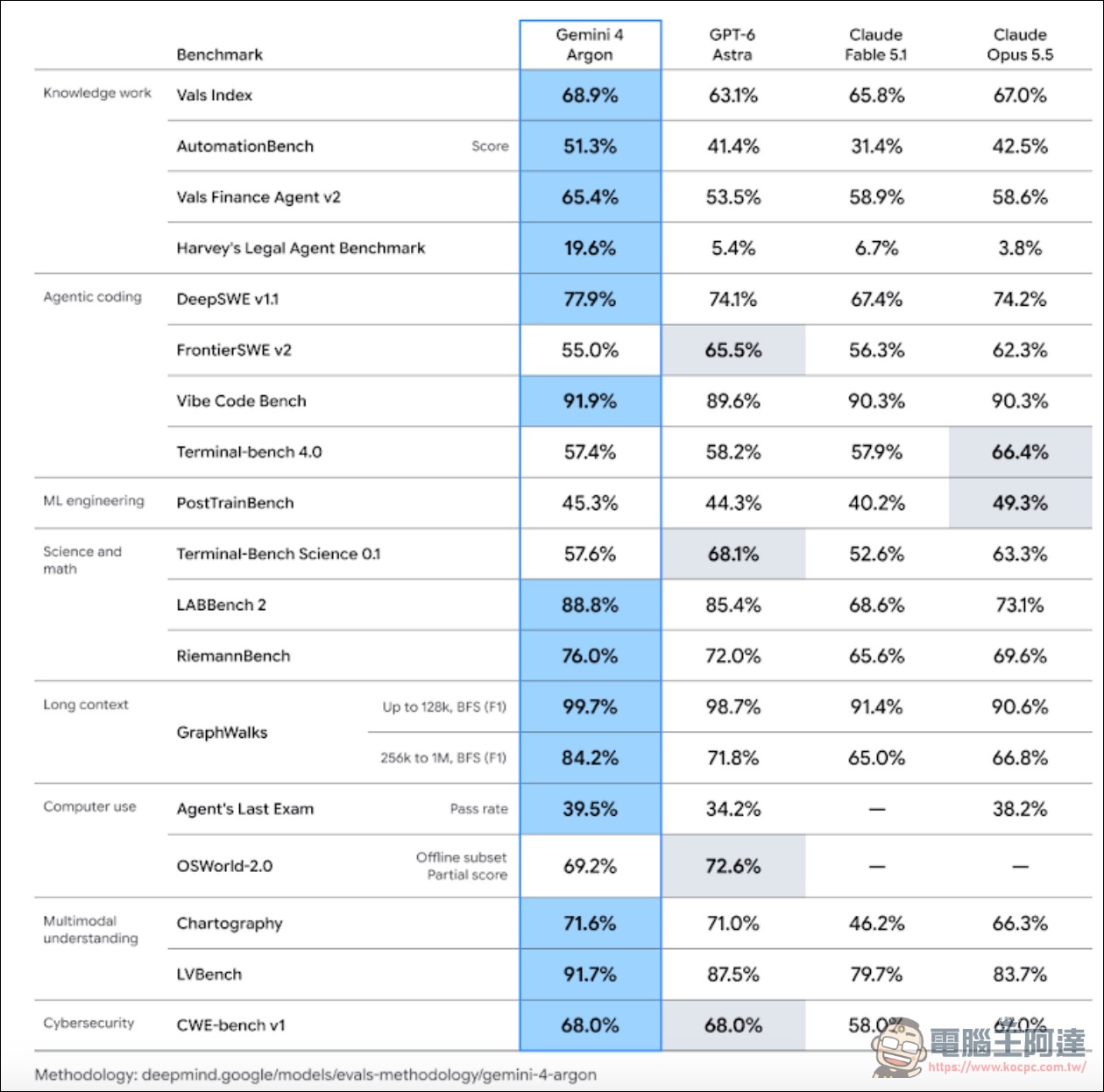
The official model card compares Argon with GPT-6 Astra, Claude Fable 5.1, and Claude Opus 5.5 in the same table. The items where it took first place include Vals Index 68.9% (competitors at 63.1%, 65.8%, 67.0%), Zapier AutomationBench 51.3%, Vals Finance Agent v2 65.4%, Harvey legal agent benchmark 19.6% (second place only 6.7%), DeepSWE v1.1 77.9%, Vibe Code Bench 91.9%, LABench 2 88.8%, RiemannBench 76.0%, long-context GraphWalks 99.7% within 128K and 84.2% in the 256K to 1M range, computer use Agent’s Last Exam 39.5%, chart understanding Chartography 71.6%, long video understanding LVBench 91.7%, and CWE-bench v1 tied with GPT-6 Astra at 68%.
Official safety test figures were also released: in Gray Swan’s indirect prompt injection tests, the success rate of 15 adaptive attacks was driven down to 0.7%, the bypass/shortcut rate fell to 2%, and the biological-domain red team unlocked less than 1% of subtasks.
What did Google itself do with it?
The Chrome team used Argon to split out an old feature folder of about 6 million lines from Chromium’s 40 million lines. Architectural refactoring of hundreds of files was compressed from months to weeks. In the future, web pages can move between tabs, side panels, and floating windows without reloading. The open-source framework ADK (google/adk-python) team gave Argon a .agents/skills ruleset and a goal, letting it run autonomously overnight. The final merged changes reduced memory preparation time for long sessions by 40% and made cold-start imports 21% faster. Open-source Gemma 4 E2B sped up 2.85x with vLLM, throughput increased from about 37,900 to 108,000 token/s, with tokens completely identical. Quantum chemistry package xTB’s molecular structure prediction is 2.3x faster and conformational search is 1.8x faster. Data center memory optimization has freed over 300 TiB, with estimated total between 500 TiB and 1 PiB; C and C++ to Rust migration went from re2, libgav1 all the way to Fuchsia’s Zircon kernel (over 800,000 lines). libgav1, after rewriting with 32K lines of SIMD, is 2.7x faster than the original Rust version.
Results in other areas are scattered across sections of the announcement. In quantum computing, Argon rewrote its in-house AlphaQubit decoder into a single hardware core, nearly doubling inference throughput; the quantum subroutine arcsin cut spacetime cost by more than 100x, with its implementation formally verified in Lean. In nuclear fusion, the Google team and University of Maryland professor Matt Landreman found a larger class of counterexamples to Grad’s conjecture, and the paper is now on arXiv. Gamow Labs used it to analyze de-identified genomes from newborns, uncovering chromosomal rearrangements that routine software had missed for years; it scored 57% on RareBench and 52.2% on LabBench. In robotics, it scored 87% on the ERQA benchmark, the highest among frontier models; in internal tests, it watched a video of a human tossing beanbags, autonomously computed full-body joint movements and generated a simulation program, and after being transferred to Apptronik’s Apollo humanoid robot, it made seven shots in a row.
Conclusion
Argon is already available on the paid API and subscription products, but the discounted price lasts only until November 30, and after December 1 the price doubles, so anyone who wants to try it needs to factor in that timing gap. At the end of its announcement, Google wrote, “Argon is only the beginning; next it will bring other members of the Gemini 4 family.” Compared with rumors that Carbon is already running internally, the next new model may not be far off. Finally, is Gemini 4 Argon as powerful as officially claimed? Or is it just another “cute dragon”? Developers’ hands-on impressions over the past two days will tell us the answer.
Source:google
Source: KOCPC Chinese