


Last fall, the Spotify comment sections of the U.S. public radio network NPR saw a “mystery comment incident” that was both hilarious and exasperating: the comment sections of several shows were suddenly flooded with short, nonsensical comments, and the accounts even seemed to be talking to one another. Staff’s first reaction was that they were all “AI bots,” and they angrily deleted the comments—but then someone immediately replied in protest: “It deleted my comment.” This unsolved mystery recently came up on NPR’s flagship program This American Life, episode 897, “Intergenerational Space TravelThe whole thing was fully revealed, and the answer surprised everyone: the comment section was filled with a group of middle schoolers who couldn’t use social media. They had turned NPR’s empty comment section into a secret chat room and were happily chatting away in it.
The Full Story of the Unsolved Case: From Bot Invasion to the Post-Deletion Controversy
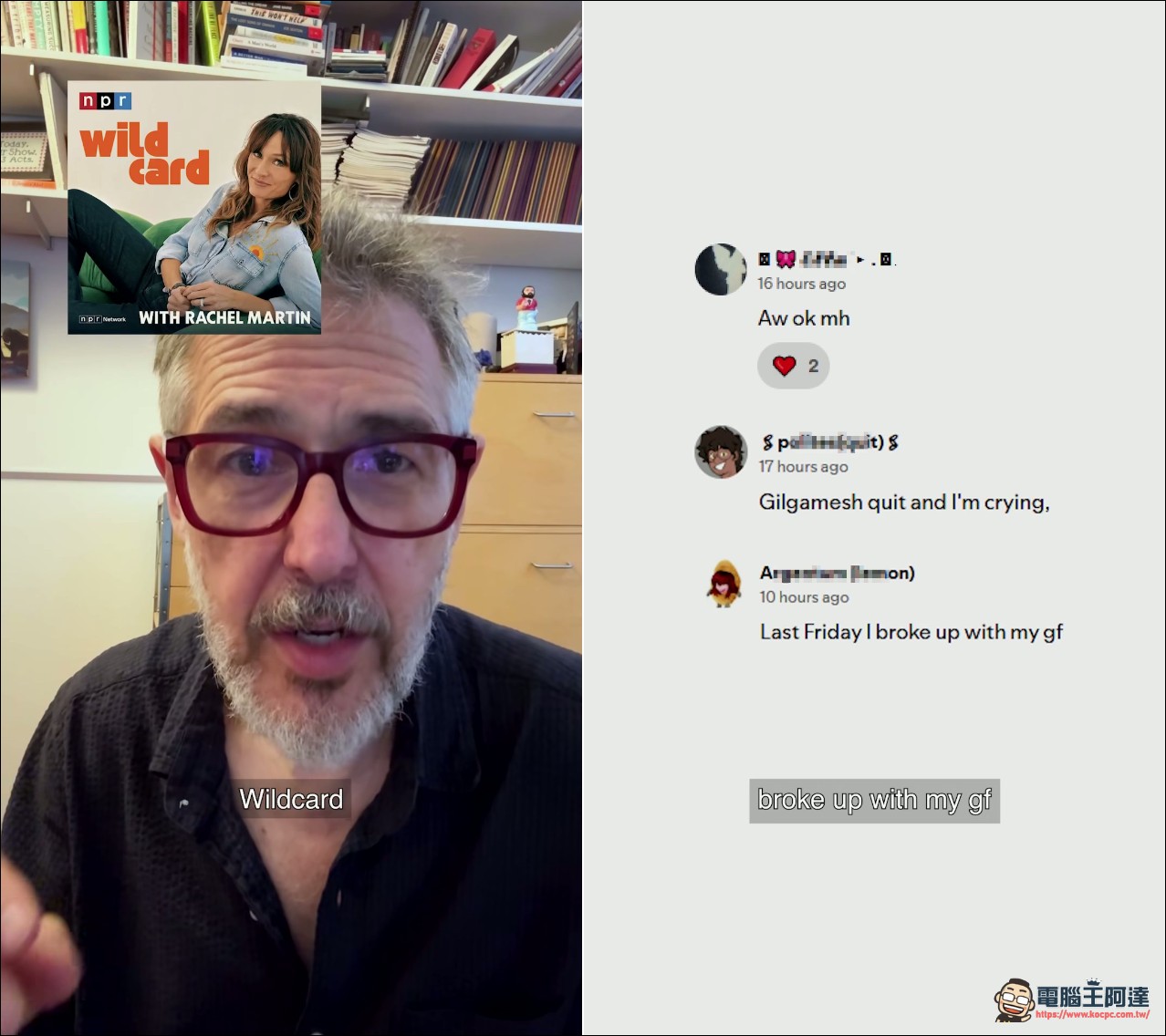
The main character of the story is Dave Blanchard, a producer for the NPR program Wild Card, hosted by Rachel Martin. One of his jobs is to monitor the show’s online comments. One day, an episode on Spotify featuring a conversation with author Elizabeth Gilbert was suddenly flooded with comments. He initially assumed the book controversy had sparked heated discussion, but when he clicked open the comments, he was stunned: “It was just a bunch of gibberish—fragmented, bizarre, incoherent. You could tell at a glance it was bots.”
He posted the screenshot to NPR’s Slack channel, and his manager, Matilde, suggested reporting it to Spotify. Just as these unidentified accounts were about to be wiped out as spam, Hannah Chinn, a Gen Z employee at NPR who is 10 years younger than Dave, opened the screenshot and cracked the case in almost a second: “My conclusion was completely different from Dave and the others’. I immediately thought: these are kids.”
Gen Z employee cracks the case at a glance: This is how I played when I was a kid.
Hannah’s reasoning process was textbook-level. She first looked at the display name: “Ella plus five emojis.” Special characters like that have to be generated one by one with an online text generator and pasted in, which is a typical style for a teenage internet kid; the profile pictures were all cartoon characters she had never seen; and the comments were all short phrases like “hi” and “this is weird,” plus a bunch of exclamation marks.
The theme of this entire episode of This American Life is precisely the generational divide in technology use, and this comment-section mystery is featured first in the opening segment, with the official transcript also fully released so listeners can follow along word for word. Spotify’s podcast comment sections were originally designed for listeners to interact with the show; to adults it’s an obscure feature, but to kids it’s a ready-made social space.
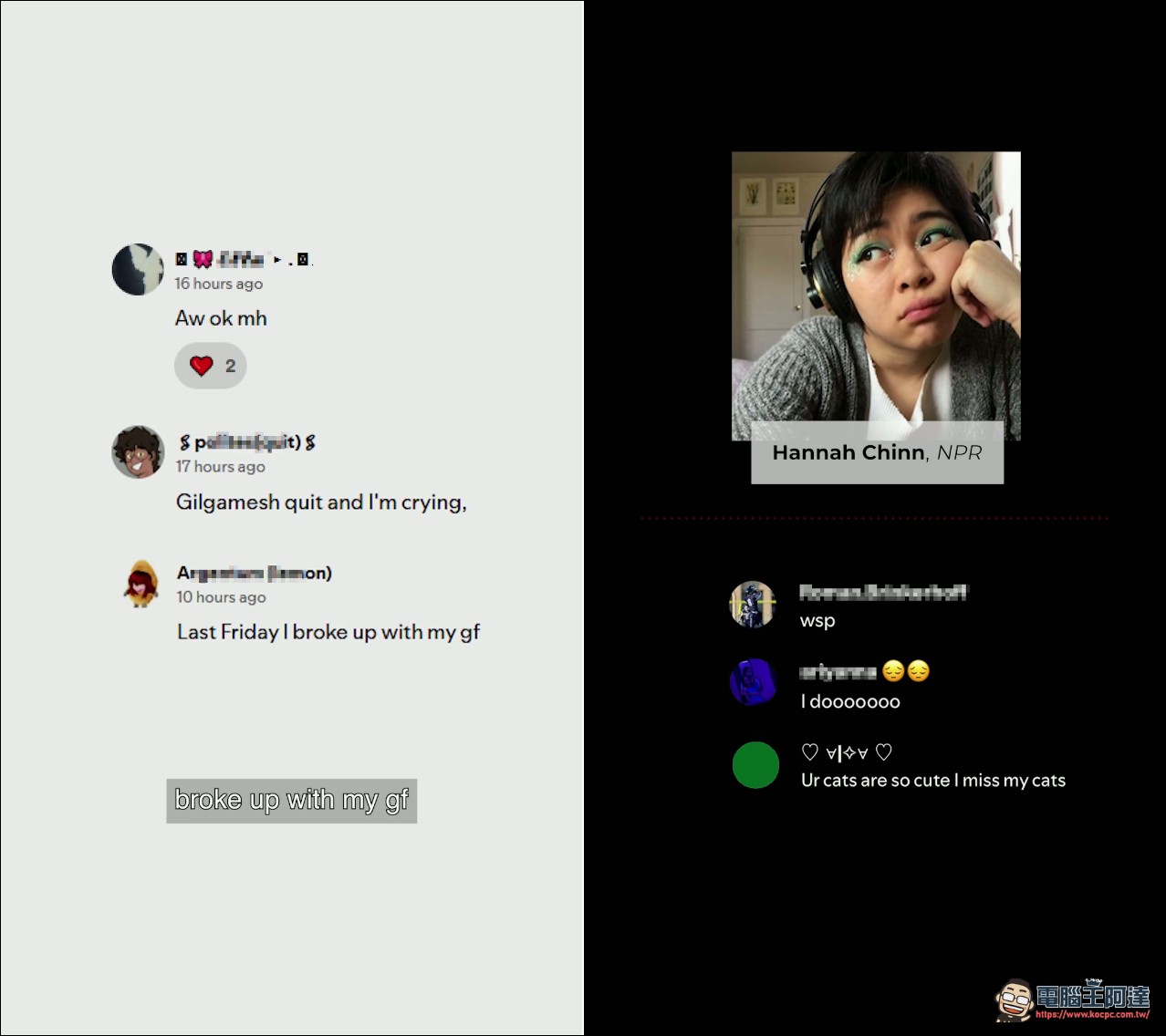
Hannah had the same kind of childhood herself. She grew up in a conservative family, was homeschooled, and had strict restrictions on social media. Back then, she and her friends chatted using Google Docs: “We’d type, delete, type again, or turn the text white to hide it against the white background. So I recognize this behavior instantly.” She wrote her assessment on Slack: “I could be wrong, but I think these are just kids hanging out, and they shouldn’t be reported as bots. They’re probably using a Spotify comment thread as a group chat—maybe the other apps on their phones are locked.”
Dave was half skeptical at the time and replied, “That theory is interesting.” Hannah admitted she was a bit annoyed in the moment: “I clearly said ‘I might be wrong,’ but I was super sure I was right.” She kept investigating and pieced together how the kids summoned each other: one kid created a public playlist on Spotify called “Let’s chat here” (come chat here), with only one podcast episode in it; other kids, while browsing public playlists, saw the signal and slipped into that episode’s comment section to gather and chat.
Why NPR, of all things? Ira Glass was hurt to hear that.
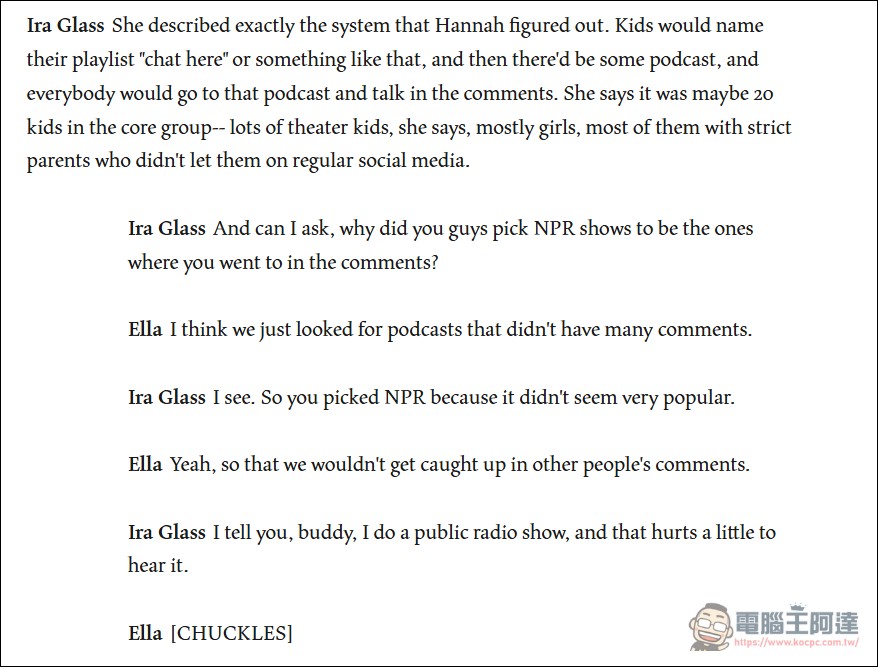
Ira Glass, the host of This American Life, later directly interviewed Ella, one of the middle schoolers in the chat, and got the funniest exchange in the whole story. “Why did you specifically choose NPR programs to leave comments on?” “We just looked for podcasts that didn’t have many comments, so we wouldn’t get pulled into other people’s comments.” “So you chose NPR because it seems unpopular.” “Yeah.”I’m telling you, kid, I do public radio, and hearing that really hurt a little.。」
This exchange, paired with the narrator’s resigned tone, became the most viral segment of the episode. NPR officially posted the edited version on Facebook, Instagram, and YouTube Shorts, with Ira Glass personally explaining this “mysterious Spotify comment incident,” and the video quickly spread across social media. Interestingly, the kids’ reason for choosing NPR was “few enough comments, quiet enough” (a reason that isn’t very aggressive but is extremely insulting XD).
Conclusion
From white-text chatting in Google Docs and using Google Sheets as a message board to Spotify public playlists paired with podcast comment sections, kids shut out of social media invent a new “underground communication protocol” every few years. What adults see as gibberish is their everyday conversation, and the spam adults want to delete is their social life. As Hannah summed it up on Slack: they’re just kids who’ve just started chatting online, and their only goal is to connect with people (and now Europe and the U.S. are cracking down hard on minors’ use of social apps, with Meta just hit with a heavy fine). As for NPR, while congratulating itself on cracking the case, it also has to accept that its own comment section was chosen for the somewhat embarrassing reason that it “wasn’t popular and was quiet enough.”
Source: KOCPC Chinese