


Friends who have been paying attention to US stocks may have noticed that recently Meta With many AI-related stocks surging, the main reason is Meta’s AI personal agent app “Meta MuseIt launched in the U.S. and Canada on September 8 and racked up more than 2.5 million downloads in less than two weeks, then surpassed ChatGPT on September 18 to become the No. 1 free app on the U.S. App Store chart. After the news gained traction, Meta shares surged more than 11% in a single day on Monday (the 21st), and Wells Fargo promptly raised its price target to $796, sparking a new AI rally in U.S. stocks.

Muse’s explosive rise signals that AI agents are moving from the developer community to ordinary consumers. Bernstein analyst Stacy Rasgon points out that in the past, most AI agent use cases were rarely aimed at the general public; now, with the emergence of Meta’s Muse and other agent tools, there is an opportunity to drive broader adoption. The full story behind this app begins with a setback Meta suffered in the AI model race.
From Llama 4’s Waterloo to Muse Spark: Meta’s AI Counteroffensive
In June 2025, Meta poured US$14.3 billion (about NT$465 billion) into Scale AI, bringing founder… Alexandr Wang Poached into the company to head the newly established Meta Superintelligence Labs. The backdrop to this reinforcement was the lukewarm reception to the Llama 4 series models after their April 2025 release, which failed to attract developers and forced Mark Zuckerberg to adjust his AI strategy.
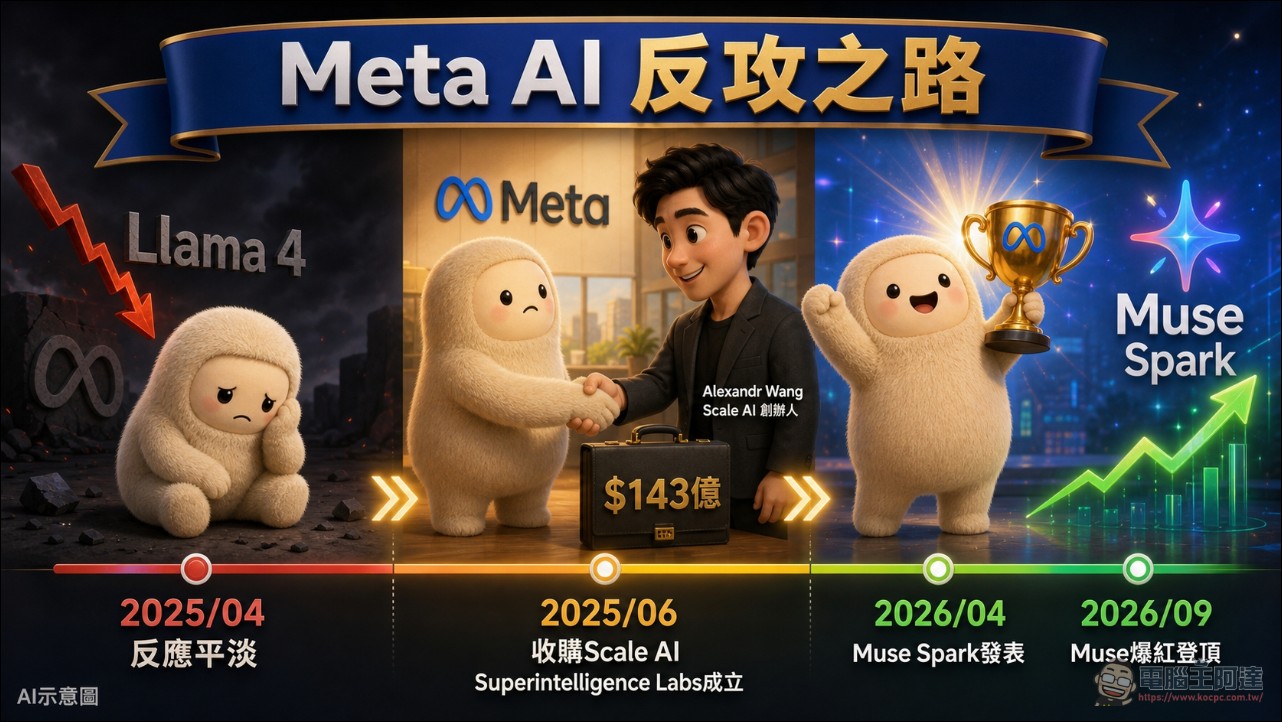
On April 8, 2026, Wang’s team delivered its first report card:Muse The first foundation model in the series, “Muse Spark” (internal codename Avocado). It is officially positioned as “small and fast,” with competitive performance in multimodal perception, reasoning, health, and agentic tasks, and achieves the level of the older mid-sized Llama 4 with “an order of magnitude less compute than before.” Muse Spark abandoned Llama’s open-source approach and switched to closed source, with officials saying they “hope to open-source future versions.”
The next moves come one after another: in August, Muse Code, a coding agent for developers, will launch; on September 8, the Muse personal agent app, internally codenamed Hatch, will officially go live, also powered by the Muse Spark series of models. Zuckerberg had already previewed to investors on the July earnings call: “The new personal agent will be the foundation of our next wave of products and revenue lines in the coming months and years.”
What Is Muse: A Personal AI Agent That Gets Things Done for You
Unlike traditional chatbots, Muse can take action on behalf of users, handling reservations, filling out online forms, organizing email inboxes, booking flights, tracking product price drops, and even monitoring home camera footage. The biggest difference between Muse and the Meta AI App launched last April is its level of personalization: Muse can respond based on users’ social content on Facebook Marketplace and Instagram, connect to third-party services such as Gmail, Google Calendar, and OpenTable, and visit other websites through a browser; the older version of Meta AI focused more on image and short video generation.
Users can name their own assistant. The in-app feed aggregates Facebook and Instagram posts and web articles, and summarizes the content based on user settings. WhatsApp also offers the same core agent features, but it does not have the feed or the ideas tool that recommends AI agent tips. Meta AI head Wang told CNBCMuse is designed to be “approachable, friendly, and explainable.” “Behind the scenes, Muse may be running highly advanced programmatic workflows, building complex integrations, and doing a lot of heavy lifting, while staying simple for users.”
On pricing, Muse offers a free tier (with a usage cap), and subscription plans at $20 per month (about NT$650) or $100 per month (about NT$3,250), depending on usage. This is Meta’s first step toward opening a revenue stream for AI agents outside its core advertising business. The company also plans to bring Muse to Ray-Ban Meta smart glasses.

Downloads skyrocket: 2.5 million in two weeks, surpassing Claude and Grok in 13 days
Data from market research firm Sensor Tower shows that Muse accumulated 730,000 downloads in its first 5 days, surpassed 2.5 million by September 21 (about 1.5 million on iOS and 1.1 million on Android), and overtook ChatGPT on September 18 to become the top free iOS app in the U.S. Based on cumulative downloads 13 days after launch, Muse surpassed Claude’s 400,000 and Grok’s 200,000; ChatGPT had 3.1 million in the same period.

Why is it blowing up now? Neil Saunders, managing director of retail analysis firm GlobalData Retail, believes this means agentic shopping is accelerating, and consumers want to hand tedious tasks like comparing prices and finding products to AI. An IBM survey shows 41% of consumers have already used AI assistants to research products, and 31% use them to find deals. John Mercer, research director at Coresight, says Muse can book flights, clean up an inbox, and track price drops, and calls it “the natural evolution of search”; the firm surveyed more than 1,000 consumers, and 30% said they would use AI to compare prices during holiday shopping.
E-commerce Wars Begin: Amazon Bans, Shopify Embraces
Muse’s rise immediately disrupted the status quo of online commerce. Amazon has blocked Muse from accessing its shopping site, citing privacy and security concerns. Amazon said Meta let the agent visit its store without prior notice, accused Muse of bypassing personalization features in the shopping experience, and appeared to also capture and store customer credentials and scrape account data: “Continuous access by unauthorized AI agents violates the terms of use our customers agreed to.” (The same playbook also happened with China’s Doubao phone, cutting into e-commerce advertising’s pie.) Meanwhile, Shopify CEO Tobi Lütke announced on September 21 a partnership with Muse to let online stores on its platform support agentic checkout, with AI agents completing checkout directly. Muse has also partnered with PayPal, fintech company Plaid, and others.

Amazon’s counterattack has precedent: last year Amazon filed a lawsuit because Perplexity’s Comet browser could access Amazon accounts; recently the U.S. Court of Appeals for the Ninth Circuit ruled that users chose on their own to visit Amazon through Perplexity’s bots, and Amazon is still fighting. A notable industry reality is that Amazon has its own shopping agent, Buy for Me, and CEO Andy Jassy has said it is exploring partnerships with third-party AI shopping agents. Nikesh Arora, CEO of cybersecurity firm Palo Alto Networks, wrote on X: “It’s only a matter of time before Apple and Google versions of Muse appear, and maybe a TikTok version. Every service, marketplace, or commerce app must decide: whether to open APIs to let consumers’ agents interact.”
Wall Street’s two-sided reaction: Meta soars, financial and travel stocks tumble.
Capital markets are divided on how to interpret Muse. On the positive side, Evercore ISI analyst Mark Mahaney’s team said bluntly in a report that “Meta already has a hit product in hand,” calling it strong evidence that Meta’s more than $200 billion (about NT$6.5 trillion) investment in AI research and data centers has not gone to waste, and that Muse could open up new revenue streams such as advertising, subscriptions, and transaction revenue sharing.

On the other hand, “AI disruption fears” made a comeback. On September 22, Wall Street dumped financial and travel stocks: S&P 500 financials fell 2%, Charles Schwab, LPL Financial, Raymond James, and Ameriprise dropped more than 5%, JPMorgan Chase fell 3.4%, Wells Fargo fell 3.9%, and Booking Holdings and Allstate were also hit. Devin Ryan, head of financial services and fintech research at Citizens, pointed to the core concern: if AI agents can manage clients’ funds 24/7, the idle cash that brokerages and other financial firms rely on for profits could disappear. But Alois Pirker, founder of Pirker Partners, cautioned that the panic reaction in financial stocks could later reverse. “If you’re operating an ocean liner, you can’t turn it around tomorrow,” he said, adding that the traditional financial industry holds vast amounts of customer data, giving it a chance to strike back.

Privacy and Historical Shadows: Sober Reflections Amid the Hype
Muse requires users to hand over extensive account access permissions before it will act on their behalf, so privacy is naturally a focus. Wang emphasized that the app runs in an “isolated, separate environment” within Meta’s infrastructure and “can never see your actual passwords or payment information,” and that it will ask first before any sensitive action; official documents say online shopping uses one-time card numbers and does not expose real card data. But the training data policy is “opt-out”: unless users actively decline, Meta will use Muse conversations and interactions to train AI models after removing key personal information.
Meta’s past privacy record has also raised outside doubts. Meta is embroiled in class-action lawsuits related to smart glasses, with allegations that some images captured by the glasses (including highly private content) were sent to third-party workers for labeling and used for AI development, which Meta disputes; in addition, Meta has just settled, for nearly $17 billion (about NT$553 billion), a lawsuit with a coalition of state attorneys general over social media’s harm to teenagers.
Cognitive scientist Gary Marcus, meanwhile, dug up an old example as a reminder: Facebook had already launched an AI assistant called “Project M” back in 2015, billed as able to book restaurant reservations and arrange itineraries. It generated huge hype at the time, but ultimately, because operating costs were too high, it was made available to only about 10,000 users, and later it was reported that human employees were handling tasks behind the scenes. There are also recent examples of AI applications that “blow up at launch and then lose steam”: OpenAI’s Sora and Meta’s own Vibes video tool both had only a fleeting moment in the spotlight, and whether Muse can sustain its popularity remains unknown.
Conclusion
From OpenClaw sparking an AI agent wave in developer circles earlier this year to Muse getting everyday consumers to queue up to download it on the App Store for the first time, the AI Agent adoption curve has shot up sharply in two weeks. The next three things to watch are: whether Muse’s retention rate can survive the novelty wearing off, how the “open versus closed” battle represented by Amazon and Shopify evolves, and whether transaction revenue sharing can become a real revenue engine beyond Meta ads. And don’t forget, Zuckerberg is set to announce new smart glasses developments at the Connect conference on September 24; at that point, how integrated Muse is with wearables will be the next key move in this game.
Source:1 / 2
Source: KOCPC Chinese