


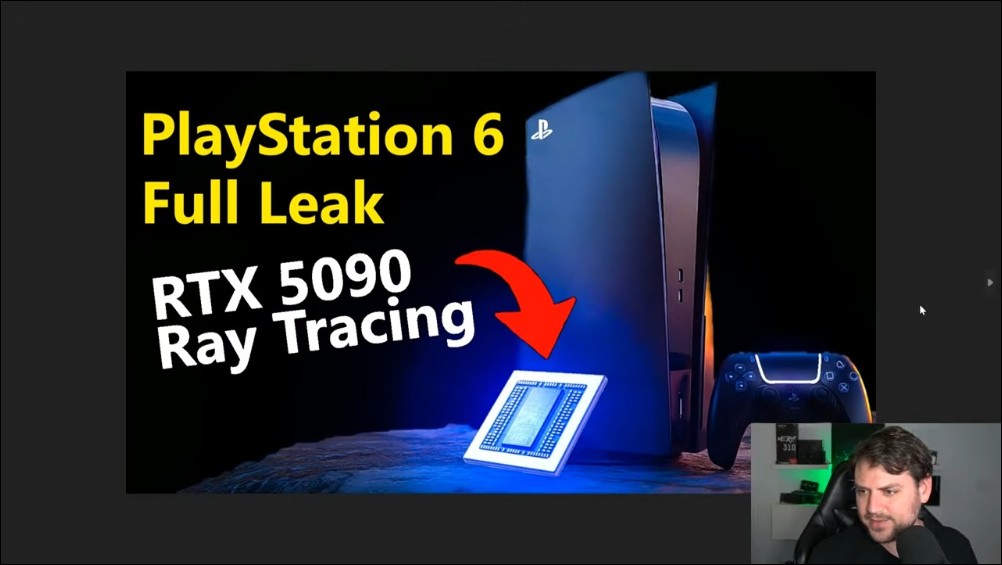
According to the latest information from well-known hardware leaker MLID (Moore’s Law Is Dead/Moore’s Law is Dead), Sony’s next-generation PlayStation 6 (PS6) will bring a shocking improvement in ray tracing performance. It is rumored that the PS6’s ray tracing computing power will be 6 to 12 times that of the previous generation PS5, even enough to rival NVIDIA’s upcoming RTX 5090 flagship graphics card. If the rumors are true, this will be the largest generational leap in the history of home game consoles. The gaming experience of 4K 120fps with complete ray tracing effects will become a norm from a dream.
AMD Orion APU core specifications revealed
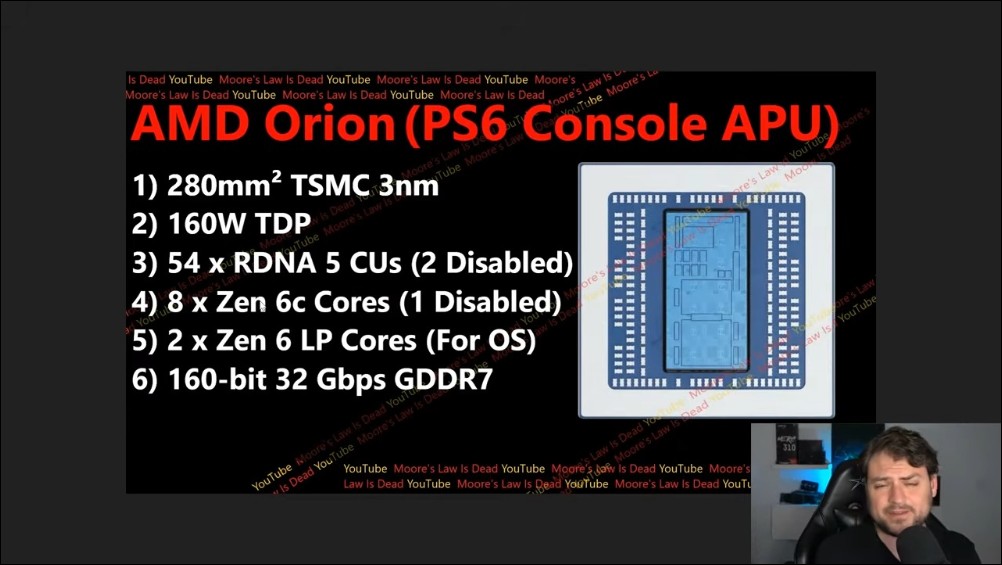
According to supply chain information obtained by MLID, PS6 will use the Orion APU integrated processor developed by AMD. This is the first time that complete specifications have leaked. The APU will combine AMD’s most advanced Zen 6 CPU architecture and RDNA 5 GPU architecture and be produced using TSMC’s 3nm process, which is expected to achieve an excellent balance between performance and power consumption.
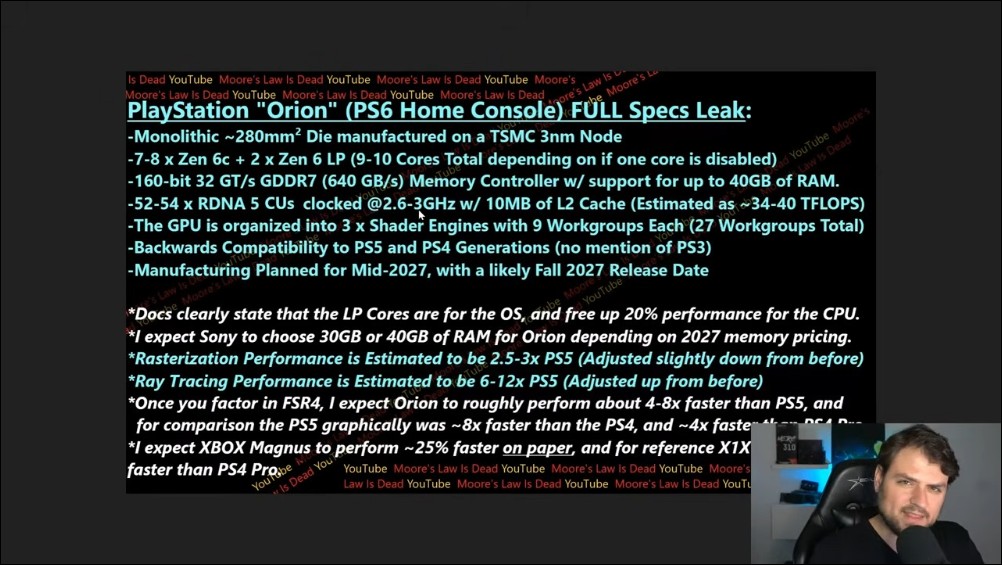
As for the processor (CPU), PS6 will be equipped with 8 to 10 Zen 6 computing cores. Compared with the Zen 2 architecture (8 cores) used by PS5, Zen 6 is expected to have a 25% to 30% improvement in single-core performance, which means that both game execution speed, loading time, and background system operations will be significantly improved. This will be a boon for players in open-world games and multitasking situations where processor performance is important.
The graphics processing unit (GPU) part is the focus of this upgrade. The RDNA 5 graphics core built into the Orion APU will be equipped with 52 to 54 computing units (CUs) with clock speeds between 2.6 and 3 GHz. The overall computing power is estimated to be 34 to 40 TFLOPs, which is 3.3 to 3.9 times that of PS5 (10.28 TFLOPs). More importantly, the number and efficiency of light tracing computing units will be greatly increased, achieving a 6 to 12 times improvement in light tracing performance.
Memory and Bandwidth: Say Goodbye to Loading Screens
PS6’s upgrade in memory specifications is also exciting. According to the leaked information, the new console will be equipped with 30 to 40 GB GDDR7 memory, with a memory bandwidth of 640 GB/s. Compared with PS5’s 16 GB GDDR6 and 448 GB/s bandwidth, this is more than 2 times the capacity increase and about 43% bandwidth increase respectively.
Such a huge memory and bandwidth configuration means that PS6 will be able to retain more game resources in the memory, completely changing players’ existing perception of “loading screens.” Open world games can achieve true “seamless integration”, and scene switching will become a thing of the past; map preloading for multiplayer games will also be smoother, reducing the impact of network delays.
Performance analysis: from “can play ray tracing” to “standard ray tracing”
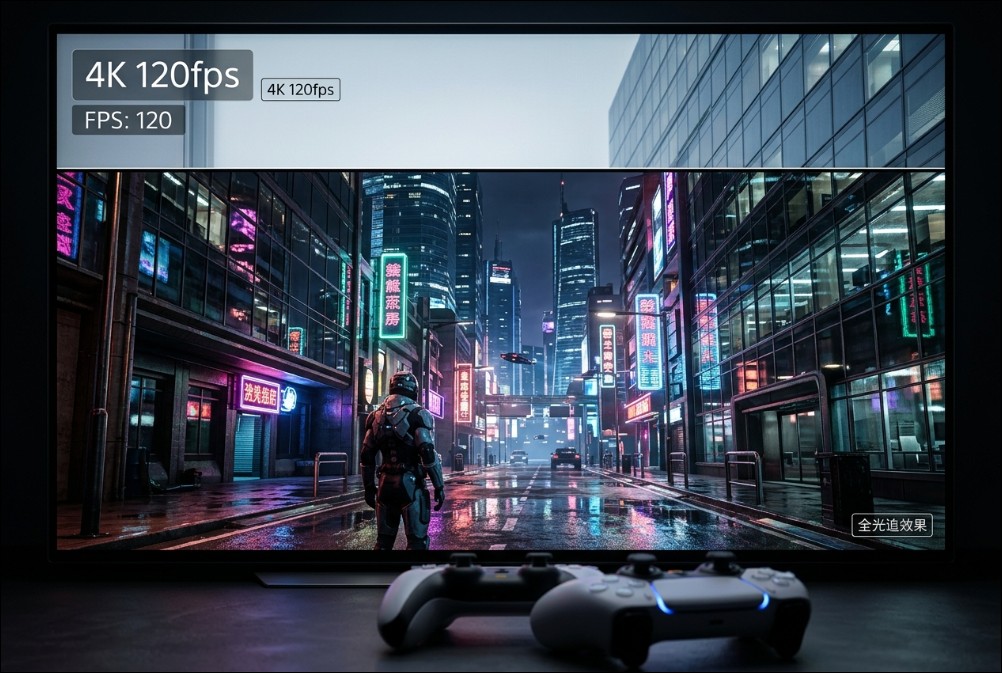
Although the light-tracing experience in the PS5 era is amazing, due to performance limitations, developers often have to choose between image quality and light-tracing effects. However, the PS6’s ray tracing performance has been improved so much that “4K 120fps + ray tracing” will become a standard feature rather than an option. This is the first time that a home console can simultaneously achieve a high frame rate and complete light-tracing gaming experience at native resolution.
According to MLID’s analysis, PS6’s ray tracing performance is comparable to NVIDIA RTX 5090-level graphics cards, which is an unprecedented breakthrough in the field of game consoles. In the past, the ray tracing capabilities of consoles have often lagged behind high-end graphics cards by two to three generations, but Sony seems determined to break this convention this time. If the rumors are true, PS6 will become the most cost-effective light-tracing gaming platform on the planet: players only need to spend about US$800 (approximately NT$25,000) to get a light-tracing experience close to that of flagship graphics cards.
Market Outlook: On sale in autumn 2027, affordable price
Regarding the release time and price, MLID speculates that the PS6 will be officially launched in the fall of 2027, which is consistent with Sony’s past model of updating the console cycle every seven years (PS4 2013, PS5 2020). In terms of price, considering the hardware cost and market strategy, the estimated selling price of US$800 seems quite reasonable. This price is not only slightly higher than the US$499 when the PS5 was released that year, but taking into account inflation and substantial performance improvements, it is still an investment worth looking forward to for players who pursue a top-notch gaming experience.
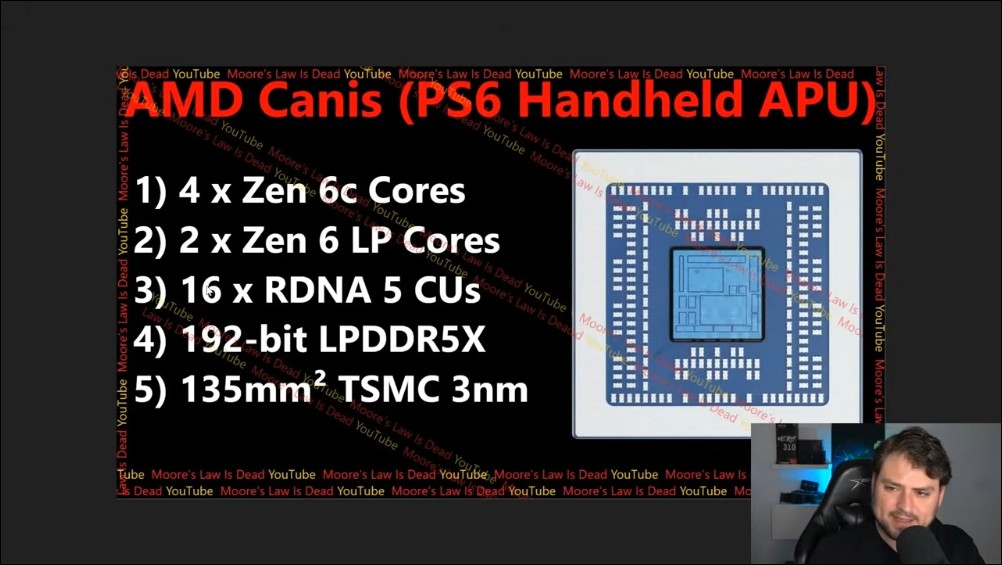
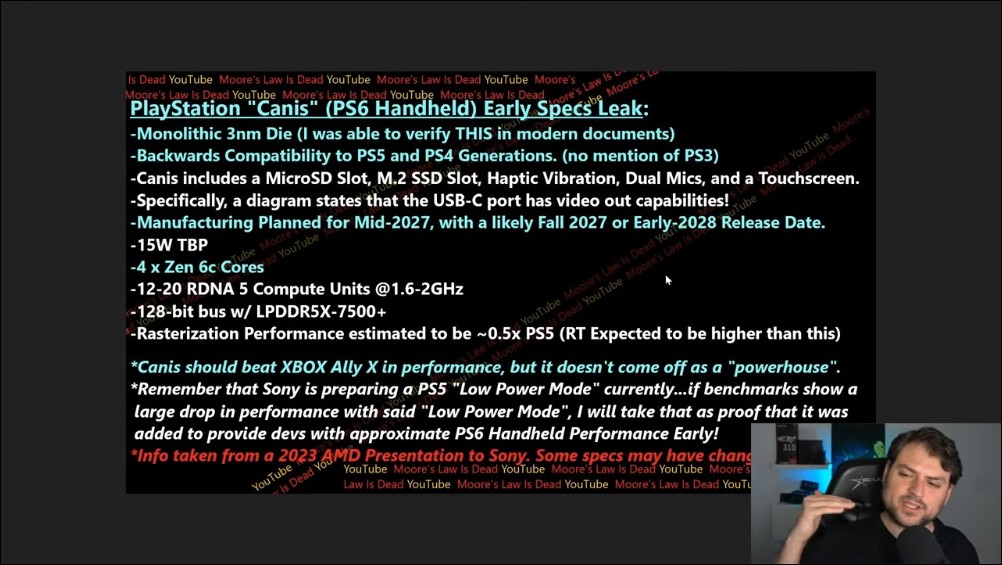
It’s worth noting that Sony also seems to be preparing to enter the handheld market. It is rumored that a PS6 handheld version code-named “Canis” is under development, and its performance will exceed that of the ASUS ROG Ally X. This handheld handheld is positioned in a hybrid mode of cloud and local computing, allowing players to experience PS6-level game quality when going out. If it comes true, this will completely subvert the competitive landscape of the handheld market. The APU used in this legendary PS6 handheld console uses TSMC’s 3nm process, using 4 Zen 6 cores and two low-power cores and other related specifications:
Competitive Landscape: The Threat of Xbox Magnus
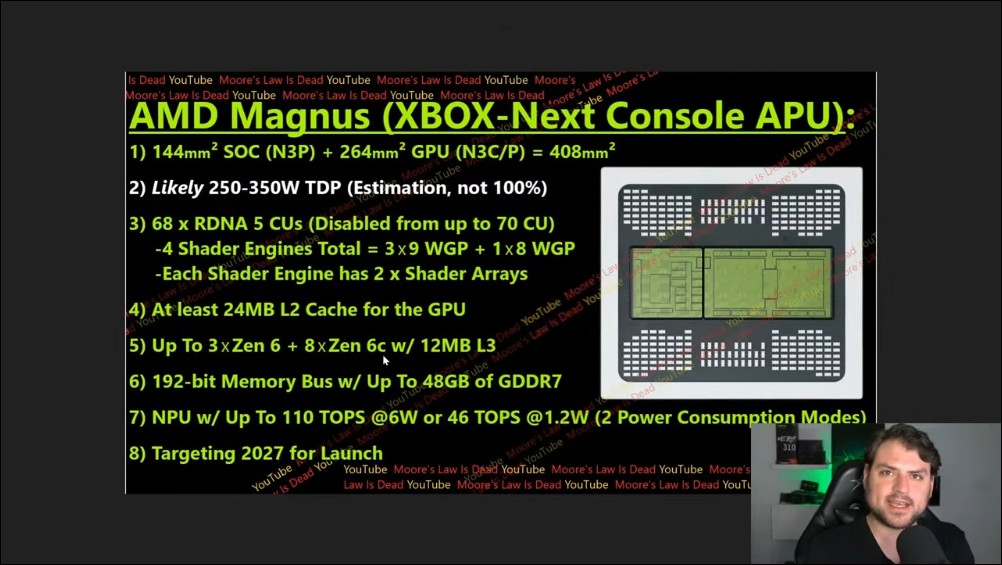
Sony isn’t the only winner, however. Based on current paper specifications, Microsoft expects the Xbox Magnus console to be about 25% ahead of the PS6 in performance. This means that the console war will heat up again, and the competition between Sony and Microsoft will transform from a pure competition in the gaming camp to a comprehensive showdown of technical specifications and ecosystems.
For players, healthy competition is always a good thing. The competition between the two camps in terms of performance will ultimately benefit consumers. More powerful hardware means a more exciting gaming experience, which is what players want to see. Interested friends can directly watch MLID’s analysis and revelations video, but his information is also based on relevant information guesses provided by the supplier. You can just use it as a reference before the product is officially released:
Conclusion: The most anticipated console generation in history
Based on the above information, PS6 is undoubtedly the console generation upgrade that players are most looking forward to. From 6 to 12 times the ray tracing performance, 34 to 40 TFLOPs of computing power, and 4K 120fps ray tracing games becoming standard equipment, this upgrade is unprecedented in the history of game consoles. Paired with GDDR7 memory, TSMC’s 3nm process, and an affordable price of $800, PS6 has the potential to become the gold standard for gaming experiences in the next seven years.
However, all this is still in the rumor stage, and final specifications and release time are still to be officially announced by Sony. But judging from supply chain news and industry trends, the credibility of these revelations is quite high. For players around the world who are looking forward to it, the fall of 2027 may be the best time to welcome the new generation of gaming revolution.
Source: KOCPC Chinese