


As game screen quality requirements become higher and higher, the rendering pipeline of modern graphics cards becomes increasingly complex, and traditional ray tracing processing methods have begun to become a performance bottleneck. Microsoft’s latest revolutionary technology “Shader Execution Reordering (SER)” has officially been added to DirectX 12 Shader Model 6.9, bringing unprecedented performance improvements to graphics cards. According to Microsoft’s test results, after enabling SER, the performance of Intel’s “B series” (Battlemage) graphics cards is improved by as much as 90%, and the NVIDIA GeForce RTX 4090 also has 40% performance growth.
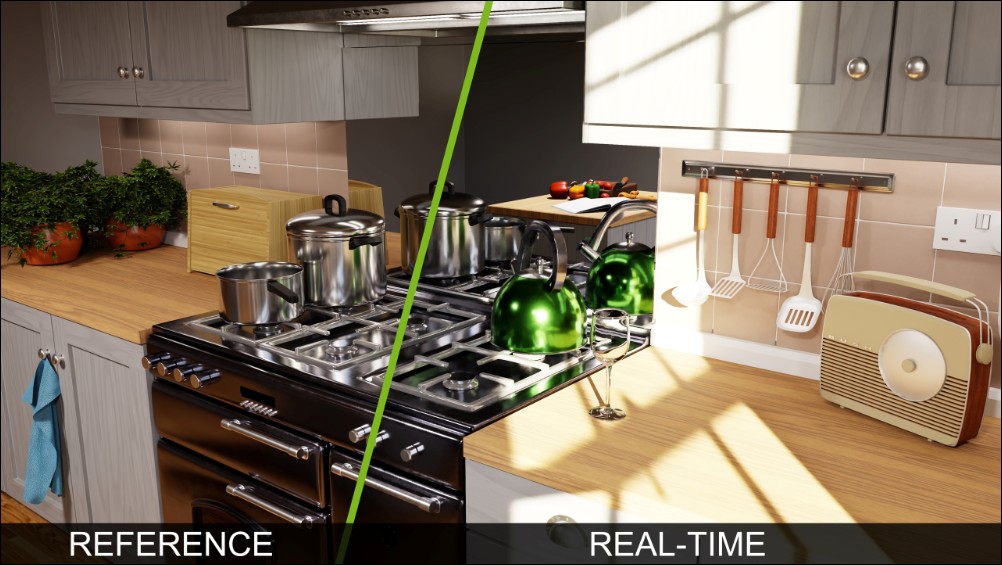
This technology was originally announced with DXR 1.2 at the 2025 GDC (Game Developers Conference), when Remedy Entertainment showed that in the “Alan Wake 2” game, combined with Opacity Micromaps (OMMs) and Shader Execution Reordering, ray tracing resource consumption was successfully reduced by one-third.
How SER works: Breaking the ray tracing bottleneck
The full name of SER is “Shader Execution Reordering”, and its core concept is to optimize ray tracing efficiency. Due to the stochastic nature of many ray tracing workloads, DXR applications often suffer from “divergent shader execution” and “divergent data access” issues.
The bottleneck of the traditional approach is: when a single ray hits multiple objects, and each object requires a different shader, the traditional approach makes each thread in the warp wait for each other, resulting in a lot of idle time. In this case, even though the graphics card has powerful computing power, it cannot reach its full potential due to poor execution order.
SER’s solution
Through SER, all objects hit by a light are first stored and then reordered based on two key factors:
- Spatial Locations – Sort objects based on their position in 3D space
- Shader Similarities – Place objects that require the same shader together
This allows the execution process to be carried out in a more “coherent” manner, greatly reducing the execution thread waiting time and allowing the graphics card’s computing resources to be more fully utilized.
「HitObject 與 SER 的結合特別強大,能夠利用 HitObject 中的資訊和使用者提供的額外提示,進一步提升 hit/miss 處理的連貫性潛力。」— Microsoft
HitObject technology: decoupling the stages of ray tracing
In addition to SER, this update also introduces the “HitObject” concept, which decouples the “traversal” of ray tracing (including AnyHit shading and Intersection shading) from “ClosestHit” and “Miss” shading.
This design brings several important advantages:
- Reduce duplicate code: Common code that used to have to be repeated in every ClosestHit shader (such as vertex fetching and interpolation) can now be avoided
- More flexible processing: Simple visibility rays now eliminate the need to execute a full hit shader to get basic hit information
- Multi-source scheduling: Dispatch of ClosestHit/Miss can start from sources other than traversal (such as RayQuery)
Shader Model 6.9 complete updates
The release of Shader Model 6.9 brings a number of importantrenew:
| Function | illustrate |
|---|---|
| Long Vector | Supports vector operations up to 1024 elements |
| 16-bit Float Specials | HLSL adds IsNan(), IsInf(), and IsFinite() support for 16-bit floating point numbers |
| DXR 1.2 | Contains Opacity Micromaps and SER |
| 16/64-bit Shader Ops | These features are now required in SM 6.9 |
Also included are several customer-requested feature improvements, such as a revised resource view creation API, periodic clipping notifications, increased dispatch grid limits, and more.
Supported hardware and usage
Users don’t need to worry about how to enable this feature because SER is integrated into Microsoft’s Shader Model 6.9 and requires AgilitySDK version 1.619.
Hardware support
According to Microsoft’s demonstration videos and test results, hardware expected to support SER includes:
- NVIDIA Ada Lovelace and above architecture(RTX 40 series and above)
- Intel Battlemage Series(Arc B570/B580, etc.)
It’s worth noting that SER is a “required feature” in Shader Model 6.9, which means that all graphics card drivers must support shader code that contains SER. Whether you can actually get performance improvements depends on the support of individual graphics card hardware.
Performance test instructions
Microsoft observed a 90% performance improvement on Intel Arc B-series graphics cards and a 40% improvement on NVIDIA RTX 4090 in sample testing. However, Microsoft also specifically points out that these tests do not fully reflect actual game performance, so the performance improvement experienced by players in actual games may be slightly lower than the above data.
Developer resources
Microsoft also released a number of developer resources:
- PIX tool support:SER got full PIX support the same day it was released[2]
- Sample code: NVIDIA’s RTX Path Tracing sample and Microsoft’s D3D12RaytracingHelloShaderExecutionReordering sample both support SER
- Detailed documentation: The complete SER technical specifications can be found in the official DirectX specs file on GitHub
What it means to players
For the majority of PC gamers, the official support of DirectX 12 SER means that future ray tracing games will be able to achieve smoother frame rate performance while maintaining image quality. Especially for players using mid-range graphics cards such as the Intel Arc B580, this technology is expected to give them an experience close to that of high-end graphics cards in ray tracing games.
As more and more game developers adopt Shader Model 6.9 and SER technology, we can expect to see more games that support real-time ray tracing, bringing more realistic visual effects to PC games (hopefully not to scare players…).
Source: KOCPC Chinese