


NVIDIA is about to launch DLSS 5, its next-generation AI graphics technology, with the goal of bringing real-time game visuals closer to actual photographic quality. This feature, built on new 3D-guided neural rendering technology, is scheduled to go live on the evening of September 3rd Pacific Time, and NBA 2K27 will be the first title to support it, covering RTX 50 series graphics cards, laptop platforms, and the GeForce NOW cloud gaming service.

NVIDIA DLSS 5 will go live on 9/3 alongside NBA 2K27, keeping the art style unchanged while making the visuals more realistic.
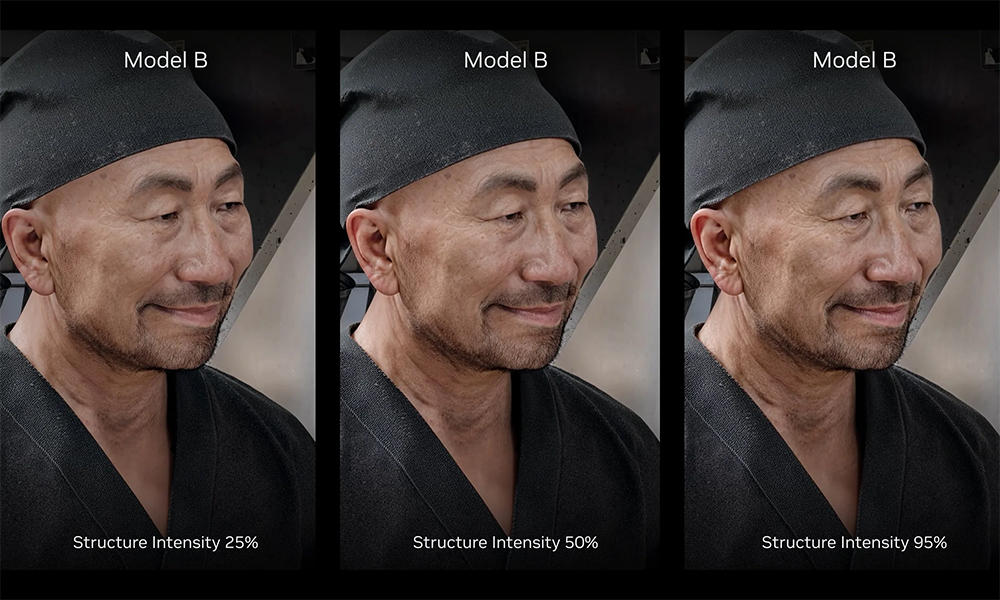
When NVIDIA first unveiled DLSS 5, one of the biggest concerns from outsiders was whether AI would overstep in image generation, thereby diluting the original creative intent of the development team and art designers. However, after actually seeing the demonstration, those worries seem to have been greatly reduced—DLSS 5 does not completely take over the game’s visuals, but rather performs smarter optimization on top of the existing frames.

On the technical level, DLSS 5 analyzes rendered frames, combining data such as color information and motion vectors to understand the characters, objects, materials, and lighting relationships in a scene through a neural network, then further enhances the overall visual quality. More importantly, game developers still maintain a high degree of control, with the freedom to decide the scope and intensity of AI involvement.

The flexibility of this control mechanism is truly remarkable. Developers can use automatic or manual masking to individually adjust details such as contact shadows, reflections, and ambient occlusion, while also controlling broader lighting and color behavior. These adjustments can be applied not only to the entire scene but also precisely to specific objects. In other words, DLSS 5 isn’t simply about making the image look prettier—it lets creators decide which elements need AI enhancement and to what degree.


This is also the most anticipated aspect of DLSS 5. The system can identify and distinguish different elements such as characters, clothing, environmental objects, and backgrounds, and process them independently. The final result is more natural light and shadow interaction, more realistic material rendering, and a more layered overall image. NVIDIA also emphasized that DLSS 5’s effects are highly dependent on the quality of the original image. This technology does not generate an entire world out of thin air; instead, it builds on the data provided by the game itself, using AI to further enhance the final output.
Depending on the quality settings, there is still a trade-off between performance and image quality. However, NVIDIA’s published test data for NBA 2K27 remains impressive: with DLSS 5, ray tracing, and DLSS multi-frame generation enabled, the RTX 5060 can reach 258 FPS at 1080p high quality settings; meanwhile, the RTX 5090 can achieve 370 FPS at 4K resolution with performance mode.
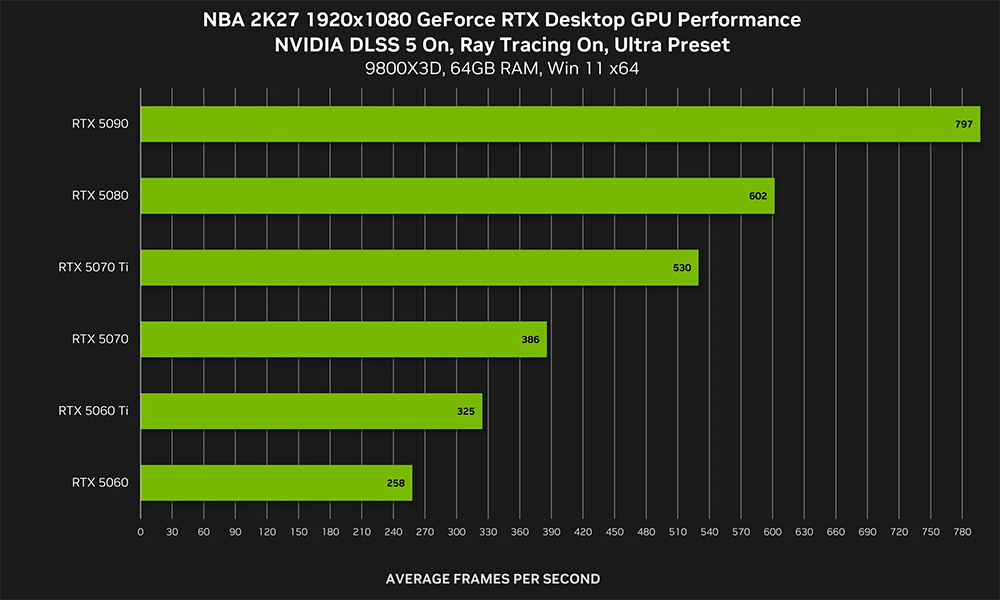
NBA 2K27 will be one of the first games to support DLSS 5 on September 3. Whether this technology can continue to deliver that “wait, this is rendered in real time?” sense of awe once it leaves the demo environment will be the most compelling thing to watch next.
Source: KOCPC Chinese