


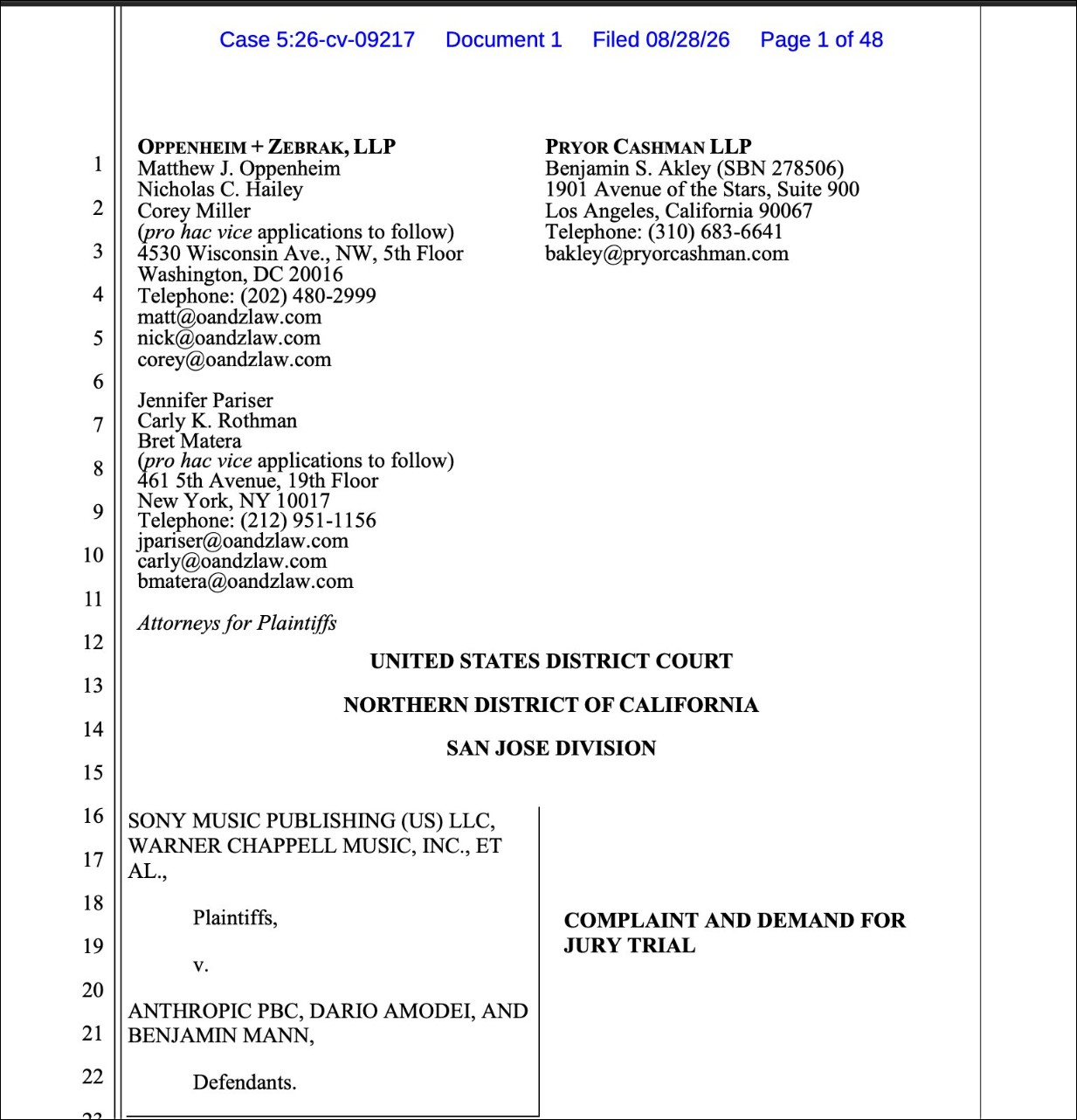
Sony Music Publishing and Warner Chappell Music filed a lawsuit against Anthropic on August 28 in the U.S. District Court for the Northern District of California, naming CEO Dario Amodei and co-founder Benjamin Mann as individual defendants. The complaint opens with unusually strong language, directly characterizing the case as “one of the largest, most brazen, and ongoing intellectual property thefts in history.”
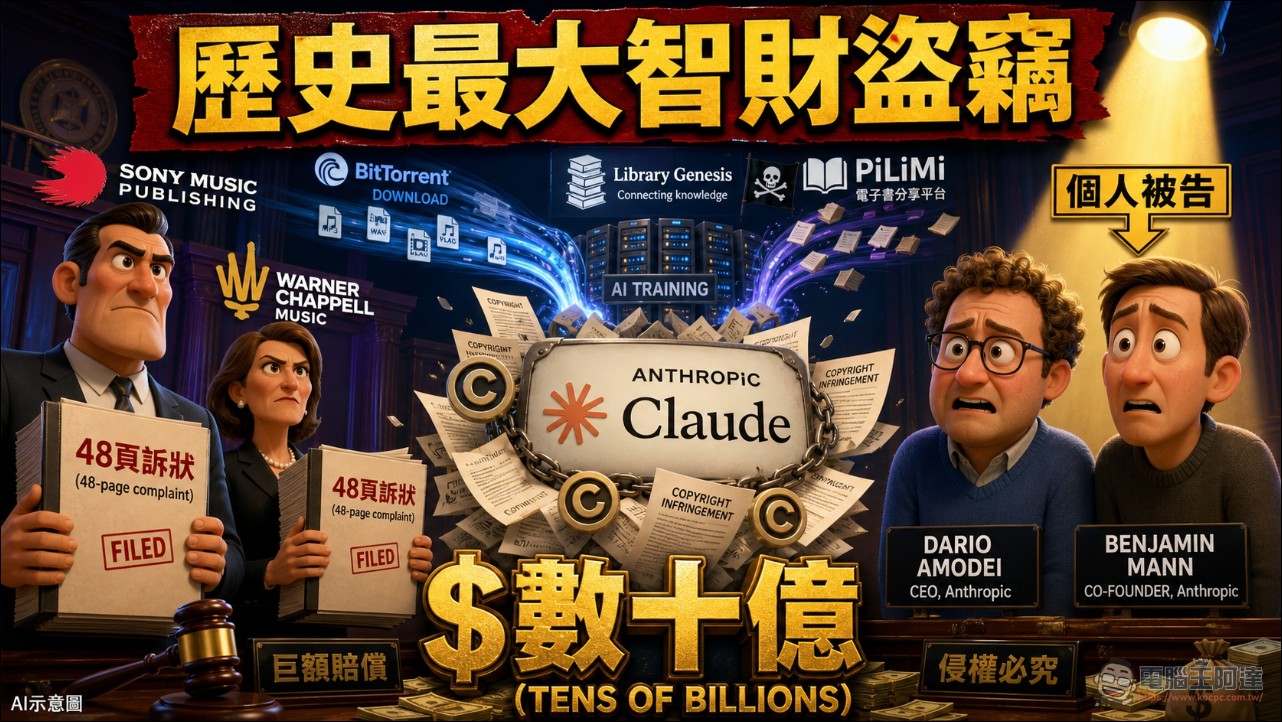
This is the fourth batch of music publishers to file copyright lawsuits against Anthropic, following Universal Music Publishing Group, Concord Music Group, and ABKCO. The publishing divisions of all three major record labels have now entered litigation, marking a full escalation of the copyright battlefront. The plaintiffs have retained Oppenheim + Zebrak, LLP and Pryor Cashman LLP as counsel, with Oppenheim + Zebrak also serving as lead counsel in Universal Music’s case against Anthropic, reflecting a highly integrated litigation strategy across the plaintiffs.
Core allegation: mass downloading of pirated content via BitTorrent
The complaint is 48 pages long and accuses Anthropic of mass-downloading pirated books and music via the BitTorrent protocol since the company’s early days. According to the complaint, in June 2021, Mann downloaded at least 5 million pirated books from Library Genesis (LibGen) on behalf of Anthropic; in July 2022, Anthropic employees downloaded at least 2 million more from the Pirate Library Mirror (PiLiMi), including large volumes of copyrighted lyrics, sheet music, and other musical works. The plaintiffs allege that these pirated materials were replicated multiple times, serving both as training input for the Claude model and appearing in the model’s generated output.
These numbers come from earlier. Bartz v. Anthropic Regarding the investigation findings of that case, the judge once described Anthropic’s conduct as “straightforward piracy but at massive scale,” and this phrasing has been cited multiple times in this complaint.
Internal documents leaked: “sketchy AF” and “don’t want people to know”
The complaint cited Bartz v. Anthropic The Anthropic internal documents unsealed in the case. In internal communications, Mann had described LibGen as “sketchy AF,” and Anthropic’s own Archive Team also acknowledged that LibGen was a “blatant violation of copyright.”

More critically, there is an internal Anthropic planning document that, in discussing data acquisition strategies, states: “We don’t want it to be known that we are working on this.” The plaintiffs interpret this passage as evidence that Anthropic knowingly concealed its conduct while being fully aware it was illegal. The complaint emphasizes that these internal documents show Anthropic was fully aware, from top to bottom, of the illegal nature of LibGen and PiLiMi, yet still systematically used this pirated content as training material for the Claude models.
The works involved in the case and the claimed amount
The complaint states that the infringed musical works number in the tens of thousands, including well-known songs such as “Ain’t No Mountain High Enough,” “All I Want for Christmas is You,” “Eye of the Tiger,” “Here Comes Santa Claus,” and “Paper Rings.”
Regarding compensation, Sony and Warner are seeking statutory damages of up to $150,000 (approximately NT$4.88 million) per willfully infringed work, plus up to $25,000 (approximately NT$810,000) for each instance of copyright management information being removed. Calculated across “tens of thousands of works,” Anthropic’s potential liability could reach the billions of dollars. Additionally, the plaintiffs are asking the court to order the destruction of all infringing copies and to require Anthropic to disclose the complete training data sources for the Claude model.
Four accusations: responsibility traced to the founder personally
The complaint asserts four counts: first, direct BitTorrent infringement against the three defendants (Anthropic, Amodei, Mann); second, contributory BitTorrent infringement against Amodei and Mann individually; third and fourth, direct infringement and removal of copyright management information against Anthropic only.
The complaint explicitly states: “Dr. Amodei and Mr. Mann bear personal responsibility for their respective roles in this illegal piracy.” This indicates that accountability in copyright litigation has shifted from “what data the company used” to “who approved it and who executed it,” with responsibility piercing through the corporate veil directly onto the founders.
The $1.5 billion settlement is just “the cost of doing business.”
This is not the first time Anthropic has been sued over training data issues. In September 2025, Anthropic reached a $1.5 billion settlement (approximately NT$48.8 billion) with authors and publishers over mass pirated books, setting a record for the largest copyright settlement in U.S. history.

However, Sony and Warner directly cited this settlement in their complaint, stating that $1.5 billion is “not enough to deter infringement,” and that Anthropic clearly treats it as “the cost of doing business” because “its entire business model continues to be built on copyright theft.”
Music industry launches full-scale crackdown on Anthropic
So far, five groups of music copyright holders have filed lawsuits against Anthropic. In October 2023, Universal Music, Concord, and ABKCO filed suit in Nashville over approximately 500 songs, which was later moved to California. In January 2026, the same group of plaintiffs filed a second suit covering more than 20,000 works, seeking over $3 billion (approximately NT$97.5 billion) in damages. In March 2026, BMG filed a third suit over 493 works. On August 17, 2026, Round Hill Music filed a fourth suit.

The addition of Sony and Warner means that the publishing divisions of all three major record companies have now entered litigation. The law firm Oppenheim + Zebrak, LLP, retained by the plaintiffs, also serves as lead counsel in the Universal Music v. Anthropic case, reflecting a highly integrated litigation strategy.
New Twist in the Copyright War: From Corporate Accountability to Individual Accountability
What makes this lawsuit most noteworthy is no longer just how much Anthropic will ultimately have to pay. The direction of accountability in the copyright wars is undergoing a fundamental shift: from “what data the company used to train its models” to further追问 “who approved these actions, and who personally carried them out.” When founders are named as individual defendants, this is no longer a legal risk the company can simply settle away with money—it is a direct threat to the personal legal liability of leadership.
Anthropic is currently planning to go public, reportedly seeking a valuation of around $2 trillion (approximately NT$65 trillion). With copyright lawsuits intensifying and founders facing personal liability, these legal risks are bound to become a key factor in investor evaluations. From the first wave of lawsuits in 2023, five groups of music copyright holders have filed suit against Anthropic within just three years, with the works involved surging from an initial 500 songs to tens of thousands, and total claims climbing from hundreds of millions of dollars to the billions. The direction of this copyright war will directly shape the AI industry’s benchmark for determining the legality of training data.
Source: KOCPC Chinese