


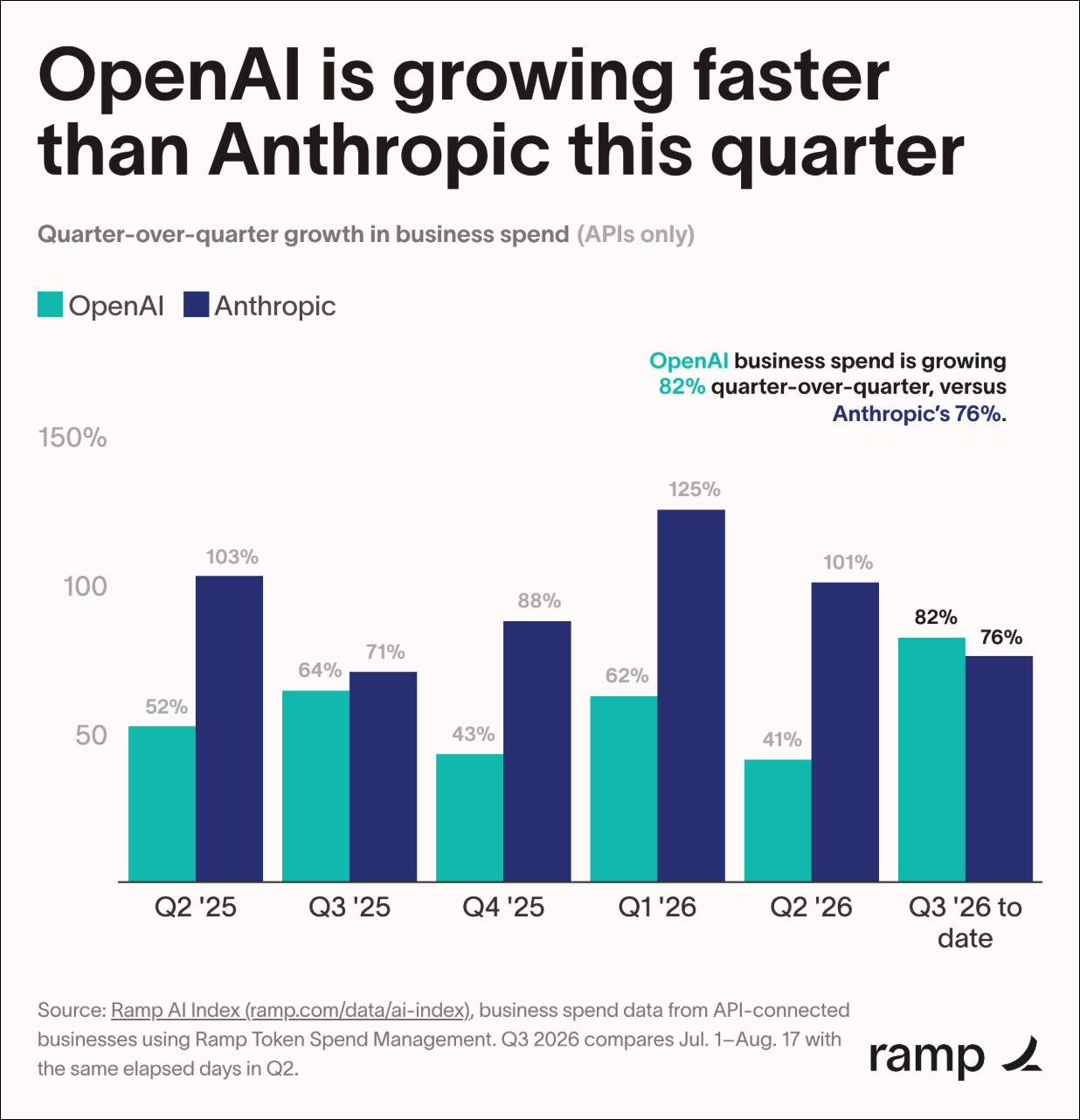
OpenAI and Anthropic—two AI giants—have traditionally been seen as having Anthropic (Claude Code) with more enterprise users on the C-side, while OpenAI, thanks to its chatbot, skews toward general consumers on the C-side. But recently, the competitive dynamics in the enterprise AI market have started to shift. Ara Kharazian, an economist at the corporate spend management platform Ramp, posted on X on August 20 that since the start of Q3, OpenAI’s enterprise spending has grown 82% quarter-over-quarter, surpassing Anthropic’s 76%. This marks the first sign of the gap reversing since Anthropic overtook OpenAI for the enterprise market lead in May. Kharazian put it bluntly: “GPT-5.6 Sol is really strong.”
May startle the markets with this but: OpenAI is growing faster than Anthropic, actually.
While data through Q2 shows tepid growth for OpenAI vs. Anthropic, Q3 to date shows that OpenAI has surpassed Anthropic in QoQ enterprise growth: 82 vs. 76.
Why? GPT-5.6 Sol is really… pic.twitter.com/RrhPTYbBG4
— Ara Kharazian (@arakharazian) August 20, 2026
OpenAI’s enterprise spending growth rate overtakes Anthropic
Where does the data come from: Real bills from 70,000 companies
This data comes from Ramp’s AI IndexRamp is a corporate credit card and expense management platform commonly used in Silicon Valley. Its AI Index tracks AI subscription and API spending by over 70,000 U.S. companies through their corporate cards and billing systems. Because it measures actual payment records rather than survey responses, the index is seen as one of the few windows into the business operations of the two private companies. Ramp’s customers span a range of industries, but as a popular Silicon Valley corporate card, the sample skews clearly toward tech. Ramp also declines to disclose total spending amounts, sharing only percentage changes. Even so, every bill actually charged still gets closer to the truth than any market survey.
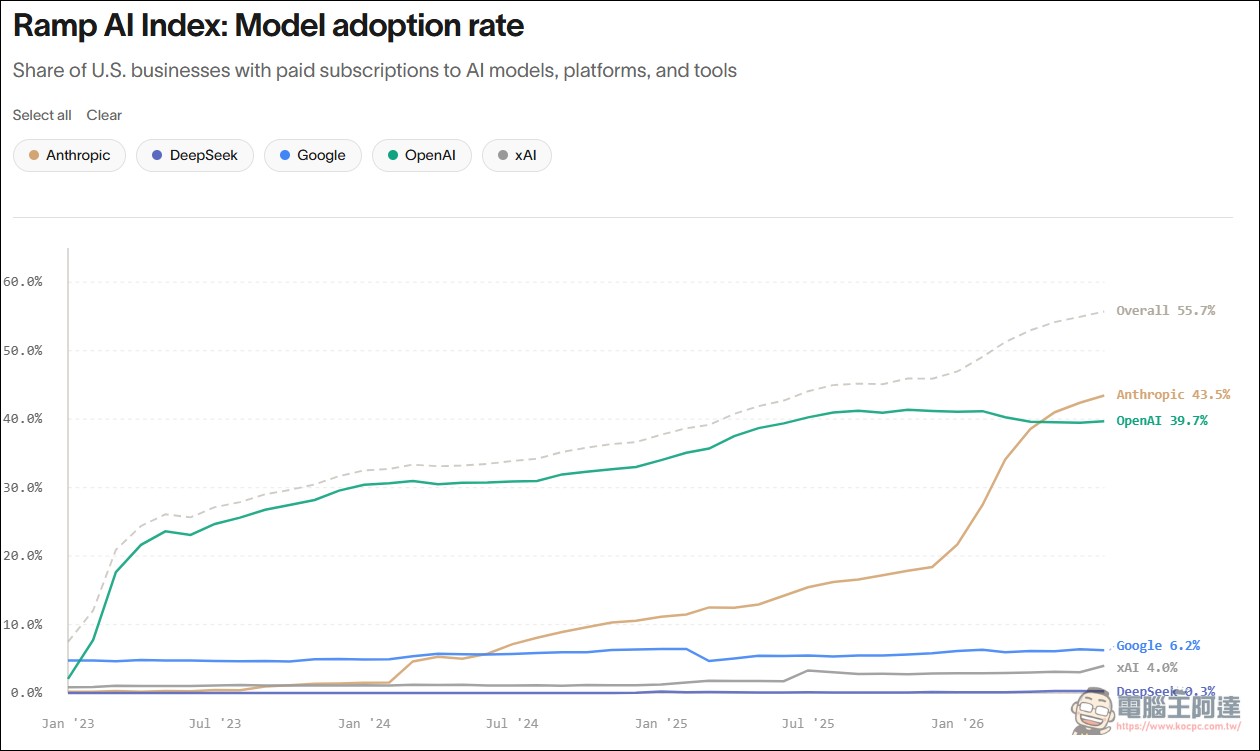
First, look at the overall market share picture: OpenAI was once the leader in both enterprise and consumer markets, but in May this year it was overtaken by Anthropic for the first time among Ramp’s paying users (41% to 39%), and has been trailing ever since. By July, Anthropic had extended its lead to 43.5%, adding 1.1 percentage points in a single month; OpenAI stood at 39.7%, with a monthly increase of only 0.23 percentage points. In other words, what OpenAI regained this time is the lead in growth speed, while its market share still trails by about 4 percentage points.
According to the long-term chart released by Ramp, Anthropic’s enterprise spending has grown faster than OpenAI’s on a quarterly basis for each of the past five quarters. In Q1, Anthropic surged to 125%, while OpenAI came in at just 62%; both companies slowed in Q2, but Anthropic still posted 101% while OpenAI dropped to 41%. The 82% versus 76% reading so far in Q3 marks the first reversal within the chart period; 82% is also OpenAI’s best quarter in nearly six, while 76% is Anthropic’s weakest in nearly five.
Core Flip: GPT-5.6 Sol vs. Fable 5
Kharazian called out two new models in a tweet. He wrote: “GPT-5.6 Sol is really impressive and is gradually becoming developers’ top choice.” (Editor’s note: The fact that Codex is very useful should also be factored in.) In contrast, “Fable 5 has been disappointing in both adoption and real-world usage, due to its price and the data retention requirements imposed by regulators.”

Model-level data from Ramp’s August update supports this claim. Anthropic’s high-end model Fable 5, released in July, accounted for only 6% of the company’s tokens sold and 11.4% of revenue in its first month on the market, despite pricing at roughly $10 per million tokens (about NT$325). OpenAI’s GPT-5.6 Sol, at half the price, captured 25% of the company’s tokens and 23% of spending. In July, model-attributed spending driven by Fable 5 was approximately 75% of GPT-5.6 Sol’s.
Worth noting is the divergence in model pricing strategies. OpenAI uses half the price to capture developers’ daily workloads, while Anthropic bets its chips on the most expensive flagship. When the bulk demand from enterprise customers is for “high-volume, cheap, good-enough” API calls, the choice of price point directly shows up in the market share curve.
The pie is still growing.
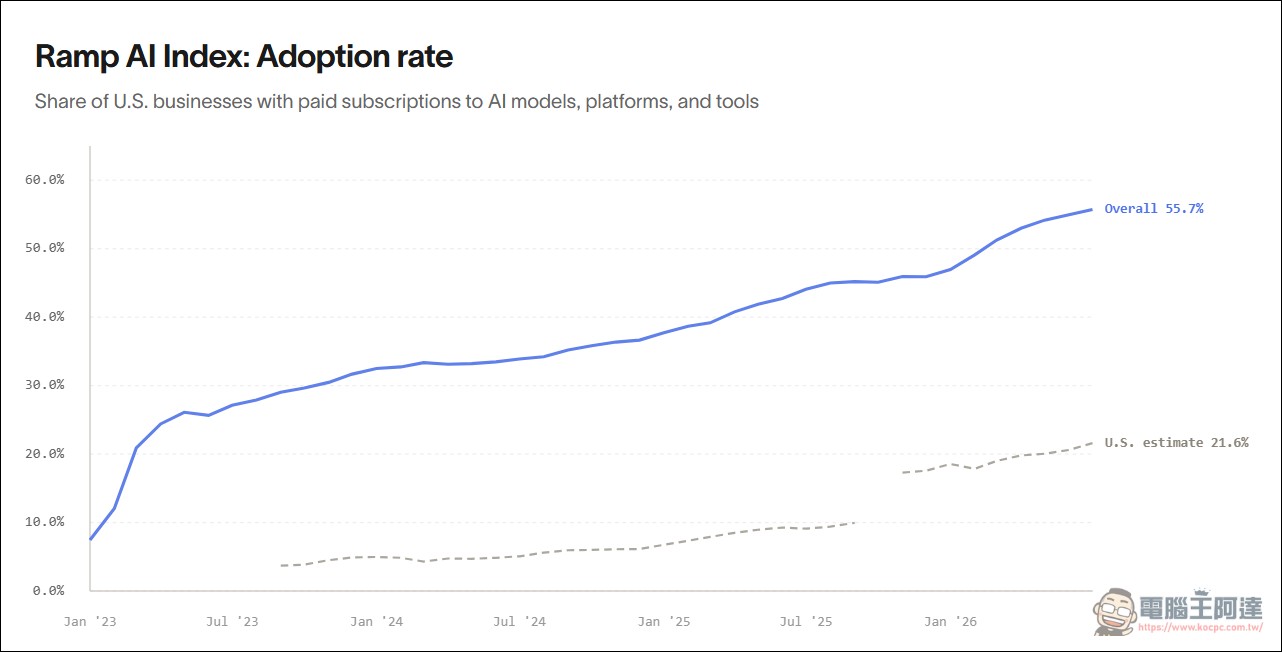
This battle for the lead is playing out in a continuously expanding market. Among Ramp’s customers, the share of companies paying for AI surpassed 50% in March and reached 55.7% by July. Total AI spending on the platform has grown about fourfold over the past year.
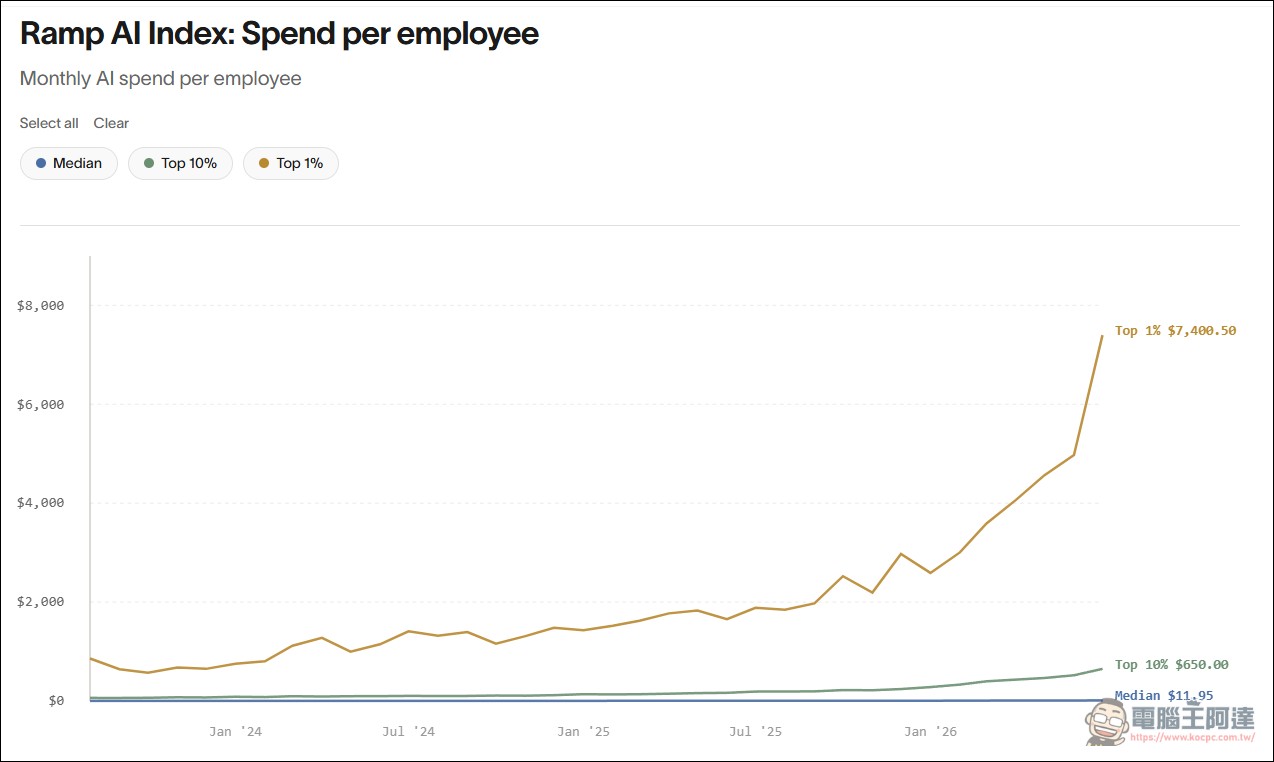
The spending amounts are equally striking: among companies with AI expenditures in July, the median was $11.95 per employee per month (approximately NT$388), the top 10% spent $650 (approximately NT$21,000), and the median for the top 1% reached $7,400 (approximately NT$240,000). Even as the two labs compete for each other’s clients, overall revenue continues to rise alongside market expansion, which is why neither side has any incentive to cut prices.
Another track is open-source models. In July, 6.1% of AI-spending enterprises used model hosting or inference platforms that route to open-source and Chinese models, up from 4.5% in January. Kharazian observed that enterprises purchasing AI for the first time still almost exclusively choose the two major American labs, but existing customers with the heaviest spending are gradually adding open-source options. For the two labs, the long-term threat may not be each other, but rather this group of biggest spenders beginning to diversify their procurement.
The quarter isn’t over yet, so the numbers are still moving.
Kharazian himself said this is just a mid-quarter snapshot. This Q3 data covers spending from July 1 to August 17, compared with the same period in Q2, with still a month left before the quarter ends. The limitations of the metric itself should also be kept in mind. Ramp’s customers skew toward the tech industry, and the sample doesn’t cover large enterprises, whose AI spending mostly goes through other spend management systems like American Express. The metric only counts paid transactions, so businesses on the free tier are not included in the statistics, meaning actual adoption may be higher than what the metric shows. The model-level data comes from a subset of customers using Ramp token spend management products, and that sample also skews toward tech.
Regardless of how the late September data shapes up, this report has already made one thing clear: enterprise AI spending stickiness is lower than expected. Enterprise customers will shift back and forth as various AI vendors release new models. The leader changed in May, growth rates flipped again in August, and within a single year the market has already reshuffled twice. For the two companies preparing for IPOs, billing data volatility speaks more honestly than marketing noise. Ramp’s next full monthly report is expected to be released in mid-September, which will verify whether OpenAI’s latest offensive is a flash in the pan or the true beginning of reclaiming lost ground.
Source: KOCPC Chinese